May 22, 2026
Understanding Advanced Financing Mechanisms in Modern Gold Mining Development
Contemporary gold mining development has evolved far beyond traditional equity and debt structures, with specialized credit advisory services becoming essential infrastructure for optimizing capital deployment and operational flexibility. The Barton Gold credit adviser appointment reflects the increasing complexity of mining project economics, where commodity price volatility, operational risk allocation, and market timing considerations require sophisticated financial engineering approaches.
Credit structuring in mining industry evolution encompasses diverse mechanisms including commodity trading agreements, structured credit products, trade finance arrangements, and hybrid equity-debt instruments. These approaches enable mining companies to align financing costs with operational cash flows while maintaining development flexibility across volatile commodity cycles.
When big ASX news breaks, our subscribers know first
Strategic Infrastructure Advantages in Regional Gold Processing
Processing facility monopolies within defined mining districts create significant competitive advantages for gold mining operations, particularly in established geological provinces where infrastructure development costs can represent substantial barriers to entry. The Central Gawler mill's position as the sole operational gold processing facility in South Australia's Central Gawler region demonstrates how existing infrastructure assets provide leverage for cost-effective transitions from exploration to production phases.
Regional processing monopolies offer several operational benefits beyond direct cost savings:
- Regulatory Pathway Optimisation: Established facilities maintain existing environmental permits and community relationships
- Supply Chain Integration: Existing contractor networks and technical service providers reduce operational setup timelines
- Workforce Availability: Regional employment pools with mining-specific skills reduce training and recruitment costs
- Transportation Efficiency: Established logistics networks for consumables, equipment, and concentrate transportation
The strategic value of processing infrastructure becomes particularly pronounced during periods of elevated commodity prices, when previously uneconomic ore grades and processing sources achieve commercial viability through existing mill capacity utilisation.
Technical Specifications for Optimised Stage 1 Operations
Stage 1 gold mining operations represent carefully engineered approaches to minimise initial capital expenditure while establishing immediate cash flow generation from multiple ore sources. The Challenger project's technical framework demonstrates how sequential processing strategies optimise resource utilisation across varying grade profiles and geological characteristics.
Resource Base Analysis:
| Processing Source | Material Type | Processing Timeline | Strategic Function |
|---|---|---|---|
| Historical Tailings | Higher-grade material | Months 1-12 | Immediate cash flow generation |
| Near-surface Material | Variable grade zones | Months 6-18 | Operational flexibility |
| Underground Access | High-grade mineralisation | Months 12-24 | Long-term production base |
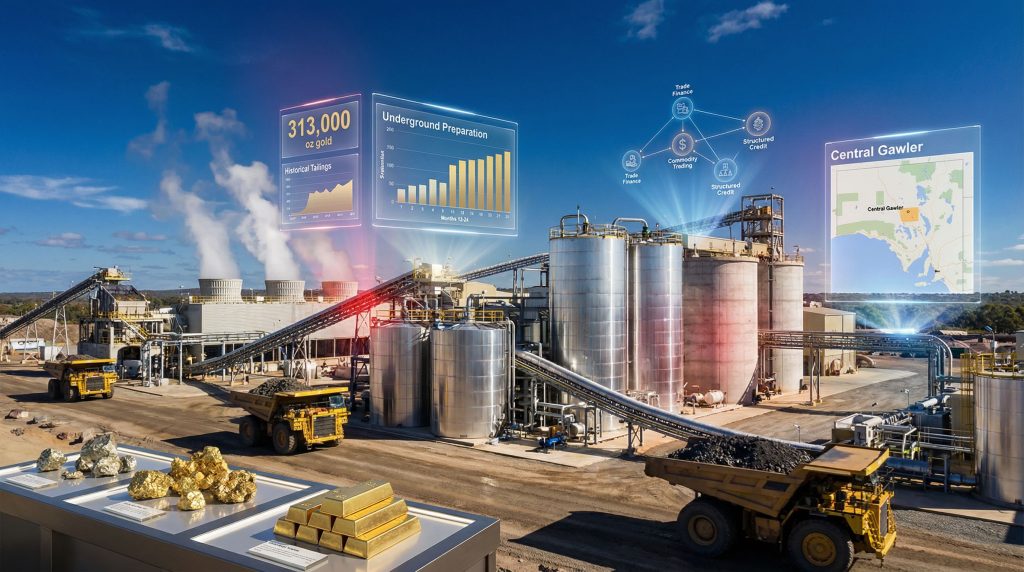
The 313,000 oz gold JORC (2012) resource at Challenger provides substantial processing flexibility across multiple operational phases. Historical tailings processing offers immediate cash flow generation through direct mill feed, while near-surface material extraction enables selective mining approaches that optimise grade profiles during operational ramp-up phases.
Furthermore, metallurgical testing and recovery optimisation become critical factors in Stage 1 success, with established processing technology for regional ore types providing technical risk mitigation. The integration of multiple feed sources enables operational continuity during underground development phases while maintaining consistent mill throughput rates.
Market Timing Optimisation in Current Gold Price Environment
Current gold market conditions create exceptional economic opportunities for Stage 1 mining operations, particularly for projects utilising existing infrastructure to process previously marginal ore grades. Gold prices as inflation hedge considerations have contributed to the gold price of $5,038.83 per ounce as of February 2026, representing historically elevated levels that transform project economics across multiple operational parameters.
Economic Enhancement Factors:
- Margin Expansion: Higher commodity prices improve operational margins across all grade categories
- Financing Accessibility: Enhanced project economics enable more favourable debt-to-equity ratios and reduced financing costs
- Operational Flexibility: Elevated prices justify processing lower-grade materials that extend operational timelines
- Capital Deployment Timing: Current market conditions enable accelerated development schedules through improved cash flow projections
The relationship between commodity prices and mining project financing reflects sophisticated risk assessment frameworks where lenders evaluate project viability across multiple price scenarios. However, gold price forecast analysis suggests current market conditions enable mining companies to secure financing terms that were previously unavailable during lower price cycles.
Stage 1 operations particularly benefit from elevated gold prices through their focus on immediate production rather than extensive development capital requirements. Consequently, this operational approach enables companies to capitalise on favourable market timing while building cash flow foundations for longer-term underground development programs.
Portfolio Integration Strategies for Multi-Asset Development
Regional asset consolidation represents an advanced development strategy where mining companies optimise operational synergies through shared infrastructure utilisation and diversified feed source management. Barton Gold's portfolio integration demonstrates how multi-project development reduces individual project risk while enhancing overall operational flexibility.
Asset Integration Framework:
Tarcoola Project Benefits:
- Historical high-grade gold and silver mineralisation provides premium feed sources
- Truck-and-leach operational model enables flexible processing scheduling
- Established geological databases reduce exploration and development timelines
- Complementary mineralisation characteristics optimise mill recovery rates
Wudinna and Tolmer Strategic Value:
- Additional feed source diversification reduces single-project dependency
- Risk mitigation through geographically distributed resource base
- Extended operational timeline through sequential development phases
- Enhanced financing terms through diversified cash flow projections
Portfolio integration enables mining companies to present more attractive financing propositions through diversified risk profiles and extended operational timelines. For instance, multiple feed sources provide operational continuity during individual project maintenance or development phases while optimising infrastructure utilisation rates.
Advanced Credit Structuring in Mining Finance Evolution
Modern mining finance has evolved to incorporate sophisticated credit instruments that align more effectively with commodity price cycles and operational cash flow patterns. The Barton Gold credit adviser appointment reflects industry recognition that traditional project finance structures often fail to optimise capital costs across volatile commodity environments.
Contemporary Financing Categories:
Structured Credit Approaches:
- Commodity price-linked credit facilities that adjust terms based on market conditions
- Production-based repayment schedules aligned with operational cash flows
- Multi-tranche funding structures that release capital based on operational milestones
- Integrated trade finance and working capital facilities for operational flexibility
Alternative Financing Mechanisms:
- Streaming and royalty agreements providing upfront capital for future production rights
- Commodity trading partnerships with advance payment structures
- Equipment financing with operational performance guarantees
- Hybrid debt-equity instruments with conversion features based on project performance
In addition, commodity hedging strategies and credit advisory services provide essential coordination between multiple funding sources while optimising risk allocation across operational, market, and credit components. According to Mining Weekly, this specialised expertise becomes particularly valuable during transitional phases from exploration to production.
The next major ASX story will hit our subscribers first
Underground Development Integration with Surface Operations
Underground mine development represents the strategic growth component of integrated gold mining operations, with Stage 1 surface processing providing essential cash flow generation to fund underground access and development programs. The Challenger underground mine demonstrates how historical high-grade mineralisation can be accessed through systematic development programs coordinated with surface processing operations.
Underground Development Strategy:
- Historical Mineralisation Access: Proven high-grade zones provide target areas for initial underground development
- Infrastructure Leverage: Existing surface facilities enable cost-effective underground access and ventilation systems
- Scalable Production Capacity: Underground development can be phased based on cash flow generation and market conditions
- Integrated Mine Planning: Surface and underground operations coordinated to optimise mill feed quality and consistency
Development timeline integration becomes critical for sustainable long-term operations, with Stage 1 cash flows funding underground capital requirements. Meanwhile, parallel development activities optimise overall capital deployment efficiency through capital raising methods that leverage existing operational success.
Regulatory and Environmental Optimisation in South Australian Mining
South Australia's mining regulatory environment provides several strategic advantages for gold mining development, including streamlined permitting processes, established environmental frameworks, and supportive government policies for mining investment. The regulatory stability creates predictable development timelines that enhance project financing and operational planning.
Regional Mining Environment Benefits:
- Established Regulatory Frameworks: Predictable permitting processes with defined timelines and requirements
- Skilled Workforce Availability: Regional mining employment pools reduce training and recruitment challenges
- Technical Service Networks: Established contractor and consulting services specialised in regional geological conditions
- Transportation Infrastructure: Access to major export facilities and transportation networks
Government Support Mechanisms:
- Mining industry development incentives and support programs
- Research and development partnerships with academic institutions
- Infrastructure development programs supporting regional mining activities
- Export facilitation services for mineral concentrate transportation
The combination of regulatory predictability and industry support creates favourable investment conditions that reduce political and regulatory risks typically associated with mining development. These factors become particularly important during financing negotiations, where lenders evaluate regulatory risk alongside technical and market factors.
Risk Mitigation Through Diversified Operational Approaches
Contemporary gold mining development employs sophisticated risk mitigation strategies that address geological, operational, market, and financial uncertainties through diversified approaches and flexible operational frameworks. The integration of multiple processing sources, varied development timelines, and alternative financing structures creates resilient operational models capable of adapting to changing market conditions.
Risk Management Framework:
Geological Risk Mitigation:
- Multiple ore sources reduce dependency on individual geological zones
- Established metallurgical testing provides processing predictability
- Historical mining data reduces geological uncertainty
- Diverse grade profiles enable operational flexibility across varying market conditions
Market Risk Management:
- Flexible processing schedules enable response to commodity price fluctuations
- Multiple product streams (gold and silver) provide price diversification
- Operational scaling capabilities adjust production to market demand
- Contract mining options reduce fixed operational costs during market downturns
Financial Risk Optimisation:
- Diverse funding sources reduce dependency on individual financial institutions
- Staged development approaches minimise initial capital exposure
- Operational cash flow generation funds expansion phases
- Commodity price hedging options provide revenue predictability
As reported by Small Caps, the Barton Gold credit adviser appointment exemplifies how sophisticated financial risk management has become integral to modern mining operations.
Strategic Positioning for Sustainable Long-Term Production
The integration of advanced financing structures, existing infrastructure utilisation, and systematic development approaches positions contemporary gold mining operations for sustainable long-term production across varying market cycles. Success requires careful coordination between technical development, financial optimisation, and operational execution during critical transitional phases from exploration to production.
Sustainability Framework Components:
- Technical Excellence: Proven processing technology and systematic mine development approaches
- Financial Optimisation: Diversified funding sources and flexible financing structures
- Operational Resilience: Multiple production sources and scalable operational approaches
- Market Adaptability: Flexible production scheduling and diverse product streams
The evolution of mining finance toward integrated credit advisory services and sophisticated financing instruments reflects industry maturation and increasing operational complexity. Projects that successfully integrate these advanced approaches demonstrate enhanced resilience and superior long-term performance across volatile commodity markets.
Contemporary gold mining development success depends on optimising coordination between infrastructure utilisation, financing innovation, and operational excellence. Companies that master this integration create sustainable competitive advantages in increasingly complex global mining markets.
Ready to Invest in the Next Major Mineral Discovery?
Discovery Alert instantly alerts investors to significant ASX mineral discoveries using its proprietary Discovery IQ model, turning complex mineral data into actionable insights. Understand why historic discoveries can generate substantial returns whilst beginning your 14-day free trial today to position yourself ahead of the market.