May 22, 2026
The Hidden Economics of High-Grade Underground Gold Mining and Why Equipment Strategy Matters
Most casual observers of the gold mining sector focus on headline production numbers and commodity prices. Far fewer pay attention to the quiet, capital-intensive decisions unfolding underground that ultimately determine whether a mine can sustain and grow its output over time. Fleet modernisation choices, supplier relationships, and equipment sequencing across multiple assets are among the most operationally significant yet underreported dimensions of mine management. When a producer commits to expanding its underground equipment base across two separate operations within the same quarter, that pattern deserves closer examination.
That is precisely what is unfolding in Colombia right now, where Sandvik to supply more equipment to Aris Mining's Segovia operation follows an earlier agreement covering the Marmato mine. Taken together, these back-to-back orders reveal something meaningful about the direction of underground gold mining in Latin America and the growing strategic importance of long-term supplier relationships in capital-intensive extraction environments.
When big ASX news breaks, our subscribers know first
Segovia's Reserve Grade in Global Context
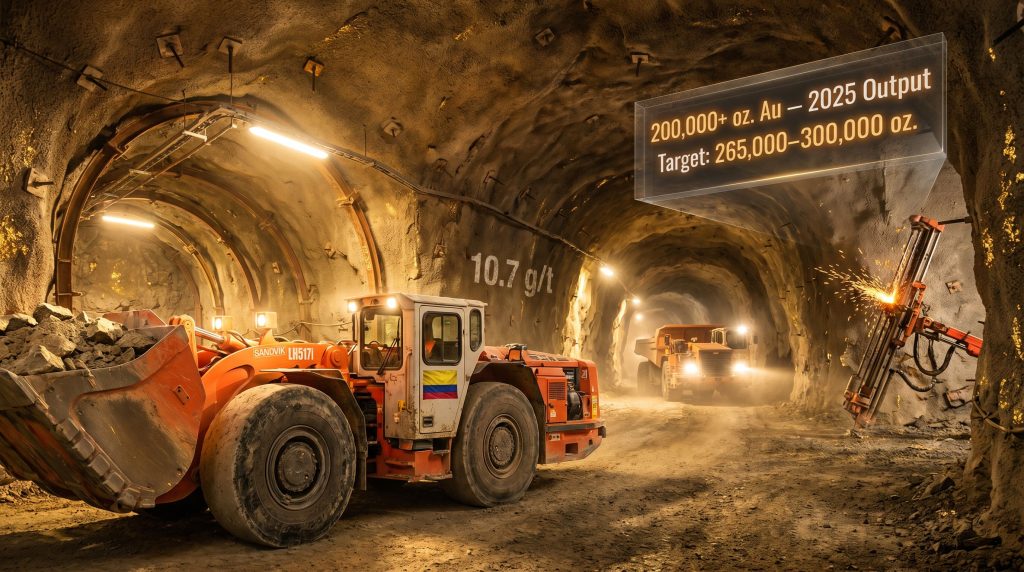
Before examining the equipment dynamics, it is worth anchoring the conversation in the geology that makes Segovia so commercially significant. The operation, located in Colombia's Antioquia department, carries a reserve grade of approximately 10.7 grams per tonne (g/t), placing it in rarefied company on the global stage.
To put that figure in perspective, the global average reserve grade for underground gold mines has been declining for decades. Many large-scale underground operations now mine material grading between 3 and 6 g/t, with grades above 8 g/t increasingly uncommon outside a handful of exceptional assets. Segovia's 10.7 g/t reserve grade is not simply a favourable statistic; it fundamentally restructures the economics of the operation.
Higher ore grades mean that each tonne of rock moved through the system delivers substantially more recoverable gold. This has compounding effects across the operation:
- Higher grades reduce the break-even gold price required to sustain profitability
- Each unit of fleet capacity, whether a loader, truck, or drill rig, generates greater revenue per cycle
- Capital expenditure on equipment is justified at lower throughput volumes than at lower-grade peers
- The asset retains economic viability across a wider range of gold price scenarios
This is why Segovia is not a speculative growth story. It is a proven, high-returning underground operation where fleet investment is a rational, performance-driven decision rather than a discretionary expansion gamble. Furthermore, understanding the gold price outlook provides important context for why such investment decisions are accelerating now.
Two Orders, Two Mines, One Strategic Narrative
To understand the Segovia equipment order in proper context, it is necessary to look at what preceded it. In Q1 2026, Sandvik secured an agreement with Aris Mining covering the Marmato underground gold operation in Colombia's Caldas department. That contract, valued at approximately SEK 250 million, encompassed loaders, underground trucks, and a full suite of development, production, and longhole drill rigs, alongside maintenance and repair services. Deliveries from that agreement were scheduled to run from Q2 2026 through Q2 2027.
Within a single quarter, Aris Mining returned to Sandvik with a second order, this time directed at Segovia. The Segovia booking was confirmed in Q2 2026, with deliveries scheduled to begin in July 2026. The financial value of the Segovia order has not been publicly disclosed.
| Attribute | Marmato Order | Segovia Order |
|---|---|---|
| Order Booking Period | Q1 2026 | Q2 2026 |
| Disclosed Value | ~SEK 250 million | Not disclosed |
| Delivery Commencement | Q2 2026 | July 2026 |
| Equipment Scope | Loaders, trucks, drill rigs, maintenance | Underground equipment package |
| Mine Type | Underground gold | Underground gold |
| Region | Caldas, Colombia | Antioquia, Colombia |
The rapid sequencing of these two orders across different assets is a signal worth reading carefully. Mining companies rarely accelerate capital deployment across multiple sites simultaneously unless they hold strong confidence in both the reserve quality and the cash generation capacity of those assets. For Aris Mining, commissioning back-to-back fleet upgrades across Marmato and Segovia within months of each other reflects a coordinated, multi-asset production scaling strategy.
Understanding Underground Equipment Categories and Why They Matter
For those less familiar with underground gold mining operations, it is useful to understand what different equipment categories actually do and why each is operationally critical in a stope-based environment like Segovia.
Load-Haul-Dump (LHD) Machines and Underground Trucks
LHD loaders are the workhorses of underground ore extraction. They scoop broken rock from a blasted stope and transport it to an underground crusher or ore pass. The Sandvik Toro LH410, one of the models relevant to operations of Segovia's scale, is engineered for productivity in confined underground environments. Underground haul trucks then transport the crushed or run-of-mine material through haulage drives toward surface processing facilities. Together, these machines define the rhythm of the ore extraction cycle, and their availability directly governs daily production tonnages.
Drill Rigs Across Three Functions
Drilling programs in underground gold operations serve distinct but interconnected purposes:
- Development drill rigs advance primary haulage drives, ventilation raises, and access headings into new ore zones, enabling stope preparation ahead of production schedules
- Production drill rigs target ore extraction within defined stope boundaries, drilling blast holes that are later charged with explosives to fragment ore for loading
- Longhole drill rigs support bulk extraction in wider ore zones by drilling longer, parallel holes across large stope geometries, maximising the volume of ore fragmented per blast and reducing the number of development entries required
The distinction between these rig types matters for mine planning. A well-balanced underground fleet maintains the correct ratio of development to production capacity. Under-investing in development drill rigs creates bottlenecks that constrain stope availability months later, effectively capping production well below theoretical capacity.
Maintenance and Repair Services as a Core Procurement Component
A less-discussed but critically important element of modern underground equipment contracts is the integration of maintenance and repair services. Historically, mines purchased equipment and managed servicing independently. Increasingly, large mining companies are bundling OEM maintenance agreements into procurement contracts, locking in parts supply chains, technician access, and predictive maintenance programmes. This shift reflects a growing recognition that unplanned downtime in high-grade underground operations carries severe revenue consequences.
In underground environments operating at grades above 10 g/t, a single LHD sitting idle for an unplanned 48-hour repair can translate directly into tens of thousands of dollars in unrealised gold production. Maintenance contract integration is no longer a convenience; it is a risk management mechanism.
From 200,000 Ounces Toward 300,000: What Production Growth Requires Underground
Aris Mining produced more than 200,000 ounces of gold from the Segovia operation in 2025. The company has stated its expectation that annual production will rise to between 265,000 and 300,000 ounces in the coming years. That represents a midpoint uplift of roughly 57,500 ounces annually, an increase approaching 30% above the 2025 baseline.
| Production Milestone | Volume (oz. Au) | Timeframe |
|---|---|---|
| Confirmed 2025 Output | 200,000+ oz. | Full Year 2025 |
| Near-Term Target (Lower Bound) | 265,000 oz. | Coming Years |
| Near-Term Target (Upper Bound) | 300,000 oz. | Coming Years |
| Midpoint Growth Uplift | ~57,500 oz. | Incremental |
Achieving that level of production growth from an underground operation is not simply a matter of working existing stopes harder. It requires expanding the active stope inventory, which demands more development metres completed per quarter, greater fleet availability, and higher cycle time efficiency throughout the ore handling system. In practical terms, growing an underground mine's annual output by 30% requires proportional growth in fleet capacity, which is precisely what this equipment order is designed to deliver.
This is a frequently misunderstood dimension of underground mine scaling. Unlike open-pit operations where production growth can sometimes be achieved by expanding the cut or running additional shifts with existing equipment, underground production growth is inherently constrained by the number of active working faces available simultaneously. Each working face requires its own equipment allocation during operating cycles. Consequently, understanding how to interpret drill results from ongoing underground programmes is equally important for tracking a mine's growth trajectory.
Sandvik's Latin American Positioning and the Logic of Repeat Relationships
From Sandvik's commercial perspective, the Segovia order represents more than incremental revenue. It reinforces an increasingly concentrated position within one of the most active underground gold mining jurisdictions in the Western Hemisphere.
Sandvik's Andean and South Cone sales division operates across a region that spans Colombia, Peru, Chile, Ecuador, and Argentina, all of which host significant underground mining activity. Colombia in particular has been undergoing a quiet but meaningful transformation in its underground gold sector, with investment flowing toward mechanisation and away from the artisanal and small-scale mining methods that have historically dominated parts of Antioquia.
In capital-intensive underground mining environments, repeat equipment orders from the same supplier are a strong indicator of operational satisfaction, parts ecosystem compatibility, and total cost of ownership alignment. These factors frequently carry more weight in procurement decisions than upfront unit pricing alone.
The strategic logic of supplier loyalty in underground mining is rooted in practical realities. When a mine standardises its fleet around a single OEM's product range, it achieves significant advantages in parts interchangeability, technician training efficiency, and diagnostic system integration. Conversely, operating a mixed fleet from multiple manufacturers introduces complexity in maintenance scheduling, parts inventory management, and operator cross-training that can erode productivity gains over time.
The next major ASX story will hit our subscribers first
Why Latin American Underground Gold Miners Are Accelerating Fleet Investment in 2025–2026
The Sandvik-Aris Mining relationship does not exist in isolation. It reflects a broader pattern of fleet modernisation investment that is accelerating across underground gold operations throughout Latin America, driven by several converging forces.
Gold Price Dynamics
Gold prices reaching multi-year highs in 2024 and remaining elevated through 2025 and into 2026 have substantially expanded the capital budgets available to profitable underground producers. When gold trades above US$2,000 per ounce and an operation carries grades north of 10 g/t, the economics of fleet modernisation become highly compelling, often delivering payback periods well within the useful life of modern underground equipment. This is especially evident when considering the impact of gold mining equities and how price movements translate into investment capacity at the operational level.
Productivity Pressure in High-Grade Environments
High-grade underground mines face a paradox: their exceptional ore value creates intense pressure to maximise machine availability and cycle time efficiency, because the cost of downtime is proportionally higher than at lower-grade operations. This creates a powerful incentive to replace ageing fleet components with modern equipment offering superior reliability, predictive maintenance capability, and improved fuel efficiency. For further context, the largest gold mines globally demonstrate how fleet investment correlates directly with sustained production performance.
Safety and Emissions Standards
Evolving workplace safety expectations and diesel particulate matter (DPM) regulations across South American jurisdictions are also reshaping procurement decisions. Newer underground equipment is engineered with improved ventilation compatibility, reduced emissions outputs, and integrated safety systems that help operations align with tightening regulatory frameworks without requiring costly retrofits to older machines.
| Factor | Ageing Fleet Risk | Modern Fleet Advantage |
|---|---|---|
| Downtime Frequency | Higher unplanned stoppages | Predictive maintenance capability |
| Energy Consumption | Elevated diesel usage | Improved fuel efficiency profiles |
| Operator Safety | Greater mechanical failure exposure | Enhanced integrated safety systems |
| Parts Availability | Supply chain vulnerability | OEM ecosystem access |
| Throughput Consistency | Variable cycle times | Optimised tramming and loading cycles |
What the Undisclosed Contract Value Actually Communicates
The absence of a disclosed financial figure for the Segovia equipment order is notable but should not be interpreted as a reduction in strategic significance. In the underground mining equipment sector, contract values are frequently withheld when they involve commercially sensitive pricing arrangements or ongoing framework agreements where individual order values form part of a broader, multi-year procurement relationship.
What the undisclosed value does confirm, by virtue of the order being publicly announced at all, is that the transaction meets materiality thresholds relevant to Sandvik's reporting obligations within its Andean and South Cone sales division. Equipment orders of negligible commercial significance are rarely announced through formal channels.
For industry observers tracking the Sandvik-Aris Mining relationship, the more relevant data point is the behavioural pattern: two separate underground operations, two equipment orders placed within consecutive quarters, deliveries commencing within months of each order being booked. This pace of procurement is not consistent with routine maintenance replacement. It reflects deliberate, accelerated fleet build-out across a multi-asset Colombian production platform.
Key Takeaways for Industry Observers and Investors
The following points summarise the structural significance of this equipment expansion. They are intended as analytical observations, not financial advice. Readers should conduct their own due diligence before making investment decisions.
- Aris Mining's simultaneous fleet expansion across both Segovia and Marmato reflects a coordinated, multi-asset production growth strategy rather than isolated asset-level maintenance activity
- Segovia's 10.7 g/t reserve grade provides the economic foundation that makes sustained capital equipment investment rational and defensible across a wide range of gold price scenarios
- The production growth target from 200,000 ounces toward 265,000–300,000 ounces annually cannot be achieved without proportional underground fleet capacity, making this equipment order operationally essential rather than discretionary
- Sandvik's repeat engagement across two distinct Colombian operations within a single quarter signals a deepening strategic supplier position in the Andean region and the compounding commercial logic of fleet standardisation
- The broader trend of fleet modernisation in Latin American underground gold mining is being driven by converging pressures including elevated gold prices, productivity imperatives, safety requirements, and emissions compliance expectations
- For equipment suppliers operating in the region, establishing early, deep relationships with growing producers in jurisdictions like Colombia increasingly determines long-term market share in what remains one of the world's most geologically prospective underground gold belts
For ongoing coverage of underground mining equipment trends and Latin American gold operations, the Global Mining Review provides detailed reporting on mine development, procurement decisions, and operational updates across the sector.
Want to Capitalise on the Next Major Underground Gold Discovery Before the Market Moves?
Discovery Alert's proprietary Discovery IQ model delivers real-time alerts on significant ASX mineral discoveries, instantly translating complex geological data into actionable investment insights for both short-term traders and long-term investors. Explore how historic discoveries have generated extraordinary returns on Discovery Alert's dedicated discoveries page, and begin your 14-day free trial today to position yourself ahead of the broader market.