
May 22, 2026
The Hidden Cost of Operational Missteps During a Gold Bull Market
Few scenarios expose the fault lines in a mining company's governance more clearly than a CEO departure during a commodity price boom. When gold prices are climbing toward historical highs and a major producer is simultaneously cutting production guidance, the market's verdict tends to be swift and unforgiving. The combination signals something more troubling than a downturn in commodity prices; it points directly at execution risk embedded within the organisation itself.
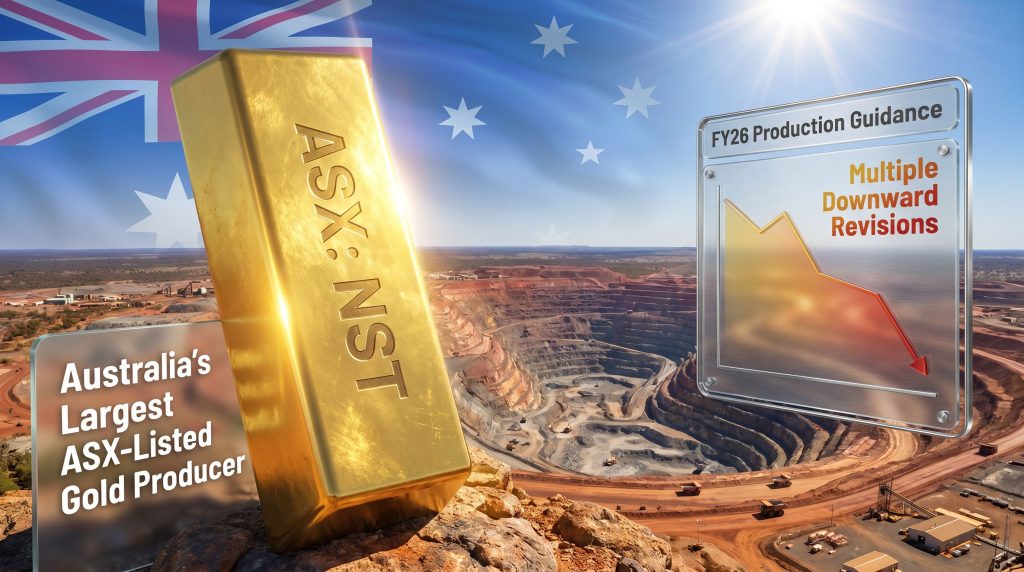
That is precisely the environment surrounding the announcement that Northern Star CEO Stuart Tonkin will step down after nearly a decade leading Australia's largest ASX-listed gold producer. The departure lands against a backdrop of sustained production difficulties at the company's flagship Kalgoorlie Consolidated Gold Mines (KCGM) operation, multiple downward revisions to FY26 gold production guidance, and a share price that has deteriorated sharply even as the broader gold sector has benefited from elevated commodity pricing.
Understanding what this transition means requires looking beyond the headlines and examining the operational pressures, strategic legacy, and forward-looking risks that define this moment for Northern Star Resources (ASX: NST).
When big ASX news breaks, our subscribers know first
A Tenure Defined by Transformational M&A
Building Australia's Largest ASX-Listed Gold Producer
Stuart Tonkin's approximately 13-year association with Northern Star Resources charts one of the most consequential corporate growth arcs in recent ASX history. Progressing from senior operational roles, including Chief Operating Officer, before ascending to CEO and Managing Director, Tonkin presided over a period of aggressive strategic expansion that fundamentally reshaped the company's scale, asset base, and global relevance.
The two acquisitions that most clearly define his leadership era are the purchases of Saracen Mineral Holdings and De Grey Mining. The Saracen transaction dramatically expanded Northern Star's production profile and reserve base, while the De Grey acquisition added substantial development pipeline optionality to the company's asset portfolio in Western Australia. Together, these deals repositioned Northern Star from a regionally focused mid-tier producer into a major-tier gold company operating at a scale capable of competing with globally significant peers.
The Northern Star board formally acknowledged Tonkin's contribution to this transformation, noting in the company's announcement that under his leadership the company grew from a small-cap Western Australian-focused miner into Australia's largest ASX-listed gold producer.
The milestones below illustrate the strategic arc of that transformation:
| Milestone | Strategic Significance |
|---|---|
| Saracen Mineral Holdings acquisition | Dramatically expanded reserve base and production scale |
| De Grey Mining acquisition | Added development pipeline in the Pilbara region |
| KCGM Fimiston Mill expansion | Cornerstone capital project for medium-term production growth |
| Multiple FY26 guidance downgrades | Created near-term operational credibility challenges |
The legacy is genuinely two-sided. Tonkin leaves behind a company of considerably greater strategic weight than the one he inherited. However, the final chapter of his tenure has been marked by the operational difficulties that ultimately accelerated his exit. This broader context of gold M&A activity across the Australian sector makes his transformational deals all the more significant in hindsight.
What Actually Went Wrong at Kalgoorlie
Production Underperformance at the Worst Possible Time
The core operational problem confronting Northern Star is centred on its flagship KCGM operation in Kalgoorlie, Western Australia. The Fimiston Super Pit and its associated processing infrastructure represent the heartbeat of the company's production profile, and sustained underperformance there cascades directly into group-level guidance metrics.
Northern Star has issued multiple downward revisions to its FY26 production guidance, a pattern that mining analysts typically interpret as a signal of systemic operational issues rather than isolated short-term disruptions. Each successive guidance cut compounds investor concern, because it suggests management visibility into near-term production rates remains limited, undermining confidence in forward planning.
What amplifies the damage considerably is the gold price context. Global gold prices have reached historically elevated levels during this period, creating a significant revenue tailwind for producers globally. Against that backdrop, a decline in Northern Star's gold sales volumes represents a missed opportunity of considerable magnitude. The company was positioned to capitalise on one of the most favourable pricing environments in decades, yet found itself constrained by production difficulties that prevented full realisation of that commodity price advantage. The current gold price outlook for miners makes this underperformance even more striking.
When a gold producer underperforms on volume during a period of record-high gold prices, the market interprets this as an execution failure rather than a commodity cycle problem. That distinction matters enormously for how institutional investors price leadership risk into the stock.
This disconnect between gold price performance and operational delivery became the defining tension of Tonkin's final period in the role, and the proximate trigger for the leadership transition now underway.
The Takeover Vulnerability Admission
Perhaps the most striking element of the period leading up to the Northern Star CEO Stuart Tonkin step down announcement was his own public acknowledgement in analyst calls that Northern Star risked becoming a takeover target. For a sitting CEO to raise this concern openly represents an unusually candid signal about the company's perceived vulnerability, as reported in detail by The Australian.
The logic is straightforward. When operational underperformance depresses a company's market capitalisation below the intrinsic value of its underlying assets, the gap between market price and asset value widens. For a company with KCGM's reserve quality and long mine life, that gap becomes an invitation for a well-capitalised global gold major with the balance sheet to execute an opportunistic acquisition. Northern Star's combination of tier-one asset quality and temporarily depressed valuation makes it theoretically attractive to:
- Global gold majors seeking expansion into jurisdictionally stable, established mining regions
- Companies targeting increased Australasian production exposure
- Strategic acquirers attracted specifically by the KCGM reserve base and processing infrastructure
Whether this risk crystallises depends heavily on how quickly the incoming leadership team can stabilise production and restore guidance credibility, thereby narrowing the valuation gap that creates acquisition opportunity.
The Formal Transition: Structure, Timeline and Succession Search
Why the Retention Period Matters
Northern Star has structured the transition deliberately rather than immediately. Tonkin will remain in the role until the first quarter of FY27, providing a defined handover window that serves several practical purposes. The most critical is continuity during the ongoing KCGM Fimiston Mill expansion, which represents the company's single most important capital project and the primary mechanism through which production recovery is expected to be delivered.
Mill expansion and commissioning projects in the gold sector are notoriously sensitive to management continuity. The technical complexity of integrating new processing capacity into existing operations requires sustained leadership attention, institutional knowledge about site-specific metallurgical challenges, and relationships with the contractor and engineering teams executing the work. Replacing the CEO mid-commissioning without adequate transition planning introduces unnecessary execution risk at precisely the moment when operational focus is most critical.
By retaining Tonkin through Q1 FY27, the board has signalled that this departure is structured rather than forced — a governance distinction that markets typically reward with a smaller initial valuation discount compared to abrupt, unplanned exits.
Internal vs. External: The Succession Calculus
Northern Star's board has initiated a formal succession process considering both internal and external candidates. As of the announcement date in May 2026, no successor has been publicly named. The board's selection criteria will almost certainly reflect the specific operational challenges the company currently faces, with the following capabilities likely to weigh heavily:
- Deep operational expertise in large-scale underground and open-pit mining environments
- Mill commissioning and ramp-up experience, given the centrality of the Fimiston expansion to the production recovery thesis
- Guidance credibility track record, given the damage caused by repeated FY26 downgrades
- Capital allocation discipline at major-tier scale
- M&A integration experience, given the complexity of managing the Saracen and De Grey integrations
The internal versus external question carries strategic implications beyond the individual hire. An internal promotion signals continuity of operational philosophy and leverages accumulated institutional knowledge about KCGM's specific geological and processing characteristics. An external appointment, however, suggests the board believes a fresh strategic perspective is necessary to break the pattern of production underperformance.
The KCGM Fimiston Mill: Understanding the Technical Stakes
Why This Expansion Defines Northern Star's Near-Term Investment Case
The Fimiston Mill expansion at KCGM is not simply a capital project. It is the structural mechanism through which Northern Star intends to translate its world-class reserve base into the production volume and cash generation needed to justify its market capitalisation and restore investor confidence. The expansion is designed to materially increase ore processing throughput, which is the primary bottleneck constraining production growth at the operation.
Processing capacity constraints are a common but often underappreciated challenge in large-scale gold mining. Even when a mine can extract ore at elevated rates, the ability to convert that ore into gold ounces is limited by the throughput capacity of the processing plant. Investments in mill expansion therefore directly translate into production volume improvement, provided the ore feed grade and metallurgical characteristics remain consistent with processing design parameters.
This technical context explains why the Fimiston Mill expansion is described as the cornerstone of Northern Star's medium-term production growth thesis. Successful commissioning and ramp-up would address the throughput constraints contributing to production shortfalls. Furthermore, it would simultaneously demonstrate that capital invested in the expansion is generating the improvements promised to shareholders. For context, the Evolution Mining expansion at Mungari illustrates how such investments can meaningfully shift a producer's output trajectory.
Three operational benchmarks will define how the market assesses Northern Star's recovery trajectory under incoming leadership:
- Guidance stabilisation — ending the cycle of successive downward revisions and demonstrating the ability to forecast production accurately
- Fimiston Mill throughput improvement — proving the expansion is delivering the processing capacity gains underpinning the production recovery narrative
- All-in sustaining cost management — maintaining competitive cost metrics relative to elevated gold prices to maximise margin capture
Market Implications: Reading the Signals Correctly
Investor Sentiment During the Transition Window
Mining sector leadership transitions generate a distinctive pattern of investor behaviour that experienced fund managers have observed across multiple cycles. The initial reaction to a CEO departure announcement at a large-cap miner is typically negative, reflecting uncertainty about strategic continuity and the loss of institutional knowledge. However, the medium-term market response depends almost entirely on the quality and credibility of the succession process.
For Northern Star, the key variables that will shape investor sentiment over the coming months are captured in the table below:
| Factor | Current Risk Signal | Potential Opportunity Signal |
|---|---|---|
| Production guidance | Repeated FY26 downward revisions | Fimiston expansion as recovery catalyst |
| Gold price environment | Limited ability to capitalise on elevated prices | Record prices amplify upside once volumes recover |
| Succession process | No named successor as of announcement | Formal, board-led structured process underway |
| Takeover risk | Depressed valuation relative to asset quality | Acquisition premium potential for shareholders |
| CEO retention period | Transition uncertainty | Structured handover through Q1 FY27 |
Institutional investors managing large positions in Northern Star will be closely monitoring several specific data points during the transition period:
- The timing and quality of the successor announcement, which will signal board confidence and strategic clarity
- Q1 FY27 production data, which will serve as the first meaningful operational read under transition conditions
- Fimiston Mill commissioning progress updates, the most technically significant milestone for the production recovery narrative
- Any signals of a strategic review, particularly regarding capital allocation priorities or the company's M&A posture under new leadership
The Governance Dimension: What Institutional Investors Are Scoring
The manner in which a board manages CEO succession has evolved into a meaningful governance quality indicator for institutional investors and ESG-focused funds that collectively represent significant ownership in large-cap ASX companies. Proactive, well-structured transitions with defined timelines and clear strategic rationale are scored positively in governance assessments, while reactive departures amid operational crises raise questions about board oversight quality.
Northern Star's approach — retaining Tonkin through a defined transition period tied to a specific project milestone — suggests deliberate planning rather than a forced exit. This distinction matters for institutional ownership flows, as governance-focused funds have increasingly stated that succession planning quality influences their voting behaviour and long-term ownership decisions in resource sector investments.
The next major ASX story will hit our subscribers first
Sector Context: How Northern Star Compares to ASX Gold Peers
Position Within the Australian Gold Landscape
Northern Star's situation reflects broader structural tensions within the Australian gold sector, where elevated commodity prices have not universally translated into superior financial performance. This is largely due to the simultaneous increase in operational costs, labour market pressures, and technical challenges at ageing mining complexes. The relationship between gold and mining equities has consequently become more nuanced than simple commodity price correlation would suggest.
The consolidation of the Australian gold sector through transactions like the Newcrest acquisition by Newmont has reduced the number of independent large-cap players, increasing the strategic significance of Northern Star as a potential acquisition target or acquirer. The company's current challenges, while material, occur against the backdrop of an asset portfolio that retains genuine world-class credentials. In addition, for investors seeking undervalued gold stocks within the sector, Northern Star's combination of depressed valuation and high-quality assets represents a case study worth monitoring closely.
The broader implication for investors tracking the ASX gold sector is that Northern Star's transition represents both a company-specific inflection point and a case study in the governance and operational execution challenges that define large-cap mining at the current stage of the commodity cycle.
Frequently Asked Questions
Why is Northern Star CEO Stuart Tonkin stepping down?
Stuart Tonkin's departure follows a period of sustained production difficulties at the company's flagship KCGM operation in Kalgoorlie, which resulted in multiple downward revisions to FY26 gold production guidance and contributed to significant share price weakness. The departure was announced in May 2026, with Tonkin confirmed to remain in the role until Q1 FY27 to oversee the current strategic plan and the KCGM Fimiston Mill expansion.
How long has Stuart Tonkin been with Northern Star Resources?
Tonkin has been associated with Northern Star for approximately 13 years, progressing through senior operational roles including Chief Operating Officer before becoming CEO and Managing Director. During this period he oversaw the company's most transformative growth phase, including the acquisitions of Saracen Mineral Holdings and De Grey Mining.
Who will be the next CEO of Northern Star Resources?
As of the May 2026 announcement, no successor has been publicly named. Northern Star's board has initiated a formal succession process evaluating both internal candidates with deep institutional knowledge and external candidates who may bring fresh strategic perspective. The timeline for the appointment has not been specified beyond confirming Tonkin's retention through Q1 FY27.
What is the KCGM Fimiston Mill expansion and why does it matter?
The Fimiston Mill expansion at Kalgoorlie Consolidated Gold Mines is Northern Star's flagship capital project, designed to increase ore processing throughput and support production volume growth at the company's most significant operation. It is central to the company's medium-term production recovery thesis, and Tonkin's retention through the transition period is specifically tied to overseeing the project's progress through its current phase.
Is Northern Star a realistic takeover target?
Tonkin publicly raised the possibility in analyst calls, noting the risk that the company's combination of depressed market capitalisation and high-quality assets could attract acquisition interest. No formal approach has been disclosed. However, the theoretical attractiveness of KCGM's reserve base and long mine life to a global gold major with adequate balance sheet capacity makes this a live consideration, particularly if the valuation gap persists through the transition period.
What should investors watch during the Northern Star leadership transition?
The most critical signals are the timing and quality of the successor announcement, Q1 FY27 production data as the first major operational read under transition conditions, Fimiston Mill commissioning progress as the pivotal technical milestone, and any indication from incoming leadership of a strategic review affecting capital allocation or M&A posture.
This article is intended for informational purposes only and does not constitute financial advice. Forecasts, strategic assessments, and market commentary involve inherent uncertainty. Readers should conduct their own due diligence and consider seeking independent financial advice before making investment decisions. Past performance of a company's shares or strategic execution is not a reliable indicator of future results.
Want to Stay Ahead of Significant ASX Gold Discoveries Before the Broader Market?
While Northern Star navigates its leadership transition, Discovery Alert's proprietary Discovery IQ model scans ASX announcements in real time, instantly alerting subscribers to significant mineral discoveries and actionable investment opportunities — explore historic discovery returns to understand what early positioning can mean, and begin your 14-day free trial at Discovery Alert to secure your market-leading edge.