June 9, 2026
The Architecture of a Global Debt Crisis and What It Means for Gold
There is a structural dynamic playing out across sovereign bond markets that has no modern precedent in terms of its geographic breadth. For the first time in living memory, the United States, United Kingdom, Germany, Japan, France, Italy, and a range of emerging economies are all exhibiting simultaneous sovereign yield expansion. This is not a localised fiscal problem with contained spillover effects. It is a synchronised stress signal, and the gold and US debt crisis narrative is now entering mainstream financial discourse.
When big ASX news breaks, our subscribers know first
Sovereign Debt Has Changed in Character, Not Just Scale
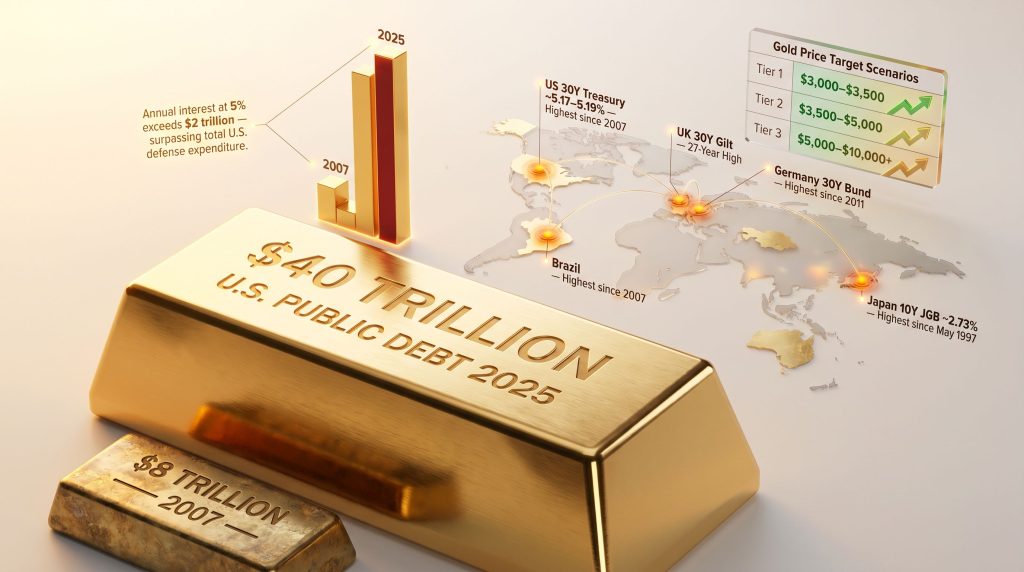
When commentators reference U.S. public debt as a concern, the framing often treats it as a linear extension of a longstanding issue. However, the structural reality is categorically different today than it was even fifteen years ago. In 2007, total U.S. public debt stood at approximately $8 trillion. By 2025, that figure is approaching $40 trillion, representing a roughly fivefold expansion within less than two decades.
The critical analytical point here is not the nominal debt figure itself, but what that expansion means when applied to prevailing interest rates. At a 5% average yield, annual interest obligations on $8 trillion would be approximately $400 billion. The same rate applied to a $40 trillion debt load generates an annual interest burden exceeding $2 trillion, surpassing the entirety of U.S. defense spending and making debt servicing the fastest-growing line item in the federal budget.
Furthermore, understanding gold and bond dynamics helps clarify why this interest burden has such profound implications for asset allocation across the global monetary system.
"When annual interest payments on sovereign debt exceed total defense expenditure, it signals a fundamental shift in how fiscal resources are allocated. Capital that would otherwise fund infrastructure, healthcare, or national security is instead flowing to creditors, both domestic and foreign."
This is not a theoretical risk scenario. It is the current operating reality of U.S. federal finance, and it explains why the 30-year U.S. Treasury yield reaching 5.17 to 5.19% in 2025 carries weight beyond a simple interest rate statistic. It represents the market demanding compensation for a debt profile that looks structurally different from anything priced into long-duration bond markets over the past two decades.
A Synchronised Global Yield Signal
What separates the current environment from previous episodes of U.S. fiscal concern is the simultaneous deterioration in sovereign bond markets across multiple major economies. This is not a story about one country's fiscal mismanagement.
| Country | Instrument | Recent Yield Level | Historical Comparison |
|---|---|---|---|
| United States | 30-Year Treasury | ~5.17–5.19% | Highest since 2007 |
| United Kingdom | 30-Year Gilt | Multi-decade high | Highest in 27 years |
| Germany | 30-Year Bund | Elevated | Highest since 2011 |
| Japan | 10-Year JGB | ~2.73% | Highest since May 1997 |
| Japan | 30-Year JGB | ~4.1% | Near historic highs |
Each of these yield movements reflects the same underlying dynamic: bond markets are demanding higher compensation to hold sovereign debt, because confidence in the long-run sustainability of government balance sheets is eroding. When this occurs across the U.S., UK, Germany, and Japan simultaneously, the signal is systemic rather than idiosyncratic.
The debt-to-GDP dimension reinforces this. Several G7 economies now carry net debt levels that exceed 100% of annual economic output, meaning a full year of all goods and services produced within those economies would be insufficient to retire the outstanding debt.
- Italy: Net debt materially above 100% of GDP
- Japan: One of the highest debt-to-GDP ratios among developed economies
- United States: Net debt crossing the 100% GDP threshold
- France and Belgium: Approaching critical thresholds
- United Kingdom: Trending in the same direction
According to analysis of how debt tops GDP affects gold, these thresholds have historically served as meaningful inflection points for gold demand, as investors seek counterparty-free stores of value.
"When a nation's debt-to-GDP ratio exceeds 100%, it is not a theoretical warning level. It is the lived fiscal reality for multiple members of the G7 today, and it changes the calculus of sovereign risk in ways that bond markets are beginning to price explicitly."
The Japan Factor: The World's Largest Treasury Creditor at a Crossroads
Japan occupies a uniquely consequential position in this global dynamic. As the single largest foreign holder of U.S. Treasury securities, ahead of China and all other sovereign creditors, Japanese capital flows have long acted as a structural stabiliser for the U.S. bond market.
The mechanism underpinning this relationship is the Japanese carry trade. For years, Japanese institutional investors could borrow in yen at near-zero domestic rates and deploy that capital into higher-yielding U.S. assets, capturing a meaningful spread. That spread is now compressing rapidly as Japanese domestic yields rise.
With Japan's 10-year yield reaching 2.73%, its highest level since May 1997, and the 30-year JGB yield approaching 4.1%, the return calculus for Japanese investors is shifting. Domestic Japanese bonds are becoming increasingly competitive relative to U.S. Treasuries on a risk-adjusted, currency-hedged basis. This creates the conditions for capital repatriation, where Japanese investors sell U.S. Treasury holdings and redeploy capital domestically.
The implications of this dynamic compound. If Japan, the largest foreign holder, reduces its Treasury position, the U.S. must attract alternative buyers for that debt. The primary mechanism available is offering even higher yields, pushing the current 5% figure higher rather than lower. This is not a static equilibrium; it is a potential feedback loop where rising yields incentivise further creditor exit, which necessitates still higher yields to replace them.
A preview of what this unwinding can look like occurred in 2024, when carry trade disruption triggered a sharp, sudden episode of equity market volatility that was narrowly contained. With Japanese yields now meaningfully higher than during that episode, the structural pressure on this dynamic has intensified rather than resolved.
The China Dimension and the Cascade Scenario
China has been engaged in a multi-year, deliberate reduction of its U.S. Treasury holdings as part of a broader geopolitical and financial diversification strategy. Consequently, this process has been gradual, in part because a rapid, large-scale exit would inflict costs on China as well as the U.S. through price impact on its remaining holdings.
However, the risk scenario that bond market analysts increasingly discuss involves a shift from managed reduction to forced or accelerated selling driven by geopolitical stress, sanctions, or financial crisis. The broader global monetary shift driven partly by China's strategic repositioning adds another layer of complexity to this already fragile dynamic.
If Japan, China, and other significant holders were to reduce positions simultaneously, even without coordination, the result would be a self-reinforcing yield spiral that current monetary policy tools would struggle to contain without significant inflationary consequences.
What History Tells Us About Gold During Sovereign Debt Stress
The European sovereign debt crisis of 2009 to 2012 offers the most recent historical parallel for how gold behaves during periods of concentrated sovereign fiscal stress. During that episode, which was geographically contained to peripheral Eurozone economies including Greece, Portugal, Ireland, Spain, and Italy, gold appreciated from approximately $1,000 per ounce to $1,920 per ounce, representing a gain of roughly 80 to 90% over three years.
The driving mechanism was not hyperinflation. It was a loss of confidence in sovereign debt instruments as reliable stores of value, which redirected capital toward gold as a counterparty-free alternative. Gold does not depend on any government's willingness or ability to honour an obligation. It carries no default risk because there is no issuer.
The analytical implication for the current environment is significant. That 2009 to 2012 precedent involved stress concentrated in economies representing a fraction of global GDP. The current synchronised yield expansion involves the United States, the UK, Germany, Japan, France, Italy, and Brazil simultaneously. The structural magnitude of a globally coordinated sovereign debt stress event dwarfs the European precedent by any reasonable measure.
Historical currency collapse episodes in emerging markets provide another reference point. Nations including Venezuela, Argentina, and Mexico, during periods of acute fiscal and currency crisis, saw gold reprice by 6x to 10x in local currency terms. These precedents represent extreme scenarios, but they illustrate the order of magnitude that gold revaluation can reach when fiat monetary systems lose credibility.
Central Bank Gold Buying: The Institutional Signal Most Investors Are Missing
Perhaps the most analytically significant development in gold markets over the past two years is not retail investment flows or ETF demand. It is the behaviour of the institutions that manage the world's reserve currencies. Indeed, central bank gold demand has emerged as one of the most consequential structural forces shaping the market today.
Central banks self-report gold purchases to the International Monetary Fund, a structure that creates both reporting lags and discretionary disclosure opportunities. Independent analysis by major financial institutions, including Goldman Sachs, has revealed that official data has been materially understating actual central bank gold accumulation. Since mid-2024, independent estimates have been revised upward by approximately 70% compared to what official reporting suggested.
This gap between reported and actual purchases is analytically telling. Central banks are accumulating physical gold at a rate significantly higher than publicly disclosed, and they are doing so at a time when gold prices are already elevated. This is behaviour consistent with institutions executing a strategic hedge against known systemic risks.
Goldman Sachs and other institutional research operations have identified this central bank demand as a structural price floor for gold, distinct from cyclical or sentiment-driven demand. When the world's largest institutional buyers are purchasing at scale regardless of short-term price levels, the demand baseline shifts in a way that alters the probability distribution of future price outcomes.
Institutional Price Targets and Scenario Analysis
Forecasting gold prices over medium to long time horizons involves significant uncertainty, and the following scenarios should be understood as analytical frameworks rather than reliable predictions. That said, the range of institutional price targets in circulation reflects the breadth of scenarios that credible analysts are modelling.
| Scenario Type | Gold Price Target Range | Key Trigger Conditions |
|---|---|---|
| Base Case (Moderate Stress) | $3,000–$3,500/oz | Persistent deficits, moderate dollar weakness |
| Elevated Stress Scenario | $3,500–$5,000/oz | Treasury demand collapse, Fed credibility erosion |
| Currency Reset / Systemic Scenario | $5,000–$10,000+/oz | Sovereign debt restructuring, dollar reserve status loss |
| Historical Currency Collapse Precedent | 6x–10x revaluation | Emerging market-style fiat collapse |
J.P. Morgan has modelled scenarios in which gold trades above $5,000 per ounce under conditions of sustained fiscal stress and creditor withdrawal from U.S. debt markets. The $3,000 level has already been tested in 2025, and the trajectory beyond that level depends on variables including Federal Reserve policy credibility, the pace of de-dollarisation, and whether Japanese and Chinese creditor dynamics accelerate.
These projections represent the output of scenario modelling, not guaranteed outcomes. Investors should approach all price target ranges with appropriate scepticism and consult qualified financial advisers before making allocation decisions.
The next major ASX story will hit our subscribers first
The Long-Run Correlation Between U.S. Debt Growth and Gold
When U.S. public debt stood at approximately $8 trillion in 2007, gold was trading in the range of $650 to $800 per ounce. With debt now approaching $40 trillion, gold has already surpassed the $2,500 to $3,000 range. While short-term divergences occur driven by real interest rates, Federal Reserve policy, and risk sentiment cycles, the long-run positive correlation between U.S. debt expansion and gold price appreciation is well documented across multiple decades of data.
Zooming out on a long-duration price chart removes the noise of quarterly volatility and reveals a structural uptrend that maps closely to the expansion of sovereign balance sheets globally. Periods where gold declines despite rising debt are typically followed by mean-reversion rallies that restore the structural relationship.
This correlation reflects a fundamental monetary reality. Gold is not primarily priced against a basket of goods. It is priced against the credibility of the fiat monetary system. As that system's balance sheets expand without corresponding increases in productive economic output, the relative scarcity and counterparty-free nature of gold becomes more valuable, not less.
De-Dollarisation: A Structural Process With Accelerating Implications
De-dollarisation is frequently mischaracterised as a binary event — a single dramatic moment when the dollar loses reserve currency status. In reality, it is a slow-moving structural shift that has been underway for multiple decades. The dollar's share of global foreign exchange reserves has been declining gradually, from approximately 72% in 2000 to levels below 60% more recently, with further erosion occurring as nations diversify into alternative assets including gold, the Chinese renminbi, and other currencies.
The relevance for gold is direct. As nations reduce dollar-denominated reserve holdings, they need alternative stores of value that satisfy the criteria of liquidity, stability, and political neutrality. Gold satisfies all three criteria more comprehensively than any competing asset. The acceleration of de-dollarisation during periods of geopolitical stress creates non-linear demand surges for gold that can temporarily compress the gradual nature of the long-run trend.
Factors That Can Interrupt Gold's Structural Ascent
A rigorous analysis of the gold and US debt crisis relationship requires acknowledging the variables that can create meaningful divergences between debt levels and gold prices in shorter time horizons.
- Real interest rates: When inflation-adjusted yields are positive and rising, gold faces genuine headwinds regardless of nominal debt levels. The opportunity cost of holding a non-yielding asset increases.
- Federal Reserve policy: Aggressive rate hiking cycles can strengthen the dollar and suppress gold, as occurred in 2022.
- Risk appetite cycles: During equity bull markets, capital can rotate away from gold even in high-debt environments as investors chase return rather than protection.
- Credible fiscal consolidation: If the U.S. demonstrated a credible path to meaningful debt reduction, Treasury demand could stabilise and reduce the urgency of gold as a hedge.
- New supply dynamics: While geological constraints limit gold supply growth, meaningful new discoveries or extraction technology advances could alter the supply side of the equation.
"Gold's relationship with sovereign debt operates powerfully over long time horizons but is not mechanically linear in any given quarter or year. Real interest rates, monetary policy, and risk sentiment can all create divergences that frustrate short-term positioning even when the long-run structural case is intact."
Portfolio Thinking: Gold as Systemic Insurance
The distinction between holding gold as a speculative trade and holding it as structural portfolio protection is analytically important. Considering gold as strategic investment acknowledges that the conditions generating long-run demand — expanding sovereign balance sheets, de-dollarisation, and central bank accumulation — are structural rather than temporary.
| Asset Class | Counterparty Risk | Inflation Hedge | Currency Collapse Protection | Liquidity |
|---|---|---|---|---|
| Physical Gold | None | Strong | Strong | Moderate |
| Gold ETFs | Moderate (issuer) | Strong | Moderate | High |
| U.S. TIPS | Government | Moderate | Weak | High |
| Bitcoin/Crypto | Protocol risk | Speculative | Speculative | High |
| Real Estate | Moderate | Strong | Moderate | Low |
Institutional frameworks have historically suggested allocations of 5 to 15% in gold as a systemic hedge within diversified portfolios. Furthermore, central banks themselves — the world's largest institutional participants in gold markets — execute gradual, systematic accumulation rather than attempting to time entry around specific fiscal milestones. This approach reflects the structural rather than speculative rationale for holding gold in an environment of expanding sovereign debt.
Nothing in this article constitutes financial advice. All investment decisions should be made in consultation with a qualified financial professional after consideration of individual circumstances and risk tolerance.
Frequently Asked Questions
What Is Driving the Gold and US Debt Crisis Relationship Right Now?
The relationship is driven by a combination of factors converging simultaneously: U.S. public debt approaching $40 trillion with annual interest payments exceeding defence spending, synchronised sovereign yield increases across G7 economies, Japan's potential capital repatriation from U.S. Treasury markets, and central bank gold accumulation running materially above officially reported levels. Each of these factors independently would influence gold demand. Their simultaneous occurrence creates a structural demand environment without recent historical precedent.
Why Does Japan's Yield Movement Matter for U.S. Gold Prices?
Japan is the largest foreign holder of U.S. Treasury securities. As Japanese domestic yields rise toward levels competitive with U.S. Treasuries on a hedged basis, the incentive for Japanese investors to hold U.S. debt diminishes. Capital repatriation from this dynamic would force the U.S. to offer higher yields to attract alternative buyers, accelerating the fiscal pressure that drives gold demand. Japan's 10-year yield reaching its highest level since May 1997 at 2.73% makes this dynamic increasingly pressing.
Are Central Banks Actually Buying More Gold Than the Data Suggests?
Independent analysis has confirmed that official central bank gold purchase data, which relies on self-reporting to the IMF, has understated actual accumulation by a significant margin. Since mid-2024, independent estimates have been revised upward by approximately 70%. This gap suggests that sovereign institutions are executing gold acquisition strategies at a scale that official disclosures do not fully capture.
Could Gold Really Reach $5,000 to $10,000 Per Ounce?
Institutional scenario modelling, including analysis from J.P. Morgan, has mapped pathways to gold above $5,000 per ounce under conditions of sustained fiscal stress and Treasury market demand deterioration. Historical currency collapse episodes in Venezuela, Argentina, and Mexico produced gold repricing of 6x to 10x in local currency terms. Whether analogous dynamics apply to the U.S. dollar at a global reserve currency scale depends on variables including the pace of de-dollarisation, Federal Reserve credibility, and creditor behaviour — none of which are deterministic. These remain scenarios, not forecasts.
Is This Problem Unique to the United States?
No. The debt stress is demonstrably global. Italy, Japan, and the United States already carry net debt exceeding 100% of GDP. France, Belgium, and the UK are approaching similar thresholds. Germany's 30-year yields are at their highest since 2011. The UK's 30-year borrowing costs are at a 27-year high. Brazil, Russia, and major Eurozone economies are all exhibiting simultaneous yield expansion. The synchronisation of this dynamic across the world's largest bond markets is what distinguishes the current environment from previous regional debt episodes. In addition, gold's safe-haven role becomes particularly pronounced precisely when stress is this broadly distributed across global sovereign markets.
Want to Know Which ASX Mining Companies Could Benefit From Rising Gold Demand?
Discovery Alert's proprietary Discovery IQ model delivers real-time alerts the moment significant mineral discoveries are announced on the ASX, transforming complex geological data into actionable investment insights for both short-term traders and long-term investors. Explore Discovery Alert's discoveries page to understand how historic finds have generated substantial returns, and begin a 14-day free trial to position yourself ahead of the broader market.