May 21, 2026
Underground Mining's Equipment Inflection Point: Why Fleet Procurement Is Becoming a Strategic Differentiator
The economics of underground gold mining have always been shaped by the relationship between capital intensity and operational throughput. However, the current environment — defined by elevated gold prices, aging equipment fleets across Latin America, and mounting pressure to adopt automation-ready technologies — is forcing operators to rethink procurement not as a logistical exercise but as a strategic investment with long-term competitive implications.
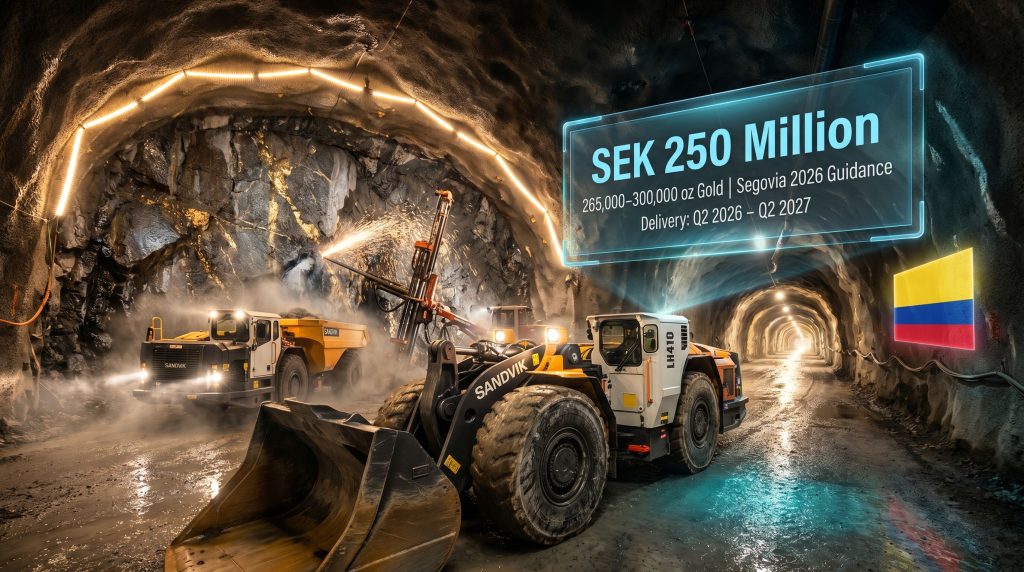
Few recent transactions illustrate this shift more clearly than the SEK 250 million underground equipment order that defines the Sandvik Aris Mining Segovia order, primarily targeting the Marmato gold operation in Caldas, Colombia. The deal, booked in Q1 2026, encompasses one of the most complete single-vendor underground fleet packages seen in Latin American gold mining in recent years, and its strategic dimensions extend well beyond the mechanical specifications of the equipment involved.
Understanding why this procurement decision matters requires examining the dual-asset Colombian strategy Aris Mining is executing, the competitive dynamics reshaping the underground equipment market, and the broader fleet renewal cycle now accelerating across the sector.
When big ASX news breaks, our subscribers know first
Aris Mining's Colombian Platform: Two Assets, Two Distinct Roles
Aris Mining operates two wholly owned underground gold assets in Colombia, each serving a fundamentally different purpose within the company's growth architecture.
Segovia, located in the Antioquia province, is the operational cornerstone. With gold production guidance of 265,000 to 300,000 ounces for 2026, it ranks among the most productive underground gold operations in Latin America by output volume. Segovia runs a hybrid production model combining owner-operated mining with contractor participation, a structure that provides cost flexibility while maintaining high-grade output.
Antioquia itself carries significant historical weight as one of South America's most productive gold-bearing provinces, with artisanal and industrial mining traditions stretching back centuries. This geological heritage translates into genuinely high-grade ore bodies that underpin Segovia's cash generation capacity.
Marmato, situated in the Caldas department, plays a different role entirely. It is the growth engine, currently undergoing a capital-intensive deep-level expansion that will transition the operation from its current production configuration to large-scale longhole open stoping at depth. This transition demands a fundamentally different equipment profile than Segovia's existing setup, which is precisely where the Sandvik order becomes significant.
The strategic logic is straightforward: Segovia generates the cash that funds Marmato's development capital. Furthermore, the Sandvik procurement reflects confidence that this internal funding mechanism is sufficiently robust to support a US$26 million-plus fleet commitment on a phased delivery schedule running from Q2 2026 through Q2 2027.
The Sandvik Aris Mining Segovia Order and Marmato Fleet: What Was Actually Procured
The equipment package Sandvik secured for Marmato, alongside a further order referenced for Segovia operations, represents a multi-category underground fleet rather than a specialised single-category purchase. This distinction matters enormously in assessing the deal's strategic significance.
| Equipment Category | Operational Function | Relevance to Marmato Expansion |
|---|---|---|
| Underground Loaders (LH410 and related) | Ore and waste mucking in development and production headings | Critical for deep-level access drives and stope extraction |
| Underground Haul Trucks | Material transport from stopes to ore passes | Volume movement as mining advances deeper |
| Development Drill Rigs | Face drilling for horizontal tunnel advance | Opening up new levels and access drives |
| Production Drill Rigs | Drilling for stope preparation | Preparing ore blocks for extraction |
| Longhole Drill Rigs | Extended-reach drilling for bulk ore extraction | High-productivity extraction in established stopes |
| Maintenance and Repair Services | Contracted fleet uptime assurance | Lifecycle cost management and availability guarantees |
The phased delivery timeline spanning five quarters is not simply a logistical convenience. Underground mine development at depth requires careful sequencing of equipment deployment to avoid creating bottlenecks in development headings or overwhelming the mine's ventilation and tramming infrastructure with equipment that arrives before the physical infrastructure is ready to accommodate it.
The transition from a contractor-dominated equipment model to an owner-operated fleet at Marmato is not merely a procurement decision. It represents a fundamental shift in how fixed and variable costs are structured, with owner-operated fleets typically delivering better unit cost control over the medium term as fixed overheads are spread across growing throughput volumes.
The Competitive Calculus: Why Full-Fleet Bundling Changes the OEM Dynamic
The underground mining equipment market is dominated by three major original equipment manufacturers, each with distinct competitive positioning.
| OEM | Primary Underground Strengths | Latin America Presence | Key Differentiators |
|---|---|---|---|
| Sandvik | Loaders, trucks, drill rigs across all categories | Strong across Colombia, Chile, Peru, Brazil | Integrated full-fleet capability plus service contracts |
| Epiroc | Drill rigs, rock bolters, automation systems | Strong in Chile, Peru, Mexico | Battery-electric technology focus, SmartROC platform |
| Caterpillar | Large underground trucks and loaders | Moderate, primarily large-tonnage operations | Scale economics and depth of dealer network |
What sets the Sandvik Aris Mining Segovia and Marmato procurement apart from a competitive standpoint is not the individual quality of any single equipment category, but rather the ability to supply a complete matched fleet across loaders, trucks, and three distinct drill rig types simultaneously. This full-fleet capability is something neither pure drill rig specialists nor pure loading equipment manufacturers can easily replicate.
For Epiroc, which has made significant inroads in Latin America through its battery-electric equipment offerings and SmartROC automation platform, the loss of this particular order highlights the growing commercial importance of bundled fleet solutions. In addition, a mine operator managing a large-scale underground development project faces meaningful operational advantages when all heavy equipment shares the same service infrastructure, spare parts ecosystem, and digital monitoring platform.
The contracted maintenance and repair services component of the Sandvik deal deserves particular attention. In underground mining, equipment availability is arguably the single most important driver of production outcomes. A matched fleet from one supplier, supported by a contracted service agreement, shifts a portion of equipment risk from the mine operator to the OEM while providing Sandvik with predictable, recurring revenue that extends well beyond the initial capital equipment sale.
Overall Equipment Effectiveness and the Single-Vendor Advantage
Underground mine productivity is determined by three interlocking variables: equipment availability, utilisation rate, and cycle time efficiency. When these three metrics are optimised together, the productivity gains are non-linear.
A fully matched fleet from a single OEM supplier reduces interface complexity, simplifies parts logistics, and can improve overall equipment effectiveness (OEE) by reducing inter-system compatibility issues that arise when loaders, trucks, and drill rigs are sourced from competing manufacturers with different service requirements, telemetry standards, and operator training protocols.
This operational reality has significant implications for how underground mine operators evaluate procurement decisions. The initial capital cost comparison between competing OEM bids represents only one dimension of the total cost of ownership calculation. When lifecycle service costs, parts availability, technician training requirements, and production continuity risks are factored into the analysis, integrated fleet packages from single suppliers often present a more compelling economic case than piecemeal procurement across multiple vendors.
For Aris Mining at Marmato, where the operation is transitioning from a contractor-heavy model to full owner-operation during an active deep-level development programme, minimising equipment-related operational disruptions is critical. Consequently, the Sandvik contract's service component provides a degree of uptime assurance that would be significantly more difficult to achieve with a fragmented multi-vendor fleet.
The Automation Horizon: What Comes After Equipment Delivery
Both Aris Mining and Sandvik have indicated interest in extending their commercial relationship into automation and digital mine optimisation territory. This forward-looking dimension of the partnership is arguably as commercially significant as the equipment order itself. Notably, mining automation trends across the industry are accelerating this type of strategic thinking.
Sandvik's automation portfolio includes platforms such as AutoMine, which enables remote and autonomous operation of underground loaders and trucks, and OptiMine, a digital fleet management and optimisation system. These technologies are already deployed in mature automation markets including Australia and Scandinavia, where underground mines have demonstrated measurable improvements in metres developed per shift, equipment utilisation rates, and personnel safety outcomes.
Colombian underground gold mining currently lags these markets in automation adoption, which creates a meaningful first-mover opportunity for operators willing to invest in automation-ready infrastructure during the current equipment replacement cycle. Furthermore, AI mining efficiency tools are increasingly being layered on top of these automation-compatible fleets, amplifying returns on the initial capital commitment.
The fact that Aris Mining has procured automation-compatible Sandvik equipment at Marmato positions the operation for technology upgrades without requiring fleet replacement — a consideration that adds long-term value to the current procurement decision beyond its immediate operational benefits.
The commercial model implications are also significant. Sandvik's strategic direction, consistent with broader mining technology transformation trends across the industrial equipment sector, involves shifting revenue mix toward recurring technology-as-a-service arrangements rather than one-off capital equipment sales.
The next major ASX story will hit our subscribers first
Gold Price Tailwinds and the 2025-2026 Fleet Upgrade Cycle
The timing of the Sandvik Aris Mining Segovia and Marmato procurement is not coincidental. The current elevated gold and mining equities environment, with prices sustaining levels significantly above the historical average through 2024 and into 2025, has materially expanded the capital expenditure headroom available to underground gold producers.
Several converging forces are driving the underground equipment replacement cycle currently underway across Latin America:
- Aging fleet demographics: Many Latin American underground operations deferred equipment replacement during the gold price weakness of the early 2020s, creating accumulated replacement demand that is now being addressed
- ESG and emission reduction pressure: Regulatory and investor-driven pressure to reduce underground diesel emissions is accelerating the transition to newer, cleaner equipment platforms even where existing assets retain mechanical life
- Productivity competition: As gold miners face rising input costs including labour, energy, and consumables, equipment productivity improvements become essential to maintaining competitive all-in sustaining costs
- Automation readiness as procurement criterion: Sophisticated mine operators are increasingly selecting OEM partners based on their digital and automation roadmaps, not purely on equipment specifications, recognising that the equipment purchased today will need to interface with tomorrow's automation systems
Key Metrics to Watch as Marmato Develops
For investors and industry observers tracking the Marmato expansion's progress, several key performance indicators will signal whether the equipment investment is translating into operational outcomes.
| Metric | Current Phase | Post-Expansion Expectation |
|---|---|---|
| Mining Method | Development and transition phase | Established longhole open stoping |
| Fleet Configuration | Phased Sandvik equipment delivery | Full owner-operated fleet operational |
| Marmato Production Contribution | Lower than Segovia currently | Material increase as deep levels come online |
| Unit Operating Costs | Elevated during development | Declining as fixed costs spread over greater throughput |
| Automation Integration | Pre-deployment baseline | Progressive AutoMine/OptiMine integration possible |
The progression from development-phase cost profile to production-phase cost efficiency is the critical financial transition investors should monitor. Underground mine development is inherently cost-intensive because development metres are advancing into unproductive rock with minimal ore recovery, while fixed costs including equipment, labour, and ventilation continue accumulating.
The step-change in economics comes when production headings become sufficiently numerous and well-developed that the fixed cost base is distributed across meaningful ore tonnage.
Frequently Asked Questions: Sandvik Aris Mining Segovia Order
What is the total value of the Sandvik Aris Mining equipment order?
The primary order associated with the Marmato operation is valued at approximately SEK 250 million, independently estimated at more than US$26 million. Mining Magazine has also reported a further, separate order for the Segovia operation in Antioquia, indicating this is an ongoing multi-asset procurement relationship rather than a single transaction.
When will equipment deliveries to Marmato begin?
The order was booked in Q1 2026, with equipment deliveries scheduled to commence in Q2 2026 and continue through Q2 2027, reflecting a phased deployment aligned with the Marmato underground development programme's sequencing requirements.
What makes the Segovia operation significant in Latin American gold mining?
Segovia's production profile and 2026 production guidance of 265,000 to 300,000 ounces positions it among the most productive underground gold operations in Latin America. Its hybrid owner-contractor production model and location in the historically gold-rich Antioquia province underpin its role as the primary cash generator funding Marmato's capital-intensive development.
Why does a matched single-vendor fleet matter operationally?
A matched fleet from a single OEM reduces parts inventory complexity, simplifies technician training, enables unified digital monitoring, and eliminates inter-system compatibility issues that arise in multi-vendor environments. These factors collectively improve overall equipment effectiveness and reduce unplanned downtime risks during critical development phases.
What is the significance of the contracted maintenance agreement?
The service contract component transfers a portion of equipment availability risk from Aris Mining to Sandvik, providing production continuity assurance while creating predictable recurring revenue for Sandvik beyond the initial capital equipment sale. It also establishes the commercial platform for future automation and digital services integration.
This article contains forward-looking statements and projections regarding production guidance, equipment delivery timelines, and operational outcomes. These are based on publicly available information and should not be construed as investment advice. Actual outcomes may differ materially from projections due to operational, geological, regulatory, financial, and market factors. Readers should conduct independent due diligence before making investment decisions.
Want to Track the Next Major ASX Mineral Discovery Before the Market Does?
Discovery Alert's proprietary Discovery IQ model delivers real-time alerts on significant ASX mineral discoveries, transforming complex geological and market data into actionable investment insights for both short-term traders and long-term investors — explore historic discoveries and their exceptional returns to understand what early positioning can mean, then begin your 14-day free trial at Discovery Alert to gain a market-leading edge.