July 21, 2026
Advanced Geochemical Techniques in Multi-Metal Exploration Systems
Modern mineral exploration increasingly relies on sophisticated geochemical analysis to identify subsurface ore bodies, particularly in complex multi-metal systems where traditional prospecting methods fall short. The Killi Resources Mt Rawdon West gold-copper anomaly exemplifies how advanced techniques can reveal significant mineralization potential. Furthermore, the integration of surface sampling, geophysical surveys, and structural geology creates a comprehensive exploration framework that significantly reduces drilling risk while maximizing discovery potential.
Epithermal and porphyry systems represent some of the most economically significant gold-copper deposits globally, yet their detection requires nuanced understanding of hydrothermal processes and metal association patterns. These systems develop through specific geological conditions where magmatic fluids interact with crustal rocks, creating distinctive geochemical signatures that can be detected through systematic exploration programs. Understanding mineral exploration importance provides context for these sophisticated exploration methodologies.
When big ASX news breaks, our subscribers know first
Understanding Queensland's Strategic Mineral Corridors
The Bundaberg mineral district in Queensland has emerged as a significant exploration target due to its established infrastructure and proven mineralization. The region benefits from proximity to operational facilities and transportation networks that reduce development costs for successful discoveries.
Regional Geological Framework
Queensland's eastern mineral corridors developed through complex tectonic processes involving multiple intrusive events and structural reactivation. The geological architecture creates favorable conditions for hydrothermal fluid focusing and metal precipitation, particularly where regional fault systems intersect with intrusive contacts.
The Mt Rawdon West project, operated by Killi Resources, exemplifies this regional geological setting. Positioned within the broader Bundaberg mineral corridor, the project area demonstrates the characteristic features of epithermal-porphyry systems that have generated significant economic deposits throughout eastern Australia.
Infrastructure Advantages in Established Mining Districts
Proximity to existing mining operations provides substantial competitive advantages for exploration companies. Access to processing facilities, skilled labor, and established supply chains can significantly reduce the capital expenditure required to bring new discoveries into production.
The Mt Rawdon gold mine, located 20 kilometers southeast of the exploration target, operates as a regional processing hub that could potentially service additional discoveries in the district. This infrastructure proximity creates inherent value for exploration projects even before drilling commences.
Historical Production Context
Regional mining history provides critical geological insights for contemporary exploration programs. Historical workings often indicate structural controls on mineralization and can guide modern exploration strategies toward similar geological environments.
The Mt Perry district historically produced copper-gold mineralization from similar geological settings, demonstrating the regional potential for economic deposits. Understanding this historical context helps exploration geologists develop more effective targeting strategies. Moreover, deposit tiers guide principles apply directly to evaluating these historical precedents.
Interpreting Multi-Element Geochemical Signatures
Geochemical analysis forms the foundation of modern mineral exploration, providing quantitative data on element distribution patterns that indicate proximity to ore bodies. The interpretation of these signatures requires sophisticated understanding of background variations and anomaly recognition techniques.
Statistical Approaches to Anomaly Recognition
Effective geochemical interpretation depends on rigorous statistical analysis to distinguish genuine anomalies from background variation. The Killi Resources Mt Rawdon West gold-copper anomaly demonstrates exceptional grade tenor compared to regional background values.
Geochemical Signature Analysis:
| Element | Background Values | Anomalous Threshold | Peak Results |
|---|---|---|---|
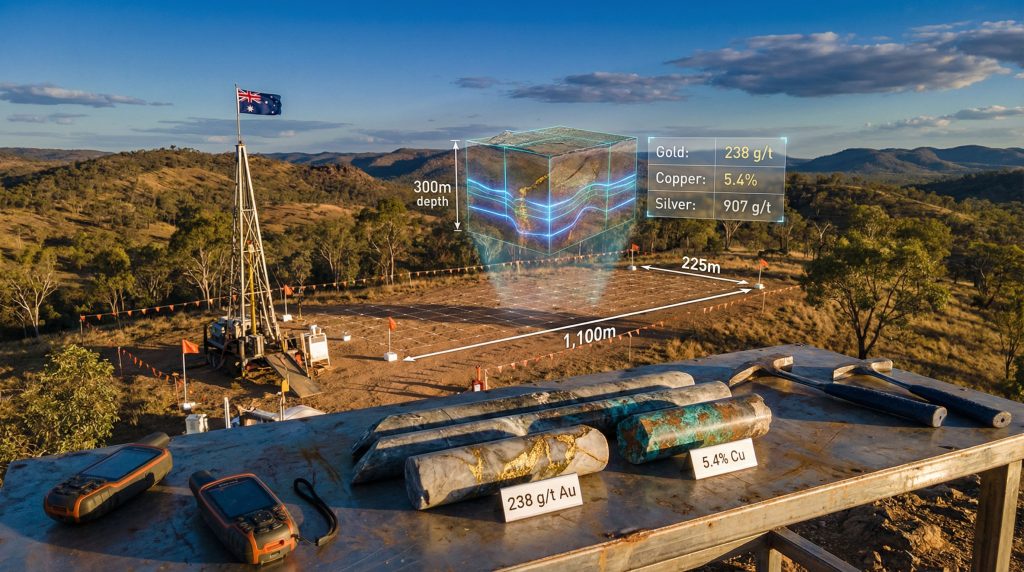
| Gold | 4.7 ppb | >50 ppb | 238 g/t |
| Copper | <0.1% | >0.5% | 5.4% |
| Silver | <5 g/t | >20 g/t | 907 g/t |
| Molybdenum | Variable | Context-dependent | Detected |
The statistical significance of these results becomes apparent when considering the magnitude of enrichment above background values. Gold grades reaching 238 g/t represent approximately 50,000 times background concentration, indicating highly localized mineralization processes.
Pathfinder Element Associations
In epithermal and porphyry systems, specific element associations provide vectoring information toward higher-grade mineralization. The combination of gold, copper, silver, and molybdenum detected at Mt Rawdon West follows classic pathfinder patterns observed in similar deposit types globally.
Copper serves as a particularly valuable pathfinder element due to its mobility in hydrothermal fluids and tendency to precipitate in intermediate temperature zones. Silver often occurs in peripheral positions relative to gold-copper cores, providing additional vectoring capability.
Molybdenum detection adds another dimension to the geochemical signature, as this element typically associates with higher-temperature hydrothermal systems and can indicate proximity to porphyry-style mineralization at depth. Additionally, proper geological logging codes ensure accurate documentation of these complex mineral associations.
Surface Sampling Methodology Considerations
Rock chip sampling provides point-source data that can identify extremely high-grade zones, but interpretation must account for potential sampling bias and weathering effects. The 1,100-meter by 225-meter anomaly footprint at Mt Rawdon West suggests a substantial mineralized system rather than isolated high-grade pods.
Soil sampling offers more representative coverage of anomaly extents and helps define geochemical halos around mineralization. The background soil value of 4.7 ppb gold provides statistical foundation for anomaly declaration and helps establish exploration target priorities.
Structural Controls in Hydrothermal Systems
Structural geology plays a fundamental role in hydrothermal ore formation by controlling fluid flow pathways and creating sites for metal precipitation. Understanding these structural relationships guides exploration targeting and drilling strategies.
Breccia Formation and Fluid Flow
Hydrothermal breccias represent zones of intense fracturing and fluid interaction, often marking the core areas of epithermal and porphyry systems. The discovery of breccia zones at the King Louie prospect indicates active hydrothermal processes and structural preparation for ore deposition.
According to Killi Resources CEO Brett Smith, "breccias are commonly associated with mineral deposits formed within porphyry copper-gold and epithermal copper-gold systems." These structures potentially delineate focuses of tectonic activity and hydrothermal fluid flow.
Granodiorite Host Rock Characteristics
Granodiorite intrusions provide ideal host rocks for porphyry-style mineralization due to their chemical composition and structural competency. These rocks often undergo hydrothermal alteration that creates favorable conditions for metal precipitation.
The interaction between hydrothermal fluids and granodiorite host rocks produces characteristic alteration assemblages that can be mapped and used to vector toward mineralization centers. Understanding these alteration patterns helps optimize drilling programs.
Fault Systems and Structural Preparation
Regional fault systems create pathways for hydrothermal fluid migration and provide structural sites for ore deposition. The Rawdon fault system represents a significant structural feature that may control mineralization distribution across the broader project area.
Structural preparation of host rocks through faulting and fracturing increases permeability and creates space for hydrothermal minerals to precipitate. This structural control often determines the geometry and continuity of ore bodies.
Geophysical Target Definition Strategies
Induced Polarization surveys provide critical subsurface information that complements surface geochemical data. These surveys detect electrical properties of sulfide minerals that commonly associate with gold-copper mineralization. However, AI in exploration techniques is revolutionizing how these datasets are interpreted and integrated.
IP Survey Technical Applications
The pole-dipole configuration employed at Mt Rawdon West achieves effective depth penetration to 300 meters across a 2.52 square kilometer survey area. This configuration specifically targets chargeable zones associated with sulfide mineralization.
Sulfide minerals exhibit high chargeability due to their electrical properties, making IP surveys particularly effective for detecting porphyry and epithermal copper-gold systems. The three-dimensional nature of IP data provides drilling vectors that optimize target testing.
Integrating Multiple Geophysical Datasets
Modern exploration programs integrate IP data with other geophysical techniques to create comprehensive subsurface models. Magnetic surveys can identify structural controls, while gravity data may indicate density variations associated with alteration zones.
The combination of surface geochemical anomalies with subsurface IP chargeability patterns provides complementary evidence for mineralization. This multi-disciplinary approach significantly reduces geological uncertainty before drilling commences.
Depth Penetration and Resolution Trade-offs
Geophysical surveys involve fundamental trade-offs between depth penetration and resolution. The 300-meter depth capability at Mt Rawdon West provides sufficient penetration to test the upper levels of potential porphyry systems while maintaining adequate resolution for target definition.
Understanding these technical limitations helps optimize survey design and interpretation. Electrode spacing and array configuration must balance depth requirements against the need for detailed target resolution.
Risk-Weighted Drilling Strategy Development
Exploration drilling represents the highest-cost phase of mineral exploration, making risk assessment and target prioritization critical for project economics. Successful programs integrate geological, geochemical, and geophysical data to optimize drilling strategies. Furthermore, proper drilling results interpretation methodologies are essential for maximizing the value of drilling investments.
Multi-Disciplinary Target Ranking
The Mt Rawdon West exploration program demonstrates systematic target prioritization through integration of:
- Surface rock chip geochemistry (238 g/t Au, 5.4% Cu, 907 g/t Ag)
- Soil geochemistry baseline establishment (4.7 ppb Au background)
- IP geophysical chargeability mapping to 300m depth
- Structural breccia identification and mapping
This integrated approach provides multiple lines of evidence supporting drill target selection and reduces the probability of testing barren ground.
Access Route Optimization
Drilling access represents a significant logistical challenge that affects program timing and costs. The assessment of physical access routes for drilling equipment at Mt Rawdon West demonstrates practical considerations that influence exploration economics.
Remote exploration targets often require road construction or helicopter support, adding substantial costs to drilling programs. Optimization of access routes can significantly impact project economics and drilling timeline.
Staged Exploration Approach
Killi Resources' planned March 2026 field program follows a staged exploration approach that includes ridgeline and spur rock chip sampling, soil sampling, and mapping before drilling commences. This methodology maximizes target definition while managing exploration expenditure.
The staged approach allows companies to refine targets and optimize drill hole placement, potentially reducing the total number of holes required to test each target effectively.
The next major ASX story will hit our subscribers first
Regional Competitive Analysis
Understanding the competitive landscape helps investors evaluate relative project merit and development potential. The Mt Rawdon West project benefits from established regional infrastructure while competing for investment capital with other exploration opportunities.
Development Stage Comparison
Regional Project Context:
| Project | Development Stage | Key Metals | Strategic Advantage |
|---|---|---|---|
| Mt Rawdon Mine | Production | Gold | Processing infrastructure |
| Mt Perry District | Historical | Copper-Gold | Geological continuity |
| King Louie Target | Early exploration | Cu-Au-Ag-Mo | Untested high-grade potential |
The proximity to operational mining infrastructure provides Mt Rawdon West with inherent advantages over greenfield exploration projects in undeveloped regions.
Grade Tenor Benchmarking
Surface grade results provide initial indication of mineralization intensity, though extrapolation to bulk mineable grades requires extensive drilling verification. The peak grades of 238 g/t gold and 5.4% copper at Mt Rawdon West compare favorably with historical discoveries in similar geological settings.
However, surface enrichment through weathering processes can artificially concentrate metals in oxidized zones, potentially overstating primary sulfide grade potential at depth. Realistic assessment requires understanding of supergene vs. primary mineralization effects.
Market Positioning Considerations
Junior exploration companies compete for investor attention based on technical merit, management track record, and market timing. The Killi Resources Mt Rawdon West gold-copper anomaly offers investors exposure to multi-metal exploration in an established mining district.
Market capitalization of $5.608 million as of February 2026 provides potential leverage to successful exploration results, though also indicates higher risk relative to producing companies.
Commodity Market Dynamics and Project Economics
Understanding commodity price relationships helps evaluate exploration project potential and investment timing. Multi-metal projects like Mt Rawdon West benefit from diversified commodity exposure and correlation patterns.
Gold Price Impact Assessment
Gold price volatility directly affects project economics and investor sentiment toward exploration companies. The precious metal's role as a safe-haven asset creates cyclical demand patterns that influence exploration funding availability.
At current gold prices, high-grade discoveries can support economic development even at relatively small scales, providing exploration companies with multiple pathways to value creation.
Copper Demand Fundamentals
Global copper demand continues growing driven by electrification trends and infrastructure development, particularly in renewable energy systems. This demand growth supports long-term price expectations and exploration investment.
The 5.4% peak copper grades at Mt Rawdon West could support economic extraction if confirmed across sufficient tonnages, providing project leverage to copper market dynamics.
Silver Market Industrial Applications
Silver serves both precious metal and industrial commodity functions, with growing demand from solar panel manufacturing and electrical applications. The 907 g/t peak silver results add potential economic contribution to the Mt Rawdon West project.
Industrial silver demand provides price support beyond precious metal investment demand, creating more stable long-term market fundamentals.
Technology Integration in Modern Exploration
Advanced exploration technologies continue evolving, offering improved detection capabilities and cost efficiencies. Integration of these technologies with traditional geological methods creates more effective exploration programs.
Remote Sensing Applications
Hyperspectral imaging technology can detect alteration minerals associated with hydrothermal systems, providing regional targeting capability before ground-based exploration. This technology offers cost-effective regional reconnaissance for large project areas.
LiDAR surveys provide detailed topographic data and can identify subtle structural features that control mineralization distribution. These datasets support geological interpretation and drilling access planning.
Machine Learning Target Generation
Artificial intelligence applications in exploration continue advancing, offering pattern recognition capabilities for complex geological datasets. Machine learning algorithms can identify subtle geochemical or geophysical patterns that may not be apparent through traditional analysis methods.
However, these technologies supplement rather than replace geological expertise and field-based exploration methods. The most effective exploration programs combine technological capabilities with experienced geological interpretation.
Environmental and Regulatory Considerations
Modern exploration programs must integrate environmental management and regulatory compliance from project inception. These considerations increasingly influence exploration economics and development timelines.
Permitting requirements for drilling programs can create significant delays, making early engagement with regulatory authorities essential for maintaining exploration momentum.
Consequently, leading exploration companies are adapting their strategies to incorporate these regulatory frameworks from the earliest stages of project development.
"The Mt Rawdon West discovery represents a systematic exploration success that demonstrates the value of integrated geological, geochemical, and geophysical targeting in established mineral districts. The combination of exceptional surface grades, structural controls, and regional infrastructure creates compelling investment potential for investors seeking exposure to Queensland's emerging gold-copper exploration opportunities."
Investment Disclaimer: This analysis contains forward-looking statements and speculative assessments based on early-stage exploration results. Mineral exploration involves substantial risk, and surface sampling results may not accurately reflect subsurface mineralization continuity or grade distribution. Investors should conduct independent due diligence and consider professional financial advice before making investment decisions related to exploration companies or mining sector investments.
Seeking the Next Major Gold-Copper Discovery?
Discovery Alert's proprietary Discovery IQ model instantly identifies significant ASX mineral discoveries like the exceptional gold-copper anomaly discussed above, transforming complex geological data into actionable investment insights. Explore how historic discoveries can generate substantial returns and begin your 14-day free trial today to position yourself ahead of the market with real-time alerts on Australia's most promising exploration developments.