August 11, 2026
When Porphyry Scale Becomes the Story: Reading the Thira Signal
Copper exploration cycles have a rhythm that experienced investors learn to recognise. Junior explorers drill, report isolated intercepts, and wait for the market to respond. But occasionally, a drill programme returns results that reframe the entire thesis around a project, shifting the conversation from whether mineralisation exists to how large the system might ultimately become. That inflection point is precisely where the Vizsla Copper Thira drill results now sit.
The spring 2026 Phase 1 programme at the Poplar Project in central British Columbia has delivered something geologically rare: a fully mineralised drill campaign where every hole encountered porphyry-related copper-molybdenum mineralisation, a defined footprint already measuring approximately 800 metres east-west by 900 metres north-south, and intercepts of sufficient width and grade to warrant serious attention from the broader mining investment community.
When big ASX news breaks, our subscribers know first
Understanding What Makes a Copper Porphyry System Economically Compelling
Before dissecting the Vizsla Copper Thira drill results in detail, it is worth anchoring the discussion in the geology and economics of porphyry copper systems more broadly. These deposits are the backbone of global copper supply, accounting for roughly 75% of the world's copper production according to the United States Geological Survey. Their appeal lies not in spectacular high-grade shoots, but in the combination of enormous tonnage, predictable mineralisation geometry, and multiple metal streams that can be recovered simultaneously.
A copper-molybdenum porphyry is particularly prized among the various porphyry subtypes. Molybdenum, used primarily as a steel-hardening additive and increasingly in high-performance alloys, consistently trades at prices that translate into meaningful by-product credits. When silver and gold are also present in the system, as they are at Thira, the copper equivalent calculation captures the true economic value more accurately than copper-only grades alone. Furthermore, understanding copper market trends helps contextualise why discoveries of this nature attract significant investor attention.
The copper equivalent metric standardises a multi-metal deposit by converting all recoverable metals into a single copper-referenced value using prevailing metal prices. This allows direct comparison between deposits with different metal mixes and helps investors quickly assess economic relevance.
Three characteristics define the most investable porphyry discoveries at the exploration stage:
- Near-surface commencement of mineralisation, which lowers initial strip ratios and pre-production capital requirements
- Demonstrated lateral and vertical continuity across multiple drill holes, confirming a coherent mineralised envelope rather than isolated zones
- By-product diversity that improves project economics across a range of copper price environments
All three of these characteristics are present at the Thira Discovery, which is precisely why the Phase 1 results carry weight beyond a single programme.
Phase One Programme Architecture: Scope, Methodology, and Design Rationale
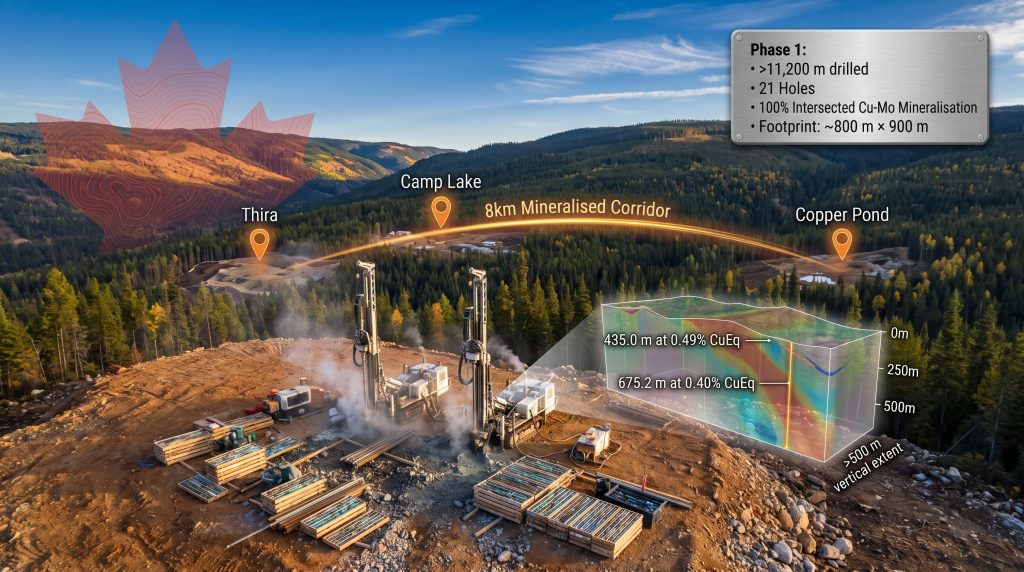
The spring 2026 Phase 1 programme was constructed to test both the lateral extent and vertical persistence of the porphyry system across three spatially distinct targets: Thira, Camp Lake, and Copper Pond. The programme totalled more than 11,200 metres across 21 holes using two drill rigs operating concurrently.
The analytical framework applied three copper equivalent cutoff thresholds:
- 0.10% CuEq for broad composite intervals capturing the full mineralised envelope
- 0.20% CuEq for the economically relevant core
- 0.30% CuEq for higher-grade subsets that inform potential mining selectivity
This tiered reporting approach is standard practice in porphyry exploration and serves an important function: it allows geologists and investors to distinguish between the bulk mineralised system and the higher-grade domains within it. Understanding cut-off grade economics is essential here, as both have relevance to future resource modelling and mine planning. Higher-grade domains within a larger lower-grade envelope are often the targets for early-stage extraction in a phased open-pit scenario, significantly improving project economics in the first years of mine life.
Geological mapping, geophysical surveys, and soil geochemical sampling ran concurrently with drilling to build the targeting dataset for Phase 2.
Thira Drill Results: A Detailed Breakdown of the Phase One Intercepts
The headline numbers from the Vizsla Copper Thira drill results programme are best understood through a structured comparison of the key intercepts across multiple cutoff thresholds.
| Drill Hole | Composite Interval (m) | CuEq (%) | Cu (%) | Mo (%) | Ag (g/t) | Au (g/t) | Cutoff |
|---|---|---|---|---|---|---|---|
| TH26-151 | 435.0 | 0.49 | 0.31 | 0.022 | 1.24 | 0.04 | ≥0.20% CuEq |
| TH26-151 (broad) | 675.2 | 0.40 | 0.26 | 0.015 | 1.06 | 0.04 | ≥0.10% CuEq |
| TH26-154 | 304.8 | 0.48 | 0.26 | 0.017 | 0.87 | 0.04 | ≥0.20% CuEq |
| TH26-154 (broad) | 475.8 | 0.40 | 0.26 | 0.017 | 0.87 | 0.04 | ≥0.10% CuEq |
| TH26-154 (high-grade) | 45.0 | 0.58 | — | — | — | — | ≥0.20% CuEq |
| TH26-148 | 205.5 | 0.50 | 0.36 | 0.010 | 1.32 | 0.08 | ≥0.30% CuEq |
| TH26-148 (broad) | 483.0 | 0.40 | 0.26 | 0.016 | 0.93 | 0.04 | ≥0.10% CuEq |
| TH26-163 (Copper Pond) | 177.3 | 0.31 | 0.17 | 0.012 | 2.32 | 0.07 | ≥0.10% CuEq |
Several observations stand out from this dataset:
- The 675.2-metre broad composite in TH26-151 at 0.40% CuEq is an exceptionally wide intercept for an exploration-stage porphyry. Intervals exceeding 600 metres of continuous mineralisation at this cutoff are uncommon in the junior exploration space and suggest a genuinely large mineralised mass.
- TH26-154's shallow start at just 13.2 metres depth is a significant operational advantage. Mineralisation beginning this close to surface points toward a low strip ratio in any future open-pit scenario, which has direct implications for pre-production capital intensity and early-stage economics.
- The 45-metre high-grade zone at 0.58% CuEq within TH26-154 indicates the presence of structurally enhanced higher-grade domains, likely controlled by fault geometry. These zones frequently correlate with areas of higher fluid flux during the porphyry mineralising event and can act as anchors for higher-value material in a future mine plan.
- TH26-148's 205.5-metre interval at 0.50% CuEq using a ≥0.30% cutoff confirms that the higher-grade envelope is not isolated to a single drill hole. Spatial repeatability of grade across multiple holes is one of the strongest indicators of genuine mineralised continuity.
Molybdenum Grades: A By-Product That Changes the Economics
One aspect of the Vizsla Copper Thira drill results that deserves separate attention is the consistency of molybdenum grades across the programme. Molybdenum values ranging from 0.010% to 0.022% Mo across multiple holes are not incidental trace quantities. At prevailing molybdenum prices, these grades can contribute meaningful revenue per tonne of ore processed, effectively reducing the copper price needed to achieve economic viability.
In practical terms, a porphyry copper-molybdenum deposit where molybdenum grades consistently sit above 0.010% Mo across hundreds of metres of composite width represents a qualitatively different economic proposition compared to a pure copper porphyry at the same copper grade. This distinction is frequently underappreciated by generalist investors who focus exclusively on the copper equivalent headline number without interpreting drill results in their full context.
System Dimensions and What Remains Open
Phase 1 has defined an initial mineralised footprint, but the boundaries of the Thira system have not yet been closed. This distinction matters enormously for how investors should interpret the current results.
| Dimension | Phase 1 Defined Status |
|---|---|
| East-West Extent | ~800 metres |
| North-South Extent | ~900 metres |
| Vertical Depth Confirmed | Greater than 500 metres |
| Open to North | Yes |
| Open to South | Yes |
| Open at Depth | Yes |
| 100% Hole Success Rate | Confirmed |
The combination of an unclosed system with a 100% drill success rate across all holes is statistically meaningful in porphyry exploration. It means that every metre drilled within the current programme has intersected the target mineralisation, providing no evidence of spatial boundaries from any direction tested. Phase 2 drilling is specifically designed to probe the northern and southern extensions, as well as deeper targets, to begin constraining the true scale of the system.
Camp Lake and Copper Pond: The Multi-Centre Corridor Thesis
One of the most strategically important aspects of the Poplar Project is the presence of not one but three mineralised targets within the same property, all positioned along what company management describes as an 8-kilometre mineralised corridor.
Camp Lake Target
Seven drill holes at Camp Lake defined a mineralised zone measuring approximately 800 metres by 400 metres. This target represents a separately defined porphyry centre within the broader corridor, and its southern extension remains untested heading into Phase 2.
Copper Pond Target
The Copper Pond target produced a result with a different character to Thira. The mineralisation here is described as vertically oriented, which geologically implies a different structural setting, potentially a feeder conduit or a separate porphyry intrusion with a steeper geometry. Hole TH26-163 returned 177.3 metres at 0.31% CuEq, and notably carried the highest silver grades of the entire Phase 1 programme at 2.32 g/t Ag. The elevated silver values could indicate proximity to a different part of the zoning pattern typical of porphyry systems, where silver enrichment often occurs in the transitional zones between the chalcopyrite-dominated core and the peripheral silver-lead-zinc mineralisation.
In copper porphyry systems, metal zonation is a well-documented phenomenon. Copper-molybdenum grades are typically strongest in the central potassic alteration zone, while silver, lead, and zinc tend to increase outward toward the peripheral propylitic zone. Elevated silver at Copper Pond may signal a different spatial position within the broader hydrothermal system compared to Thira.
The presence of three distinct mineralised targets within a single project area creates the potential for a combined resource scale substantially larger than any individual target. Multi-centre porphyry districts, such as those in Chile's Atacama region or British Columbia's own Golden Triangle corridor, are responsible for some of the world's largest copper endowments precisely because of this additive geometry. The mineral exploration importance of identifying such corridor-scale systems early cannot be overstated.
The next major ASX story will hit our subscribers first
Phase Two Programme: Parameters, Priorities, and Funding Status
With Phase 1 results now fully reported, Vizsla Copper is advancing toward a Phase 2 programme scheduled to commence in late July 2026. The programme is described as fully funded, removing the near-term capital risk that often creates uncertainty for junior explorers at this stage.
| Phase 2 Parameter | Detail |
|---|---|
| Total Planned Metres | Up to 8,000 metres |
| Approximate Number of Holes | ~16 holes |
| Number of Drill Rigs | Two |
| Commencement | Late July 2026 |
| Funding Status | Fully funded |
The targeting priorities for Phase 2 reflect the open nature of all three targets:
- Thira northern and southern extensions — where fault zone controls on higher-grade mineralisation will be specifically tested
- Camp Lake southern zone — the untested extension of the defined 800 metre by 400 metre footprint
- Copper Pond eastern zone — probing the lateral extent of the vertically oriented mineralised body
Concurrently, geological mapping, geophysical surveys, and soil sampling programmes are informing collar positioning for the upcoming holes, reducing geological risk ahead of drilling.
Benchmarking Thira Against the Porphyry Copper Landscape
For investors attempting to contextualise the results within the broader universe of copper porphyry exploration, a grade-width comparison provides useful framing. World-class largest copper mines currently in production, including assets in Chile, Peru, and British Columbia itself, are typically developed at copper resource grades between 0.30% and 0.55% Cu. The Thira intercepts, ranging from 0.40% to 0.49% CuEq at the broad composite level and reaching 0.58% CuEq in the high-grade subinterval, sit directly within this economically relevant window.
Critically, the near-surface commencement at 13.2 metres depth differentiates Thira from many porphyry discoveries where significant overburden must be stripped before reaching economic grades. Lower strip ratios translate directly into reduced pre-production capital requirements and faster payback periods in any future project economics study.
British Columbia itself is an established porphyry copper jurisdiction, hosting producing mines and advanced development projects across the region. The Poplar Project benefits from operating within a jurisdiction with established mining infrastructure, regulatory frameworks, and geological precedent for large-scale porphyry systems — factors that reduce sovereign and logistical risk relative to frontier exploration destinations. For instance, Vizsla Copper's aggressive drill programme across the Thira alteration corridor underscores the company's conviction in the system's scale.
Key Metrics Summary
| Metric | Value |
|---|---|
| Best single composite intercept | 435.0 m at 0.49% CuEq (TH26-151) |
| Longest broad composite | 675.2 m at 0.40% CuEq (TH26-151) |
| Highest-grade subinterval | 45.0 m at 0.58% CuEq (TH26-154) |
| Shallowest mineralisation start | 13.2 m depth (TH26-154) |
| Total Phase 1 metres drilled | More than 11,200 m |
| Total Phase 1 holes | 21 holes |
| Holes intersecting mineralisation | 100% |
| Defined footprint | ~800 m × 900 m |
| Confirmed vertical extent | Greater than 500 m |
| Phase 2 planned metres | Up to 8,000 m |
| Phase 2 commencement | Late July 2026 |
Investor Disclaimer: This article contains forward-looking statements and exploration-stage data. Drill intercepts do not constitute a mineral resource estimate under any recognised reporting standard. Copper equivalent calculations are based on prevailing metal prices and assumed recoveries and may not reflect actual future economics. Investors should conduct independent due diligence and consult a licensed financial adviser before making investment decisions.
What the Phase One Results Tell Us About the Poplar Project's Trajectory
The Vizsla Copper Thira drill results from Phase 1 have accomplished what every exploration programme aims to achieve: they have answered key geological questions while simultaneously generating a larger set of follow-up questions about system scale. Every hole returning mineralisation means Phase 1 has not found the edges of the deposit. Every open extension means Phase 2 has defined targets with genuine upside potential.
Furthermore, every kilometre of the 8-kilometre corridor that remains undrilled represents incremental optionality for the project's long-term resource potential. The convergence of near-surface mineralisation, economically relevant grades, multi-metal by-product credits, and a multi-centre structural setting within an established Canadian mining jurisdiction creates a technical foundation that will now be tested by the drills scheduled to turn in late July 2026.
The results from Phase 2 will determine whether Thira remains a compelling single-target discovery or begins to demonstrate the corridor-scale endowment that the geological interpretation currently suggests is possible. Consequently, investors tracking this programme will find that recent drill results at Thira provide the clearest window yet into the system's emerging scale.
For more detail on the Phase 1 results and Vizsla Copper's exploration activities across British Columbia, the original reporting is available at Mining Technology: Vizsla Copper reports phase one drill results at Thira Discovery.
Want to Be First When the Next Major Copper Discovery Hits the ASX?
Discovery Alert's proprietary Discovery IQ model scans ASX announcements in real time, instantly identifying significant mineral discoveries — including copper-molybdenum porphyry systems — and delivering actionable alerts before the broader market reacts. Explore Discovery Alert's dedicated discoveries page to understand why major finds have historically generated substantial returns, and begin your 14-day free trial today to position yourself ahead of the market.