
August 8, 2026
Underground Lithium and the Science of Deposit Growth: Why Pegmatite Geometry Changes Everything
Most conversations about lithium exploration focus on grade and tonnage. What gets far less attention is the structural geometry of the deposit itself, and how that geometry determines whether a project can realistically grow its resource over time. In underground hard-rock lithium mining, the shape, orientation, and internal consistency of a pegmatite body are just as consequential as the numbers on a drill assay. The Core Lithium BP33 lithium discovery at the Finniss operation in the Northern Territory illustrates this principle in sharp relief.
When big ASX news breaks, our subscribers know first
BP33 Within the Finniss Lithium Operation: Geology, Location, and Role
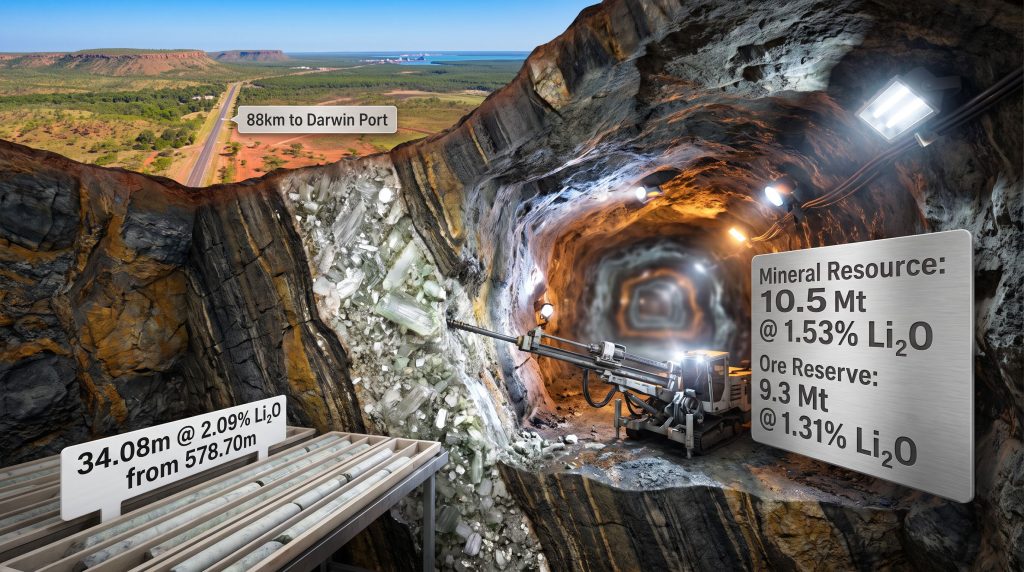
The Finniss Lithium Operation sits on the Cox Peninsula, connected to Darwin Port by approximately 88km of sealed road. That logistical detail carries more economic weight than it might first appear. For context, many of Australia's most prominent hard-rock lithium operations in the Pilbara and Goldfields regions require multi-hundred-kilometre road hauls to reach bulk export facilities. At Finniss, the sealed-road connection to a functioning deep-water port compresses that cost significantly, improving the economics of concentrate export to Asian processing markets.
Within the Finniss tenement package, BP33 functions as the long-life production anchor. It is not a satellite target or a speculative exploration play. It is the deposit around which the entire Finniss mine plan has been constructed, carrying a JORC-compliant mineral resource of 10.5 million tonnes at 1.53% Li₂O and an ore reserve of 9.3 million tonnes at 1.31% Li₂O that directly underpins the project's financing and development schedule.
How BP33 Compares to Typical Australian Spodumene Deposits
| Attribute | BP33 (Finniss) | Typical Australian Spodumene Deposit |
|---|---|---|
| Deposit geometry | Large sub-vertical pegmatite | Variable, often tabular or steeply dipping |
| Strike length | ~350 metres | 100–500+ metres (highly variable) |
| True width | Up to ~40 metres | 5–30 metres (typical range) |
| Mining method | Underground longitudinal open stoping | Open pit (majority of Australian operations) |
| Mineral resource | 10.5 Mt at 1.53% Li₂O | Varies widely |
| Ore reserve | 9.3 Mt at 1.31% Li₂O | Varies widely |
| Depth profile | Extends to ~1,200m below surface | Most resources confined to less than 400m |
The deposit's sub-vertical architecture and minimal internal zoning are not incidental characteristics. They are the geological features that make longitudinal open stoping the preferred extraction method, and they are what allow geologists to anticipate grade consistency from one drill intersection to the next. Furthermore, understanding spodumene extraction processes helps contextualise why these geometric qualities translate directly into processing efficiency.
Drill Hole NMRD100: What the Numbers Actually Reveal
The Core Lithium BP33 lithium discovery received renewed focus following the results of drill hole NMRD100, the first completed hole in the latest resource extension programme. The headline intersection of 34.08 metres at 2.09% Li₂O from 578.70 metres depth, with an estimated true width of 28.50 metres, was returned from a position beyond the current mineral resource boundary.
That distinction matters enormously. An intersection within an existing resource confirms what is already known. An intersection outside the resource boundary signals that the deposit's defined limits may not represent its actual geological extent.
Key Assay Intervals from NMRD100
The headline figure contains several high-grade sub-intervals that deserve individual attention:
- 5.28m at 2.80% Li₂O (highest sub-interval grade returned)
- 9.83m at 2.23% Li₂O (thickest high-grade sub-interval)
- 7.11m at 2.19% Li₂O
- 5.40m at 2.37% Li₂O
- Secondary intersection: 3.43m at 2.44% Li₂O from 616.54m depth
Each of these sub-intervals exceeds the current mineral resource average grade of 1.53% Li₂O. In practical terms, the peripheral zone of the deposit is carrying grade quality that is at least equivalent to, and in several intervals materially above, the average grade of the resource as a whole. This is geologically significant. Many hard-rock lithium deposits exhibit grade attenuation at their margins, where the spodumene-bearing mineralisation grades outward into barren or low-grade material. BP33's margins appear to behave differently.
The Relationship Between NMRD100 and NMRD085
NMRD100 was not drilled in isolation. It was positioned adjacent to NMRD085, which had previously returned one of the broadest single intersections reported at Finniss: 90.17 metres at 1.80% Li₂O from 568.83 metres depth. That earlier result was itself returned from outside the current mineral resource boundary.
When interpreting drill results of this nature, it is important to note that the two holes together define a coherent, continuous zone of high-grade spodumene pegmatite extending beyond the deposit's currently defined limits. This pattern, where multiple drill holes confirm grade and geometry in a consistent spatial relationship, is the precursor to formal resource extension.
Four additional holes are planned to test down-dip and along-strike extensions from both NMRD085 and NMRD100. The results of those holes will determine whether the zone can be incorporated into a future resource estimate or whether it requires further infill drilling before a JORC-compliant upgrade is possible.
The Engineering Logic of Underground Mining at BP33
Why Deposit Geometry Drives Method Selection
The choice to develop BP33 as an underground operation rather than an open pit is a direct function of the deposit's structural characteristics. Its sub-vertical orientation and consistent width make it poorly suited to open-pit extraction beyond shallow depths, where strip ratios would become economically prohibitive. Underground, however, those same characteristics become advantages.
Longitudinal open stoping is a mining method particularly well-matched to steeply dipping, tabular-to-massive ore bodies with predictable grade distribution. The method involves drilling and blasting ore in elongated stopes oriented along the deposit's strike, with the resulting void supported by the surrounding rock mass. For it to work efficiently, the ore body needs to be:
- Geometrically consistent and traceable along strike
- Wide enough to support productive stope dimensions
- Internally uniform enough to avoid excessive dilution from barren zones
BP33 satisfies all three criteria. The deposit's minimal internal zoning, which is a relatively unusual characteristic among lithium pegmatites, reduces the risk of incorporating low-grade or barren material into the ore stream during stoping. This translates directly into processing efficiency and concentrate quality. In addition, underground lithium mining at comparable Australian operations demonstrates how consistent pegmatite geometry can underpin stable long-term production rates.
What Depth Means for Long-Term Resource Growth
One of the less widely appreciated aspects of underground mining is that the development infrastructure itself creates future exploration capability. Surface drill rigs are limited in their ability to test deep targets economically. Underground drill platforms, established during active mining, allow drill holes to be oriented far more efficiently toward down-plunge targets, reducing the hole lengths required and improving drill-hole angle relative to the mineralisation.
BP33's down-plunge exploration target of 3.9 to 6.5 million tonnes at 1.5 to 1.6% Li₂O, which extends to approximately 1,200 metres below surface, will likely require exactly this approach. The target is conceptual under the JORC Code and cannot be incorporated into any economic or mine-planning assessment until confirmed by systematic drilling. But its existence signals that the geological system feeding BP33 may extend well beyond what the current resource inventory captures.
Critical investor distinction: An exploration target is not a resource. Under the JORC Code (2012), exploration targets represent a range of potential tonnage and grade based on limited geological evidence. They require systematic drilling and formal resource estimation before they can be used in financial models or feasibility assessments. The BP33 down-plunge target should be understood as a prospective exploration concept, not a confirmed inventory addition.
Development Timeline: From Portal to Production
The BP33 underground mine is not a future concept. Development is actively underway. The portal was cut in June 2026, marking the formal commencement of underground decline development, with ore production targeted for mid-2027 and nameplate production rates projected for mid-2028.
BP33 Development Milestones
| Development Milestone | Status / Target Timing |
|---|---|
| Underground mining contract awarded | A$274 million (Dev Mining Services, a subsidiary of Develop Global) |
| Portal cut | June 2026 (achieved) |
| First ore from BP33 | Mid-2027 (projected) |
| Nameplate production rate | Mid-2028 (projected) |
| BP33 share of ore feed (first 10 years) | ~88% of total Finniss ore feed |
The scale of the mining contract, A$274 million covering a three-year initial term with a two-year extension option, reflects the capital intensity of underground hard-rock development. Dev Mining Services was selected as the mining contractor for BP33, bringing underground decline development expertise to a project where precise execution of the ramp-up schedule directly affects the project's financial performance.
BP33's projected contribution of approximately 88% of Finniss's total ore feed across the first decade of production underlines its singular importance to the operation's economic model. Satellite deposits and exploration targets including Blackbeard are being advanced in parallel, but BP33 is the irreplaceable foundation. Consequently, Australia's first underground lithium mine developments offer a useful benchmark for understanding the broader significance of this milestone.
Blackbeard: Exploration Optionality and Ore Feed Diversification
While BP33 anchors Finniss's production base, the Blackbeard exploration campaign represents the project's medium-term optionality. Up to 12,150 metres of drilling is planned at Blackbeard, with a second diamond rig mobilised to accelerate the programme timeline. Results from the campaign are anticipated over coming months.
The strategic logic of Blackbeard is straightforward: reducing Finniss's long-term dependence on a single deposit improves the project's resilience and potentially extends its operational life beyond the current resource inventory. A successful conversion of Blackbeard mineralisation to a defined JORC resource would add supplementary ore feed to the Finniss processing facility, smoothing production throughput and reducing single-asset concentration risk.
The dual-rig approach at Blackbeard is a deliberate signal that the exploration timeline is being accelerated to align potential resource additions with BP33's production ramp-up. If Blackbeard returns compelling results, the window between initial discovery and resource definition could be compressed, providing the mine plan with additional ore feed options before BP33 reaches its full production rate.
The next major ASX story will hit our subscribers first
Understanding JORC Classifications: A Practical Guide for Non-Technical Investors
One of the most common sources of investor misinterpretation in the Australian junior mining sector is the conflation of exploration targets with mineral resources. The distinction carries significant financial and legal consequences.
| Classification | BP33 Status | Practical Meaning |
|---|---|---|
| Mineral Resource (JORC 2012) | 10.5 Mt at 1.53% Li₂O | Defined, independently estimated, supports mine planning |
| Ore Reserve (JORC 2012) | 9.3 Mt at 1.31% Li₂O | Economically extractable portion, underpins project financing |
| Exploration Target (down-plunge) | 3.9–6.5 Mt at 1.5–1.6% Li₂O | Conceptual range only, not a resource, requires further drilling |
| New intersections (NMRD100) | Outside current resource | Potential future resource addition, pending confirmation drilling |
The new intersections from NMRD100 sit in a fourth category that is neither a resource nor a formal exploration target. They are raw assay data from holes drilled beyond the current resource boundary. Before these intersections can contribute to a formal resource estimate, they require additional infill drilling to demonstrate continuity, geological modelling to establish their three-dimensional geometry, and an independent resource estimation process conducted by a JORC-qualified Competent Person.
However, when assessing these intersections, understanding true widths vs apparent widths is essential for evaluating the reported 28.50 metre true width figure from NMRD100 in its proper context.
Darwin Port and the Spodumene Supply Chain: BP33's Commercial Context
Australia supplies the majority of global spodumene concentrate, and the economics of that supply are heavily influenced by infrastructure. The 88km sealed-road connection between Finniss and Darwin Port provides a logistical cost structure that is genuinely differentiated from many competing Australian projects.
Spodumene concentrate from the Core Lithium BP33 lithium discovery would feed into lithium hydroxide conversion facilities, which are the preferred feedstock source for high-nickel cathode chemistries used in long-range electric vehicles. The consistency of BP33's grade profile, a consequence of the deposit's low internal zoning and uniform pegmatite character, reduces variability in concentrate quality.
For downstream battery supply chain customers, predictable concentrate specifications reduce processing complexity and improve planning certainty, factors that can influence offtake pricing and contract terms. Darwin Port's proximity to North Asian battery supply chain markets, including facilities in South Korea, Japan, and China, further strengthens Finniss's commercial positioning for offtake negotiations, though the precise terms of any future agreements remain commercially sensitive and subject to market conditions at the time of contracting.
Disclaimer: This article is intended for informational purposes only and does not constitute financial advice. Readers should conduct their own independent research and seek qualified professional advice before making any investment decisions. Exploration targets, projected timelines, and production estimates discussed in this article are forward-looking statements subject to material risks and uncertainties. Past drilling results are not necessarily indicative of future outcomes.
Summary: Core Lithium BP33 Key Metrics at a Glance
| Metric | Detail |
|---|---|
| Deposit type | Sub-vertical spodumene pegmatite |
| Mineral resource | 10.5 Mt at 1.53% Li₂O |
| Ore reserve | 9.3 Mt at 1.31% Li₂O |
| Latest drill result (NMRD100) | 34.08m at 2.09% Li₂O from 578.70m depth |
| Estimated true width (NMRD100) | 28.50m |
| Best sub-interval | 5.28m at 2.80% Li₂O |
| Previous adjacent hole (NMRD085) | 90.17m at 1.80% Li₂O from 568.83m |
| Down-plunge exploration target | 3.9–6.5 Mt at 1.5–1.6% Li₂O (conceptual only) |
| Underground mining contract | A$274 million (Dev Mining Services) |
| Portal cut | June 2026 (achieved) |
| First ore target | Mid-2027 |
| Nameplate production target | Mid-2028 |
| BP33 share of 10-year ore feed | ~88% |
| Blackbeard drilling programme | Up to 12,150m planned |
| Distance to Darwin Port | 88km by sealed road |
Frequently Asked Questions: Core Lithium BP33 Lithium Discovery
What grade did the latest BP33 drill hole return?
Drill hole NMRD100 returned a headline intersection of 34.08 metres at 2.09% Li₂O from 578.70 metres depth, with an estimated true width of 28.50 metres. The highest-grade sub-interval within that intersection reached 2.80% Li₂O across 5.28 metres.
What is the current mineral resource at BP33?
BP33 hosts a JORC-compliant mineral resource of 10.5 million tonnes at 1.53% Li₂O, supported by an ore reserve of 9.3 million tonnes at 1.31% Li₂O that underpins the underground mine plan.
When is first ore production expected from BP33?
Following the cutting of the underground portal in June 2026, first ore from BP33 is targeted for mid-2027, with nameplate production rates projected for mid-2028.
Is the BP33 exploration target a confirmed mineral resource?
No. The down-plunge exploration target of 3.9 to 6.5 million tonnes at 1.5 to 1.6% Li₂O is conceptual and does not constitute a mineral resource under the JORC Code. It will require systematic underground drilling and independent estimation before any potential resource upgrade is possible.
Who holds the BP33 underground mining contract?
Dev Mining Services, a subsidiary of Develop Global, holds the A$274 million underground mining contract at BP33, covering an initial three-year term with a two-year extension option.
For ongoing coverage of Australian critical minerals exploration and development, visit australianmining.com.au.
Want to Stay Ahead of the Next Major ASX Lithium Discovery?
Discovery Alert's proprietary Discovery IQ model delivers real-time alerts on significant ASX mineral discoveries — instantly translating complex geological data into actionable investment insights for both short-term traders and long-term investors. Explore how historic mineral discoveries have generated substantial returns on Discovery Alert's dedicated discoveries page, and begin your 14-day free trial today to position yourself ahead of the broader market.