August 8, 2026
The Geology Behind Africa's Quiet Gas Revolution
Across the African continent, a structural shift in upstream energy development has been unfolding over the past decade. While much of the global attention on African hydrocarbons has focused on East African LNG megaprojects and West African deepwater oil, a quieter but equally consequential transformation has been taking shape in Angola's offshore basins. The story is not simply about a new gas field. It is about what happens when geology, regulatory reform, and revised commercial logic converge at precisely the right moment.
The Sonangol Katambi gas discovery in Angola represents exactly that kind of convergence. A formation that a major international oil company once walked away from has returned to prominence, not because the geology changed, but because the commercial and regulatory context surrounding it changed dramatically.
When big ASX news breaks, our subscribers know first
Why Angola's Benguela Basin Is Back in the Spotlight
The Geological Case for Non-Associated Gas in Offshore Angola
Angola's offshore acreage has historically been synonymous with oil. The pre-salt and post-salt formations of the Congo Basin and Kwanza Basin have attracted billions in capital from operators including TotalEnergies, Chevron, ExxonMobil, and BP. The Benguela Basin, situated further south along the Angolan shelf, has received comparatively less attention, partly because its hydrocarbon character differs from the oil-dominated northern blocks.
What the Benguela Basin offers is a distinct geological signature: non-associated gas accumulations hosted within carbonate and clastic reservoir systems. Unlike the gas-cap or solution-gas systems that accompany oil production elsewhere on the shelf, these reservoirs produce gas independently. That distinction carries profound commercial implications, which Angola's regulatory framework only recently began to accommodate.
How Pre-Salt Formations Differ From Conventional Offshore Reservoirs
Pre-salt reservoirs in Angola's offshore basins are sealed beneath thick layers of evaporite salt deposited during the Cretaceous period, when the South Atlantic was still opening. These salt sequences act as near-perfect seals, preserving hydrocarbon columns over geological timescales. However, they also create significant drilling and imaging challenges. Seismic waves refract unpredictably through salt, making it difficult to accurately characterise reservoir geometry and fluid contacts beneath.
The implication for Katambi is technically important. The improved reservoir quality confirmed by the Katambi-2 appraisal well, relative to what BP encountered in its original drilling campaign, likely reflects advances in seismic imaging and drilling precision that have allowed operators to target the highest-quality reservoir intervals more accurately.
Block 24's Position Within Angola's Broader Offshore Acreage Map
Block 24 sits approximately 500 kilometres south of Angola's existing offshore infrastructure network. This geographic isolation has historically been the single largest obstacle to development. The block's position places it outside the range of any cost-effective tie-back to existing subsea infrastructure, which is why BP's original commercial assessment concluded the discovery was not viable. That calculation is changing as new infrastructure developments close the distance gap.
What Did the Katambi-2 Appraisal Well Actually Find?
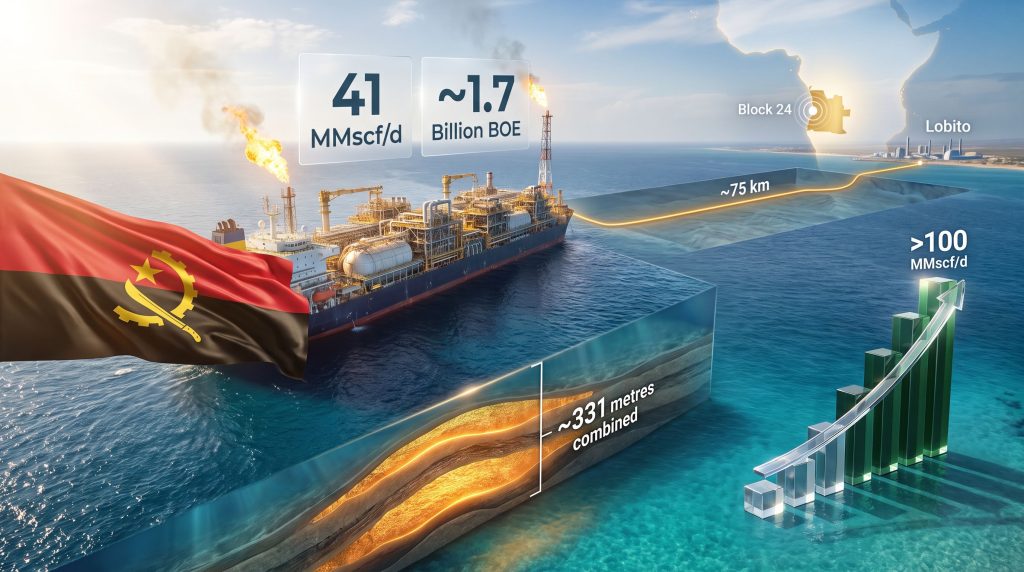
Reservoir Architecture: Two Productive Intervals Totalling ~331 Metres
The Katambi-2 appraisal well intersected two distinct productive intervals with a combined net pay thickness of approximately 331 metres. This is a substantial gross reservoir thickness by offshore African standards and indicates a vertically stacked system with considerable volumetric potential. The identification of two separate productive zones is also strategically important because it suggests the field may have multiple independently drainable compartments, which can support phased development planning.
Flow Rate Results: 41 MMscf/d of Gas and 1,160 Barrels Per Day of Condensate
During well testing, Katambi-2 achieved a stabilised flow rate of 41 million cubic feet of gas per day (MMscf/d) alongside 1,160 barrels of condensate per day. Condensates are light liquid hydrocarbons that exist in gaseous phase within the reservoir but condense to liquid form at surface conditions. Their presence alongside dry gas materially improves project economics because condensate commands crude oil-equivalent pricing in export markets.
Key Data Snapshot: The Katambi-2 well intersected two productive intervals with a combined thickness of approximately 331 metres, recorded a stabilised flow rate of 41 MMscf/d, and yielded 1,160 barrels of condensate per day. Preliminary modelling suggests output potential exceeding 100 MMscf/d under optimised production conditions.
Why the Absence of Water and Hydrogen Sulfide Is Commercially Significant
Two specific reservoir characteristics confirmed during testing carry outsized commercial weight. First, the reservoir contains no water influx, which eliminates the need for water handling facilities and removes a key source of production decline uncertainty. Second, and perhaps more importantly, the gas contains no hydrogen sulfide (H₂S). Sour gas containing H₂S requires specialised metallurgy throughout the production system, dramatically increases capital costs, creates health and safety management complexity, and complicates LNG processing. A sweet, dry gas reservoir with condensate yield represents an operationally clean development target.
What "Appraisal Well" Means and Why This Is Not Yet a Development Decision
It is critical to distinguish between an appraisal result and a development commitment. An appraisal well's purpose is to characterise a discovery already made, not to confirm commercial development intent. Katambi-2 has confirmed that the original discovery holds better-quality rock than previously understood. However, substantial additional work — including a definitive feasibility study, further appraisal drilling, independent reserves certification, engineering studies, and regulatory approval processes — is required before any Final Investment Decision can be contemplated.
How Does Katambi-2 Compare to the Original BP Discovery?
A Timeline of Block 24: From BP's Withdrawal to Sonangol's Re-Entry
| Milestone | Year | Key Detail |
|---|---|---|
| BP drills Katambi-1 | ~2013-2015 | Declared commercially unviable; stake returned to state |
| Angola gas sector reforms | 2018 | Presidential decree opens non-associated gas to private capital |
| Katambi-2 appraisal well drilled | 2026 | Confirms superior reservoir quality vs. Katambi-1 |
| Preliminary flow rate confirmed | August 2026 | 41 MMscf/d stabilised; over 100 MMscf/d indicated |
Why BP's Commercial Assessment No Longer Applies Under Current Conditions
BP's decision to return its stake following the Katambi-1 well was a product of the conditions that prevailed at that time: a regulatory environment that granted Sonangol exclusive rights over non-associated gas, meaning private operators had no legal pathway to monetise a standalone gas discovery in Angola. In that context, even a technically interesting reservoir was commercially inert for an international operator. The 2018 reforms fundamentally changed this equation. Furthermore, with private capital now permitted to develop non-associated gas under a dedicated fiscal framework, the same geology that was worthless to BP carries genuine development optionality today.
Reservoir Quality Differences Between Katambi-1 and Katambi-2
The improved results from Katambi-2 versus the original Katambi-1 well reflect the value of targeted appraisal drilling informed by better subsurface data. Katambi-2 confirmed higher-quality reservoir rock than encountered in the original well, according to both Sonangol and Angola's national petroleum regulator, ANPG. This outcome is consistent with a pattern seen across offshore African basins where initial exploration wells drilled under older seismic vintages systematically underestimated reservoir quality, only to be revised upward once improved imaging resolved the internal architecture of the target formation.
How Large Is the Katambi Field? Understanding the Reserve Estimates
The 1.7 Billion Barrel Oil Equivalent Figure and What It Includes
Sonangol estimates the Katambi field's total resource base at approximately 1.7 billion barrels of oil equivalent (BOE). This aggregate figure reflects a combination of gas and condensate volumes expressed in a common energy unit. The BOE metric is used to allow comparison across different hydrocarbon types but can obscure important distinctions about the nature of the resource and its development economics.
Breaking Down the ~8 Tcf Gas in Place and ~280 Million Barrels of Condensate
Reserve Context: Estimates place the Katambi field's total resource base at approximately 8 trillion cubic feet (Tcf) of gas in place and 280 million barrels of condensate, combining to roughly 1.7 billion BOE. These are in-place volumes, not recoverable reserves. The distinction matters enormously for development economics: recovery factors for offshore gas fields typically range from 60% to 80% under favourable conditions, but infrastructure costs, reservoir heterogeneity, and market access constraints can reduce effective recoverable volumes significantly.
Understanding this distinction is essential for any investor or analyst assessing the project's scale. The 8 Tcf figure represents total gas estimated to exist within the reservoir rock, not the volume that can be economically extracted.
Why Sonangol Considers This Angola's Largest Gas Field
Based on its own data, Sonangol characterises Katambi as Angola's largest gas field. Angola has historically been an oil-dominant producer, so the country lacks the deep inventory of large gas field precedents that characterise basins like the Rovuma in Mozambique or the Niger Delta in Nigeria. Katambi's scale, if confirmed through independent certification, would represent a step-change in Angola's gas resource inventory.
Comparing Katambi's Scale to Other Major African Gas Discoveries
| Country | Key Gas Asset | Estimated Reserves | Development Status |
|---|---|---|---|
| Angola | Katambi Field, Block 24 | ~8 Tcf gas in place; ~1.7 Bn BOE | Appraisal stage (2026) |
| Mozambique | Rovuma Basin (Area 1 and 4) | Over 100 Tcf | Partial FID; Area 1 LNG stalled |
| Tanzania | Block 2 and 4 offshore | ~57 Tcf | Pre-FID; regulatory negotiations ongoing |
In pure volumetric terms, Katambi is smaller than the Rovuma Basin giants. However, its sweet gas composition, condensate yield, and deepwater infrastructure optionality may give it a faster pathway to development than either of its East African counterparts. In addition, energy transition demand for cleaner-burning gas feedstocks continues to grow, further strengthening the energy transition demand case for projects of this nature.
What Angola's 2018 Gas Sector Reforms Made Possible
The Presidential Decree That Unlocked Non-Associated Gas Development
Prior to the 2018 reforms, Angola's legal architecture treated non-associated natural gas as a state-exclusive resource under Sonangol's control. This effectively prohibited international operators from developing standalone gas fields, even when discoveries were technically promising. A presidential decree in 2018 opened exploration and production of non-associated gas to private investment for the first time, fundamentally altering the commercial calculus for operators across Angola's offshore acreage.
Fiscal Architecture: The 10-Year Tax Exemption for New Gas Projects
The reform package did not stop at licensing access. The Angolan government introduced targeted fiscal incentives to attract capital into a sector that had been dormant for private operators. Notably, new gas projects receive a 10-year tax exemption, according to reporting from the African Energy Chamber. This fiscal concession is significant in the context of offshore development timescales, where projects typically require five to ten years from discovery to first gas, meaning the tax holiday period could effectively overlap with early production years.
How the Regulatory Shift Repositioned Angola for Private Capital Inflows
Policy Context: Before 2018, Angola's legal framework granted Sonangol exclusive rights over non-associated natural gas resources, effectively removing commercial incentive for international operators to pursue standalone gas development. The reform package created a competitive licensing environment with dedicated fiscal concessions designed specifically to attract private capital into non-associated gas.
The timing of this reform also intersected with growing global demand for LNG, particularly from European buyers seeking to diversify away from Russian pipeline gas. Angola's position on the West African coast gives it natural proximity to Atlantic Basin LNG markets, including both European and Latin American import terminals. However, government intervention in resource sectors can cut both ways, and investors will monitor whether Angola's fiscal terms remain stable as the project matures.
The next major ASX story will hit our subscribers first
What Are the Infrastructure Challenges Facing Katambi's Development?
The 500-Kilometre Distance Problem: Block 24's Isolation From Existing Infrastructure
Block 24's approximately 500-kilometre separation from Angola's existing offshore infrastructure network is the dominant development challenge. At this distance, conventional subsea tie-back solutions are economically impractical. The cost per kilometre of deepwater pipeline installation, combined with the engineering complexity of operating over such distances, renders standard development approaches unworkable without intermediate infrastructure anchors.
How TotalEnergies' Kaminho Project Reduces the Gap to ~250 Kilometres
The advancement of TotalEnergies' Kaminho deepwater project, once operational, will reduce the effective infrastructure gap from approximately 500 kilometres to roughly 250 kilometres. While 250 kilometres remains a substantial distance for a direct tie-back, it brings the Katambi field within a range where creative infrastructure solutions, including intermediate hub facilities, become technically and economically feasible. Kaminho's development therefore functions as an indirect enabler for Katambi, even without any formal connection between the two projects.
Development Pathway Option 1: Floating LNG Terminal at the Discovery Site
The first development concept under evaluation involves deploying a Floating LNG (FLNG) terminal directly at the Katambi field location. FLNG vessels perform gas liquefaction offshore, eliminating the need for onshore pipeline infrastructure and processing facilities. This approach has been demonstrated successfully in projects including Shell's Prelude FLNG off Australia and the Coral Sul FLNG in Mozambique, the latter representing a particularly relevant African precedent.
Development Pathway Option 2: The ~75-Kilometre Pipeline to Lobito Industrial Complex
The second option involves constructing an approximately 75-kilometre pipeline connecting the Katambi field to Angola's Lobito industrial complex. This route would leverage existing onshore infrastructure at Lobito, potentially enabling gas to serve both domestic industrial demand and an LNG export terminal.
| Development Option | Key Feature | Primary Advantage | Primary Challenge |
|---|---|---|---|
| Floating LNG (FLNG) Terminal | Offshore gas liquefaction and export vessel | No onshore pipeline required; direct LNG export | High capital cost; complex offshore logistics |
| Pipeline to Lobito Complex | ~75 km subsea and onshore pipeline to industrial hub | Leverages existing onshore infrastructure | Requires pipeline investment and regulatory approvals |
Which Development Model Is More Likely Given Angola's Current Infrastructure Position?
The FLNG option offers greater speed to market and avoids the onshore permitting and land-use complexities associated with pipeline corridors. However, FLNG vessels represent some of the most capital-intensive assets in the energy sector. The pipeline-to-Lobito option aligns more closely with Angola's stated ambition to industrialise its energy sector and develop domestic gas consumption markets, but requires a longer permitting runway and greater upfront infrastructure commitment. A hybrid approach, using a pipeline for domestic gas supply and a separate LNG component for exports, cannot be ruled out at this stage.
Angola's First Full Test of a Non-Associated Gas Reservoir
What Non-Associated Gas Means and How It Differs From Associated Gas Production
The technical distinction between associated and non-associated gas has profound commercial consequences. Associated gas is produced as a by-product of oil extraction. Its production rate is tied to oil output, and historically it has been flared, re-injected, or sold at a significant discount when oil prices were the primary revenue driver. Non-associated gas exists in reservoirs where gas is the primary hydrocarbon, allowing production to be independently optimised for gas markets. This independence gives operators the ability to manage gas output, quality, and destination without the constraints imposed by oil production scheduling.
The Technical and Commercial Significance of Angola's First Non-Associated Gas Reservoir Test
The Katambi-2 well test represents Angola's first full test of a non-associated gas reservoir, according to Oil and Gas Journal. This milestone carries significance beyond the specific well results. It demonstrates that Angola now possesses the operational capability and regulatory framework to develop standalone gas assets, which opens an entirely new category of upstream investment opportunity in a country that has historically been almost exclusively oriented toward oil production.
How This Milestone Reshapes Angola's Gas Sector Credibility With International Investors
For international investors and operators evaluating Angola's gas sector, the Katambi-2 result serves as a proof-of-concept for the 2018 regulatory reforms. The ability to point to a successfully tested non-associated gas reservoir, with confirmed flow rates and reservoir quality data, removes a layer of technical uncertainty that previously made Angola a difficult gas investment proposition. Whether or not Katambi itself reaches Final Investment Decision, it has materially improved Angola's credibility as a non-associated gas frontier.
How Does Katambi Fit Into Angola's Long-Term Energy Strategy?
Angola's Declining Oil Output and the Strategic Case for Gas Diversification
Angola's oil production has been on a structural decline for several years, falling from a peak of approximately 2 million barrels per day in 2008 to levels that have consistently struggled to remain above 1.1 million barrels per day in recent years. This decline reflects a combination of maturing reservoir dynamics across legacy fields and insufficient new project sanctioning to offset natural production fall-off. Gas diversification represents one of the most credible pathways available to Angola for expanding its hydrocarbon revenue base without relying entirely on new oil discoveries.
The Role of Domestic Gas in Angola's Power Generation and Industrialisation Agenda
Beyond export markets, domestic gas demand in Angola is substantial and growing. Power generation remains a persistent bottleneck for Angola's industrialisation agenda, and gas-fired power capacity offers a scalable, lower-emission alternative to the liquid fuel-based generation that currently dominates off-grid and semi-grid supply. The Lobito corridor, which Angola is developing as a major industrial and infrastructure spine linking the Atlantic coast to landlocked Central African markets, would be a natural anchor demand centre for gas produced at Katambi.
LNG Export Potential: Where Katambi Gas Could Flow in Global Markets
Angola already operates the Angola LNG facility at Soyo, which processes associated gas from deepwater oil operations. Katambi gas, if developed under an FLNG model or connected to a new LNG terminal, would give Angola a second, independently operated LNG export stream. European buyers seeking post-Russia supply diversification, as well as Asian markets with growing LNG import dependency, represent the most likely long-term destination markets.
What Needs to Happen Before Katambi Becomes a Producing Field?
Step-by-Step: From Appraisal Confirmation to Final Investment Decision
-
Reservoir delineation — Additional appraisal wells to confirm lateral extent and connectivity of the two productive intervals identified in Katambi-2.
-
Resource certification — Independent reserves audit to convert in-place estimates into certified recoverable volumes under standard international reporting frameworks such as SPE-PRMS.
-
Development concept selection — Formal evaluation of FLNG versus pipeline-to-Lobito options, supported by engineering feasibility and concept selection studies.
-
Regulatory approvals — ANPG and government review and sign-off on the proposed development plan and associated fiscal terms.
-
Infrastructure financing — Securing project finance through international oil company partnerships, development finance institutions, or structured commodity-linked financing arrangements.
-
Final Investment Decision (FID) — Commercial commitment from project partners to proceed with capital expenditure.
-
Construction and commissioning — A multi-year construction programme with duration dependent on the development concept selected.
Key Risks That Could Delay or Derail Katambi's Development
Several risk factors could extend the timeline or alter the commercial outcome:
-
Commodity price volatility in LNG markets could shift the project's economics between now and FID.
-
Financing availability for large-scale deepwater gas projects has tightened as some international lenders have introduced restrictions on fossil fuel project lending.
-
Geopolitical risk within Angola, including potential shifts in fiscal terms or licensing conditions, could affect investor confidence.
-
Infrastructure cost overruns in FLNG or pipeline construction remain a material risk based on precedent projects across Africa.
-
Reservoir complexity if further appraisal drilling reveals more compartmentalised reservoir architecture than current data suggests.
Frequently Asked Questions: Sonangol Katambi Gas Discovery in Angola
What is the Katambi gas field in Angola?
The Katambi field is a non-associated offshore gas discovery located on Block 24 in Angola's Benguela Basin. Sonangol estimates it holds approximately 8 Tcf of gas in place and 280 million barrels of condensate, making it potentially Angola's largest gas field.
Where is Block 24 located in Angola?
Block 24 is situated offshore in Angola's southern shelf region, approximately 500 kilometres south of the country's existing offshore infrastructure network.
What flow rates did the Katambi-2 well record?
The Katambi-2 appraisal well achieved a stabilised flow rate of 41 MMscf/d of gas and 1,160 barrels of condensate per day, with preliminary modelling indicating potential output exceeding 100 MMscf/d under optimised conditions.
How large is the Katambi gas field?
Sonangol estimates total resources of approximately 1.7 billion BOE, comprising roughly 8 Tcf of gas in place and 280 million barrels of condensate. These are in-place volumes, not certified recoverable reserves.
Why did BP originally abandon the Katambi discovery?
BP's decision to return its stake followed its Katambi-1 drilling campaign, which encountered lower-quality reservoir conditions than the Katambi-2 appraisal subsequently confirmed. Additionally, Angola's pre-2018 regulatory framework gave Sonangol exclusive rights over non-associated gas, leaving international operators with no legal pathway to commercialise a standalone gas discovery.
What development options is Angola considering for the Katambi field?
Two primary options are under evaluation: a floating LNG terminal deployed at the offshore field location, and an approximately 75-kilometre pipeline connecting the field to the Lobito industrial complex.
What is non-associated gas and why does it matter for Angola?
Non-associated gas is natural gas produced from reservoirs where gas is the primary hydrocarbon, independent of oil production. Katambi-2 marked Angola's first full test of a non-associated gas reservoir, a milestone that signals a new phase of gas sector development for a country historically focused almost entirely on oil.
When could the Katambi field begin producing commercially?
No timeline has been confirmed. The project remains at appraisal stage as of August 2026, and multiple steps including further drilling, reserves certification, development concept selection, and regulatory approvals must be completed before any FID can be taken. A realistic first-gas timeline, should FID be reached, would likely extend several years beyond that decision point.
Key Takeaways: What the Katambi-2 Discovery Signals for Angola and African Gas Markets
Summary Statistics at a Glance
| Metric | Figure |
|---|---|
| Stabilised gas flow rate (Katambi-2) | 41 MMscf/d |
| Condensate flow rate | 1,160 barrels per day |
| Preliminary production potential | Over 100 MMscf/d |
| Combined productive interval thickness | ~331 metres |
| Estimated field resource (BOE) | ~1.7 billion barrels |
| Estimated gas in place | ~8 Tcf |
| Estimated condensate in place | ~280 million barrels |
| Distance from existing offshore infrastructure | ~500 km (reducing to ~250 km post-Kaminho) |
| Angola gas sector reform date | 2018 |
| Tax exemption for new gas projects | 10 years |
What Investors, Policymakers, and Energy Analysts Should Watch Next
The Sonangol Katambi gas discovery in Angola is a technically credible result that reframes the development potential of Angola's southern offshore blocks. Several near-term indicators will determine whether this appraisal confirmation translates into a commercial development:
-
Whether Sonangol and ANPG fast-track additional appraisal drilling to delineate the full field extent before the end of 2026.
-
Whether TotalEnergies' Kaminho project timeline remains on track, given its role in reducing the infrastructure gap to Block 24.
-
Whether Angola can attract an international oil company partner with FLNG operational experience to co-develop the project, given the capital and technical intensity of the preferred development options.
-
Whether the 10-year tax exemption framework introduced in 2018 is extended or modified in ways that improve or erode project economics.
The broader lesson embedded in the Katambi story is one that applies across Africa's upstream gas sector: regulatory architecture shapes commercial viability at least as decisively as geology. The rock at Katambi did not change between BP's departure and Sonangol's rediscovery of its quality. What changed was the framework surrounding it. Consequently, the Sonangol Katambi gas discovery in Angola stands as a compelling case study in how policy reform can unlock stranded geological value across an entire basin.
Disclaimer: This article contains forward-looking statements, production estimates, and reserve figures that are subject to change as further technical data becomes available. In-place resource estimates are not equivalent to certified recoverable reserves. Readers should not interpret this article as financial or investment advice. All investment decisions should be made in consultation with qualified professional advisers.
Further Exploration: Readers seeking additional context on Angola's upstream energy sector and African gas market dynamics can explore coverage from Upstream Online, which provides ongoing reporting on international oil and gas developments, and CNBC Africa for broader African energy market coverage.
Want to Track the Next Major Energy Discovery Before the Market Moves?
Discovery Alert's proprietary Discovery IQ model scans ASX announcements in real time, instantly identifying significant mineral and energy discoveries — the kind of opportunities that can reshape entire sectors, much like the regulatory and geological convergence unfolding at Angola's Katambi field. Explore how historic discoveries have generated extraordinary returns and begin your 14-day free trial at Discovery Alert to position yourself ahead of the broader market.