August 6, 2026
When Geology and Timing Converge: What Structurally Hosted Gold Systems Really Mean for Investors
West Africa's gold belts have generated some of the world's most prolific high-grade discoveries over the past three decades. Yet one corner of this geological domain has remained systematically underexplored: the Precambrian schist belts of southwest Nigeria. These ancient rock sequences share fundamental characteristics with the greenstone terranes of Ghana and Côte d'Ivoire, where mines like Obuasi and Bonikro have demonstrated the enormous grade potential locked within structurally controlled vein systems. The difference in Nigeria was not geology, but history. A hydrocarbon-dominated economy left the country's solid minerals sector largely dormant until commercial gold mining finally arrived.
That context makes the Thor Explorations Segilola Mine high-grade gold discoveries particularly significant. The results emerging from beneath the existing open pit, and from a near-mine target located roughly 15 kilometres to the west, are redefining what Segilola can become beyond its current configuration.
When big ASX news breaks, our subscribers know first
Understanding the Geological Architecture That Makes Segilola Work
The Ilesha Schist Belt: An Underappreciated Gold Address
Segilola sits within the Ilesha Schist Belt in Osun State, approximately 190 kilometres northeast of Lagos. This Precambrian terrane is geologically analogous to the greenstone belts of Ghana and Mali that have hosted some of West Africa's most celebrated gold mines. Schist belt settings across the region share a defining characteristic: tectonic deformation has concentrated gold mineralisation along steeply dipping structural corridors, creating structurally hosted gold deposits rather than the large, disseminated bulk-tonnage systems found in porphyry copper-gold provinces elsewhere.
The key distinction matters enormously for understanding how these deposits behave with depth. Disseminated deposits tend to grade down gradually as you move away from the primary fluid source. Structurally hosted shoots, by contrast, can maintain or even improve grade at depth along the vein corridor, provided the structural architecture remains intact. This is precisely why Segilola's steeply dipping quartz-pegmatite vein system creates a geological framework that geologists and engineers find compelling as a target for underground development.
Stacked Vein Systems and the Concept of Open-Depth Potential
What sets Segilola apart from many West African deposits is its stacked vein architecture. Rather than a single dominant shear zone, the deposit hosts multiple parallel and sub-parallel vein sets that collectively create a wide mineralised envelope. This geometry produces what industry geologists describe as broad high-grade zones, where individual vein cores carry exceptional grades while the surrounding mineralised envelope provides bulk tonnage for mill feed blending.
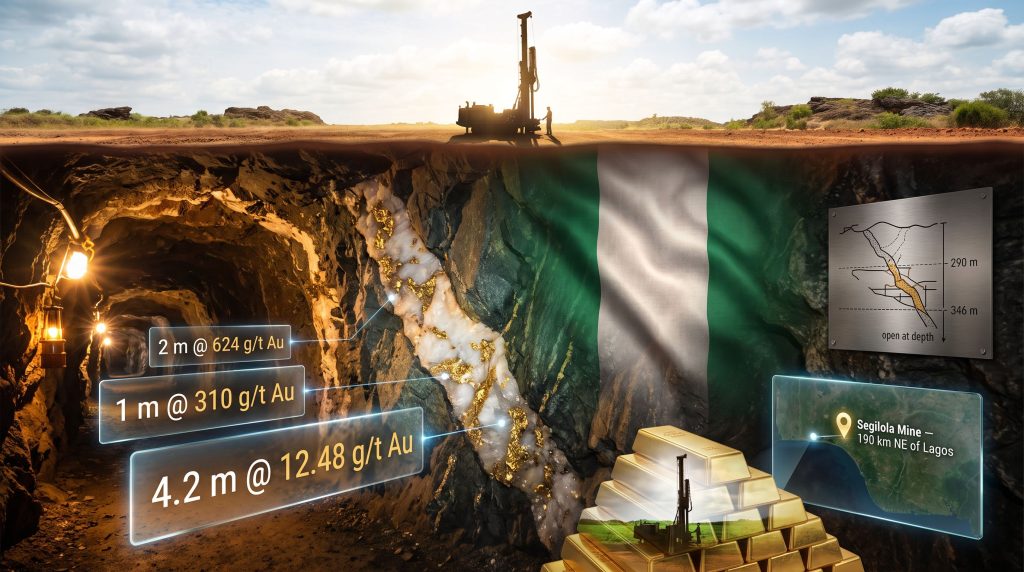
The phrase open at depth carries real weight in resource estimation. It means systematic drilling has not yet encountered a geological boundary where mineralisation terminates. In practical terms, every metre drilled deeper without hitting barren rock expands the potential resource envelope. Furthermore, for a deposit already demonstrating intercepts at 346 metres below surface, the implication is that meaningful mineralisation likely continues further down the structural corridor.
Decoding the Latest Drill Results: Grades, Depths, and What They Signal
A Technical Breakdown of the Underground Intercepts
The drilling results from beneath the Segilola open pit represent a materially different category of discovery compared to incremental resource additions. The table below summarises the key intercepts and their significance within the broader underground context.
| Drill Hole / Zone | Intercept Width | Grade (g/t Au) | Approximate Depth | Significance |
|---|---|---|---|---|
| SNMDD089 (below pit) | 19.4 m | 3.01 g/t Au | ~346 m | Broad mineralised envelope confirming deep continuity |
| Below pit (narrow zone) | 5.3 m | 5.66 g/t Au | 290–420 m range | High-grade shoot within broader envelope |
| Below pit (vein core) | 2.0 m | 9.27 g/t Au | 290–420 m range | Narrow vein core exceeding underground cut-off grade |
| Below pit (vein core) | 1.2 m | 11.31 g/t Au | 290–420 m range | Approaching bonanza-style vein intersection |
| Deeper extension | 3.4 m | 7.58 g/t Au | Below 420 m | Confirms shoot continuity at greater depth |
| Deeper extension | 4.2 m | 12.48 g/t Au | Below 420 m | Strong indicator of sustained underground resource |
| Deeper extension | 2.0 m | 17.86 g/t Au | Below 420 m | Exceptional grade at depth, potential shoot core |
| SGD238 (15 km west) | 2.0 m | 227 g/t Au | Near-surface | Extraordinary bonanza-grade satellite discovery |
| SGD238 (15 km west) | 1.0 m | 310 g/t Au | Near-surface | Among the highest reported grades in West Africa |
| SGD238 (15 km west) | 3.5 m | 14.9 g/t Au | Near-surface | Broad high-grade confirmation of satellite zone |
| SGD238 (15 km west) | 2.0 m | 624 g/t Au | Near-surface | Exceptional bonanza intersection, potential nugget effect |
What Constitutes High-Grade in a West African Gold Context?
These numbers require calibration against industry benchmarks to fully appreciate their significance:
- Open pit gold operations typically require sustained resource grades above 1.0 g/t Au to justify capital investment at current cost structures.
- Underground gold mines generally require 4.0 to 5.0 g/t Au or higher as a minimum average resource grade to be economically viable, accounting for the substantially higher operating costs of underground extraction.
- The Segilola underground intercepts routinely exceed 7.0 g/t Au in the vein cores, with the deepest extension returning 17.86 g/t Au, sitting comfortably above the underground viability threshold even before factoring in the current elevated gold price environment.
Grade Context: At gold prices above USD 3,000 per ounce, the minimum underground cut-off grade required for profitability effectively decreases, meaning mineralisation that was previously sub-economic becomes viable. This price-grade relationship is fundamental to understanding why the 2018 underground resource estimate, conducted in a lower gold price environment, materially understates the current economic potential of what lies beneath Segilola's pit.
A Word on True Width vs. Reported Drill Width
One technically important but frequently overlooked consideration when interpreting drill results is the difference between true width and reported drill width. When a drill hole intersects a steeply dipping vein at an oblique angle, the reported intercept length can exceed the true thickness of the mineralised zone. Understanding true width vs apparent width is particularly important for steeply dipping vein systems like those at Segilola, where reported intercept widths of 19.4 metres or 5.3 metres may represent a broader corridor that includes both vein material and adjoining mineralised wallrock. Investors and analysts should note this distinction when comparing Segilola's intercepts to other deposits, as true width calculations will be a critical input to the updated resource estimate expected by end-2026.
Comparing New Results Against the 2018 Underground Resource Estimate
| Resource Category | Ounces | Grade (g/t Au) | Current Status |
|---|---|---|---|
| Indicated (2018) | 28,000 oz | 9.4 g/t Au | Partially absorbed into expanded open pit design |
| Inferred (2018) | 90,000 oz | 7.9 g/t Au | Partially absorbed into expanded open pit design |
| New deep drilling target | Open at depth | Multiple intercepts exceeding 7 g/t Au | Updated estimate targeted for end-2026 |
The 2018 estimate was generated under meaningfully different gold price conditions and before the current multi-rig drilling programme identified the steeply dipping shoot extending 400 metres beneath the pit floor. The updated resource estimate expected by the end of 2026 will need to account for the considerably larger footprint now emerging from ongoing drilling.
The Open Pit-to-Underground Transition: A Decision Process with Many Inputs
How Mining Companies Evaluate the Underground Pathway
Transitioning an operating open pit mine to underground production is one of the most capital-intensive decisions a mining company can make. The decision framework typically follows a structured sequence:
- Confirm sub-pit mineralisation through systematic deep drilling, establishing that grade and continuity justify further investigation.
- Establish structural predictability by building a geological model that allows engineers to forecast where mineralisation will be found at depth with reasonable confidence.
- Commission independent geotechnical studies to assess rock mass quality, ground stability, and whether the subsurface conditions support underground excavation.
- Complete metallurgical test work at depth to confirm gold recovery rates remain consistent with surface ore, as mineralogy can sometimes change with depth in hydrothermally altered systems.
- Engage a specialist mining consultancy to model extraction methodologies, stoping geometry, dilution factors, ventilation requirements, and capital cost estimates.
- Publish an updated mineral resource estimate incorporating all new drilling data under JORC or equivalent reporting standards.
- Conduct a preliminary economic assessment (PEA) or pre-feasibility study (PFS) to test whether the underground scenario generates acceptable returns at current and forecast gold prices.
Thor Explorations is currently executing steps three through six simultaneously, with four company-owned drill rigs active on site. Running geotechnical, metallurgical, and drilling programmes in parallel rather than sequentially compresses the timeline significantly. This approach suggests a deliberate effort to reach a development decision within a commercially relevant timeframe, and mining feasibility studies of this nature are a critical component of that process.
Underground Stoping Methods Applicable to Segilola's Vein Geometry
For steeply dipping vein deposits with the geometry described at Segilola, three underground extraction methods are most commonly evaluated:
- Longhole open stoping: Drills rings of holes from drill drives above and below the ore zone, then blasts large panels in one pass. Highly productive and cost-effective for consistent, predictable vein widths.
- Cut-and-fill stoping: Extracts ore in horizontal slices, backfilling each cut with waste or cemented fill before advancing to the next. Preferred where vein geometry is complex or where ground conditions require tighter control of the excavation.
- Shrinkage stoping: A lower-capital method where broken ore acts as its own working platform as mining advances upward. Less common in modern operations due to challenges with dilution control and ore handling.
The choice of method will depend heavily on the geotechnical results, the true width of individual vein packages, and the degree of structural complexity that the ongoing drilling programme continues to resolve.
Why the Open Pit Extension Remains Strategically Relevant
The underground pathway is not the only option on the table. Rising gold prices fundamentally change the economics of open pit mining by improving the break-even stripping ratio, which is the maximum volume of waste rock that can be economically removed per tonne of ore extracted. When gold prices increase, the revenue generated per tonne of ore rises while mining costs per tonne remain relatively stable, meaning deeper and wider pit shells become economically viable.
This is the mathematical basis for the open pit pushback concept currently under evaluation at Segilola. Sequential development, where operators maximise pit extraction before committing underground capital, is a well-established approach in West African gold mining. It consequently represents a rational hedge against the uncertainty inherent in underground development decisions. The gold price outlook for 2025 and beyond further strengthens the case for evaluating all available development pathways simultaneously.
The Western Target: When Satellite Discoveries Change the Strategic Calculus
Bonanza-Grade Intersections at SGD238: What They Really Mean
The near-mine western target, drilled under hole SGD238 approximately 15 kilometres from the main Segilola pit, represents a categorically different discovery type from the underground extension. Grades of 227 g/t Au, 310 g/t Au, and 624 g/t Au at near-surface depths are extraordinary by any measure. For context, bonanza-grade gold is an industry term generally applied to intersections exceeding 30 g/t Au. The western target's grades are multiples beyond that threshold.
It is important for technically informed readers to note that bonanza-grade intersections in narrow vein systems can be influenced by the nugget effect, a statistical phenomenon where individual gold particles of exceptional size create highly variable grade distributions within a small spatial footprint. This means a single one-metre intercept at 310 g/t Au does not automatically extrapolate to a commercially significant tonnage. However, the presence of a 3.5-metre intersection at 14.9 g/t Au at the same hole suggests a broader mineralised corridor exists, rather than a single anomalous particle.
Strategic Insight: A high-grade satellite deposit located within trucking distance of an operating processing plant represents one of the most capital-efficient exploration outcomes possible. The fixed costs of milling infrastructure are already sunk. Incremental satellite ore feed directly into the bottom line without requiring a standalone processing facility, providing financial leverage that greenfield projects simply cannot replicate.
The Hub-and-Spoke Model in West African Gold Operations
The hub-and-spoke mine development approach, where a central processing plant receives ore feeds from multiple satellite pits or underground sources, is well established across West Africa. Operations in Ghana and Mali have demonstrated how this model extends mine life, improves mill utilisation rates, and distributes capital costs across a larger resource base.
For Segilola, the combination of a deepening underground resource directly beneath the current pit and a potentially high-grade satellite discovery 15 kilometres to the west creates the conditions for exactly this kind of operational evolution. Even modest tonnages from a satellite zone grading at multiples above 100 g/t Au would contribute disproportionately to annual gold production relative to the volume of ore processed. This grade-tonnage leverage is particularly meaningful for a processing plant operating at fixed capacity.
Nigeria's Gold Sector and the Broader Significance of Segilola
A Proof-of-Concept That Could Reshape Investment in Nigerian Mining
Nigeria's economy has been structurally anchored to oil and gas revenues for decades, with solid mineral development representing a historically underinvested opportunity. Segilola holds the distinction of being Nigeria's first commercial-scale gold mine, a status that carries both symbolic and practical weight. Every milestone the operation achieves — whether a successful underground development decision or the delineation of satellite resources — builds the evidentiary base that other investors and explorers require before committing capital to the Nigerian gold sector.
The Ilesha Schist Belt extends well beyond the current Segilola licence area. Successful underground development and the maturation of the western satellite target would represent compelling evidence that the belt hosts a larger gold system than the existing resource inventory suggests, potentially attracting exploration interest from a broader range of operators.
Comparing Nigeria's Regulatory Environment to Peer West African Jurisdictions
| Jurisdiction | Primary Regulatory Framework | Relative Stability | Key Infrastructure Challenges |
|---|---|---|---|
| Nigeria | Nigerian Minerals and Mining Act, Ministry of Solid Minerals Development | Moderate | Power reliability, road logistics in Osun State |
| Ghana | Minerals Commission, Minerals and Mining Act 2006 | High | More established mining services ecosystem |
| Côte d'Ivoire | Code Minier 2014 | Moderate-High | Transport infrastructure improving |
| Senegal | Code Minier 2016 | Moderate-High | Emerging mining sector, improving services |
| Mali | Code Minier 2019 | Elevated risk | Security and political instability concerns |
Nigeria's regulatory framework for mining has been evolving, with the Ministry of Solid Minerals Development increasingly active in promoting commercial mining as part of economic diversification. From an investment risk perspective, Nigeria sits in a middle tier relative to West African peers, with greater political stability than Mali but less established mining infrastructure than Ghana. For underground capital decisions specifically, reliable power supply and access to technical services are material considerations that operators must factor into project economics.
The next major ASX story will hit our subscribers first
Key Milestones to Track Through End-2026
The Critical Path to an Underground Development Decision
| Milestone | Expected Timeline | Why It Matters |
|---|---|---|
| Continued four-rig drilling programme | H2 2026 | Defines spatial extent of deep shoot and western target |
| Geotechnical study completion | H2 2026 | Determines whether underground rock conditions are suitable |
| Metallurgical test work results | H2 2026 | Confirms gold recovery characteristics at depth |
| Mining consultancy underground assessment | H2 2026 | Models extraction scenarios, stoping methods, and capital requirements |
| Updated mineral resource estimate | End-2026 | The critical quantification milestone for any underground decision |
| Open pit extension feasibility review | Concurrent | Evaluates sequential pit deepening as a complementary pathway |
What a Positive Development Decision Would Change at Segilola
A commitment to underground development would fundamentally alter the long-term profile of the Thor Explorations Segilola Mine high-grade gold discoveries programme. The transition would, in addition to extending mine life, bring several material changes to the operation's trajectory:
- Significantly extended mine life beyond what the current open pit inventory supports.
- A larger total resource base incorporating the deep shoot currently being drilled.
- Enhanced fixed-cost absorption across the processing plant as total annual throughput is sustained from multiple ore sources.
- Stronger production visibility for the medium to long term, improving the operational predictability that investors and lenders require.
- A template for the broader Ilesha Schist Belt, potentially triggering increased exploration activity from other operators across southwest Nigeria.
The Thor Explorations Segilola Mine high-grade gold discoveries, taken together, represent one of the more compelling development narratives currently emerging from West Africa's gold sector. The confluence of high-grade underground continuity, extraordinary bonanza-grade satellite results, and a favourable gold price environment creates a rare alignment of geological, technical, and financial conditions. However, as with all exploration-stage decisions, the outcome ultimately depends on what the ground delivers as drilling continues through 2026.
This article is intended for informational purposes only and does not constitute financial or investment advice. Mineral resource estimates, development timelines, and economic projections referenced in this article involve forward-looking assumptions that are subject to material risks and uncertainties. Readers should conduct independent due diligence before making any investment decisions.
For ongoing coverage of Thor Explorations, Segilola Mine, and the West Africa gold sector, visit africanminingmarket.com.
Want to Be First When the Next High-Grade Discovery Hits the ASX?
Discovery Alert's proprietary Discovery IQ model scans ASX announcements in real time, instantly identifying significant mineral discoveries — including high-grade gold systems — and translating complex data into actionable insights for investors at every level. Explore how major discoveries have historically delivered extraordinary returns on Discovery Alert's dedicated discoveries page, then begin a 14-day free trial to position yourself ahead of the broader market.