August 5, 2026
When Gold Exploration Meets Infrastructure: The Rare Convergence Driving Attention at Cariboo
In the world of gold exploration, proximity is everything. Finding high-grade mineralisation in a remote wilderness is one thing. Finding it within seven kilometres of a fully permitted, construction-stage underground mine with a near-billion-dollar after-tax valuation is something far more consequential. That intersection of geological discovery and development-ready infrastructure is precisely what makes the Osisko Gold Proserpine discovery at Cariboo worth examining in depth.
The Proserpine target is not simply another exploration intercept. It represents a structurally distinct, potentially open-pit-amenable system located within practical haulage distance of an existing processing complex, emerging at a moment when the broader Cariboo project is transitioning from feasibility to active construction. Understanding what that combination means — geologically, operationally, and from an investor standpoint — requires unpacking both the deposit's technical architecture and the district context it sits within.
When big ASX news breaks, our subscribers know first
The Wells-Barkerville Camp: A District With Depth That Most Investors Overlook
The Wells-Barkerville mining district in central British Columbia carries a historical weight that shapes how geologists interpret new discoveries within its boundaries. Located roughly 500 km north of Vancouver, this corridor was the epicentre of British Columbia's gold rush in the 1860s, and the geological conditions that attracted nineteenth-century placer miners have since proven to host something far more structurally significant: orogenic gold systems.
Orogenic gold deposits form during major mountain-building events when hydrothermal fluids migrate along crustal-scale fault systems and deposit gold in structurally controlled vein networks. The Wells-Barkerville camp exemplifies this process, with its characteristic axial planar vein systems representing the kind of geological architecture that tends to produce mineralisation that is both high-grade and spatially repeatable across district-scale footprints.
What Makes This Geological Style Particularly Valuable for Resource Expansion?
Unlike porphyry or epithermal systems that may be genetically isolated, orogenic gold camps routinely host multiple deposits sharing a common structural and fluid pathway. This means that when a new mineralised body is identified within the same district, it carries a higher prior probability of sharing the same grade characteristics and depth continuity as the known deposit. At Cariboo, the main deposit zones — including the Cow, Island, and Barkerville Mountain zones — all reflect this shared genetic architecture. Proserpine's early drill results suggest it may belong to the same family.
Furthermore, understanding the nuances of interpreting gold drill results is essential when evaluating targets like Proserpine within an orogenic setting.
- Axial planar vein systems at Wells-Barkerville generate both high-grade core intervals and broader, lower-grade envelopes — a geometry that supports both selective underground mining and bulk open-pit extraction depending on the mineralisation's lateral extent.
- The Cariboo Gold Trend extends across approximately 6 km of strike length, hosting multiple targets with similar lithological and structural controls.
- Proserpine's vein geometry is consistent with the mineralisation style observed at the main deposit zones, reinforcing the case for a shared geological origin.
Proserpine Target: Technical Architecture of an Emerging Discovery
The Osisko Gold Proserpine discovery at Cariboo has accumulated approximately 10,500 metres of historical drilling across 25 holes since initial work began in 2019. That foundation is now being aggressively expanded through a 26,500-metre campaign using three simultaneous drill rigs, representing one of the most intensive systematic evaluations ever applied to a regional target within the Cariboo land package.
Drilling History and the Significance of the 2019 Discovery Hole
The first meaningful signal at Proserpine came from hole PSP-19-002, which returned 17.78 g/t Au over 5.60 metres, confirming the presence of high-grade axial planar veins consistent with those documented at the core deposit zones. That initial result established Proserpine as a priority follow-up target and set the geological expectation for subsequent programmes.
By the end of 2025, cumulative drilling had traced an anomalous trend across approximately 1.5 km of strike, with early modelling suggesting a potential open-pit target geometry broader in both strike and width than the Cariboo deposit's current defined footprint. That finding, if validated by the current campaign, would position Proserpine not as a supplement to Cariboo but as a potentially co-equal contributor to district-level resource inventory.
August 2026 Drill Results: Reading the Data Beyond the Headlines
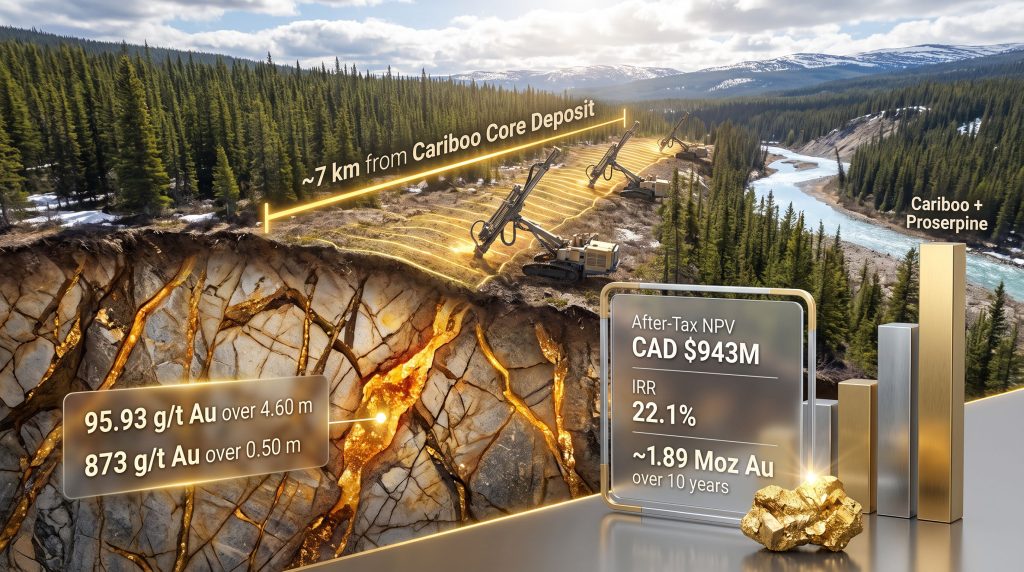
The August 2026 results from the current campaign provide the most comprehensive picture yet of Proserpine's system-wide characteristics. The standout intercept — 95.93 g/t Au over 4.60 metres in hole PSP-26-004, including a sub-interval of 873 g/t Au over 0.50 metres at approximately 112 metres downhole — has attracted significant attention. However, the analytical value of that result extends beyond its grade alone.
| Drill Hole | Interval (m) | Grade (g/t Au) | Depth (m) | Key Significance |
|---|---|---|---|---|
| PSP-26-004 | 4.60 | 95.93 | 110 | Highest-grade intercept to date |
| PSP-26-004 (sub-interval) | 0.50 | 873.00 | 112 | Bonanza-grade core confirmation |
| PSP-26-001 | 8.60 | 5.46 | 97 | Broad near-surface envelope |
| PSP-26-001 | 14.50 | 2.17 | 572 | Deep system continuity |
| PSP-26-009 | 5.50 | 3.17 | 408 | Mid-depth structural continuity |
| PSP-26-003 | 12.40 | 1.46 | 367 | Wide lower-grade envelope |
A critical but underappreciated aspect of these results is what they reveal collectively rather than individually. All 14 holes that reached their intended target depths encountered mineralisation, spanning a vertical range from near surface to approximately 400 metres downhole. In structural geology terms, a 100% hit rate across a 1.0 km strike by 0.5 km width footprint signals system-wide coherence rather than isolated high-grade pods.
When reviewing drill results for investors, this level of spatial consistency across an entire footprint is precisely the kind of signal that warrants closer analysis.
"The combination of bonanza-grade core intervals alongside broader, lower-grade envelopes at multiple depths is a hallmark of structurally controlled orogenic systems. The same architecture underpins the main Cariboo resource, and its replication at Proserpine strengthens the case for a genetically linked district-scale system."
Understanding Bonanza Gold Grades in Orogenic Systems
The 873 g/t Au sub-interval warrants specific technical commentary. Bonanza-grade intervals in orogenic systems typically reflect localised zones of fluid focusing, where structural jogs or dilational sites cause rapid pressure drops and concentrated gold precipitation. These intervals are not necessarily indicative of overall deposit grade, but their presence confirms that the hydrothermal system was actively transporting and depositing gold at economically significant concentrations.
In exploration terms, bonanza intercepts within broader lower-grade envelopes are often the first indication that a system has the structural complexity necessary to support both selective high-grade mining and bulk tonnage extraction. It is also worth noting that true widths vs apparent widths can significantly affect how these intercept grades are ultimately interpreted when building resource models.
The Dual-Mining Architecture: Why Proserpine Changes the Cariboo Equation
The Cariboo project's permitted underground operation has a clearly defined economic profile based on its 2025 feasibility study. Those numbers establish a compelling standalone case.
| Economic Parameter | Value |
|---|---|
| After-Tax NPV (5% discount rate) | CAD $943 million |
| Internal Rate of Return | 22.1% |
| Gold Price Assumption | US$2,400/oz (CAD $3,360/oz) |
| Projected Production | ~1.89 million oz. Au over 10 years |
| Measured and Indicated Resource | 17.4 Mt @ 2.88 g/t Au (1.61 Moz) |
| Inferred Resource | 18.8 Mt @ 3.09 g/t Au (1.86 Moz) |
What Proserpine introduces is a structurally different opportunity that does not simply add tonnes to the underground inventory. Near-surface, laterally extensive mineralisation with geometry potentially suited to open-pit extraction methods would diversify the project's mining optionality in ways that are economically material.
Open-pit operations typically carry lower unit operating costs than underground methods, particularly in the early years of production when waste stripping ratios are manageable. If Proserpine's lateral extent at shallow depth is confirmed by ongoing drilling, it could deliver a lower-cost, higher-throughput production profile in the early years of mine life, front-loading cash flows and improving the project's overall NPV sensitivity to gold price assumptions.
Deep Drilling at Cariboo: The Underground Dimension That Extends the Timeline
Independently of Proserpine, recent deep drilling at the Cariboo underground complex has extended confirmed gold mineralisation below 700 metres vertical depth. For a project operating on a 10-year feasibility timeline, depth extensions of this nature are strategically important. They signal that the underground resource base has material expansion potential beyond the current reserve — potential not yet captured in the project's economic models.
Construction activities at the permitted Cariboo underground complex are advancing concurrently with regional exploration, demonstrating that Osisko Gold is executing a genuine dual-track strategy. The Cariboo Gold Project website provides further detail on construction milestones and infrastructure progress for those seeking a closer look at the operational side of the programme.
Market Response and Investor Psychology at an Inflection Point
Osisko Gold's share price advanced approximately 9% to CAD $3.73 on the day of the August 2026 announcement, lifting the company's market capitalisation to approximately CAD $1.1 billion (US$814 million). Against a 52-week trading range of CAD $3.07 to $6.63, the move reads as a meaningful re-rating rather than a speculative reaction.
The psychology behind this price behaviour follows a well-documented pattern in junior-to-mid-tier gold exploration. Markets assign a premium to discovery news when it occurs within an already-permitted, construction-stage project because the incremental value of a new mineralised system is amplified by existing infrastructure. The marginal cost of evaluating and potentially developing Proserpine is substantially lower than it would be for a standalone greenfield target, and that capital efficiency is something sophisticated investors price in quickly.
What Investors Should Watch Over the Next 12 to 18 Months
The current moment at Proserpine represents a specific type of market inflection that exploration investors recognise as high-stakes but also high-information. The 26,500-metre drilling programme will generate a sustained flow of results capable of either confirming or recalibrating the resource growth thesis.
Key catalysts and risk factors include:
- Near-term catalysts: Continued drill results from the three-rig campaign, potential maiden resource estimate for Proserpine, and ongoing construction milestones at the Cariboo underground complex.
- Resource conversion uncertainty: The progression from discovery drilling to a formal resource estimate requires demonstration of grade continuity across a statistically sufficient number of drill holes, and the current dataset, while promising, remains at an early stage.
- Metallurgical performance: High-grade orogenic gold systems can carry complex mineralogy in some structural settings. Independent metallurgical test work on Proserpine material will be a critical data point before any open-pit development scenario can be economically modelled.
- Capital requirements: An open-pit development at Proserpine would require a separate definitive feasibility study, including strip ratio analysis, infrastructure connectivity to the existing processing facility, and environmental baseline work.
- Corporate identity signal: The name change from Osisko Development to Osisko Gold, completed in July 2026, reflects a deliberate repositioning toward a combined producing and discovering gold company identity — a rebranding consistent with the dual-track strategy now being executed across the Cariboo land package.
"Investors should note that early-stage exploration results, however compelling, do not constitute a resource estimate. The transition from discovery drilling to resource definition to economic study involves multiple rounds of additional work, each carrying its own risk of delivering results that differ materially from initial expectations."
Frequently Asked Questions: Osisko Gold Proserpine Discovery at Cariboo
Where Is Proserpine Located Relative to the Main Cariboo Deposit?
Proserpine sits approximately 7 km from the core Cariboo gold deposit within the Wells-Barkerville mining camp, roughly 500 km north of Vancouver in central British Columbia. That proximity places it within practical haulage range of Cariboo's existing and planned processing infrastructure.
What Is the Current Drilling Footprint at Proserpine?
As of August 2026, cumulative drilling encompasses approximately 10,500 metres across 25 historical holes, with a new 26,500-metre programme underway using three active rigs. Known mineralisation currently extends across approximately 1.0 km along strike by 0.5 km in width, with boundaries open for expansion in all directions.
What Is the Highest-Grade Intercept Recorded at Proserpine?
The peak intercept from the August 2026 campaign is 95.93 g/t Au over 4.60 metres in hole PSP-26-004, which includes a bonanza-grade sub-interval of 873 g/t Au over 0.50 metres at approximately 112 metres depth.
Does Proserpine Have Open-Pit Mining Potential?
Yes. The shallow depth of mineralisation, its lateral extent across a broad strike footprint, and the near-surface intercepts recorded across multiple holes have led Osisko Gold to identify Proserpine as potentially amenable to open-pit extraction. This remains an early-stage geological characterisation and has not yet been validated through a formal economic study.
How Does Proserpine's Scale Compare to the Main Cariboo Deposit?
Early modelling suggests Proserpine's potential open-pit footprint could exceed the Cariboo deposit's current strike and width dimensions. However, Proserpine remains at a significantly earlier stage of geological characterisation and has not yet been converted to a formal resource estimate. Direct scale comparisons at this stage carry inherent uncertainty.
The next major ASX story will hit our subscribers first
Key Takeaways for Investors and Industry Observers
The Osisko Gold Proserpine discovery at Cariboo is best understood not as a single drill result but as an emerging district-scale variable with the potential to materially alter the Cariboo project's long-term production profile. In addition, several factors distinguish this situation from typical early-stage exploration news. Consequently, those monitoring gold exploration trends more broadly will recognise that the combination of infrastructure adjacency and geological coherence is increasingly rare in today's discovery environment.
- Infrastructure adjacency: Proserpine sits within 7 km of a fully permitted underground mine, reducing the capital threshold for any future development scenario.
- System-wide mineralisation continuity: A 100% hit rate across all 14 completed target-depth holes demonstrates lateral and vertical coherence that supports resource conversion potential over time.
- Geological alignment with the main deposit: Proserpine's vein geometry mirrors the axial planar architecture observed at Cariboo's core zones, suggesting a shared genetic origin and comparable grade potential.
- Dual-mining optionality: The combination of underground operations at Cariboo and a potential open-pit at Proserpine could diversify the production profile and front-load cash flows relative to a purely underground model.
- Feasibility-stage financial foundation: The CAD $943 million after-tax NPV and 22.1% IRR established by the 2025 Cariboo feasibility study provide a credible financial platform against which Proserpine's incremental value can be assessed as exploration advances. For further context, reporting on multiple new high-grade discoveries adjacent to the main deposits reinforces the district-scale opportunity taking shape across the broader land package.
The next 12 to 18 months of drilling will be the primary determinant of whether Proserpine graduates from a regional exploration target to a resource-defining discovery. Market participants appear to be assigning meaningful probability to that outcome. Whether the geological evidence ultimately supports that assessment is a question the drill rigs are now in the process of answering.
This article contains forward-looking statements and speculative analysis based on early-stage exploration results. Drill intercepts do not guarantee the presence of a mineral resource. Investors should conduct independent due diligence and consult a qualified financial adviser before making investment decisions.
Want to Stay Ahead of the Next Major ASX Gold Discovery?
Discovery Alert's proprietary Discovery IQ model scans ASX announcements in real time, instantly identifying significant mineral discoveries and translating complex geological data into clear, actionable investment insights — so subscribers are positioned before the broader market reacts. Explore how historic discoveries have generated exceptional returns on the Discovery Alert discoveries page, and begin your 14-day free trial today to secure your market-leading edge.