August 4, 2026
When Space Infrastructure Collides With National Security Minerals
The global critical minerals race rarely unfolds in a straight line. While geopolitical narratives focus on supply chains, trade restrictions, and diplomatic manoeuvres, some of the most consequential bottlenecks emerge from unexpected domestic conflicts. The situation unfolding in eastern Nevada is a striking illustration of this reality: NASA opposition to Nevada tungsten mine operations has placed a potentially transformative discovery at the centre of an intra-government standoff. Understanding how this conflict developed requires stepping back from the headlines and examining what tungsten actually is, why the United States abandoned its domestic production, and what the stakes truly are when two branches of national infrastructure collide.
When big ASX news breaks, our subscribers know first
The Metal That Made Modern Defense Possible
Tungsten's Role Across Defense, Electronics, and Aerospace Applications
Tungsten occupies a unique position in the periodic table and in industrial history. With the highest melting point of any metal at 3,422 degrees Celsius, it is irreplaceable in applications where extreme heat, hardness, and density are required simultaneously. The strategic importance of tungsten in defence manufacturing is clear — it forms the core of armour-piercing kinetic energy penetrators, a function no substitute material can replicate at scale. Beyond munitions, it appears in rocket nozzles, turbine blades, radiation shielding, electrical contacts, and the filaments of high-intensity lighting systems.
In the electronics sector, tungsten is used as an interconnect material in semiconductor fabrication, where its thermal stability and conductivity make it essential at nanoscale geometries. As chip architectures become more demanding and defence electronics grow more sophisticated, consumption patterns for tungsten are expected to intensify rather than diminish.
Why the U.S. Abandoned Domestic Tungsten Production
The United States was once a meaningful tungsten producer, but a combination of cheaper Chinese imports and a lack of coordinated industrial policy led to a gradual exit from domestic mining across the 1980s and 1990s. The decision reflected short-term cost logic rather than long-term strategic planning. As 3 Proton Lithium's chief executive Kevin Moore noted to the Financial Times, tungsten is a metal the United States stopped mining roughly a decade ago and now imports entirely, while China exercises significant control over global market dynamics.
That withdrawal left a structural vulnerability that went largely unaddressed for decades.
China's 80% Market Share and the Cost of Dependency
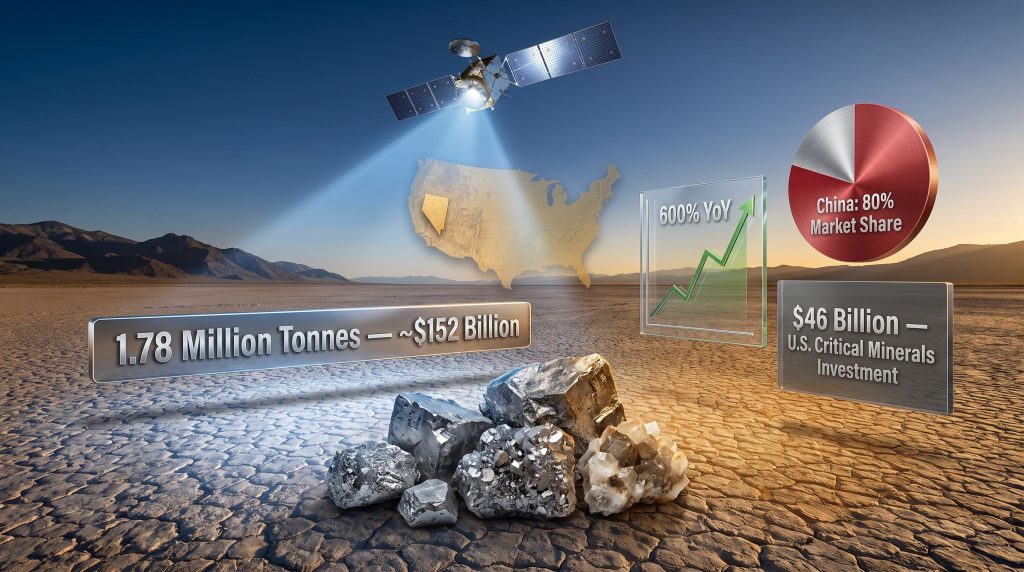
China controls approximately 80% of global tungsten supply, a dominance built through decades of coordinated state investment in mining, processing, and export infrastructure. This concentration is not merely a market statistic; it represents a leverage point in any geopolitical confrontation involving advanced manufacturing.
In 2026, Beijing formalised export restrictions on tungsten, compounding an already tight supply environment driven by elevated military demand from two active armed conflicts. The result was a tungsten price surge of approximately 600% year-over-year, a trajectory that dramatically reframed the economics of any potential domestic alternative.
Critical Market Insight: China's export restrictions on tungsten are part of a broader pattern that has also encompassed gallium, germanium, and graphite. Each successive restriction has demonstrated that Beijing views mineral exports as a geopolitical instrument rather than purely a commercial function. This pattern suggests tungsten restrictions are unlikely to be reversed without significant diplomatic concessions.
A Discovery Beneath the Nevada Desert
Inside the Great Basin Find: Scale, Location, and Geology
In a remote section of the Great Basin Desert in eastern Nevada, a drilling campaign by 3 Proton Lithium (3PL) produced results that immediately attracted attention across the minerals intelligence community. The find sits within Railroad Valley, a region characterised by geological features consistent with skarn-type tungsten mineralisation — a deposit style formed through contact metamorphism where igneous intrusions interact with carbonate host rocks. Skarn deposits are among the most significant tungsten-bearing geological formations globally, and Nevada's tectonic history creates conditions broadly favourable for their formation.
How the Nevada Deposit Compares to Existing U.S. Resources
The scale of the find is difficult to contextualise without comparison. According to data reported by the Financial Times and confirmed by the operator's own estimates, the in-ground resource stands at approximately 1.78 million tonnes, which would position the Nevada discovery at roughly five times the size of the next-largest identified tungsten deposit within the United States.
| Metric | Detail |
|---|---|
| Estimated Resource in Place | 1.78 million tonnes |
| Relative Scale | ~5x larger than next-largest U.S. tungsten deposit |
| Estimated Gross Value | ~$152 billion (based on current market pricing) |
| Location | Railroad Valley, Great Basin Desert, eastern Nevada |
| Operator | 3 Proton Lithium (3PL) |
The $152 billion gross value estimate is calculated on the basis of current elevated tungsten pricing following China's export restrictions. Investors and analysts should treat this figure as a market-capitalisation-of-resource estimate rather than a net present value, since it does not account for extraction costs, processing infrastructure, permitting timelines, or grade variability across the deposit.
From Discovery to Commercial Viability: What Still Needs to Be Proven
A resource estimate is the beginning of a development story, not the conclusion. Before any resource achieves commercial significance, it must pass through a rigorous progression of technical and economic gatekeeping. This is precisely why mineral exploration matters — the journey from initial discovery to confirmed viability is both lengthy and demanding:
-
Mineral Resource to Ore Reserve conversion requires drilling density sufficient to establish geological confidence at the indicated or measured category under JORC or NI 43-101 standards.
-
Metallurgical testwork must confirm that tungsten minerals within the deposit respond to processing in a cost-effective manner. Tungsten mineralogy can vary considerably, with scheelite and wolframite requiring different extraction approaches.
-
A definitive feasibility study translates geological data into engineering and economic projections, establishing whether the deposit can generate acceptable returns at prevailing prices.
-
Permitting and environmental approvals must be secured from relevant federal and state agencies.
-
Infrastructure development, including road access, water supply, and power, must be established in what remains a remote desert location.
None of these stages have been completed. The Nevada find is a discovery-stage asset with significant further work required before commercial viability can be confirmed.
NASA's Opposition and the Science Behind It
The Satellite Calibration Function of Railroad Valley Explained
Railroad Valley's importance to satellite science is not widely understood outside the remote sensing and Earth observation community. The dry lakebed surface offers an exceptionally stable, flat, and optically uniform reflectance profile that remains consistent across seasons and years. Earth-observing satellites — including those used for military reconnaissance, climate monitoring, and agricultural surveillance — require periodic cross-calibration against known ground reference points to maintain sensor accuracy. Railroad Valley has served this function for decades, accumulating a calibration record of irreplaceable scientific and operational value.
What Is Railroad Valley Used For? Railroad Valley in eastern Nevada functions as one of the most precisely characterised ground reference sites on Earth. Satellites passing overhead use the lakebed's uniform reflectance properties to validate instrument readings and correct sensor drift over time. Any surface disturbance, including access roads, drilling pads, or processing facilities, risks permanently altering the optical properties that make the site scientifically irreplaceable.
The Bureau of Land Management Withdrawal: Scope and Timeline
The administrative mechanism through which NASA's objection has been formalised is a Bureau of Land Management land withdrawal — a legal tool that removes specified federal lands from entry, appropriation, or disposal under public land laws, including mining claims.
Key parameters of the current restriction:
- The BLM formally withdrew approximately 22,684 to 22,995 acres of eastern Nevada federal land from new mining activity
- The withdrawal was executed in 2023 following a formal request by NASA
- The restriction carries a 20-year duration, extending through the early 2040s
- Approximately one-third of 3 Proton Lithium's mineral claims overlap with the restricted zone
Why NASA's Position Is Technically Defensible and Politically Complicated
NASA's position is scientifically sound. The agency is protecting infrastructure that serves genuine national security functions, including the calibration of satellites used by military and intelligence services. However, the political complexity arises from the fact that it is protecting this infrastructure at the direct expense of a domestic critical mineral supply that also serves national security. This is not a straightforward environmental objection; it is an intra-government conflict between two legitimate arms of federal strategic infrastructure.
The Geopolitical and Policy Context
Washington's $46 Billion Investment in Critical Mineral Supply Chain Independence
Over approximately five years, the United States federal government has directed roughly $46 billion toward building a domestic and allied critical minerals supply chain. This investment spans processing infrastructure, exploration incentives, and strategic stockpiling initiatives. The scale of this commitment reflects a bipartisan recognition that mineral dependency on geopolitically adversarial nations represents a structural risk to both economic and military capability. Indeed, the broader US critical minerals push has elevated tungsten to the top of Washington's strategic agenda.
How China's Export Restrictions Triggered a Tungsten Price Surge
The price dynamics now surrounding tungsten are not incidental. They represent a deliberate compression of supply from the world's dominant producer at a moment when demand from military manufacturing is running at elevated levels.
- China formalised tungsten export restrictions in 2026, compounding existing supply tightness
- Tungsten prices surged approximately 600% year-over-year following the announcement
- Demand acceleration from active military conflicts in multiple theatres further tightened global availability
- The price rally elevated the operator's estimated gross value of the Nevada deposit to approximately $152 billion
Investor Caution: Resource value estimates derived from commodity price peaks carry significant inherent risk. Tungsten prices at current levels reflect extraordinary supply disruption rather than long-term equilibrium pricing. Investors evaluating the Nevada deposit should model scenarios across a range of price assumptions rather than anchoring to current spot values.
The Domestic Permitting Paradox
Perhaps the most structurally significant aspect of the Nevada situation is what it reveals about the gap between federal policy ambition and federal regulatory architecture. The U.S. government is simultaneously committing billions of dollars to secure critical mineral supply chains while multiple federal agencies operate with conflicting mandates and no binding mechanism to resolve them.
Furthermore, defence-critical mineral shortages have already demonstrated the consequences of delayed action — a pattern that makes the Nevada standoff all the more consequential. The BLM withdrawal executed for NASA's benefit is a legally valid administrative action. So is the mining claim held by 3PL. The system contains no pre-existing hierarchy to adjudicate between them.
Two National Security Interests, One Geographic Footprint
Defense and Industrial Supply Security vs. Space Infrastructure Integrity
| Consideration | NASA Calibration Site | Nevada Tungsten Deposit |
|---|---|---|
| Strategic Function | Satellite sensor accuracy and validation | Domestic critical mineral supply |
| Duration of Restriction | 20-year BLM withdrawal from 2023 | Long-term mining horizon if approved |
| Overlap with Claims | ~1/3 of 3PL's mineral claims | Full deposit spans restricted and open zones |
| Reversibility | Technically reversible with federal action | Commercially viable status still unproven |
| National Security Linkage | Space and intelligence infrastructure | Defense manufacturing and supply chain |
Both assets serve legitimate national security functions. Tungsten is essential to weapons systems, armour-piercing munitions, aerospace components, and advanced electronics. Earth-observing satellites calibrated at Railroad Valley support military reconnaissance, strategic intelligence gathering, and climate monitoring. The framing of this as an environment-versus-industry dispute would be fundamentally inaccurate.
Can the Conflict Be Resolved? Legislative and Regulatory Pathways
Several resolution pathways exist in theory, each carrying distinct implications:
-
Scenario A: Full BLM withdrawal maintained. One-third of 3PL's claims remain inaccessible through the early 2040s. Mining proceeds only in the unrestricted zone, potentially limiting the deposit's commercial scope.
-
Scenario B: Negotiated boundary adjustment. Federal agencies agree to a more precisely drawn exclusion zone that protects the most sensitive calibration areas while releasing surrounding land for mineral development. This is technically feasible but requires inter-agency cooperation that has historically proven difficult.
-
Scenario C: Congressional override. Legislation specifically addressing the withdrawal could reverse or modify the restriction. This pathway introduces political risk and precedent concerns for other federal land use protections.
-
Scenario D: Discovery proves non-viable. If metallurgical testwork or feasibility studies determine the deposit cannot be economically extracted, the regulatory conflict becomes moot regardless of outcome.
The next major ASX story will hit our subscribers first
A Systemic Problem in American Critical Mineral Development
The Gap Between Policy Ambition and Permitting Reality
The Nevada situation is not an isolated anomaly. It is, however, a concentrated expression of a structural problem that has repeatedly frustrated domestic critical mineral development in the United States. Federal land management, environmental review processes, inter-agency conflicts, and fragmented regulatory jurisdictions collectively create a permitting environment that can extend development timelines by a decade or more, even when strategic rationale is clear.
Lessons From China's Long-Term Critical Mineral Strategy
China's dominance in tungsten, rare earths, and other strategic minerals was not the product of geological luck alone. It was constructed through deliberate, long-horizon state investment in exploration, processing infrastructure, export policy coordination, and vertical integration from mine to finished product.
The competitive disadvantage the United States now faces stems not primarily from a lack of resources, but from a fragmented regulatory environment in which multiple federal agencies can simultaneously pursue conflicting objectives without any binding arbitration mechanism to resolve them.
Strategic Insight: The NASA opposition to Nevada tungsten mine development illustrates that winning the global mineral race requires more than discovery and investment. It requires a federal governance architecture capable of making coherent decisions when competing national priorities occupy the same physical geography. Without that architecture, the gap between policy ambition and operational reality will continue to widen.
Frequently Asked Questions: NASA Opposition to Nevada Tungsten Mine
Why is NASA involved in a mining dispute in Nevada?
NASA operates a long-standing satellite instrument calibration site in Railroad Valley. The agency maintains that mining activity — including roads, drilling pads, and surface disturbance — would compromise the flat, optically uniform lakebed surface that makes the valley uniquely suited for calibrating Earth-observing satellites.
How large is the Nevada tungsten deposit?
The in-ground resource estimate stands at approximately 1.78 million tonnes, which would make it roughly five times larger than any other identified tungsten deposit currently known within the United States.
Why has tungsten become so expensive?
A combination of Chinese export restrictions announced in 2026 and elevated demand from defence-related manufacturing amid active military conflicts drove tungsten prices up by approximately 600% year-over-year, significantly increasing the strategic and financial value of any domestic supply alternative.
How much of the deposit is affected by the NASA restriction?
Approximately one-third of the mineral claims held by 3 Proton Lithium overlap with the federally withdrawn zone, which covers between 22,684 and 22,995 acres of eastern Nevada under a 20-year BLM restriction initiated in 2023.
What is the U.S. government doing to reduce tungsten import dependency?
As part of a broader critical minerals strategy, the federal government has directed approximately $46 billion toward building domestic and allied supply chains. However, internal regulatory conflicts such as the NASA opposition to Nevada tungsten mine operations illustrate the structural barriers that continue to slow progress despite this investment.
Could the land withdrawal be reversed?
The BLM withdrawal is a federal administrative action and can theoretically be modified or reversed through executive or legislative intervention. The project operator has indicated it is actively engaging lawmakers and federal officials to seek a narrowing or reversal of the restriction.
The Bigger Picture: What This Dispute Reveals About America's Mineral Future
Why Domestic Supply Development Must Become a Coordinated Federal Priority
The Nevada tungsten situation exposes a governance failure that goes beyond any single project. When two federal agencies can simultaneously claim legitimate jurisdiction over the same patch of land for competing national security purposes — and no arbitration mechanism exists to resolve the conflict efficiently — the result is paralysis. The $46 billion committed to critical mineral supply chain independence cannot achieve its intended strategic effect if the regulatory environment consistently prevents translation of geological discovery into operational production.
The Risk of Winning the Global Mineral Race While Losing Ground at Home
The United States is actively competing on the international stage for critical mineral access, reportedly outbidding allied nations in some cases, according to reporting by the Wall Street Journal. Yet domestically, a deposit potentially worth $152 billion sits partially locked beneath a satellite calibration zone. The contradiction between external ambition and internal constraint is not just an irony; it is a strategic liability.
Building a Regulatory Architecture That Serves Multiple National Interests
Resolving conflicts like the one at Railroad Valley will ultimately require more than case-by-case negotiations. It will require a coherent federal framework capable of evaluating and ranking competing national interests across land use, with clear decision-making authority and defined timelines. Without such a framework, the pattern of discovery followed by regulatory deadlock will continue to define America's domestic critical mineral story, regardless of how much is invested at the policy level.
Disclaimer: This article is for informational purposes only and does not constitute financial or investment advice. Resource estimates, price projections, and commercial viability assessments referenced in this article involve significant uncertainty and should not be relied upon as the basis for investment decisions. All financial figures and commodity price data reflect conditions at the time of writing and are subject to change.
Want To Track The Next Major Critical Mineral Discovery Before The Broader Market Does?
Discovery Alert's proprietary Discovery IQ model delivers real-time alerts on significant ASX mineral discoveries — including critical minerals like tungsten — instantly translating complex geological data into actionable insights for investors at every level. Explore why major mineral discoveries can generate substantial returns by visiting Discovery Alert's dedicated discoveries page, and begin your 14-day free trial today to position yourself ahead of the market.