August 11, 2026
Silver Below the Gold Line: What High-Sulfidation Zonation Tells Us About Treaty Creek's CBS Discovery
Precious metals exploration across British Columbia's Golden Triangle has long operated on a simple premise: find the gold, define the resource, build the mine. But the geology of high-sulfidation hydrothermal systems rarely respects that linear script. These complex, fluid-driven environments frequently stack multiple metal assemblages at different depths, with gold concentrated near the top of a system and silver, copper, or base metals enriching the deeper corridors. When drill results break that expected pattern, they tend to signal something more architecturally interesting than a single-commodity deposit. The Tudor Gold CBS Zone silver discovery is precisely that kind of inflection point, and understanding what it means requires stepping back from the headline intercept and examining the geological mechanics at play.
When big ASX news breaks, our subscribers know first
The Multi-Zone Architecture of Treaty Creek: Why CBS Is Not Goldstorm
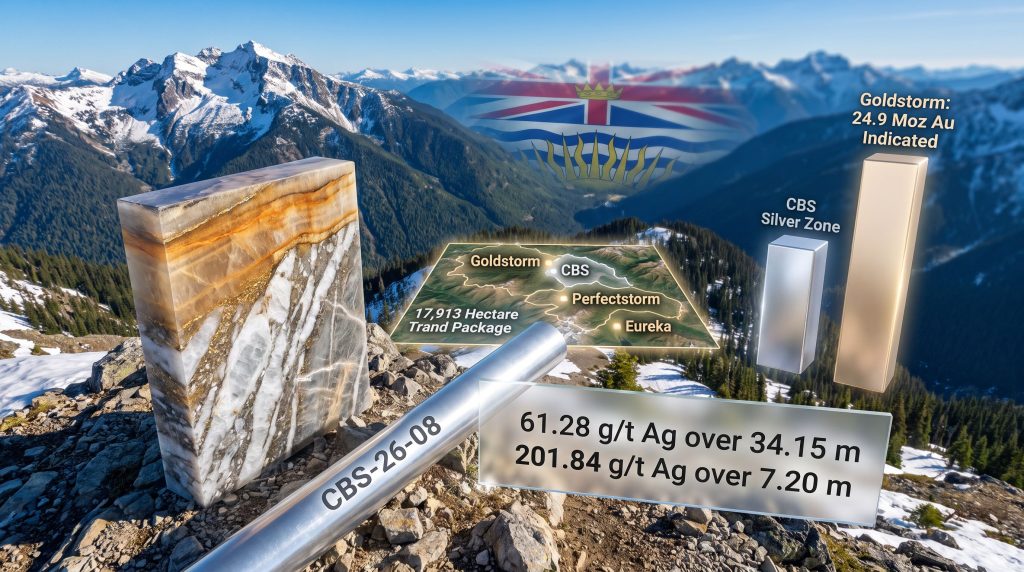
Treaty Creek is not a single-deposit land package. Spread across 17,913 hectares in the heart of the Golden Triangle, the project hosts at least four distinct mineralised zones: Goldstorm, CBS, Eureka, and Perfectstorm. Tudor Gold (TSXV: TUD) holds an 80% working interest in the project, with the property sharing boundaries with Seabridge Gold's KSM asset to the southwest and Newmont Corporation's Brucejack Mine to the southeast.
That boundary alignment matters geologically. Both KSM and Brucejack are world-class assets sitting within the same Stikine Terrane geological corridor, a Triassic to Early Jurassic arc sequence that hosts some of the most significant copper-gold-silver porphyry and epithermal systems in North America. Treaty Creek's positioning within this established corridor provides geological credibility that extends across all exploration targets on the land package, not only the primary development asset.
The CBS Zone sits spatially separate from the Goldstorm Deposit and, critically, outside its current resource boundary. This distinction is not administrative; it has direct implications for how results from CBS are interpreted relative to Tudor's near-term development timeline. The Goldstorm resource, anchored by a NI 43-101 technical report dated November 30, 2025, underpins the preliminary economic assessment (PEA) now in progress. CBS results feed neither the resource estimate nor the PEA modelling, which means any value attributed to the silver breccia discovery must be assessed on its own geological and economic merits, independently of the Goldstorm development case.
Decoding the CBS Silver Intercept: Grades, Geometry, and Geological Context
Assay results released on July 7, 2026, from the two most recently completed CBS Zone holes produced a result that diverged sharply from the zone's historical gold-dominant character. Drill hole CBS-26-08 returned the following:
| Parameter | Value |
|---|---|
| Silver grade (primary interval) | 61.28 g/t Ag |
| Interval width | 34.15 metres |
| Higher-grade sub-interval | 201.84 g/t Ag over 7.20 metres |
| Gold grade (primary interval) | 0.09 g/t Au |
To put the primary intercept in context, 61.28 g/t silver over 34.15 metres represents a grade-width product that exploration geologists refer to as a meaningful silverwidth. For comparison, earlier CBS drilling from 2021 returned 1.30 g/t gold equivalent over 53.9 metres, a result that was solidly gold-dominant. You can review Tudor Gold's official announcement for the full technical detail on this intercept. The July 2026 intercept flips that ratio almost entirely, with silver carrying the grade and gold contributing only marginally at 0.09 g/t.
The silver-dominant character of this intercept is not simply a curiosity. In high-sulfidation epithermal systems, gold enrichment typically occurs at shallower, oxidised levels while silver becomes the dominant precious metal at deeper, less oxidised portions of the hydrothermal plumbing. The CBS intercept's depth positioning and metal ratio are entirely consistent with this textbook zonation pattern.
What High-Sulfidation Zonation Actually Means for Investors
High-sulfidation epithermal systems are defined by their acidic, oxidising hydrothermal fluids, which leach and replace host rock to create distinctive alteration assemblages. These systems are globally recognised for producing bonanza-grade precious metal intervals, particularly in breccia-hosted structures where fluid channelling creates high-permeability pathways for metal precipitation. Understanding the mineral system architecture at play here is consequently essential to interpreting what the CBS silver intercept represents within the broader Treaty Creek framework.
The key geological point for investors to understand is vertical metal zonation:
- Gold-dominant mineralisation typically forms at shallower crustal levels, closer to the paleowater table
- Silver enrichment accelerates with depth as fluid temperatures, pressures, and sulphidation states change
- Copper and base metal concentrations often increase at still greater depths, transitioning toward porphyry-style mineralisation
- Breccia corridors, like the one Tudor identifies at CBS, act as high-permeability conduits that can preserve multiple metal assemblages across a wide vertical range
Tudor's interpretation of the CBS breccia as a high fluid-flow corridor within a broader high-sulfidation system is consistent with this model. The silver-rich interval encountered in CBS-26-08 was identified at a greater depth than any previously tested horizon at the zone, which aligns precisely with the expected spatial positioning of silver enrichment in this class of deposit.
Multi-Point Spatial Correlation: More Than a Single Anomaly
What distinguishes this result from an isolated drill hole anomaly is the multi-point spatial correlation Tudor describes. The silver breccia intercept correlates with:
- A lower-grade silver hit from an earlier CBS drill hole at the same zone
- Surface chip samples that previously flagged silver values at surface, establishing vertical expression from outcrop to depth
- The broader high-sulfidation structural framework already established at the CBS Zone through prior drilling
This three-point correlation provides a minimum framework for arguing geological continuity rather than a single-hole outlier. However, investors should apply appropriate caution: the target remains open in all directions, meaning true width, strike length, dip, and depth extent are all undefined. Furthermore, when interpreting drill results of this nature, it is important to recognise that no resource estimate exists for the silver breccia, and the zone is firmly in early-stage exploration territory.
The Goldstorm Anchor: Understanding the Development Case That CBS Cannot Influence
While the CBS silver discovery attracts exploration attention, the quantitative foundation of Tudor's investment thesis rests on Goldstorm. The deposit's current resource, as reported under NI 43-101 standards, stands at:
| Resource Category | Gold (Moz) | Silver (Moz) |
|---|---|---|
| Indicated Mineral Resource | 24.9 | 148.7 |
| Inferred Mineral Resource | Included in NI 43-101 report (Nov 30, 2025) | Includes copper credit |
These figures position Goldstorm as one of the largest undeveloped gold resources in British Columbia, and the advancing PEA will translate that resource into the economic parameters investors need to form a valuation view: net present value (NPV), internal rate of return (IRR), capital cost estimates, and operating cost projections for an underground mining scenario. This mining study pathway is a well-established sequence for large-scale underground precious metals projects.
Alongside the PEA, Tudor has filed a permit application for an underground ramp to access the high-grade SC-1 Zone within Goldstorm, a concrete operational step that moves the project beyond pure resource definition toward mine access planning. This sequencing reflects the standard development pathway for large underground precious metals deposits: resource definition, followed by preliminary economics, followed by access permitting, followed by feasibility and financing.
The Goldstorm PEA will provide the primary valuation anchor for Tudor Gold. Once published, it will give investors a structured economic baseline against which any future CBS or Perfectstorm results can be assessed as incremental additions, rather than speculative value assumed ahead of a completed economic study.
Drill Rig Positioning and the September 2026 Return to CBS
Following the CBS Zone results, Tudor relocated both active drill rigs to the Perfectstorm Zone for the summer 2026 program. Perfectstorm targets porphyry-style gold, silver, and copper mineralisation hosted in potassic-altered diorite, the same host rock lithology associated with the Goldstorm Deposit. This geological affinity makes Perfectstorm a strategically relevant target: if results demonstrate similar mineralisation styles to Goldstorm, the case for a spatially expanding mineralised system across the Treaty Creek land package strengthens.
The CBS follow-up campaign is scheduled to resume in September 2026. The objectives of that program will likely focus on:
- Testing strike extensions of the silver breccia beyond the CBS-26-08 intercept footprint
- Infill drilling to establish grade and width continuity between the primary intercept and the earlier corroborating hole
- Assessing down-dip depth extent below the current deepest tested horizon
- Potentially defining the relationship between the silver breccia and the gold-dominant shallow portions of the CBS system
Until September results are available, the silver discovery remains a geologically supported but geometrically undefined anomaly. The information gap between now and late 2026 follow-up assays is a key consideration for investors timing exposure to this specific catalyst.
Catalyst Timeline: What Comes Next and When
| Catalyst | Expected Timing |
|---|---|
| Perfectstorm Zone drill results | Summer to early September 2026 |
| CBS Zone silver follow-up drilling begins | September 2026 |
| Goldstorm underground PEA publication | To be determined (underway as of mid-2026) |
| CBS silver follow-up assay results | Late 2026 (estimated, post-September drilling) |
The Golden Triangle's Geological Productivity: Why Location Amplifies the Discovery's Significance
British Columbia's Golden Triangle is among the most geologically productive precious metals districts in the western hemisphere. The district's rock record spans Triassic to Jurassic arc sequences, hosting an unusually high density of porphyry copper-gold and epithermal precious metals systems within a relatively compact geographic area.
The operating context reinforces Treaty Creek's geological credibility. Newmont's Brucejack Mine, which directly borders Treaty Creek to the southeast, has produced high-grade gold from a volcanic-hosted epithermal system since 2017. Seabridge Gold's KSM project, adjacent to the southwest, hosts one of the largest undeveloped copper-gold resources globally. These neighbouring assets confirm that the structural and hydrothermal plumbing systems capable of concentrating world-class precious metals deposits extend continuously through the Treaty Creek land package.
For high-sulfidation systems specifically, the Golden Triangle's geological history provides multiple analogues. The presence of breccia-hosted precious metal corridors with vertical metal zonation has been documented across several Stikine Terrane properties, lending additional plausibility to Tudor's geological interpretation of the CBS Zone's silver-rich deeper levels.
The next major ASX story will hit our subscribers first
A Two-Layer Framework for Evaluating Tudor Gold's Investment Case
For investors seeking to properly sequence the Tudor Gold CBS Zone silver discovery within the broader investment thesis, a two-layer analytical framework provides the most useful structure. In addition, understanding drill results for investors across both layers will help clarify how each element contributes to the overall thesis.
Layer 1: Core Development Value (Quantifiable)
- Goldstorm's 24.9 million ounce gold Indicated Resource provides the resource foundation
- The advancing underground PEA will convert that resource into NPV and IRR estimates
- The SC-1 Zone ramp permit application signals concrete operational progress
- Goldstorm remains open in all directions, preserving organic resource growth potential
Layer 2: Exploration Optionality (Currently Unquantifiable)
- The CBS silver breccia represents a new mineralisation style with no defined resource
- Perfectstorm porphyry results could expand or contract the broader mineralised system thesis
- Eureka Zone results feed a separate long-term exploration pipeline
- None of these zones contribute inputs to the PEA economics now being modelled
Key Risk Factors for the CBS Silver Zone
Investors should weigh the following risks before ascribing forward value to the CBS silver discovery:
- Single-campaign intercept risk: CBS-26-08 is the primary hole defining the silver breccia target. A compelling intercept in one hole is not equivalent to a defined discovery under NI 43-101 resource estimation standards.
- Undefined geometry: Open in all directions means every critical variable for resource estimation, including true vs apparent widths, strike, and dip, remains unmeasured.
- Sequencing dependency: CBS follow-up drilling cannot begin until September 2026, creating a multi-month period with no new geological data from this target.
- PEA non-inclusion: The Goldstorm PEA will be completed and published before CBS silver follow-up results are available, meaning the market's primary economic reference point for Tudor Gold will not incorporate any CBS silver contribution.
- Breccia pod vs. system-scale mineralisation: In high-sulfidation environments, silver-rich breccia intervals can represent either the leading edge of a laterally continuous precious metals system or an isolated fluid-channelling pod. Distinguishing between these outcomes requires systematic multi-directional drilling, which has not yet occurred at CBS.
Disclaimer: This article is for informational purposes only and does not constitute financial or investment advice. Mineral resource estimates, economic projections, and exploration results described herein involve forward-looking statements subject to known and unknown risks. Readers should conduct their own due diligence before making investment decisions.
Frequently Asked Questions: Tudor Gold CBS Zone Silver Discovery
What exactly did the July 2026 CBS Zone drilling return?
Drill hole CBS-26-08 at the CBS Zone, Treaty Creek Project, intersected 61.28 g/t silver over 34.15 metres, including a higher-grade sub-interval of 201.84 g/t silver over 7.20 metres, with associated gold of 0.09 g/t. The same two holes also extended the CBS Zone's established gold breccia system further along strike toward the Goldstorm Deposit. Resource World provides additional independent coverage of these results for investors seeking further context.
Does the CBS silver result affect the Goldstorm PEA?
No. The CBS Zone falls entirely outside the current Goldstorm Deposit resource boundary. The PEA underway is modelled exclusively against the Goldstorm resource as defined in the November 30, 2025 NI 43-101 technical report, and CBS Zone results have no pathway to influence those economics.
When will follow-up drilling resume at CBS?
Both drill rigs relocated to the Perfectstorm Zone for the summer 2026 program and are scheduled to return to the CBS Zone in September 2026 to follow up the silver breccia intercept.
What is Goldstorm's current resource size?
Under the November 30, 2025 NI 43-101 technical report, Goldstorm carries Indicated Mineral Resources of 24.9 million ounces of gold and 148.7 million ounces of silver, with additional Inferred Mineral Resources and copper credits across both categories.
What is the Perfectstorm Zone and why is it being drilled now?
Perfectstorm is a separate exploration target on the Treaty Creek land package hosting porphyry-style gold, silver, and copper mineralisation in potassic-altered diorite, the same host rock associated with Goldstorm. Tudor's two drill rigs are running a summer program at Perfectstorm before returning to CBS in September.
Is there a defined resource for the CBS silver zone?
No. The CBS silver breccia is an early-stage exploration target. No resource estimate has been prepared, and the zone's geometry, true width, and strike extent remain undefined pending the September 2026 follow-up drilling program.
Readers seeking additional context on Tudor Gold's Treaty Creek Project and the broader Goldstorm development case can explore related coverage and analytical content available at Crux Investor.
Want to Know When the Next Major ASX Mineral Discovery Hits the Market?
Discovery Alert's proprietary Discovery IQ model scans ASX announcements in real time, instantly identifying significant mineral discoveries across gold, silver, copper, and more than 30 other commodities — turning complex exploration data into actionable investment insights before the broader market reacts. Explore historic discoveries and the substantial returns they have generated, then start your 14-day free trial to position yourself ahead of the next major find.