August 6, 2026
When Glacial Cover Hides a Giant: The Exploration Challenge Driving Arctic Copper Discovery
Fault-hosted copper-silver systems in glacially blanketed terrains represent one of the most chronically underexplored frontiers in global base metals exploration. Unlike exposed tropical or arid environments where mineralisation announces itself through outcrop, gossans, and surface alteration halos, Arctic corridors like those found in Nunavut, Canada present a fundamentally different challenge. Understanding the mineral exploration importance of these remote regions is critical, as glacial till can transport geochemical signals kilometres from their bedrock source, obscuring precise mineralisation locations. It is precisely this paradox that makes blind discoveries in Canada's north both rare and, when confirmed, exceptionally significant.
The Somerset Minerals Talisker copper-silver discovery operates within this framework. The confirmation that two maiden reverse circulation drill holes have each returned thick, high-grade intersections across a previously undrilled 17-kilometre corridor is not simply a company milestone. It is a validation of a systematic, data-layered exploration philosophy increasingly being applied to terrains that historical exploration campaigns largely bypassed.
When big ASX news breaks, our subscribers know first
Why the Talisker Corridor Is Generating Serious Exploration Interest
The Structural Setting That Makes Talisker Geologically Compelling
Somerset Minerals' Coppermine Project sits within Nunavut, Canada, in a region characterised by regionally significant fault architecture long associated with sediment-hosted and fault-controlled copper-silver mineralisation. The broader Coppermine district is known among specialist explorationists for hosting copper-silver systems tied to ancient continental rift structures. This geological setting produces mineralisation styles more analogous to the Zambian Copperbelt or Canada's own historic Coppermine River occurrences than to typical porphyry or volcanogenic massive sulphide (VMS) deposits.
What elevates the Talisker zone specifically is its interpreted structural connection to White Cliff Minerals' Danvers deposit, located approximately 4 kilometres away and sharing the same regional fault corridor. In exploration geology, this type of structural linkage is treated as a high-confidence analogical framework. If mineralising fluids travelled along a regional structure to produce one deposit, the same conduit may have delivered mineralisation at multiple points along its strike length. Fault-hosted copper-silver systems are particularly susceptible to this kind of corridor-scale repeatability.
The complicating factor, and the reason Talisker's corridor had never previously been drilled, is that the mineralisation is largely concealed beneath glacial cover. Surface expressions of bedrock mineralisation are rare, meaning conventional visual prospecting was unlikely to locate the system. Targets like Talisker, consequently, require a fundamentally different discovery methodology — one built from the ground up using dispersed geochemical signals and geophysical imaging rather than surface mapping alone.
How Big Is the Talisker Target? Understanding the Scale of the Anomaly
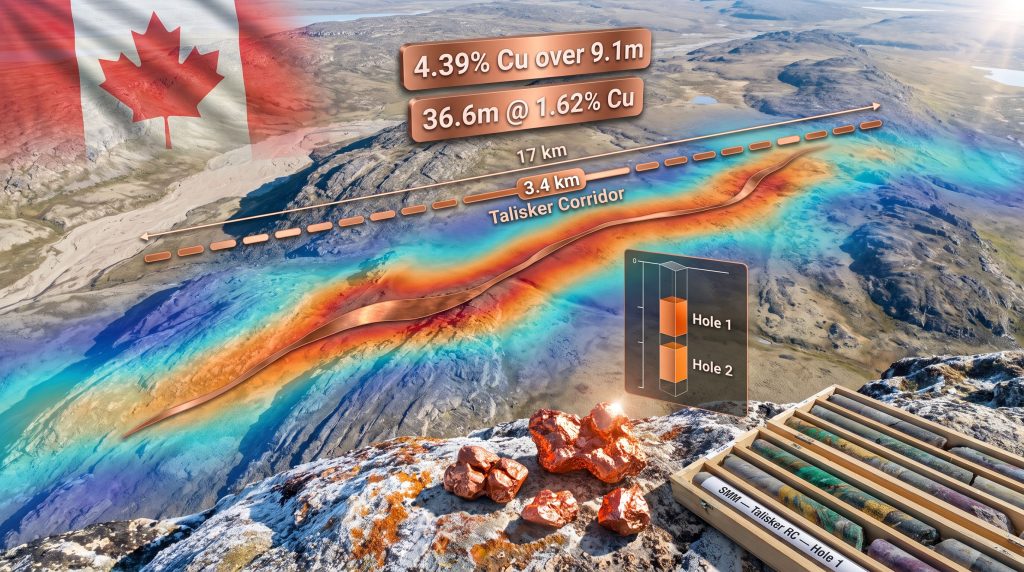
Key Metric: The Talisker corridor spans approximately 17 kilometres in strike length, with a highest-priority zone covering roughly 3.4 km of that extent, making it one of the larger untested copper-silver anomalies currently under active drilling on the ASX.
The scale of the anomaly underpinning the Talisker discovery is worth examining carefully, because corridor length alone does not define a copper target. What defines target confidence is coincidence — the spatial overlap of multiple independent datasets pointing at the same subsurface feature from different analytical angles.
At Talisker, the approximately 17 km anomaly integrates coincident geochemical and geophysical signals. A broader 14 km surface mineralisation envelope has been identified, within which a central 2 km zone was selected for testing in the maiden reverse circulation program. This graduated prioritisation is standard exploration practice: work from regional to local, concentrating early drill capital on the highest-probability intersection of multiple datasets.
For scale context, early-stage copper discoveries that generate serious institutional attention typically require anomaly footprints of several kilometres with multi-dataset convergence. A 17 km coincident anomaly, with a 14 km surface expression and a drill-ready 2 km priority zone, places Talisker in a comparatively rare category for an ASX micro-cap exploration company.
How Was the Talisker Discovery Built? Deconstructing the Targeting Methodology
Step-by-Step: The Multi-Layer Exploration Approach Somerset Used to Define Talisker
Understanding how Talisker was built as a target is as important as understanding the drill results themselves. The discovery was not the product of following historical workings, acquiring a previously drilled tenement, or purchasing a known resource. It was generated entirely through systematic modern exploration applied to a completely virgin corridor.
The methodology followed a logical escalation of resolution and confidence:
-
Regional till geochemistry — Glacially transported sediments carry trace metal signatures derived from the bedrock they have moved across. Mapping copper dispersion patterns through till sampling established the first evidence that anomalous bedrock existed somewhere along the Talisker corridor.
-
Geophysical surveying — Once geochemical anomalism was established, geophysical methods including electromagnetic and magnetic surveying were used to image subsurface conductors and structural features consistent with fault-hosted mineralisation. Conductors associated with sulphide-bearing fault zones are a primary geophysical target in this mineralisation style.
-
Detailed structural mapping — Surface structural mapping defined the fault architecture controlling where mineralisation was most likely to be trapped and concentrated. Understanding fault geometry directly informs drill collar positioning and expected intersection angles.
-
Infill till sampling (641 samples) — A systematic infill program across the highest-priority sections of the corridor tightened the geochemical footprint, enabling Somerset to rank specific drill sites by confidence level. Furthermore, effective soil sampling techniques allowed the team to reduce the risk of early drill holes missing the target entirely.
-
Surface mineralisation identification — Field teams confirmed native copper and mineralised outcrops at Talisker and the nearby Skye zone, providing physical verification of a bedrock copper-silver system at surface where glacial cover was thin enough to allow detection.
-
Maiden RC drill program (~2,500 m) — With all preceding datasets integrated, the maiden reverse circulation program was designed to test the central corridor with maximum geological efficiency.
Why This Matters: The systematic, layered approach used at Talisker converted a geochemically anomalous corridor into a confirmed copper-silver discovery with the first two holes reported — a conversion rate that reflects the quality of the pre-drill dataset, not exploration luck.
What the Pre-Drill Geochemistry Was Telling the Market
The geochemical picture at Talisker before a single drill hole was completed was already unusually strong by exploration standards. Till and soil copper values reaching up to 3,790 ppm Cu (0.38%) were recorded across the corridor, with multiple samples exceeding 1,000 ppm Cu. To contextualise this: background copper levels in glacial till typically sit in the range of 20 to 50 ppm in non-mineralised terrain, meaning the Talisker anomaly represented values 75 to 190 times above regional background in the highest-returning samples.
The silver story was similarly compelling before drilling commenced. Surface assays returned values of up to 214 g/t Ag from the Talisker and Skye zones — a figure that is exceptional even in silver-dominant systems, let alone as a co-product credit within a copper-primary corridor. According to Somerset Minerals' investor presentations, this multi-element convergence was central to the targeting rationale from the outset.
In multi-element geochemical analysis, distinguishing a primary bedrock source from dispersed glacial noise requires examining the coherence and spatial consistency of anomalism across multiple pathfinder elements. When copper, silver, and structurally compatible pathfinder elements align spatially across a corridor with the consistency observed at Talisker, experienced explorationists treat this as compelling evidence of a primary bedrock source rather than transported material.
What Do the Maiden Drill Results Actually Show?
Breaking Down the Headline Assay Intersections from Holes 1 and 2
The first two holes of Somerset's maiden reverse circulation program at Talisker returned the following intersections:
| Intersection | Width (m) | Copper Grade (%) | Silver Grade (g/t) | Depth From (m) |
|---|---|---|---|---|
| Hole 1 — Main Zone | 36.6m | 1.62% Cu | 11.8 g/t Ag | 22.9m |
| Hole 1 — High-Grade Sub-Zone | 9.1m | 4.39% Cu | 28.8 g/t Ag | Within above |
| Hole 1 — Second Zone | 38.1m | 1.27% Cu | 7.4 g/t Ag | 41.1m |
| Hole 2 — From Surface | 35.1m | 1.01% Cu | 4.7 g/t Ag | Surface |
What These Grades Mean in a Global Copper Exploration Context
Featured Insight: A copper intersection grading 4.39% Cu over 9.1 metres is considered high-grade by global exploration standards. The average copper grade produced from operating mines worldwide sits between 0.4% and 0.6% Cu, placing Talisker's high-grade sub-zone at approximately 7 to 10 times the global production average.
Grade is one dimension of a drill result. Width is the other, and in many respects the one that determines whether a discovery has genuine resource-building potential. The 36.6m and 38.1m intersections from Hole 1 are significant not just for their grades but for what they imply about mineralisation continuity at scale. Wide intersections in an initial step-out program suggest that the mineralised system has genuine thickness, reducing the risk that high grades are confined to narrow veins. Interpreting drill results at this early stage requires careful consideration of both width and grade together.
Several additional dimensions of the Talisker results deserve specific attention:
-
Dual-zone geometry within Hole 1 identifies at least two separate mineralised bodies within a broader envelope. This geometric complexity, whilst requiring further geological modelling to interpret, suggests a structurally controlled system capable of producing stacked mineralisation horizons along the fault corridor.
-
Near-surface mineralisation in Hole 2, with the intersection beginning at surface, is a material project economics consideration. Shallow mineralisation reduces stripping ratios in any potential open-pit scenario and lowers the capital intensity of early development studies.
-
Silver co-product credits at 7 to 29 g/t Ag across the intersections represent a meaningful economic contribution. Even the lower-grade 7 g/t silver in a copper-dominant system adds a measurable revenue stream that improves project payback assumptions and potentially lowers the effective copper cut-off grade required for economic viability.
Is This a Discovery or Just Anomalous Drilling? Defining the Threshold
This distinction matters enormously for investors assessing the Somerset Minerals Talisker copper-silver discovery accurately. Exploration intersections, discoveries, and defined mineral resources are not interchangeable terms.
-
An exploration intersection is a single drill result demonstrating anomalous or elevated grades. It confirms that mineralisation exists at a point in space but carries no volume or continuity implications.
-
A discovery is the point at which multiple intersections, or a single compelling intersection of sufficient grade and width across a previously untested corridor, establish that a new mineralised system has been found. Talisker meets this threshold based on the technical merit of its first two holes.
-
A defined mineral resource requires sufficient drilling density, geological modelling, and QA/QC validation to produce a JORC-compliant Mineral Resource Estimate with stated categories of Inferred, Indicated, or Measured confidence.
Talisker is currently, unambiguously, a discovery. It is not yet a defined mineral resource, and investors should not conflate these stages when assessing value. Robust drill results interpretation frameworks are essential for maintaining this distinction clearly.
How Does Talisker Fit Within Somerset Minerals' Broader Project Pipeline?
The Coppermine Project District: More Than Just Talisker
A single discovery, however compelling, does not fully represent the optionality embedded in a district-scale land package. Somerset has indicated it holds 20 analogous targets across the broader Coppermine district, each informed by the same regional geological framework that produced the Talisker mineralisation.
The validation of Talisker's geological model through drilling has implications that extend across this target pipeline. Each of the 20 additional targets was ranked using a comparable multi-dataset methodology to the one applied at Talisker. If the targeting logic is validated at Talisker, it strengthens the probabilistic case for analogous systems elsewhere in the district.
This is a concept geologists refer to as geological model confirmation: when the predictive framework underlying a target generation program is verified by drilling, the confidence applied to all other targets generated by the same framework increases. Furthermore, 3D geological modelling of the confirmed intersections will be critical in defining the geometry of the system at depth and along strike. For district-scale explorers, this is a compounding value dynamic that rarely shows up in early share price reactions but is well understood by technical analysts.
Somerset Minerals (ASX: SMM) — Company Snapshot at the Time of Discovery
| Metric | Value |
|---|---|
| ASX Code | SMM |
| Market Capitalisation | ~$13.13M |
| Share Price (at announcement) | 0.9¢ |
| Drill Program Scale | ~2,500m RC maiden program |
| Permits in Place | Up to 100 holes approved |
| Corridor Length | 17 km (maiden program testing central 2 km) |
| Proximity to Danvers Deposit | ~4 km |
Investor Context Note: At a market capitalisation of approximately $13 million at the time of the discovery announcement, Somerset Minerals represents a micro-cap exploration company. Investors should be aware that early-stage exploration results, regardless of their technical merit, carry significant uncertainty regarding ultimate resource definition and project economics. Independent financial advice is strongly recommended before making any investment decisions.
One dimension of this snapshot that experienced resource investors pay close attention to is the ratio between market capitalisation and exploration runway. With permits in place for up to 100 holes and only the first two results reported, the current market capitalisation reflects a fraction of the potential information content that could emerge from the program. Whether that information is positive or negative remains entirely unknown, and this uncertainty cuts in both directions. Recent coverage on mining.com.au provides additional context on how the market has responded to the Talisker results to date.
What Are the Next Operational Milestones at Talisker?
The Immediate Exploration Roadmap: What Comes After the First Two Holes
The work program immediately following the first two results focuses on integrating existing datasets before aggressive follow-up drilling begins. Specifically:
-
Integration of drilling results with detailed geological logging and multi-element geochemistry from the 641-sample infill soil program to constrain mineralisation geometry
-
Receipt of rolling assay results from the remaining holes in the maiden RC program, which will test additional sections of the priority corridor
-
Final laboratory assays from the soil program to further refine the surface geochemical envelope and prioritise follow-up drill collars
-
Identification and ranking of follow-up targets across the remaining approximately 15 km of untested corridor strike, representing the bulk of the Talisker anomaly that has not yet seen a single drill hole
What Would Constitute a Significant Step-Change in Talisker's Value Proposition?
Several technical outcomes from ongoing work could materially change the investment thesis around Talisker:
-
Confirmation of mineralisation continuity between Holes 1 and 2 through infill drilling, establishing that the high-grade system has spatial persistence rather than representing isolated pods
-
Extension of high-grade zones along strike toward the Danvers structural corridor, which would validate the shared fault model and expand the potential mineralised footprint
-
Geophysical targeting of deeper extensions beneath the confirmed surface mineralisation, potentially identifying blind higher-tonnage zones
-
Definition of a maiden JORC-compliant Mineral Resource Estimate, which would represent the single largest step-change in project maturity and would likely attract a materially different class of investor interest
The next major ASX story will hit our subscribers first
FAQ: Somerset Minerals Talisker Copper-Silver Discovery
What is the Talisker copper-silver discovery?
Talisker is a newly confirmed copper-silver discovery within Somerset Minerals' Coppermine Project in Nunavut, Canada. The first two holes of a maiden reverse circulation drill program intersected thick, high-grade copper-silver mineralisation across a previously undrilled 17 km corridor.
How high-grade are the Talisker drill results?
The best intersection reported to date includes 9.1 metres grading 4.39% copper and 28.8 g/t silver, contained within a broader 36.6 metre zone averaging 1.62% copper and 11.8 g/t silver — grades considered high by global copper exploration benchmarks.
Why was Talisker never drilled before?
Talisker is a largely blind target, with mineralisation concealed beneath glacial cover and no historical drilling along the corridor. The discovery was generated entirely through systematic modern exploration techniques including till geochemistry, geophysical surveying, structural mapping, and infill sampling.
How does Talisker relate to White Cliff Minerals' Danvers deposit?
Talisker is located approximately 4 kilometres from the Danvers deposit and is interpreted to share the same regional fault structure, providing a geological analogue that informed Somerset's targeting approach.
What is the current status of the Talisker drill program?
The maiden RC program is ongoing, with assay results for additional holes expected on a rolling basis. Somerset holds permits for up to 100 holes across the project area.
Is Talisker a defined mineral resource?
No. Talisker is currently an early-stage exploration discovery. No JORC-compliant Mineral Resource Estimate has been defined. The project remains at the drill confirmation stage, with significant additional work required before resource estimation can commence.
Key Takeaways: What the Talisker Discovery Signals for Copper Exploration in Canada's North
The Somerset Minerals Talisker copper-silver discovery carries implications that extend beyond a single company announcement. Several broader conclusions can be drawn from the technical picture assembled across the program to date:
-
Systematic, multi-dataset exploration methodologies can unlock large-scale copper-silver targets in glacially covered Arctic terrains that have been historically overlooked due to the absence of surface expression
-
The combination of high grades, thick intersections, near-surface mineralisation, and a 17 km largely untested corridor positions Talisker as one of the more technically compelling early-stage copper discoveries currently active on the ASX
-
Geological model confirmation at Talisker strengthens the probability-weighted case for the 20 additional analogous targets Somerset holds across the Coppermine district — an optionality dimension not yet priced into the current market capitalisation
-
The discovery remains firmly early-stage, and investors should maintain a clear conceptual distinction between confirmed drill intersections and defined mineral resources when assessing where Talisker sits in the project development lifecycle
Readers seeking broader context on the Somerset Minerals Talisker copper-silver discovery and related ASX exploration news can access ongoing coverage through The Market Online at themarketonline.com.au, where announcements from Somerset Minerals are reported as they are released.
Want to Track the Next Major Copper-Silver Discovery the Moment It Hits the ASX?
Discovery Alert's proprietary Discovery IQ model scans ASX announcements in real time, instantly identifying high-potential mineral discoveries like the kind of thick, high-grade copper-silver intersections uncovered at Talisker — converting complex exploration data into clear, actionable insights for investors at every experience level. Explore how historic discoveries have generated extraordinary returns on Discovery Alert's dedicated discoveries page, and begin your 14-day free trial today to position yourself ahead of the market.