August 6, 2026
Africa's Offshore Gas Frontier Is Being Redrawn From the South
For decades, the conventional wisdom in African upstream energy was straightforward: follow the oil. Gas was largely treated as a byproduct, a nuisance to be reinjected or flared while operators chased crude revenues. That logic shaped investment decisions, regulatory frameworks, and the careers of an entire generation of petroleum engineers across the continent. However, a fundamental recalibration is now underway, driven not by a single policy announcement or corporate strategy pivot, but by the compounding weight of geological reality, reformed fiscal architecture, and shifting global energy demand.
The Sonangol Katambi gas discovery in Angola represents one of the clearest illustrations of this shift. It is not simply a large resource find in a remote offshore block. It is the product of a decade-long confluence of regulatory change, technological re-evaluation, and deliberate state strategy. Understanding what the Katambi-2 appraisal well actually confirmed, and what it means for Angola's energy trajectory, requires moving well beyond the headline flow rates.
When big ASX news breaks, our subscribers know first
Angola's Gas Paradox: Vast Resources, Minimal Monetization
Angola sits among Africa's top crude oil producers, yet for most of its modern hydrocarbon history, natural gas has been treated as an afterthought. The structural reason for this is rarely discussed outside specialist circles: before 2018, Sonangol held exclusive sovereign rights over all natural gas resources in the country. International oil companies (IOCs) operating production-sharing contracts on Angolan blocks had no independent legal pathway to commercialise gas accumulations they encountered. The result was a systematic disincentive to appraise gas, even when geology suggested meaningful resources were present.
This explains why BP's original Katambi-1 well, drilled in the Benguela Basin on Block 24 approximately a decade ago, was ultimately assessed as commercially unviable. The regulatory environment at the time offered no mechanism for BP to monetise a non-associated gas discovery independently. Returning the stake to the state was, within that framework, the rational commercial decision. The geology was not necessarily the problem. The structure was.
What Angola's 2018 Gas Reforms Actually Changed
Angola's 2018 presidential decree fundamentally restructured the country's gas sector by opening non-associated natural gas exploration and production to private investment for the first time. Alongside this structural liberalisation, the government introduced a fiscal incentive package that included a 10-year tax exemption for qualifying new gas projects, a measure noted by the African Energy Chamber as among the more competitive incentive structures for gas development anywhere in Sub-Saharan Africa.
The practical effect of these reforms was to transform the commercial calculus for gas appraisal across Angola's offshore acreage. Resources that IOCs had previously logged and set aside became candidate targets for renewed evaluation. Sonangol's decision to drill the Katambi-2 appraisal well is a direct downstream consequence of that policy shift, not a spontaneous corporate initiative. Furthermore, these reforms connect directly to the broader geopolitical landscape in 2025, where resource nationalism and fiscal liberalisation are reshaping investment flows across the developing world.
What the Katambi-2 Appraisal Well Confirmed
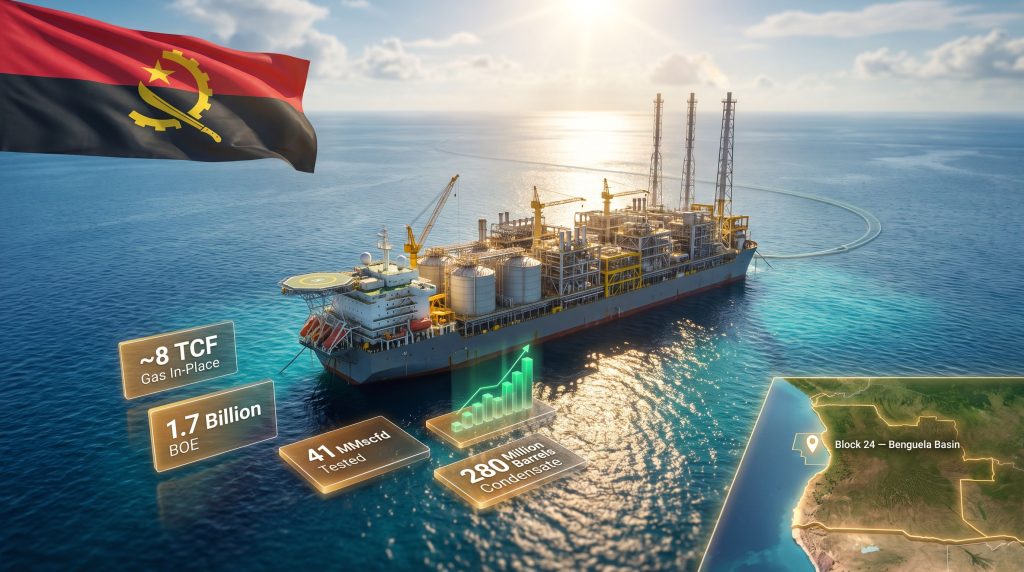
The Katambi-2 well, located on Block 24 in Angola's offshore Benguela Basin, delivered results that exceeded the reservoir quality parameters identified in the original BP appraisal. Both Sonangol and Angola's national petroleum regulator, the Agência Nacional de Petróleo, Gás e Biocombustíveis (ANPG), confirmed the results publicly in August 2026.
Reservoir Quality Metrics: A Technical Breakdown
| Parameter | Katambi-2 Result |
|---|---|
| Total productive interval thickness | ~331 metres |
| Average reservoir porosity | 9-12% |
| Stabilized gas flow rate (tested) | 41 MMscfd |
| Condensate flow rate (tested) | 1,160 barrels per day |
| Preliminary production potential | Above 100 MMscfd |
| Estimated field resources (in-place) | ~1.7 billion BOE |
| Estimated gas volume (in-place) | ~8 TCF |
| Estimated condensate volume | ~280 million barrels |
| Water or H2S detected | None |
The 331-metre productive interval across two confirmed reservoir zones is a meaningful thickness for an offshore gas-condensate system. At 9 to 12 percent porosity, these are not world-class reservoir rocks by global standards, but they are commercially workable, particularly given the absence of two reservoir quality problems that can dramatically inflate project costs.
Why No Water and No Hydrogen Sulphide Is a Bigger Deal Than It Sounds
In offshore gas development, reservoir contamination by formation water and hydrogen sulphide (H2S) are among the most consequential cost drivers an operator can encounter. H2S requires dedicated sulphur recovery infrastructure, specialised materials throughout the production system, and rigorous safety protocols that translate directly into capital and operating expenditure. Water co-production requires separation, treatment, and disposal systems that add complexity at every stage of the production process.
Katambi's reservoirs contain neither. This is not merely a technical footnote. It means the production system design is materially simpler than comparable offshore gas developments in the region, the processing infrastructure footprint is reduced, and the overall project economics improve in ways that are difficult to fully quantify until a final investment decision framework is established. For a field that already faces significant infrastructure challenges, clean reservoir chemistry is a meaningful offset.
Katambi's confirmed absence of both hydrogen sulphide and formation water reduces two of the largest cost escalation risks typically associated with deepwater offshore gas development in Sub-Saharan Africa, meaningfully improving the project's economic floor relative to regional comparisons.
Angola's First Full Non-Associated Gas Reservoir Test: The Institutional Significance
Beyond the commercial metrics, the Katambi-2 result carries institutional weight that is easy to overlook. According to reporting by Oil and Gas Journal, the test marked the first time Angola had conducted a full test of a non-associated gas reservoir, meaning a reservoir that produces gas independently of any crude oil production. This is a technical capability milestone for Sonangol and ANPG, not just a resource discovery. It signals that Angola's upstream institutions now have demonstrated competence in gas reservoir evaluation that did not formally exist in the country's operational record before this appraisal.
The Infrastructure Problem: 500 Kilometres of Open Water
The Katambi field's most significant commercial constraint is its physical isolation. Block 24 sits approximately 500 kilometres south of Angola's existing offshore infrastructure network. At that distance, no conventional tie-back to existing production and processing facilities is commercially viable. Every development scenario must address this isolation as its primary engineering and financial variable.
The picture changes partially with the progression of TotalEnergies' Kaminho deepwater project, which once operational will reduce the effective infrastructure gap from Block 24 to approximately 250 kilometres. That threshold matters because it moves Katambi from the range of complete isolation to a distance where certain pipeline development scenarios become conceptually discussable, though not automatically economical.
Scenario A: Floating LNG at the Wellhead
The first development pathway under active consideration is the deployment of a floating liquefied natural gas (FLNG) terminal directly at Block 24. FLNG technology allows gas to be liquefied offshore and loaded onto LNG carriers without any pipeline connection to shore, making it conceptually well-suited to remote deepwater locations. In addition, this pathway aligns with the global LNG supply outlook, where demand for new non-pipeline gas capacity continues to grow.
Key considerations for this scenario:
- Mid-scale FLNG units typically require USD 2 to 4 billion or more in capital expenditure, with costs scaling significantly for larger processing capacities
- Operational complexity in deepwater environments adds execution risk that must be priced into the project cost estimate
- Angola's existing LNG infrastructure at Soyo provides established buyer relationships and export logistics that could be leveraged
- FLNG eliminates dependence on third-party project timelines, giving Sonangol and any development partner greater schedule control
| Factor | Assessment |
|---|---|
| Infrastructure dependency | Low (self-contained at Block 24) |
| Capital requirement | Very high |
| Time to first production | Longer development lead time |
| Export market access | Direct global LNG market pricing |
| Suitability for remote location | High |
Scenario B: Pipeline Connection to the Lobito Industrial Complex
The second pathway involves constructing an approximately 75-kilometre pipeline connecting Block 24 gas production to the Lobito industrial complex on Angola's Atlantic coast, as reported by Upstream Online. This scenario targets domestic utilisation rather than export, with gas serving as industrial feedstock, power generation fuel, or petrochemical inputs.
Key considerations for this scenario:
- Lower capital intensity relative to FLNG, though the cost advantage narrows when deepwater pipeline engineering is fully costed
- Revenue upside is capped by domestic tariff structures rather than exposed to international LNG netback pricing
- Domestic demand absorption at Lobito must be large enough to justify dedicated infrastructure at the scale Katambi could supply
- This pathway has partial dependency on the Kaminho project timeline reducing the effective distance gap to approximately 250 kilometres
| Factor | Assessment |
|---|---|
| Infrastructure dependency | Moderate (pipeline and Lobito industrial zone) |
| Capital requirement | Moderate |
| Time to first production | Potentially faster than FLNG |
| Export market access | Indirect (domestic consumption) |
| Suitability for remote location | Conditional on Kaminho timeline |
Comparing the Two Pathways
| Development Variable | Scenario A: FLNG | Scenario B: Pipeline to Lobito |
|---|---|---|
| Primary market | Global LNG export | Domestic industrial and power |
| Infrastructure capex | Very high | Moderate |
| Revenue upside | High, LNG price-linked | Moderate, domestic tariff-linked |
| Strategic alignment | Export diversification | Industrialisation agenda |
| Third-party project dependency | Low | Moderate, tied to Kaminho |
| Environmental and social footprint | Offshore-contained | Coastal industrial zone |
How Katambi Fits Angola's Broader Gas Landscape
Angola's existing LNG benchmark is the Angola LNG project at Soyo, which processes associated gas from the country's established deepwater oil blocks. Katambi's estimated 8 TCF of gas in-place would represent a substantial addition to Angola's gas reserve inventory. Consequently, at the scale Sonangol is describing, the field is large enough to potentially anchor a second, dedicated LNG export stream rather than simply topping up existing capacity.
Angola has also carried a persistent gas flaring problem tied to its reliance on associated gas from oil production. When crude output varies, so does the gas available for processing. Non-associated fields like Katambi produce gas on their own terms, independent of oil production levels. This structural difference has implications for Angola's energy transition demand trends and its stated ambitions to reduce routine flaring, though the development timeline for Katambi means those benefits remain years away from being realised.
Angola in Africa's Emerging Gas Export Landscape
| Country | Key Gas Asset | Status |
|---|---|---|
| Angola | Katambi, Block 24 | Appraisal confirmed, development planning |
| Mozambique | Rovuma Basin LNG | Partial production; ongoing security challenges |
| Tanzania | Block 1 and 4 offshore gas | Development planning stage |
| Nigeria | Various deepwater fields | Established LNG exporter |
| Namibia | Orange Basin (Shell and TotalEnergies) | Appraisal ongoing |
What This Means for Sonangol's Strategic Evolution
The Sonangol Katambi gas discovery in Angola marks a meaningful departure from Sonangol's historical identity as a crude oil-focused national oil company. The technical execution of Angola's first full non-associated gas reservoir test, combined with the scale of the resource being claimed, positions Sonangol as an emerging gas operator with credible upstream competence in a domain where it previously had limited operational history.
Financing and partnership requirements for full development will almost certainly exceed what Sonangol can manage from its standalone balance sheet. At the capital intensities implied by either development scenario, securing a technically capable international partner with FLNG or deepwater gas pipeline expertise is a prerequisite for advancement. The resource scale and reservoir quality should attract interest from LNG-focused majors and potentially Asian national oil companies seeking long-term gas supply exposure, though the infrastructure remoteness will temper enthusiasm until a credible development pathway is confirmed.
At roughly 8 TCF of gas in-place and 280 million barrels of condensate, Katambi's resource base is large enough to anchor a standalone LNG development. However, infrastructure remoteness and the capital requirements of either development scenario mean the timeline from appraisal to first production will be measured in years, not months. Investors and policymakers should calibrate expectations accordingly.
Three Conditions Required for Katambi to Reach Full Development
- Infrastructure resolution — either FLNG deployment or confirmation of the Kaminho project timeline materially reducing the distance gap to approximately 250 kilometres
- Partner selection — Sonangol identifying and securing a development partner with demonstrated technical capability in FLNG or deepwater gas pipeline construction, alongside sufficient balance sheet strength to co-fund a multi-billion-dollar development
- Fiscal framework stability — ensuring that the 10-year tax exemption and broader gas fiscal terms introduced under Angola's 2018 reforms remain intact through the full development decision cycle, providing the investment certainty that major capital commitments require
The next major ASX story will hit our subscribers first
Frequently Asked Questions About the Katambi Gas Discovery
What is the Katambi gas field and where is it located?
Katambi is an offshore gas-condensate field located on Block 24 in Angola's Benguela Basin, situated approximately 500 kilometres south of Angola's existing offshore infrastructure network.
Who originally drilled the first Katambi well and why was it not developed?
BP drilled the original Katambi-1 well approximately a decade ago and subsequently returned its stake after concluding the discovery was not commercially viable. Under the regulatory framework in place at the time, non-associated gas could not be independently commercialised by private operators, removing the primary commercial incentive for further appraisal.
What did the Katambi-2 appraisal well confirm?
The Katambi-2 well confirmed two productive reservoir intervals across approximately 331 metres of total thickness. The well tested at a stabilised rate of 41 MMscfd of gas and 1,160 barrels per day of condensate. Preliminary assessments indicate production potential above 100 MMscfd. Critically, no water or hydrogen sulphide was detected in the reservoir.
How large is the Katambi gas field?
Sonangol estimates the Katambi field holds approximately 1.7 billion barrels of oil equivalent in-place, comprising roughly 8 TCF of gas and approximately 280 million barrels of condensate. Sonangol has described this as potentially Angola's largest gas field based on its available data.
What are the two development options being considered?
The two primary development scenarios are: a floating LNG terminal installed at the offshore Block 24 location, enabling direct LNG export; and an approximately 75-kilometre pipeline connecting to the Lobito industrial complex on Angola's coast, targeting domestic industrial and power generation demand.
Why does the absence of hydrogen sulphide matter commercially?
H2S-free reservoirs eliminate the need for sulphur recovery infrastructure, reduce materials costs across the production system, and simplify safety requirements. Combined with the absence of formation water, clean reservoir chemistry at Katambi meaningfully improves project economics relative to comparable offshore gas developments in the region.
How do Angola's 2018 gas reforms connect to the Katambi discovery?
The 2018 presidential decree opened non-associated gas exploration and production to private investment for the first time and introduced a 10-year tax exemption for new gas projects. This reformed commercial framework transformed the economic case for gas appraisal across Angola's offshore acreage, directly enabling the development logic that led to the Katambi-2 appraisal.
The Broader Signal for African Gas Investment
The Sonangol Katambi gas discovery in Angola is more significant as a proof of concept than as a standalone resource event. It demonstrates that regulatory reform, when designed with sufficient fiscal depth and legal clarity, can unlock stranded resources that international operators previously assessed as commercially inert. Resources do not change. Commercial frameworks do.
For investors tracking the commodity outlook for 2025 and beyond, the Katambi appraisal reinforces the investment case for Angola's offshore acreage beyond its maturing oil blocks. Furthermore, it signals that the country is positioning itself as a meaningful participant in the global LNG supply growth story alongside Mozambique, Tanzania, and Namibia. The development path ahead is complex, capital-intensive, and subject to timeline uncertainty. However, the geological foundation has now been confirmed, the regulatory architecture has been rebuilt, and Angola's largest potential gas field is no longer classified as commercially irrelevant. Investors tracking resource and energy exports from emerging markets will find the Katambi story an instructive parallel for how policy and geology intersect to create new opportunities.
Disclaimer: This article contains forward-looking analysis, scenario modelling, and resource estimates based on publicly available information. Resource estimates and preliminary production rates represent early-stage assessments and should not be interpreted as definitive reserve certifications. Infrastructure timelines, development costs, and commercial outcomes remain subject to material uncertainty. This article does not constitute financial advice.
Want to Track the Next Major Energy or Mineral Discovery Before the Market Moves?
Discovery Alert's proprietary Discovery IQ model scans ASX announcements in real time, instantly identifying significant resource discoveries across over 30 commodities — transforming complex geological data into clear, actionable investment insights for traders and long-term investors alike. Explore how historic discoveries have generated exceptional returns on Discovery Alert's dedicated discoveries page, and begin your 14-day free trial today to position yourself ahead of the broader market.