June 16, 2026
Strategic Energy Transformation Through Advanced Nuclear Development
The energy landscape across the United States faces unprecedented challenges as artificial intelligence infrastructure drives exponential electricity demand growth while traditional power generation struggles to maintain reliability during extreme weather events. State-level energy strategies have emerged as critical frameworks for addressing these dual pressures, with comprehensive approaches targeting both immediate grid stability needs and long-term energy security objectives. This convergence of technological demand surge and climate resilience requirements creates unique opportunities for advanced nuclear technologies that can deliver continuous baseload capacity regardless of weather conditions or time-of-day variations.
Energy planners recognise that conventional renewable deployments, while essential for decarbonisation goals, cannot independently satisfy the reliability requirements of hyperscale data centers and industrial facilities that operate continuously. Furthermore, the uranium market dynamics demonstrate how global supply chains affect nuclear fuel availability. Nuclear energy provides the missing link between renewable intermittency and industrial demand certainty, offering capacity factors exceeding 90% during exactly the periods when wind and solar generation underperform.
When big ASX news breaks, our subscribers know first
Comprehensive Nuclear Investment Strategy
The Texas nuclear energy initiative represents the most ambitious state-level nuclear advancement program in the United States, deploying $350 million through a newly established Advanced Nuclear Energy Office. This institutional framework addresses projected electricity demand scenarios where ERCOT forecasting models indicate consumption could approach double current levels by 2030, driven primarily by artificial intelligence infrastructure requirements.
State-Level Nuclear Advancement Architecture
The strategic framework establishes unprecedented coordination mechanisms between state and federal regulatory processes, creating accelerated pathways for advanced reactor deployment while maintaining safety standards. Unlike traditional energy programs that focus on single technologies or incremental capacity additions, this comprehensive approach targets multiple reactor designs simultaneously to reduce single-point-of-failure risks while maximising learning opportunities across different nuclear technologies.
However, recent developments regarding the uranium import ban impact have created new considerations for domestic supply chain security. The initiative addresses structural mismatches between projected AI-driven demand growth and renewable energy's intermittency characteristics through dedicated baseload capacity that operates independently of weather conditions.
Current ERCOT planning reserve margins of 13.75% become insufficient when extreme weather events simultaneously reduce renewable generation while increasing heating or cooling demand. Consequently, these conditions create supply-demand gaps that only dispatchable generation can reliably fill.
Capital Formation and Investment Timeline
Implementation timelines target operational capacity within five years through coordinated Early Site Permit processes with the Nuclear Regulatory Commission. This compressed development schedule leverages factory construction methods for small modular reactors, enabling quality control improvements and cost reductions compared to traditional large-scale nuclear projects that require decade-long construction periods.
The funding allocation prioritises demonstration projects that can establish regulatory precedents for commercial deployments while creating workforce development pathways from academic institutions to nuclear operations. In addition, Texas has launched a comprehensive initiative to position itself as a leader in nuclear technology development.
Policy Framework Innovation and Regulatory Coordination
House Bill 14 establishes legislative architecture that transcends traditional energy regulation by creating dedicated manufacturing ecosystems specifically designed for nuclear technology deployment. This policy framework positions the state as a testing ground for federal nuclear policy scalability while establishing institutional precedents that other states can adopt and adapt for their specific energy requirements.
Manufacturing Incentive Systems
The legislation creates supply chain localisation targets focusing on domestic uranium enrichment capabilities, fabrication facility development, and workforce pipeline establishment. These manufacturing incentives address national energy security objectives while creating high-wage employment opportunities in advanced manufacturing sectors that support both nuclear operations and broader industrial applications.
Manufacturing facility incentives specifically target components and materials that can serve multiple reactor designs, avoiding vendor-specific investments that might become stranded if particular technologies fail to achieve commercial viability. Moreover, the US uranium production surge provides additional context for domestic supply chain development strategies.
Federal-State Regulatory Integration
Regulatory coordination mechanisms align state permitting processes with NRC Early Site Permit procedures, creating streamlined approval pathways that reduce administrative redundancy while maintaining comprehensive safety reviews. This coordination model establishes templates for other states considering advanced nuclear deployment while providing feedback mechanisms that can inform federal regulatory modernisation efforts.
Integration with ERCOT interconnection requirements ensures that nuclear facilities can contribute effectively to grid stability during peak demand periods and extreme weather events. These coordination frameworks address both technical integration challenges and economic dispatch considerations that affect nuclear plant capacity utilisation and revenue generation.
Artificial Intelligence Infrastructure Demand Analysis
ERCOT forecasting models project electricity consumption increases approaching 100% by 2030, with artificial intelligence infrastructure representing the primary demand driver for this unprecedented growth trajectory. Unlike traditional industrial loads that can be scheduled or temporarily interrupted during supply constraints, AI data centers require continuous power delivery with minimal latency-related fluctuations.
Technology Company Power Requirements
Meta's nuclear procurement strategy demonstrates the scale of corporate commitments driving nuclear deployment, with announcements targeting 1-4 GW of new nuclear capacity. This requirement translates to approximately 1-2 large commercial reactors or 5-20 small modular reactors, representing 10-30% of current total nuclear generation capacity across the state.
• Power factor specifications: AI inference clusters require stable voltage delivery without the fluctuations that can disrupt computational processes
• Cooling load integration: High-density data centers consume 10-15 megawatts of thermal energy per 100 megawatts of electrical capacity
• Redundancy configurations: Data center interconnection typically requires N+1 or N+2 backup power arrangements
• Continuous operation requirements: Unlike traditional peak-load patterns, AI facilities operate at full capacity regardless of time-of-day or seasonal variations
Grid Reliability Under AI Load Growth
The demand characteristics of AI infrastructure create structural requirements for nuclear baseload capacity that renewable sources cannot reliably satisfy independently. Wind generation drops during calm periods exactly when data centers still require full power, while solar output decreases during cloud cover when computational processes continue operating at maximum capacity.
Private investment backing from technology leaders like Bill Gates through TerraPower and Sam Altman through Oklo provides capital formation models for scaling nuclear deployment beyond traditional utility-financed projects. These investment approaches demonstrate how technology companies can directly participate in nuclear development rather than simply purchasing power through traditional procurement contracts.
Grid Stability and Energy Security Enhancement
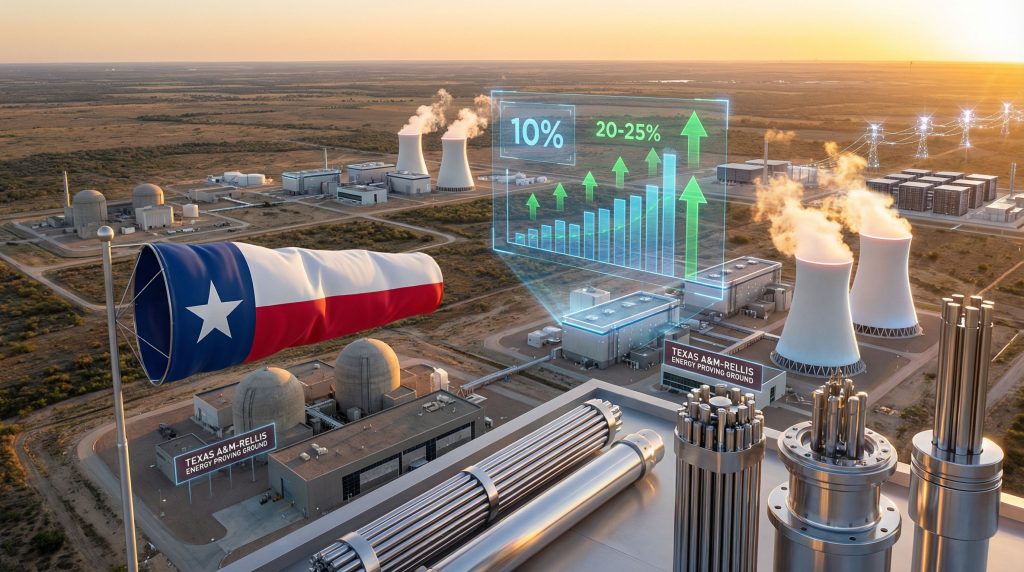
Current nuclear capacity provides approximately 10% of electricity generation through the Comanche Peak Nuclear Power Plant (1,250 MW) and South Texas Project (2,700 MW), totaling nearly 4,000 MW of baseload capacity that operates at 90%+ capacity factors regardless of weather conditions.
What Challenges Does Extreme Weather Present to Grid Reliability?
Strategic energy planners identify nuclear expansion as essential for grid reliability during simultaneous renewable generation reductions and demand surges that characterise extreme weather events. The February 2021 winter storm demonstrated this vulnerability when wind generation dropped to near-zero during peak heating demand, while nuclear plants maintained continuous operation throughout the crisis period.
Historical Performance Data:
| Weather Event | Nuclear Performance | Wind Generation | Grid Impact |
|---|---|---|---|
| Winter 2021 Freeze | 100% capacity factor | Near-zero output | Nuclear provided critical baseload |
| Summer 2023 Heat Wave | Continuous operation | Reduced efficiency | Nuclear maintained stability |
| Typical Storm Periods | 90%+ availability | Highly variable | Nuclear provides reliability anchor |
Energy Independence and Supply Security
Nuclear expansion reduces reliance on natural gas imports from other regions while eliminating vulnerability to pipeline disruptions that can affect fossil fuel supply chains during extreme weather or infrastructure incidents. Domestic uranium enrichment capabilities strengthen national energy security while reducing dependence on foreign nuclear fuel supplies.
The strategic approach targets supply chain localisation for uranium mining, enrichment, and fuel fabrication to create closed-loop domestic nuclear fuel cycles. Furthermore, understanding uranium spot price dynamics helps inform long-term planning strategies for nuclear fuel procurement.
Small Modular Reactor Technology Deployment
The Texas A&M-RELLIS Energy Proving Ground serves as a multi-vendor testing facility with potential capacity exceeding 1 GW across multiple demonstration units. This facility model accelerates technology development by allowing simultaneous testing of different reactor designs while creating workforce development opportunities and regulatory precedents.
Advanced Reactor Technology Portfolio
Partnership ecosystem includes multiple advanced nuclear companies:
• Aalo Atomics: Microreactor designs targeting AI infrastructure applications
• Kairos Power: Fluoride salt-cooled high-temperature reactors
• Natura Resources: Molten salt reactor systems for industrial applications
• X-energy: Helium-cooled pebble-bed reactor technology
The testing facility approach compresses typical 10-15 year demonstration-to-commercialisation timelines by enabling coordinated regulatory reviews and shared infrastructure development. Multiple vendors can demonstrate reactor technologies simultaneously rather than sequentially, accelerating learning curves and technology optimisation processes.
Molten Salt Reactor Industrial Integration
Natura Resources' dual-reactor strategy combines grid-connected electricity generation with industrial heat applications, demonstrating how advanced nuclear technologies can serve multiple energy needs simultaneously. The 100-MWe grid-connected unit provides baseload electricity while the Permian Basin desalination facility utilises waste heat for industrial water treatment.
Advanced molten salt reactors operate at atmospheric pressure, eliminating pressurised-boundary rupture risks while demonstrating negative temperature coefficients that automatically slow reactor operation as temperatures increase.
Industrial integration with the Texas Produced Water Consortium addresses regional water scarcity by converting oil and gas production wastewater into usable water supplies. The Permian Basin produces approximately 3-5 barrels of produced water per barrel of oil recovered, creating significant waste streams that nuclear-powered desalination can convert into valuable water resources.
The next major ASX story will hit our subscribers first
Microreactor Innovation and Commercial Applications
Last Energy's Haskell County project demonstrates scalable microreactor deployment through 30 modular units of 20 MWe capacity each, totaling 600 MW of distributed nuclear generation. This modular approach enables incremental capacity additions that can match demand growth patterns while reducing upfront capital requirements compared to large single-unit projects.
Distributed Nuclear Generation Model
Project Timeline and Specifications:
| Developer | Location | Capacity | Application | Timeline |
|---|---|---|---|---|
| Last Energy | Haskell County | 600 MW (30 x 20 MW) | Data center power | Fuel delivery Sept 2026 |
| Aalo Atomics | Austin area | Variable microreactor | AI infrastructure | Mass production phase |
| X-energy | Seadrift | Four Xe-100 SMRs | Industrial steam/power | Construction late 2020s |
The fuel delivery timeline for September 2026 represents one of the most aggressive deployment schedules for advanced nuclear technology in the United States, demonstrating how factory construction and modular design can accelerate project development compared to traditional large-scale nuclear construction.
Technology Integration with Data Centers
Aalo Atomics' Austin-area microreactor specifically targets artificial intelligence infrastructure applications, providing dedicated power supplies for hyperscale data centers that require guaranteed continuous operation. Variable capacity configurations enable matching reactor output to data center load profiles while providing backup power capabilities.
Microreactor technology offers advantages for distributed generation including reduced transmission losses, enhanced grid resilience, and ability to serve remote industrial applications. These smaller reactors can be manufactured in factories rather than constructed on-site, improving quality control while reducing construction timelines and costs.
Public-Private Partnership Development
University research institutions serve as anchor partners for reactor demonstration programs while creating talent pipelines for commercial nuclear operations. Texas A&M University and Abilene Christian University provide research capabilities, testing facilities, and workforce development programs that bridge academic nuclear engineering education with practical reactor operations.
Academic-Industry Integration Framework
Research partnerships create pathways from academic study to commercial deployment while establishing regulatory precedents for future projects. Students and faculty participate directly in reactor testing and operations, creating experienced workforce pools for expanding nuclear operations while advancing reactor technology development.
On-site training programs at demonstration facilities provide hands-on experience with advanced reactor technologies that differ significantly from traditional large-scale nuclear plants. Additionally, the Alta Mesa uranium project exemplifies innovative approaches to domestic uranium extraction that support fuel cycle security.
Corporate Investment and Demand Certainty
Technology company commitments create quantifiable demand certainty that supports nuclear project financing and development. Meta's 1-4 GW requirement represents explicit corporate backing for nuclear power procurement, moving beyond traditional utility-scale development models toward direct corporate investment in nuclear capacity.
Private investment backing from energy technology leaders demonstrates capital formation approaches that can scale nuclear deployment:
• Bill Gates (TerraPower): Advanced reactor technology development and demonstration
• Sam Altman (Oklo): Microreactor commercialisation and deployment scaling
• Technology company partnerships: Direct corporate nuclear procurement agreements
These investment models enable nuclear development outside traditional utility rate structures while creating revenue certainty that supports project financing and accelerated deployment timelines.
Economic Development and Strategic Positioning
Nuclear industry development creates multiplier effects across manufacturing, engineering, construction, and operations sectors while positioning the state as a hub for nuclear technology export and consulting services. High-wage employment opportunities extend beyond direct nuclear operations to include supply chain manufacturing, research and development, and international technology transfer.
Competitive Positioning Analysis
State-level nuclear investment exceeds other regional commitments, potentially attracting federal matching funds and private investment flows that reinforce first-mover advantages in advanced nuclear manufacturing. Early deployment success creates opportunities to export nuclear technology, engineering services, and operational expertise to other states and international markets.
Supply chain localisation strategy targets components and materials that serve multiple reactor designs while creating domestic manufacturing capabilities for:
• Uranium mining and processing: Domestic fuel cycle development
• Component manufacturing: Reactor vessels, steam generators, control systems
• Fuel fabrication: Advanced fuel designs for new reactor technologies
• Maintenance and services: Operations support for expanding nuclear fleet
Long-term Economic Impact Projections
Successful nuclear expansion could increase nuclear's share of electricity generation from 10% to potentially 20-25% by 2030, providing baseload capacity for continued economic growth and technology sector expansion. This increased nuclear capacity reduces vulnerability to natural gas price volatility while supporting industrial growth that requires reliable continuous power supply.
Economic development extends beyond direct energy production to include advanced manufacturing, research institutions, and technology development clusters that benefit from reliable low-cost electricity and proximity to nuclear innovation centers. The Texas nuclear energy initiative creates lasting infrastructure for continued competitiveness in global energy markets.
Implementation Challenges and Risk Mitigation
NRC licensing processes for advanced reactors remain largely untested at commercial scale, creating potential delays for first-generation deployments despite agency modernisation efforts. Projects serve as test cases for federal regulatory efficiency improvements while establishing precedents that can streamline future licensing procedures.
Regulatory Timeline Management
Technology diversification across multiple reactor designs reduces single-point-of-failure risks while accelerating learning across different nuclear technologies. If particular reactor designs encounter regulatory delays or technical challenges, alternative technologies can maintain overall program momentum and capacity development.
Coordination between state and federal agencies addresses potential regulatory conflicts while ensuring that state initiatives support rather than complicate federal nuclear policy objectives. Early Site Permit processes establish site-specific approvals that can accommodate multiple reactor technologies as they achieve design certification.
Public Acceptance and Environmental Considerations
Opposition to specific projects highlights ongoing public concerns about nuclear expansion despite demonstrated safety improvements in advanced reactor designs. Success depends on transparent communication about safety protocols, environmental benefits compared to fossil fuel alternatives, and economic advantages for local communities.
Environmental benefits include eliminating air pollution from fossil fuel generation while providing reliable power that enables renewable energy integration without requiring excessive backup generation capacity. Advanced reactors demonstrate passive safety features that reduce accident risks compared to older nuclear plant designs.
National Competitiveness and Strategic Context
Federal nuclear policy alignment creates synergistic relationships between state initiatives and national energy security objectives. State deployment success supports broader American competitiveness in advanced nuclear technologies while reducing dependence on foreign nuclear fuel and reactor designs.
International Nuclear Renaissance Context
Global nuclear capacity expansion, particularly across Asia and Europe, creates urgency for domestic nuclear industry revitalisation to maintain technological leadership and export opportunities. Early deployment success positions American nuclear technologies for international market penetration while demonstrating regulatory frameworks that other countries can adapt.
Competitive advantages developed through successful deployment include:
• Regulatory experience: Proven pathways for advanced reactor licensing
• Workforce expertise: Trained technicians and engineers for nuclear operations
• Manufacturing capabilities: Domestic supply chains for reactor components
• Technology leadership: Advanced reactor designs optimised for various applications
Energy Independence Strategic Benefits
Nuclear expansion reduces reliance on fossil fuel imports while strengthening domestic energy security through diversified generation portfolios. Advanced nuclear technologies provide options for industrial heat applications, hydrogen production, and other energy-intensive processes that support economic growth while reducing greenhouse gas emissions.
Domestic nuclear fuel cycle development reduces vulnerability to international supply disruptions while creating export opportunities for nuclear fuel and reactor services. This energy independence supports continued economic growth while maintaining environmental commitments through clean baseload generation.
How Will Nuclear Technology Shape Future Energy Scenarios?
2030 energy portfolio projections assume successful implementation could establish nuclear as a 20-25% share of state electricity generation, providing reliable baseload capacity that enables continued economic expansion while supporting renewable energy integration. This nuclear expansion facilitates industrial growth and technology sector development that requires guaranteed continuous power supply.
Technology Sector Growth Facilitation
Guaranteed nuclear baseload capacity removes electricity supply constraints that might otherwise limit data center development and artificial intelligence infrastructure expansion. Continuous power availability at competitive prices attracts additional technology companies while supporting existing facilities' growth requirements.
Industrial development multiplier effects create opportunities across manufacturing, research, and services sectors that benefit from reliable low-cost electricity. Nuclear power supports energy-intensive industries including advanced manufacturing, chemical processing, and materials production that require continuous operations.
Climate and Energy Transition Integration
Nuclear expansion facilitates renewable energy integration by providing reliable backup power that reduces requirements for fossil fuel peaking plants during periods of low wind or solar generation. This complementary approach accelerates decarbonisation while maintaining grid reliability and industrial competitiveness.
Advanced nuclear technologies demonstrate pathways for industrial heat applications that can replace fossil fuel use in manufacturing processes, chemical production, and other high-temperature industrial applications. These industrial applications extend nuclear's climate benefits beyond electricity generation to broader economic decarbonisation.
Industry experts recognise that nuclear energy represents a strategic opportunity for long-term energy security and economic development. The Texas nuclear energy initiative positions the state at the forefront of this transformation, creating lasting benefits for energy independence and industrial competitiveness.
Disclaimer: This analysis contains forward-looking projections and strategic scenarios that involve uncertainties regarding regulatory approval timelines, technology development progress, and market conditions. Actual outcomes may differ significantly from projections due to technical, regulatory, economic, or political factors beyond current control or prediction.
Ready to Invest in the Next Major Uranium Discovery?
Discovery Alert's proprietary Discovery IQ model delivers real-time alerts on significant uranium discoveries across the ASX, instantly empowering subscribers to identify actionable opportunities ahead of the broader market. Understand why historic discoveries can generate substantial returns by visiting Discovery Alert's dedicated discoveries page, showcasing exceptional outcomes from previous uranium finds, and begin your 30-day free trial today to position yourself ahead of the market.