June 26, 2026
The Silent Energy Giant Beneath the Himalayas: Why Geothermal Has Been Hiding in Plain Sight
Beneath some of the most forbidding terrain on Earth, a different kind of energy story is unfolding. Across the world's most productive geothermal economies, the common thread is not just abundant heat — it is the willingness to drill into complexity. Iceland built an entire modern energy identity on volcanic geology. Kenya transformed its rift valley into a continental renewable anchor. Indonesia, sitting atop the Pacific Ring of Fire, has developed more than 2,400 megawatts of installed geothermal capacity, the largest in Asia. Yet India, which sits directly atop one of the planet's most thermally active tectonic boundaries, has not commissioned a single commercial geothermal power plant. That anomaly is finally approaching its end.
The Ladakh geothermal energy project at Puga Valley is not merely an infrastructure milestone. It represents a fundamental rethinking of what India's renewable energy portfolio could look like if the country begins taking its own geology seriously. Furthermore, it connects directly to broader conversations around critical minerals and energy security that are reshaping how nations plan their energy futures.
When big ASX news breaks, our subscribers know first
Why Puga Valley Holds Such Extraordinary Energy Potential
The Tectonic Engine Driving Himalayan Heat
To understand why Puga Valley registers such exceptional subsurface temperatures, it helps to understand what is happening kilometres beneath the surface. The Himalayas exist because the Indian tectonic plate has been colliding with the Eurasian plate for approximately 50 million years, a convergence that has not stopped. This ongoing collision generates intense mechanical stress and friction deep within the crust, creating conditions where geothermal gradients — the rate at which temperature increases with depth — are dramatically steeper than in geologically stable regions.
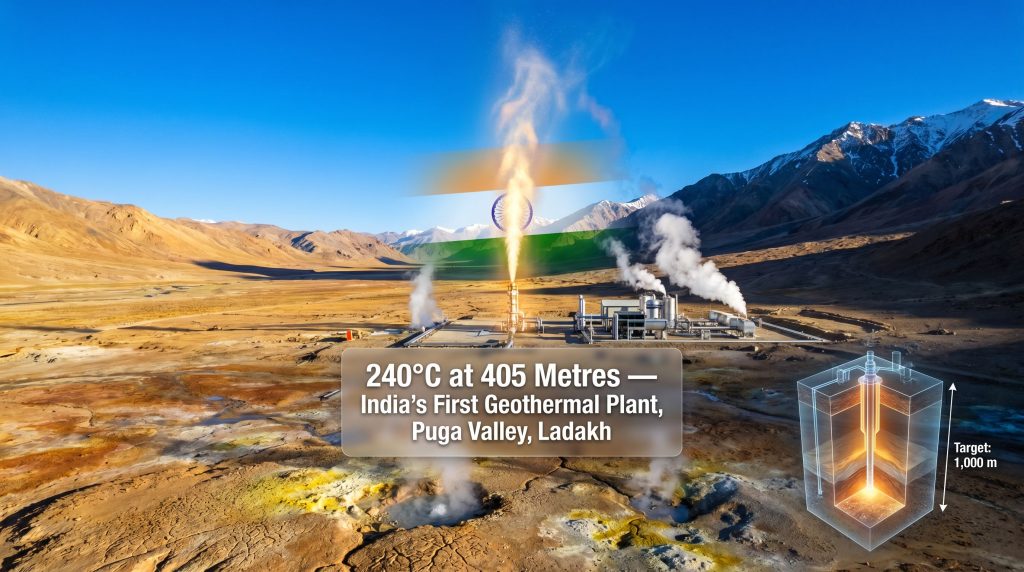
In typical continental settings, temperatures increase at roughly 25 to 30 degrees Celsius per kilometre of depth. In tectonically active zones like the Himalayan geothermal belt, that gradient can be several times higher. Puga Valley sits squarely within this belt, and the numbers confirm it: geothermometric analysis of samples extracted from the test well recorded subsurface temperatures exceeding 240°C at a depth of just 405 metres, according to an official release cited by ANI via ET EnergyWorld in May 2026. In most geothermal fields globally, reaching temperatures sufficient for power generation requires drilling to depths of 1,500 metres or more. Puga achieves this threshold at less than half that depth.
India's Long Geothermal Blind Spot
Despite this thermodynamic advantage, India has historically channelled renewable energy investment almost entirely into solar and wind. The country's solar capacity has grown exponentially over the past decade, driven by falling module costs and strong policy support. Geothermal, however, has received comparatively marginal attention in national energy policy frameworks, despite the Geological Survey of India identifying several prospective geothermal zones across the country as far back as the 1970s.
Several structural factors explain this gap:
- Geothermal development requires high upfront capital for exploratory drilling, with no guarantee of viable steam yields before significant expenditure
- The technology and operational expertise required for high-enthalpy geothermal systems is not widely available domestically
- India's renewable energy policy incentives have predominantly targeted solar and wind, creating a resource allocation imbalance
- The most thermally productive zones, particularly in Ladakh and Himachal Pradesh, are in remote, high-altitude locations that present severe logistical challenges
- Geothermal's contribution to India's total energy mix has remained at zero commercial scale, reducing institutional familiarity with the resource class
This combination of policy inertia, technical unfamiliarity, and geographic difficulty has kept India's geothermal potential largely theoretical for decades, making the Puga Valley pilot all the more significant as a proof-of-concept exercise.
Comparing Puga to Global Geothermal Benchmarks
When Puga Valley's thermodynamic profile is placed alongside the world's leading geothermal fields, its resource quality becomes more apparent. Indeed, geothermal brine extraction projects in other parts of the world offer instructive parallels for how such resources can be commercially developed.
| Country / Field | Installed Capacity | Notable Feature | Relevance to Puga |
|---|---|---|---|
| Iceland (National Grid) | ~750 MW+ | Near-surface volcanic heat | Demonstrates 24/7 baseload viability at scale |
| Kenya (Olkaria) | ~800 MW | East African Rift system | Tectonic belt analogue with comparable gradients |
| Tibet (Yangbajing) | ~28 MW | High-altitude Himalayan geology | Closest structural and geographic parallel |
| Indonesia (National) | ~2,400 MW | Highest installed capacity in Asia | Long-term scale benchmark for India |
| India (Puga, Pilot) | 1 MWe (target) | First-ever commercial geothermal plant | Foundational milestone for a nascent sector |
Tibet's Yangbajain field is perhaps the most instructive comparison. Operating at high altitude within the same Himalayan tectonic system, Yangbajain has been producing power since the 1970s, demonstrating that high-altitude Himalayan geothermal is not just theoretically viable but commercially operational. India's proximity to this geological analogue makes the absence of a domestic equivalent all the more striking.
Project Architecture: Who Is Building What and Why
The Governance Structure Behind India's First Geothermal Plant
The Ladakh geothermal energy project operates under a tripartite memorandum of understanding involving three parties: the Union Territory Administration of Ladakh, the Ladakh Autonomous Hill Development Council (LAHDC) Leh, and ONGC Energy Centre, a specialised division of the Oil and Natural Gas Corporation of India. ONGC is India's largest state-owned oil and gas enterprise, and its involvement signals the application of deep drilling expertise — normally deployed in hydrocarbon exploration — to geothermal resource development.
The original MoU was executed on 6 February 2021 and lapsed on 5 February 2026. A five-year extension was subsequently approved by Lieutenant Governor Vinai Kumar Saxena, extending the partnership through to 2031. The extension was necessitated by delays attributable to the region's extreme climate and terrain, factors that compress the annual working season into a narrow window and complicate equipment mobilisation at altitudes exceeding 14,000 feet above sea level (ANI/ET EnergyWorld, May 2026).
Technical Specifications at a Glance
| Parameter | Detail |
|---|---|
| Project Location | Puga Valley, Ladakh |
| Altitude | Over 14,000 feet above sea level |
| Lead Developer | ONGC Energy Centre |
| Governance Partners | UT Administration of Ladakh, LAHDC Leh |
| Pilot Plant Capacity (Target) | 1 MWe |
| Turbine Inlet Temperature | ~200°C |
| Subsurface Temperature Recorded | Exceeding 240°C |
| First Well Depth Achieved | 405 metres (2025) |
| Next Drilling Phase Target | 1,000 metres |
| MoU Extension Period | 5 years (from February 2026) |
| Phase II Survey Area | Chumathang region |
| Pilot Commissioning Target | FY 2026-27 |
Drilling Into the Unknown: The Two-Phase Technical Strategy
From 405 Metres to 1,000 Metres: Why Depth Changes Everything
The successful drilling of the first geothermal well to 405 metres in 2025 was a meaningful achievement given the operating environment, but it was always understood as an exploratory precursor rather than a production depth. Geothermal wells drilled for power generation typically require substantially greater depth to access steam reservoirs with sufficient pressure and volume for continuous turbine operation. For further context, direct lithium extraction technologies developed for other subsurface resources share some analogous engineering challenges around deep fluid management.
The next stage of the Ladakh geothermal energy project involves deepening the existing well to 1,000 metres during the 2026 working season, followed by drilling a second well to the same depth in a subsequent phase. This two-well strategy serves multiple purposes:
- Deeper penetration accesses higher-temperature and higher-pressure steam zones, improving the thermodynamic efficiency of power generation
- A second well provides operational redundancy, allowing one well to function as an injection well for geothermal fluid reinjection, a critical practice for sustainable resource management
- Flow testing between wells helps characterise the reservoir geometry, permeability, and long-term production potential
- Combined data from both wells informs the Detailed Project Report (DPR) needed for commercial-scale expansion
Testing, evaluation, and commissioning of the 1 MWe pilot plant is targeted for financial year 2026-27, with Phase II surveys in the Chumathang area to follow.
Phase Development Roadmap
| Development Phase | Key Activities | Target Outcome |
|---|---|---|
| Phase I, 2026 Working Season | Deepen existing well to 1,000 m | Confirm commercial steam yield |
| Phase I, Next Stage | Drill second well to 1,000 m | Redundancy and flow testing |
| Phase I, FY 2026-27 | Testing, evaluation, commissioning | 1 MWe pilot plant operational |
| Phase II | Surveys in Chumathang area | DPR for large-scale development |
| Phase II, Long-Term | Commercial-scale exploitation | Regional energy security transformation |
Engineering at the Roof of the World: Challenges Beyond the Drilling Bit
What Makes Puga One of the Most Demanding Geothermal Sites on Earth
Operating at over 14,000 feet introduces engineering constraints that do not exist in conventional geothermal settings. Atmospheric pressure at this altitude is approximately 60% of sea level pressure, which affects diesel engine performance, hydraulic system behaviour, and the thermodynamic characteristics of steam extraction equipment. Personnel productivity also declines substantially in hypoxic conditions, extending timelines and increasing operational costs.
The seasonal working window is severely compressed. Puga Valley experiences extreme winters that make drilling operations impractical for extended periods, effectively limiting active site work to a narrow annual window. This constraint is the primary reason significant work remained incomplete when the original MoU expired in February 2026, despite five years of effort.
Equipment logistics present a separate layer of complexity. Heavy drilling rigs, casing materials, and specialised geothermal wellhead equipment must be transported over high-altitude mountain roads that are themselves subject to seasonal closure, avalanche risk, and limited load capacity. According to reporting on the Puga Valley geothermal project, drilling resumptions have repeatedly been subject to these logistical pressures.
The Ecological Dimension: A Fragile Ecosystem at Stake
Environmental Note: Earlier phases of drilling at Puga raised concerns when geothermal fluid reportedly escaped into a nearby stream — a reminder that the region's high-altitude hydrology and wildlife habitat demand rigorous containment protocols. The Puga area supports critical ecosystems, and any fluid containment failure carries ecological consequences that extend well beyond the project boundary.
Geothermal fluids extracted at high temperatures often carry dissolved minerals, gases, and trace elements that can be environmentally harmful if released untreated. Best-practice geothermal operations use closed-loop systems and carefully managed fluid reinjection to minimise surface impact. For the Puga Valley project, environmental accountability is not a supplementary concern but a prerequisite for long-term operational credibility.
Ladakh's Broader Renewable Vision: Where Geothermal Fits
The Strategic Case for Baseload Power in a High-Altitude Off-Grid Environment
Ladakh's energy vulnerability is most acute in winter. Solar irradiance drops significantly, days are short, temperatures are extreme, and electricity demand for heating surges precisely when generation capacity is weakest. This is the fundamental limitation of solar-centric energy strategies in high-altitude, high-latitude environments. Consequently, the role of renewable energy in mining and remote operations across similarly challenging geographies provides useful lessons for Ladakh's planners.
Geothermal power operates at full capacity regardless of season, weather, or time of day. Unlike solar or wind, which are variable by nature, geothermal generation from a producing reservoir is essentially continuous, making it a true baseload resource. This characteristic makes it uniquely valuable for Ladakh's winter energy security in ways that no amount of additional solar panel capacity can replicate.
Strategic Framing: The complementarity between Ladakh's existing solar installations and a future geothermal baseload is not accidental. Solar handles peak summer daytime demand efficiently, while geothermal can anchor the grid through winter and overnight — a combination that could, in principle, make Ladakh genuinely energy self-sufficient across all seasons.
A 500 kWp solar demonstration plant at Pang has already been developed as part of Ladakh's renewable energy portfolio, and the geothermal project at Puga is intended to complement rather than compete with such solar assets, providing the seasonal and diurnal balance that solar alone cannot deliver.
Livelihoods, Tourism, and Distributed Heating
Beyond grid electricity, geothermal energy at Puga Valley carries practical applications that could directly improve quality of life in surrounding communities. Geothermal heat at moderate temperatures — even below the threshold required for power generation — is widely used globally for direct-use applications including district heating, greenhouse agriculture, and aquaculture. In a region where heating fuel must be trucked in at significant cost and carbon expense, locally produced geothermal heat represents a transformative resource.
Tourism infrastructure across Ladakh could also benefit from reliable, clean energy supply, reducing diesel dependency at remote lodges and monasteries where off-grid power currently comes at high environmental and financial cost. Furthermore, the broader energy transition in mining and remote industries demonstrates how geothermal baseload can anchor diverse clean energy systems in isolated regions.
The next major ASX story will hit our subscribers first
India's Geothermal Map: Puga Is the Beginning, Not the Destination
Prospective Zones Across the Country
The Ladakh geothermal energy project has national significance because Puga Valley is not India's only high-potential geothermal site. The Geological Survey of India has identified multiple prospective zones, many of which remain at early or pre-exploration stages. According to ONGC's official documentation on the Puga project, the broader ambition extends well beyond a single 1 MWe pilot.
| Region | Geothermal Field | Estimated Potential | Development Status |
|---|---|---|---|
| Ladakh (J&K) | Puga, Chumathang | High | Active pilot development |
| Himachal Pradesh | Manikaran, Tattapani | Moderate to High | Preliminary surveys only |
| Uttarakhand | Tapovan | Moderate | Early-stage assessment |
| Jharkhand / Odisha | Surajkund | Moderate | Limited exploration |
| Andaman and Nicobar | Barren Island | High (volcanic) | No active development |
A successful pilot at Puga would provide something no theoretical resource assessment can: operational proof that Indian geothermal resources can be drilled, developed, and connected to a grid. That demonstration effect carries enormous weight for future investment decisions, potential policy frameworks, and the confidence of both public and private sector developers.
The Policy Gap That Still Needs Closing
India currently has no dedicated geothermal energy policy framework at the national level comparable to its solar or wind support structures. Without feed-in tariffs, competitive tendering mechanisms, or risk-sharing instruments for exploratory drilling, private capital is unlikely to flow into geothermal development at the scale the resource warrants. The Puga pilot, if successful, could become the empirical foundation on which such a policy framework is eventually constructed.
Disclaimer: Forecasts, commissioning timelines, and capacity projections referenced in this article are based on official announcements and publicly available project documentation. Actual outcomes may differ materially due to technical, environmental, regulatory, or logistical factors. This article does not constitute financial or investment advice.
Frequently Asked Questions: Ladakh Geothermal Energy Project
What is India's first geothermal power plant and where is it located?
The pilot geothermal power plant under development at Puga Valley in Ladakh, at an altitude exceeding 14,000 feet, is set to become India's first commercial geothermal power installation. It is being developed by ONGC Energy Centre under a tripartite MoU with the Ladakh administration.
How hot is the geothermal resource at Puga Valley?
Geothermometric analysis of samples from the test well recorded subsurface temperatures exceeding 240°C at a depth of just 405 metres, a thermodynamic profile comparable to high-productivity geothermal fields elsewhere in Asia.
What is the generation capacity of the Puga Valley pilot plant?
The pilot plant is designed for a targeted generation capacity of 1 MWe, operating at a turbine inlet temperature of approximately 200°C.
Why was the ONGC MoU extended and for how long?
The original MoU, signed on 6 February 2021, expired on 5 February 2026 with significant work still incomplete due to extreme weather and terrain challenges. A five-year extension was approved, taking the agreement through to 2031.
What is the difference between Phase I and Phase II?
Phase I focuses on deepening the existing well and drilling a second well, both to 1,000 metres, followed by testing and commissioning of the 1 MWe pilot plant. Phase II involves geothermal surveys and investigations in the Chumathang area, culminating in a Detailed Project Report for large-scale commercial development.
Is geothermal energy renewable and environmentally safe?
Geothermal energy is classified as renewable because the Earth's internal heat is continuously replenished on geological timescales. Environmental safety depends on operational practices, particularly fluid containment and reinjection protocols, which are critical at ecologically sensitive sites like Puga Valley.
When is the Puga Valley geothermal plant expected to be commissioned?
Testing, evaluation, and commissioning of the pilot plant is targeted for financial year 2026-27, contingent on the successful completion of deeper drilling during the 2026 working season.
Want to Stay Ahead of the Next Major Resource Discovery?
Discovery Alert's proprietary Discovery IQ model delivers real-time alerts on significant ASX mineral discoveries — including those tied to the critical minerals and energy resources reshaping global energy security — instantly translating complex geological data into actionable investment insights. Explore Discovery Alert's dedicated discoveries page to understand how historic mineral discoveries have generated substantial returns, and begin your 14-day free trial today to position yourself ahead of the broader market.