
August 22, 2026
Advanced Pressure Oxidation Systems Transform Nevada's Complex Mineral Recovery
Nevada's geological complexity presents a fundamental challenge for gold extraction across multiple mining districts. Deep-seated hydrothermal systems have created extensive sulfide mineralization where precious metals remain encapsulated within crystalline structures, requiring specialized metallurgical approaches to achieve commercial viability. Unlike surface oxide deposits that respond to conventional cyanide leaching, these refractory formations demand high-temperature, high-pressure oxidation to break down protective mineral matrices.
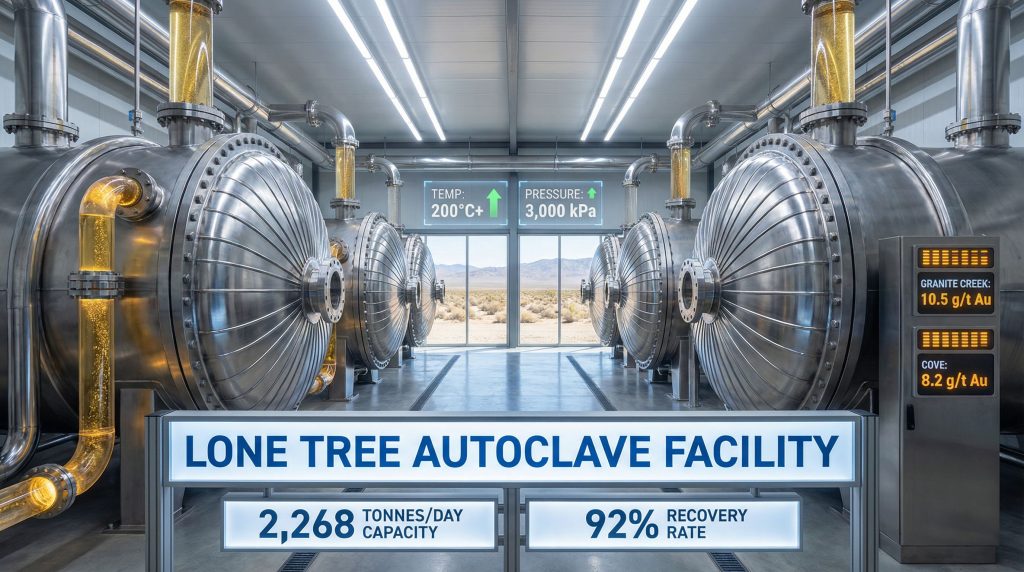
The technical requirements for processing such deposits have created infrastructure bottlenecks across Nevada's mining sector. Furthermore, understanding these industry innovation trends is crucial for companies navigating this complex landscape. Pressure oxidation systems operate at temperatures exceeding 200°C and pressures around 3,000 kPa, creating conditions that systematically decompose sulfide host minerals and liberate encapsulated gold particles.
This metallurgical process represents one of the most capital-intensive approaches in modern mineral processing, requiring specialized engineering expertise and extended construction timelines. Recovery rates between processing methods demonstrate stark economic differences. Conventional heap leaching achieves 65-75% recovery for oxide materials, while pressure oxidation systems consistently deliver 90-92% extraction rates across refractory ore types.
Processing Method Performance Comparison
| Processing Type | Recovery Rate | Capital Intensity | Ore Compatibility |
|---|---|---|---|
| Heap Leach | 65-75% | Low | Oxide ores only |
| Toll Milling | 55-60% | Medium | Limited refractory |
| Autoclave (Owner) | 90-92% | High | All ore types |
When big ASX news breaks, our subscribers know first
Infrastructure Scarcity Creates Strategic Positioning Opportunities
Nevada's autoclave capacity operates under severe supply constraints, with only two permanent pressure oxidation facilities outside Nevada Gold Mines operations. This infrastructure limitation has created a structural advantage for companies capable of developing dedicated processing capacity, eliminating third-party dependencies while capturing enhanced margin profiles through superior metallurgical performance.
The capital requirements for modern autoclave construction exceed $400 million for facilities capable of processing 2,000+ tonnes daily. These expenditure levels, combined with specialized engineering requirements and extended permitting challenges, have limited new facility development across Nevada's mid-tier mining sector. Companies pursuing toll milling arrangements typically achieve 55-60% payability compared to 92% recovery rates through owner-operated facilities.
Critical Infrastructure Development Barriers:
- Initial capital expenditure exceeding $400M for modern systems
- Specialized metallurgical engineering expertise requirements
- Extended construction timelines spanning 24-36 months
- Complex regulatory compliance for pressure vessel operations
- Procurement constraints for specialized equipment components
i-80 Gold Lone Tree autoclave refurbishment represents a strategic response to these market dynamics, targeting completion by Q4 2027 through comprehensive modernisation of existing pressure oxidation infrastructure. The facility upgrade encompasses replacement of legacy carbon-in-leach systems, oxygen generation plant expansion, and installation of mercury abatement technology meeting current environmental standards.
Comprehensive Technical Specifications Drive Processing Performance
The i-80 Gold Lone Tree autoclave refurbishment project encompasses systematic modernisation of pressure oxidation infrastructure targeting 2,268 tonnes daily processing capacity at 85% operational availability. This configuration generates annual throughput capacity approaching 828,000 tonnes of refractory ore material across multiple feed sources.
Engineering specifications include comprehensive upgrades to SAG/ball mill control systems, pressure vessel refurbishment incorporating enhanced safety protocols, and oxygen generation capacity expansion supporting higher throughput requirements. In addition, comprehensive mineral exploration insights inform the optimal feed strategies for these enhanced processing capabilities.
Mercury capture systems address regulatory compliance requirements while filtered tailings management provides operational flexibility during maintenance periods. The implementation of modern waste management solutions ensures environmental compliance throughout operations.
Major Technical Upgrade Components:
- Process Control Systems: SAG/ball mill automation and monitoring upgrades
- Pressure Infrastructure: Vessel refurbishment and safety system modernisation
- Oxygen Generation: Plant capacity expansion and purity optimisation
- Environmental Controls: Mercury capture and treatment technology
- Tailings Management: Filtered deposition systems for operational flexibility
The facility's dual-circuit design incorporates both autoclave oxidation and carbon-in-leach recovery stages, maximising gold extraction across diverse ore mineralogy. Pressure vessel refurbishment preserves existing infrastructure while upgrading internal components and instrumentation systems. This approach reduces capital requirements compared to greenfield construction while achieving comparable technical performance.
Oxygen consumption parameters require 150-300 kg per tonne of ore processed, depending on sulfide mineral content and oxidation requirements. On-site oxygen generation through pressure swing adsorption or cryogenic air separation eliminates transportation dependencies while ensuring consistent supply during continuous operations.
Recovery Rate Optimisation Transforms Project Economics
The transition from toll milling arrangements to owner-operated autoclave processing represents a fundamental shift in metallurgical economics for refractory ore deposits. Current third-party processing typically achieves 57% gold recovery, while the modernised Lone Tree facility targets 92% recovery rates across diverse refractory ore types.
This 35-percentage-point improvement in metallurgical performance translates to approximately 61% increase in recoverable gold per tonne processed. At current gold pricing levels, the recovery differential generates substantial margin expansion across the entire production profile, supporting enhanced cash flow generation and return on investment metrics.
Economic Impact Analysis:
- Current Performance: 57% recovery under toll arrangements
- Target Performance: 92% recovery through owner operation
- Revenue Enhancement: ~61% increase in recoverable gold
- Payback Timeline: 12-24 months at 200,000 oz annual production
Preliminary economic assessments indicate after-tax net present value of $1.6 billion at $2,175 per ounce gold, rising to $4.9 billion at $3,000 per ounce using 5% discount rates. These projections reflect consolidated analysis across five development projects, demonstrating significant valuation upside compared to current market capitalisation levels.
Consequently, the payback period for autoclave investment depends heavily on processing volumes and gold price assumptions. At 200,000 ounces annual production, the recovery rate improvement supports capital recovery within 12-24 months, establishing strong investment returns for subsequent operational periods.
Multi-Source Resource Portfolio Supports Long-Term Operations
The refurbished facility is designed to process ore feeds from multiple high-grade underground developments across Nevada's mineral districts. Primary feed sources include Granite Creek Underground containing 261,000 ounces at 10.5 g/t gold in measured and indicated categories, and Cove Underground holding 311,000 ounces at 8.2 g/t gold.
Additional processing opportunities exist at Ruby Hill's Archimedes deposit, which contains 436,000 ounces at 7.6 g/t gold within measured and indicated resource classifications. This diversified feed strategy provides operational flexibility and grade optimisation opportunities across varying market conditions.
Resource Portfolio Summary:
- Granite Creek Underground: 261,000 oz @ 10.5 g/t Au (M&I)
- Cove Underground: 311,000 oz @ 8.2 g/t Au (Indicated)
- Archimedes Deposit: 436,000 oz @ 7.6 g/t Au (M&I)
- Combined High-Grade Resources: 1.0M+ ounces exceeding 7.5 g/t
Resource categories reflect geological confidence levels, with measured resources demonstrating highest reliability, indicated resources showing reasonable confidence, and inferred resources containing lower certainty. The concentration of resources in measured and indicated categories supports technical planning and financing discussions for autoclave operations.
However, grade distribution across feed sources enables blending optimisation, maintaining consistent autoclave performance while maximising recovery efficiency. Underground operations typically generate higher-grade ore compared to open-pit configurations, supporting enhanced economic returns through autoclave processing.
Capital Investment Analysis Within Industry Benchmarks
The $430 million total capital requirement for the i-80 Gold Lone Tree autoclave refurbishment positions the project within established industry parameters for pressure oxidation facility development. This figure incorporates $412 million base capital plus $18 million in spare parts and contingency allowances, reflecting Class 3 engineering accuracy with ±25% confidence intervals.
Recent inflation pressures have significantly impacted construction costs across mining sector infrastructure, with steel fabrication, pressure vessel manufacturing, and specialised equipment procurement experiencing substantial price increases since 2022. For instance, companies requiring effective capital raising strategies must account for these increased costs in their funding requirements.
Capital Expenditure Breakdown:
- Process Equipment & Installation: ~$350M (81% of total)
- Infrastructure & Utilities: ~$62M (14% of total)
- Contingency & Spares: ~$18M (4% of total)
- Total Project Investment: $430M
Comparative analysis indicates autoclave construction costs of approximately $190,000 per tonne daily capacity, consistent with recent industry precedents for similar-scale pressure oxidation facilities. This capital intensity reflects specialised equipment requirements, pressure vessel fabrication complexity, and comprehensive environmental control systems.
Equipment procurement timelines represent critical path constraints, with pressure vessel fabrication requiring 12-18 months from specialised manufacturers. Major autoclave shells typically measure 3-5 meters in diameter and exceed 15 meters in length, requiring specialised transportation and installation procedures that influence overall project schedules.
The next major ASX story will hit our subscribers first
Risk Management Across Technical and Operational Parameters
Autoclave refurbishment carries inherent technical risks associated with pressure vessel operations and complex metallurgical processes. Equipment procurement schedules, skilled labour availability, and regulatory approval timelines represent primary execution variables requiring active management throughout project development phases.
Metallurgical testing programmes continue validating recovery assumptions across different ore types and feed blending scenarios. Pressure oxidation performance depends on sulfide mineral composition, organic carbon content, and trace element concentrations that vary across resource deposits. Ongoing test work supports engineering design optimisation and operational planning.
Primary Risk Categories:
- Technical Risks: Equipment performance validation and metallurgical consistency
- Schedule Risks: Permitting timelines and construction sequencing coordination
- Financial Risks: Cost escalation pressures and financing availability
- Operational Risks: Skilled labour recruitment and specialised training requirements
Permitting processes for pressure vessel operations require specialised regulatory expertise and extended review periods. Nevada Division of Environmental Protection oversight encompasses mercury emissions control, tailings management protocols, and operational safety systems. These regulatory requirements influence construction timelines and operational procedures.
Furthermore, skilled labour availability represents a regional constraint, with autoclave operations requiring specialised metallurgical engineers, pressure vessel technicians, and process control operators. Training programmes and competitive compensation packages support workforce development for specialised operational requirements.
Board Governance Enhancement Supports Technical Execution
Recent board appointments bring specialised expertise directly aligned with autoclave project requirements and capital markets oversight. Steven Yopps contributes over 35 years of metallurgical engineering experience focused on pressure oxidation systems, providing technical guidance for refurbishment execution and operational optimisation.
Michael Jalonen provides capital markets perspective through 40 years of experience including three decades at Bank of America Securities, supporting financing discussions and investor communication strategies. Ronald Butler Jr. adds financial governance discipline through 30+ years at Ernst and Young, including extensive audit and compliance expertise for capital-intensive projects.
Governance Enhancement Focus Areas:
- Technical Oversight: Metallurgical validation and engineering supervision
- Capital Allocation: Project financing and resource optimisation
- Financial Controls: Audit compliance and cost management protocols
- Risk Management: Execution monitoring and contingency planning
Board composition reflects investor emphasis on execution capability rather than exploration potential. The appointment timing coincides with feasibility study completion and construction decision processes, providing specialised oversight during critical project phases.
Technical expertise becomes particularly relevant during commissioning phases, where pressure vessel startup procedures, metallurgical optimisation, and operational troubleshooting require specialised knowledge. Board-level oversight supports management decision-making while providing investor confidence in execution capabilities.
What Are the Key Technical Milestones?
The i-80 Gold Lone Tree autoclave refurbishment follows a structured development timeline with critical technical milestones. Engineering design advancement to detailed levels supports procurement timelines and construction sequencing for Q4 2027 commissioning targets.
However, the project requires systematic completion of feasibility studies, regulatory approvals, and construction sequencing to achieve operational targets. Each phase builds upon previous achievements while maintaining strict quality and safety standards.
Production Targets and Cash Flow Projections
The refurbished Lone Tree facility targets annual gold production approaching 200,000 ounces upon achieving full operational capacity in 2028. This production level supports projected EBITDA ranging from $200-400 million annually, depending on prevailing gold prices and operational efficiency metrics.
Operational parameters include 85% plant availability, 92% metallurgical recovery, and processing throughput of 2,268 tonnes per day. These specifications establish the foundation for cash flow modelling and investment return calculations across varying gold price scenarios.
Production Performance Targets:
- Annual Throughput: 828,000 tonnes (85% availability factor)
- Metallurgical Recovery: 92% gold extraction efficiency
- Production Target: 200,000 oz gold annually
- EBITDA Range: $200-400M (gold price dependent)
Cash flow sensitivity analysis indicates project viability across gold price ranges from $1,800-3,000 per ounce. All-in sustaining costs projections range from $1,225 per ounce at higher-grade deposits to $1,893 per ounce at lower-grade sources, supporting positive margins across diverse market conditions.
Production ramp-up phases typically require 6-12 months following commissioning completion, as operational teams optimise processing parameters and achieve consistent throughput rates. Metallurgical performance validation across different ore types supports long-term production planning and resource allocation strategies.
Strategic Positioning in Nevada's Gold Infrastructure Landscape
The Lone Tree facility establishes i-80 Gold among only two companies operating permanent pressure oxidation facilities in Nevada outside Nevada Gold Mines operations. This infrastructure position creates strategic optionality including internal processing capabilities and potential third-party tolling revenue opportunities.
The combination of substantial refractory ore resources totalling 14 million ounces and dedicated processing infrastructure differentiates i-80's development profile within Nevada's mid-tier gold sector. This integrated approach reduces third-party dependencies while enhancing margin capture across the entire production profile.
Strategic Competitive Advantages:
- Processing Independence: Elimination of toll milling dependencies and associated costs
- Enhanced Margins: Superior recovery rates supporting improved cash flow generation
- Tolling Opportunities: Potential revenue from third-party processing arrangements
- Consolidation Positioning: Strategic value in potential merger and acquisition scenarios
Nevada's established mining regulatory framework and skilled labour base provide operational advantages compared to emerging market alternatives. Infrastructure supporting mining operations, including transportation, utilities, and supply chains, reduces development risk while supporting cost-effective operations.
The concentration of refractory ore resources across multiple deposits creates long-term feed security for autoclave operations. Resource life extending beyond 10 years supports capital investment recovery while providing operational stability for workforce development and community investment.
How Does This Position Compare to Industry Peers?
Nevada's limited autoclave infrastructure creates significant competitive advantages for companies with dedicated processing capabilities. The i-80 Gold Lone Tree autoclave refurbishment positions the company uniquely within Nevada's mid-tier gold sector through processing independence and enhanced recovery rates.
Consequently, this strategic positioning provides both operational flexibility and potential revenue diversification through third-party tolling arrangements. Recent analysis highlights the substantial margin improvements achievable through owner-operated autoclave processing compared to toll milling alternatives.
Investment Timeline and Catalyst Sequence
Construction decision processes target Q2 2026 completion, contingent upon regulatory approvals and final investment commitments. Engineering design advancement to detailed levels supports procurement timelines and construction sequencing for Q4 2027 commissioning targets.
Feasibility studies for primary feed sources advance in parallel, with Granite Creek and Cove studies targeting Q1 2026 completion. These technical validations support feed grade assumptions, mining method optimisation, and integrated production planning across the resource portfolio.
Development Timeline Milestones:
- Q1 2026: Feasibility study completion and permit submissions
- Q2 2026: Construction decision and financing finalisation
- Q3 2026: Physical construction commencement and procurement
- Q4 2027: Commissioning and operational startup phases
- Q1 2028: Commercial production and performance validation
Financing arrangements require coordination between equity participation, debt facilities, and potential streaming agreements to support $430 million capital requirements. Balance sheet optimisation through debt refinancing and prepayment elimination creates financial flexibility for development capital deployment.
Moreover, the company has secured significant financing arrangements to support its development plans, providing financial foundation for the i-80 Gold Lone Tree autoclave refurbishment and associated infrastructure improvements.
Disclaimer: This analysis contains forward-looking statements regarding production targets, capital requirements, and project timelines. Actual results may vary due to technical, regulatory, or market factors beyond current projections. Readers should conduct independent analysis and consult financial advisors before making investment decisions.
Looking to Capitalise on Nevada's Refractory Gold Processing Opportunities?
Discovery Alert's proprietary Discovery IQ model delivers instant notifications when ASX-listed companies announce significant mineral processing breakthroughs and metallurgical advances, helping investors identify similar technological developments before broader market recognition. Explore how major mining discoveries and technological innovations have historically generated exceptional returns by visiting Discovery Alert's dedicated discoveries page, then begin your 14-day free trial to gain immediate access to actionable investment opportunities.