
August 6, 2026
The Invisible Economy That Moves Mountains of Gold
Every year, tens of millions of people across the developing world descend into hand-dug shafts, wade through sediment-laden rivers, and process ore with rudimentary equipment to extract one of the world's most valuable commodities. Artisanal and small-scale gold mining (ASGM) is not a fringe activity. It is a parallel economy, operating at industrial scale, largely invisible to national tax systems, and increasingly impossible for resource-rich governments to continue ignoring.
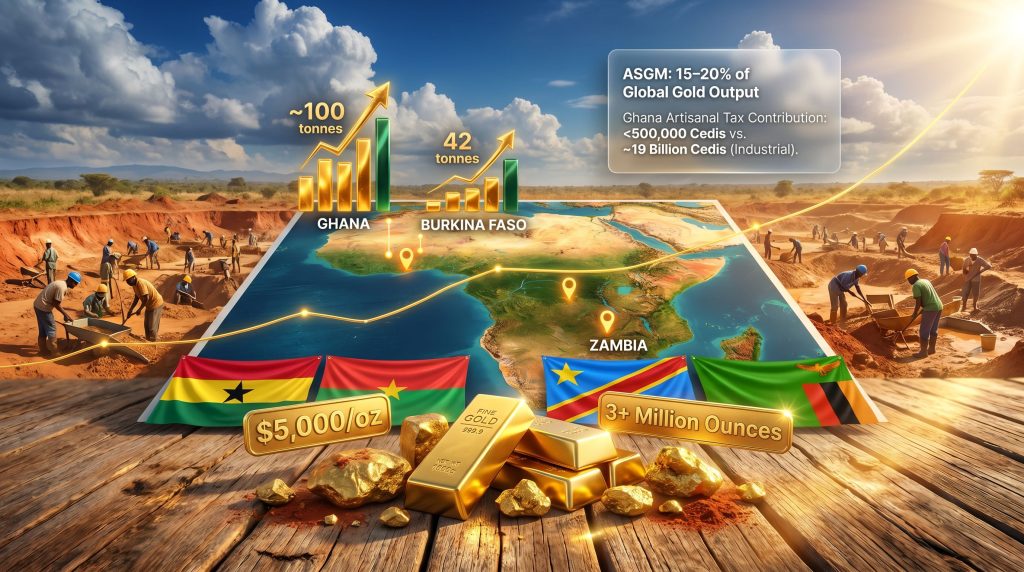
Globally, ASGM accounts for an estimated 15 to 20 percent of global gold production and engages approximately 20 million miners directly, with many millions more in downstream support roles. In Sub-Saharan Africa, the sector functions as a primary livelihood engine across rural economies where alternative employment opportunities are scarce. Yet for decades, the majority of this production has flowed through informal channels, bypassing licensing authorities, evading taxation, and contributing minimally to the formal financial systems of the countries where it originates.
That dynamic is changing, driven by a confluence of record gold prices, growing central bank gold demand for domestically sourced reserves, and mounting fiscal pressure on governments that can no longer afford to leave billions in export revenue uncaptured. Understanding where Africa artisanal gold mining formalization stands today requires examining not just headline export figures, but the structural gaps that continue to limit how much of that value actually reaches national treasuries.
When big ASX news breaks, our subscribers know first
Why Gold Prices Have Become the Decisive Catalyst
Gold's price trajectory has fundamentally altered the political calculus around ASGM regulation. The metal climbed approximately 70% in 2025, with prices hovering near $5,000 per ounce in early 2026. At that valuation, the revenue opportunity cost of informal sector dominance becomes arithmetically staggering for finance ministries already managing tight fiscal positions.
Consider the mathematics at the country level. Ghana's artisanal and small-scale miners produced more than 3 million ounces in 2025, representing over half of the country's national gold output. At $5,000 per ounce, that volume represents a gross production value of approximately $15 billion. The direct tax contribution from those same miners: less than 500,000 Ghanaian cedis, according to data from the Ghana Chamber of Mines. By contrast, large industrial mining companies, which produced a smaller share of national output, contributed roughly 19 billion cedis in direct taxes during the same period.
The fiscal asymmetry in Ghana is not a marginal accounting discrepancy. It represents one of the most stark mismatches between economic activity and fiscal contribution anywhere in the global mining sector.
This imbalance is replicated, in varying degrees, across every major ASGM-producing nation in Africa. When gold prices were lower, the revenue foregone was significant but manageable. At near-$5,000 per ounce, the political cost of continued inaction has become untenable.
A Four-Country Benchmarking Analysis: Governance Models in Practice
Assessing where Africa artisanal gold mining formalization is genuinely advancing requires comparing countries across four dimensions: regulatory architecture, state market participation, traceability infrastructure, and fiscal integration. The following country profiles illustrate the spectrum of approaches currently being deployed.
Ghana: The Centralised Buyer Model
Ghana's approach is the most structurally advanced on the continent. The Ghana Gold Board, known as GoldBod, was established as the sole national regulator and centralised buyer of artisanal gold in May 2025. The results in terms of export capture have been significant: approximately 100 tonnes of artisanal gold were exported under the centralised model during the year, generating revenues of roughly $10 billion and representing close to half of Ghana's estimated $20 billion in total gold export earnings for 2025.
Yet the fiscal contribution gap identified above reveals that export volume and tax capture are not the same thing. GoldBod has recognised this and moved to strengthen oversight infrastructure. In January 2026, the agency launched a responsible sourcing pilot covering 600 artisanal mining sites, designed to verify that gold entering formal market channels originates from regulated operations before it is purchased and exported.
The table below summarises the production-versus-tax paradox at the heart of Ghana's ASGM sector:
| Metric | Artisanal and Small-Scale Miners | Large Industrial Mining Companies |
|---|---|---|
| Gold produced (2025) | 3+ million ounces (>50% of national output) | Remainder of national production |
| Direct tax contribution | Less than 500,000 Ghanaian cedis | ~19 billion Ghanaian cedis |
| Share of national production | Majority | Minority |
| Fiscal contribution | Negligible | Dominant |
Burkina Faso: State Procurement as Output Multiplier
Burkina Faso offers a compelling case study in how competitive state procurement can rapidly shift production from informal to formal channels. The creation of a national precious substances purchasing entity provided artisanal and semi-mechanised producers with an accessible, government-backed buyer. The effect on official output was dramatic: artisanal gold volumes rose from fewer than 10 tonnes per year prior to the intervention to 42 tonnes in 2025, representing 40% of Burkina Faso's total national output of 94 tonnes.
The Artisanal Gold Council has been active in Burkina Faso, working to build supply chains that connect artisanal producers to responsible international buyers, creating traceable pathways for gold that previously had no formal market access.
What Burkina Faso's trajectory illustrates is that incentive design matters more than enforcement intensity. When official buying prices are competitive and accessible, miners respond by entering formal channels. The critical unanswered question is whether this output surge reflects genuine structural formalization or primarily a rerouting of previously informal volumes that remain operationally unchanged.
Democratic Republic of Congo: Reserve-Building With a Significant Execution Gap
The DRC's approach centres on building central bank gold reserves using artisanal production collected through DRC Gold Trading, a state-owned procurement entity. The ambition is significant: a target of 15 tonnes for 2025, representing more than a sixfold increase from the 1.75 tonnes actually exported in 2024, itself well below the 12-tonne target set for that year.
In March 2026, the DRC inaugurated a pilot refinery in Kalemie with a processing capacity of 500 to 600 kilograms per month. Authorities are also developing real-time monitoring systems connecting licensed gold-buying offices with the central bank and mining administration, establishing the data infrastructure needed to track traded volumes across the supply chain.
The execution gap, however, is substantial. The primary reason that official buying volumes remain far below targets is that official prices have not been competitive enough to redirect miners away from informal channels. This price competitiveness failure is not a technical problem — it is a policy design problem, and it is the central obstacle to DRC's formalization progress. Furthermore, formal buying offices currently make no distinction between gold sourced from regulated operations and gold originating from unregulated sites, removing any quality-based incentive for compliance.
Zambia: Joint Venture Structuring as an Entry Point
Zambia has taken a structurally distinct approach. In May 2026, state-owned mining investment company ZCCM-IH announced the creation of Kyalo Goldfields Limited (KGL), a joint venture with Mining Mineral Resources targeting gold deposits in the Kikonge area of Mufumbwe district. ZCCM-IH holds a 51% controlling stake, with the private partner retaining 49%. The operational model combines mechanised mining with a deliberate strategy to integrate artisanal miners into formal operations through structured regulation of activity in the area.
This matters because Zambia's artisanal gold sector currently supports more than 30,000 people nationwide, the vast majority of whom operate outside formal structures. The sector also remains heavily dependent on mercury-based extraction methods, creating both environmental and health risks that are compounding governance challenges.
Since November 2024, the planetGOLD initiative, funded by the Global Environment Facility and implemented by the United Nations Environment Programme, has worked with more than 11,000 Zambian miners to reduce mercury use and support formalization pathways. Mercury reduction and formalization are being treated as complementary objectives rather than competing priorities, a framing that distinguishes Zambia's approach from more narrowly revenue-focused models elsewhere.
The Five Structural Barriers That No Country Has Fully Resolved
Despite the diversity of approaches being deployed, the same systemic obstacles appear across every jurisdiction attempting Africa artisanal gold mining formalization. Understanding these barriers is essential to evaluating how durable current progress actually is.
-
Price competitiveness failure — Official buying prices consistently struggle to match informal market rates. When informal channels offer higher net prices, lower transaction costs, and immediate liquidity, economically rational miners choose informality regardless of regulatory intent.
-
Licensing and registration complexity — In most jurisdictions, legal registration requires navigating bureaucratic processes that are inaccessible at the community level, with fees and requirements that are prohibitive for low-income operators.
-
Fiscal architecture mismatch — Tax frameworks designed nominally for small-scale miners remain structurally unenforceable in sectors where informality is the operating default, not the exception.
-
Traceability infrastructure gaps — Without end-to-end supply chain verification, unregulated gold can enter formal markets at any point without detection, undermining both fiscal capture and responsible sourcing credibility.
-
Labour and safety enforcement deficits — Deadly accidents remain a recurring feature of artisanal mining across multiple African jurisdictions, and labour protections are weakly enforced. This is not merely a humanitarian concern: it is a market access risk as international responsible sourcing requirements tighten.
Research from Ghana and Mozambique has consistently found that formalization stalls when registration systems are too complex or under-resourced, even in environments where government commitment to the process is publicly stated and genuine. Simplified trade processes and community-level capacity building consistently outperform enforcement-first approaches.
Traceability: The Technical Infrastructure That Determines Whether Formalization Is Real
Export volume figures can mask profound weaknesses in actual formalization depth. The critical test of whether ASGM has genuinely entered the formal economy is traceability: the ability to verify a gold consignment's origin, processing method, and compliance status at every point in the supply chain.
Traceability is not merely a regulatory nicety. It is a prerequisite for central bank gold reserves credibility, anti-money laundering compliance, and access to responsible sourcing premiums from European and North American buyers whose procurement standards are becoming increasingly stringent. Gold that cannot be verified as responsibly sourced faces growing exclusion from premium markets, regardless of which country it originates from.
The technical tools for traceability already exist. The challenge is institutional will and enforcement capacity. The table below summarises current deployment status across the four focus countries:
| Country | Initiative | Scale | Status |
|---|---|---|---|
| Ghana | GoldBod responsible sourcing pilot | 600 artisanal mining sites | Launched January 2026 |
| DRC | Central bank to buying office integration | National monitoring system | In development |
| Burkina Faso | Artisanal Gold Council supply chain project | Multi-site | Active |
| Zambia | planetGOLD mercury reduction and formalization | 11,000+ miners reached | Active since November 2024 |
Scaling these pilots into national infrastructure requires four interconnected investments:
- Digital registration systems for miners, production sites, and output volumes
- Real-time transaction monitoring between buying offices and central authorities
- Third-party verification protocols for responsible sourcing certification
- Interoperability between national traceability systems and international responsible sourcing standards recognised by end buyers
The Monetary Dimension: Artisanal Gold as a Reserve Asset
One of the less widely discussed dimensions of Africa artisanal gold mining formalization is its intersection with central bank monetary strategy. Ghana, Zimbabwe, and the DRC are among the countries actively pursuing domestically sourced artisanal gold as a tool for building foreign exchange reserves. Furthermore, this approach reduces dependence on external currency holdings in an era of dollar volatility, making it an increasingly attractive policy lever.
This monetary application adds a layer of urgency to formalization that goes beyond tax revenue. Reserve gold sourced from unverified artisanal channels carries a credibility risk: international scrutiny of reserve quality is increasing, and gold whose provenance cannot be independently verified may face discounting or exclusion from recognised reserve accounting frameworks. For central banks pursuing gold as a safe haven and reserve accumulation as a sovereignty strategy, traceability is consequently not optional.
The next major ASX story will hit our subscribers first
Three Scenarios for Africa's Artisanal Gold Sector Through 2030
How formalization trajectories develop over the next several years will depend on the interaction of gold prices, institutional capacity, and political commitment. Three plausible pathways exist:
Scenario 1: Accelerated Formalization. If governments use the current high-price window to build competitive buying infrastructure, simplify licensing, and deploy traceability systems at national scale, formal sector capture rates could increase significantly. This pathway requires sustained international technical support alongside domestic institutional investment. Probability drivers include continued gold price elevation maintaining government motivation and development financing sustaining planetGOLD-style programmes.
Scenario 2: Partial Integration. Current reform trajectories continue without resolving the price competitiveness or licensing complexity problems. The formal sector captures a growing but still minority share of artisanal production. Traceability pilots remain subscale. This represents the most likely near-term trajectory based on current implementation evidence.
Scenario 3: Reform Stagnation. A meaningful gold price correction reduces fiscal urgency. Institutional coordination failures persist. Informal market share stabilises or expands. Mercury use and safety risks continue unaddressed. Political instability in key producing countries compounds reform bandwidth constraints.
The window for meaningful formalization is directly tied to the price environment. Governments that deploy the current high-price period to construct institutional infrastructure, rather than simply harvesting windfall export revenues, will be far better positioned to sustain formal sector gains if gold prices moderate over the medium term.
What Effective Formalization Policy Actually Requires
The evidence from Ghana, Burkina Faso, the DRC, and Zambia points toward a consistent set of policy design principles that distinguish advancing formalization efforts from those that produce export statistics without structural change. According to analysis of formalization approaches across multiple jurisdictions, the following elements are essential:
- Competitive price design — Official buying prices must be calibrated to match or exceed informal market rates. Without this, every other formalization mechanism operates against the grain of economic incentive.
- Community-accessible licensing — Registration systems must function at the community level, with reduced fees and administrative processes that low-income operators can realistically complete.
- Responsible sourcing differentiation — Formal buying offices must create quality-based incentives by distinguishing between compliant and non-compliant production at the point of purchase.
- National-scale traceability architecture — Digital systems connecting miners, buying offices, refineries, and central banks must be built at operational scale, not maintained indefinitely as pilots.
- ASGM-specific fiscal frameworks — Tax systems must be redesigned specifically for small-scale operators, with enforcement mechanisms calibrated to the realities of informal sector participation rather than borrowed from industrial mining frameworks.
The continent's artisanal gold sector has reached an inflection point. At near-$5,000 per ounce, the economic and fiscal stakes of continued informal dominance are simply too large for governments to absorb. Whether the institutional infrastructure being built today proves durable enough to sustain formalization beyond the current price cycle is the defining question for Africa's gold governance over the next decade.
This article is intended for informational purposes only and does not constitute financial or investment advice. Figures relating to gold prices, production volumes, and government revenue projections are subject to revision as official data is updated. Readers should conduct independent research before making any investment or policy decisions based on the information presented here.
For ongoing coverage of African mining sector developments across multiple jurisdictions, readers can explore reporting published by Ecofin Agency.
Want to Track the Next Major Mineral Discovery Before the Market Does?
Discovery Alert's proprietary Discovery IQ model delivers real-time alerts the moment significant ASX mineral discoveries are announced, transforming complex data across more than 30 commodities into clear, actionable insights for investors at every level — start your 14-day free trial today and see why historic discoveries have generated extraordinary returns for those positioned early.