
May 19, 2026
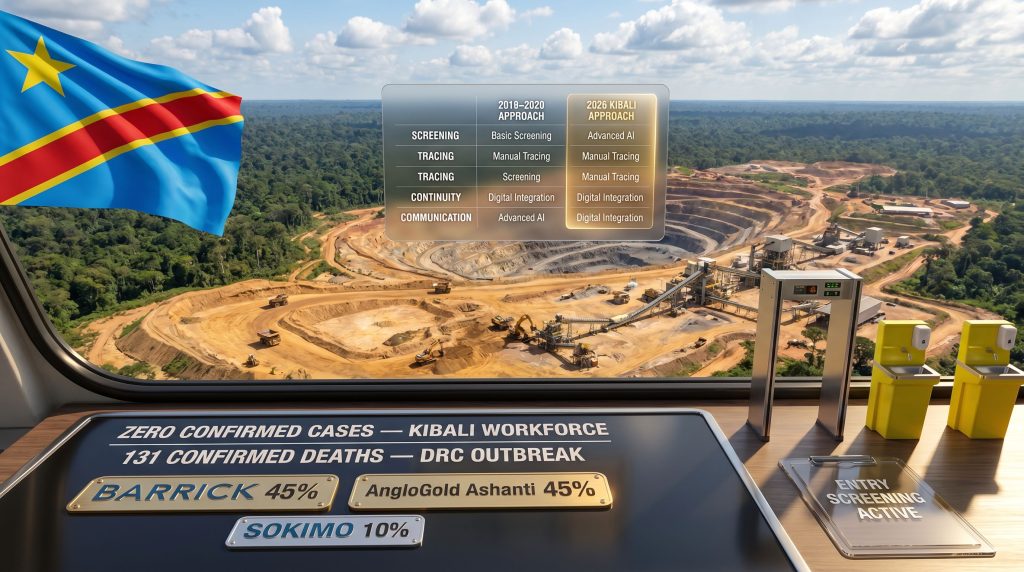
When Public Health Meets Industrial Scale: Ebola Risk in Africa's Gold Belt
Infectious disease outbreaks and large-scale mining operations have always existed in an uneasy proximity across central and eastern Africa. The geological endowment that makes regions like northeastern Democratic Republic of Congo so valuable to global gold supply chains also places them within some of the world's most persistent disease corridors. Understanding how major operators navigate this reality requires looking beyond individual outbreak events and examining the structural relationship between industrial worksites, workforce density, and viral transmission dynamics. The Barrick Kibali mine Ebola precautions offer a revealing case study in how this balance is managed at operational scale.
Few operational environments test this relationship more acutely than an active Ebola outbreak in the eastern DRC, where the intersection of forest ecosystems, high population mobility, and cross-border trade creates conditions that epidemiologists consider uniquely challenging to contain. Furthermore, the natural resources in the DRC create a powerful economic imperative to maintain operations even under significant public health pressure.
When big ASX news breaks, our subscribers know first
Why Eastern DRC Represents a Persistent Ebola Risk Environment
Eastern DRC is not simply a region that has experienced Ebola outbreaks. It is a geography that has repeatedly demonstrated the conditions under which the virus finds transmission pathways that are difficult to interrupt. The area shares porous borders with Uganda and South Sudan, both of which have experienced their own spillover events during major DRC outbreaks. Forest-dwelling wildlife populations, particularly fruit bats considered a likely natural reservoir for the Ebola virus, are distributed throughout the region's dense ecosystems.
For large-scale mining operations, these factors compound in specific ways that differ from community-level outbreak dynamics:
-
Workforce populations numbering in the thousands concentrate individuals from multiple geographic catchment areas, increasing the probability that any community exposure eventually presents at a site entry point.
-
Cross-border logistics networks, essential for fuel, equipment, and consumable supplies, create regular movement corridors that can carry viral exposure across checkpoint zones.
-
Shift-rotation systems and communal accommodation arrangements, standard features of remote mining operations, can accelerate transmission if an infectious individual reaches a common living or eating space before symptoms present.
-
Artisanal and small-scale mining communities that surround major industrial operations often lack equivalent health infrastructure, creating a vulnerability buffer zone that larger operators must factor into their risk modelling.
The current outbreak has resulted in at least 131 confirmed deaths, with public health officials warning that containment efforts face ongoing challenges and the toll is expected to increase. In addition, geopolitical mining risks across the region further complicate the operational environment for major gold producers.
Kibali's Strategic Position and Ownership Architecture
The Kibali gold mine in northeastern DRC is not merely a significant regional asset. It ranks among the largest gold-producing operations on the African continent, making its operational continuity a matter of relevance to global gold supply balancing, DRC export revenues, and the financial performance of two of the world's most prominent gold majors.
| Stakeholder | Ownership Share | Operational Role |
|---|---|---|
| Barrick Mining | 45% | Site Operator |
| AngloGold Ashanti | 45% | Co-owner |
| SOKIMO (DRC state miner) | 10% | Government Partner |
Barrick serves as the mine's operational manager, meaning the protocols deployed in response to the current outbreak fall directly under its operational authority. The mine's scale, both in terms of workforce and daily throughput, means that any disruption carries financial consequences that extend well beyond the site boundary. For Barrick's Africa portfolio specifically, Kibali represents a cornerstone asset whose sustained performance underpins regional earnings projections.
Barrick's strategic pivot toward diversified mineral exposure makes sustained performance at flagship assets like Kibali even more critical to the company's broader investment narrative.
Zero Cases Confirmed: What Barrick's Position Actually Means
As of the most recent official communication, Barrick has confirmed that no workers at the Kibali mine have contracted Ebola. The company communicated this position proactively through a spokesperson, framing it as part of an active disclosure strategy rather than a response to investor pressure or regulatory enquiry.
This distinction matters for several reasons that are not always well understood outside specialist mining and public health circles.
A zero-case outcome at an industrial worksite during an active community outbreak is not a passive result. It reflects the effectiveness of screening infrastructure deployed before cases appear, not after.
The operational logic underlying the Barrick Kibali mine Ebola precautions is that prevention is architecturally different from response. By the time a confirmed case appears within a workforce, contact tracing must work backwards through days of exposure, shift rotations, and communal interactions. The cost of that retrospective work, in both human and financial terms, vastly exceeds the cost of front-loading screening capacity before transmission occurs.
This thinking represents a meaningful evolution in how major mining companies approach disease risk, moving from outbreak response toward outbreak prevention as a standing operational function.
The Specific Precautionary Framework Deployed at Kibali
Entry Screening and Hygiene Infrastructure
Barrick has implemented worker entry screening at site access points, incorporating both temperature checks and symptom-based assessment. Thermal scanning technologies deployed at high-traffic checkpoints allow rapid identification of individuals presenting with fever, one of Ebola's early indicators. Handwashing stations and hygiene infrastructure have been positioned at key access zones to reduce surface transmission risk.
Contact Tracing and Workforce Monitoring
Beyond entry screening, the operation has established systems to identify and track workers who may have had exposure to confirmed or suspected cases in surrounding communities. Protocols for self-isolation and quarantine have been activated for close contacts and symptomatic individuals, with monitoring data integrated into the mine's site-level health management infrastructure.
Operational Adjustments
-
Non-essential cross-border personnel movements have been reduced to limit exposure through logistics corridors.
-
Shift rotation arrangements and communal gathering configurations have been modified to lower density contact between workers.
-
Coordination with DRC health authorities and international health agencies provides the operation with real-time outbreak intelligence for ongoing risk calibration.
How the 2026 Response Compares to the 2018-2020 Kivu Outbreak Era
The Kivu Ebola outbreak, which ran from 2018 to 2020 and became one of the deadliest in DRC history with over 2,200 deaths, provided the mining sector with a set of hard lessons that have directly shaped current response frameworks. A detailed report on gold mines exposed during that period highlighted the scale of operational vulnerability across the sector.
| Response Element | 2018-2020 Approach | 2026 Kibali Protocols |
|---|---|---|
| Workforce screening | Reactive, post-exposure triggers | Proactive, entry-level deployment |
| Contact tracing | Limited site-level integration | Systematic, data-integrated monitoring |
| Operational continuity | Partial shutdowns in some areas | Maintained with protocol overlays |
| Disclosure strategy | Often delayed public communication | Proactive spokesperson statements |
| Community engagement | Variable across operators | Structured buffer-zone health investment |
The shift from reactive to proactive screening is perhaps the most consequential change. During the 2018-2020 outbreak, several mining operations in affected areas found themselves deploying health measures only after workforce absenteeism or community transmission had already created operational pressure. The institutional learning from that period is visible in Barrick's current posture at Kibali.
The next major ASX story will hit our subscribers first
The Broader Exposure Landscape Across DRC Gold Mining
Kibali is not an isolated case study. Industry risk assessments have estimated that more than 35% of DRC's gold mining operations face meaningful Ebola exposure risk during active northeastern outbreak events. The geographic distribution of gold mineralisation in the DRC correlates substantially with the same northeastern corridor that experiences the highest frequency of Ebola spillover events, creating a structural overlap between resource endowment and disease risk that the sector cannot avoid through project selection alone.
Kibali's location places it within the highest-risk geographic zone by this classification. Proximity to outbreak epicentres also correlates with supply chain disruption risk that extends beyond workforce health, including:
-
Border checkpoint screening requirements that extend transit times for gold exports and inbound consumables.
-
Cascading effects of workforce absenteeism on production schedules, maintenance cycles, and contractor availability.
-
Insurance and force majeure considerations that become material when international health bodies elevate an outbreak's classification.
-
Equity valuation adjustments by institutional investors and commodity analysts who factor DRC disease risk into Africa-focused gold producer assessments.
A lesser-known dynamic worth understanding is that artisanal and small-scale mining communities surrounding large industrial operations represent a transmission risk vector that is difficult for major operators to control directly. These communities often have limited access to the same health screening infrastructure that large operators deploy internally, meaning an outbreak can circulate in the surrounding population for weeks before it presents at a major mine's entry checkpoint.
The Economics of Maintain-and-Screen Versus Precautionary Closure
Barrick's operational philosophy at Kibali reflects a clear economic calculation that is rarely discussed openly but is well understood within the mining industry's senior operational ranks.
A production shutdown at a major gold operation of Kibali's scale carries financial consequences that can run into tens of millions of dollars per week when fixed costs, contractual obligations, and revenue foregone are aggregated. Against this figure, the cost of deploying comprehensive health screening infrastructure, including thermal scanning equipment, dedicated health personnel, quarantine facilities, and contact tracing systems, represents a fraction of the shutdown cost even over an extended outbreak period.
The economic case for proactive health investment at large-scale remote mining operations is not primarily humanitarian. It is a cost-benefit calculation that consistently favours sustained operations with embedded controls over precautionary closures.
This logic requires one critical precondition: the health infrastructure must be pre-positioned before it is needed. Improvised emergency responses during an active outbreak are less effective, more expensive per unit of protection delivered, and more disruptive to workforce confidence than systems that are already operational when the first community cases are reported. The gold price and mining equities relationship means that operational disruptions at major producers like Kibali can ripple quickly into broader market sentiment.
Community Health Investment as Operational Risk Management
One dimension of the Barrick Kibali mine Ebola precautions that deserves specific attention is the role of community engagement in creating a health buffer between surrounding populations and the industrial worksite. Barrick's approach involves not just internal workforce screening but active coordination with local Congolese communities whose health conditions directly affect the risk profile of the mine's workforce catchment area.
This represents a relatively recent shift in how major operators conceptualise the boundary of their health responsibility. A mine that screens its own workers rigorously but ignores health conditions in the villages from which those workers commute is managing symptoms rather than risk. The communities surrounding Kibali are not external to the operation's epidemiological environment. They are integral to it. For further context on Kibali's broader operational approach, Barrick's official Kibali operations page provides useful background on the mine's structure and community commitments.
Gold Market Implications and Investor Risk Framing
For commodity markets, a sustained operational disruption at Kibali would not pass unnoticed. The mine's contribution to African gold output means that any significant production curtailment would register in supply-side calculations at a time when the gold market outlook is already navigating considerable macroeconomic complexity.
Institutional investors in Africa-focused gold producers have increasingly integrated disease outbreak scenarios into their DRC risk frameworks, a practice accelerated by the 2018-2020 Kivu outbreak experience. The key variable they monitor is not whether an outbreak occurs in the region, but whether a major operator's response infrastructure is capable of preventing operational penetration.
Barrick's proactive disclosure and zero-case outcome through the current outbreak's early phase provides exactly the kind of signal that manages investor sentiment before it deteriorates. Transparency at an early stage, before workforce infections or operational disruptions occur, is structurally superior to reactive communications issued under pressure.
This article is informational in nature and does not constitute financial advice. Forward-looking statements regarding operational outcomes, disease containment, and commodity market impacts are subject to significant uncertainty and should not be relied upon as forecasts.
Frequently Asked Questions: Barrick Kibali Mine Ebola Precautions
Has Barrick Confirmed Any Ebola Cases Among Kibali Workers?
No. As of the most recent official communication, Barrick has confirmed that no workers at the Kibali gold mine have contracted Ebola. Precautionary measures are active as a preventive response to a nearby community outbreak.
Who Owns the Kibali Gold Mine?
Kibali is jointly owned by Barrick Mining and AngloGold Ashanti, each holding 45%, with SOKIMO, the Congolese state mining company, holding the remaining 10%. Barrick serves as the operational manager.
How Serious Is the Current DRC Ebola Outbreak?
The outbreak has resulted in at least 131 confirmed deaths, with public health authorities warning that further escalation is likely as containment measures continue.
What Specific Measures Are Deployed at Kibali?
Active measures include entry-point temperature and symptom screening, thermal scanning at checkpoints, contact tracing systems, self-isolation protocols for exposed individuals, hygiene infrastructure at access zones, and reduced non-essential cross-border personnel movements.
Could the Outbreak Force Kibali to Shut Down?
Barrick's stated operational approach prioritises sustained production through embedded health controls rather than precautionary closure, a strategy informed by lessons from previous DRC outbreak events. No shutdown has been indicated as of current reporting.
Why Is Northeastern DRC Particularly Vulnerable to Ebola Outbreaks?
The combination of dense forest ecosystems serving as wildlife reservoirs, high cross-border population mobility, active trade networks with Uganda and South Sudan, and a history of repeated spillover events makes northeastern DRC one of the world's most persistent Ebola risk environments.
Want to Stay Ahead of Major Mineral Discoveries in High-Stakes Mining Regions Like the DRC?
Discovery Alert's proprietary Discovery IQ model delivers real-time alerts the moment significant ASX mineral discoveries are announced, translating complex geological and operational data into clear, actionable insights for investors at every level — explore Discovery Alert's discoveries page to understand why early identification of major finds has historically driven extraordinary market returns, and begin your 14-day free trial today to position yourself ahead of the broader market.