
May 19, 2026
Is the Global Gold Sector Entering a Structural Consolidation Supercycle?
Across the history of commodity cycles, the periods of most intense merger and acquisition activity rarely coincide with price weakness. They emerge when sustained price elevation shifts the strategic calculus entirely, transforming acquisition from a defensive necessity into an offensive growth tool. The gold sector in 2025 and into 2026 has entered precisely this territory, with prices holding above multi-year averages and the economics of buying reserves outperforming the economics of finding them.
For mid-tier gold producers, organic growth through greenfield exploration carries a timeline measured in decades and capital requirements that can erode shareholder returns for years before a single ounce is poured. At sustained gold prices above US$2,500 per ounce, the mathematics shift decisively: acquiring a producing or near-producing asset delivers reserve replacement faster, at a more predictable cost, and with an immediate re-rating potential that exploration-stage assets cannot match. This is the core logic powering the Mexico mining M&A wave with Equinox and Fresnillo at the centre of industry attention.
How Scale Economics Are Driving Mining M&A Across North America
One concept gaining traction among institutional mining analysts is what might be described as "market re-rating through consolidation." When two mid-tier producers merge into a single entity with production exceeding one million ounces annually, the combined company does not simply inherit the sum of two valuations. It crosses a threshold that attracts a fundamentally different class of institutional investor, including large passive index funds and sovereign wealth vehicles that apply minimum market capitalisation and liquidity filters to portfolio eligibility.
This dynamic helps explain why Canada, the United States, and Mexico are increasingly being treated as a unified operational corridor by international acquirers rather than as three separate jurisdictions requiring separate strategic rationale. Assets spanning this corridor provide diversification against single-country political risk while maintaining the operational concentration needed for efficient management structures. Furthermore, the gold M&A activity driving these decisions is being shaped by a uniquely favourable pricing environment.
Importantly, the current Mexico mining M&A wave with Equinox and Fresnillo is being driven primarily by international miners consolidating around Mexican assets, not by domestic Mexican operators acquiring each other. This distinction matters for understanding the capital flows and strategic motivations at play.
The Numbers Behind the Consolidation Wave
The Equinox Gold acquisition of Orla Mining stands as the defining transaction of this consolidation cycle, establishing a new scale benchmark for North American-focused gold producers. According to reporting by BNamericas, the deal is reshaping competitive dynamics across the entire sector.
| Metric | Indicative Scale |
|---|---|
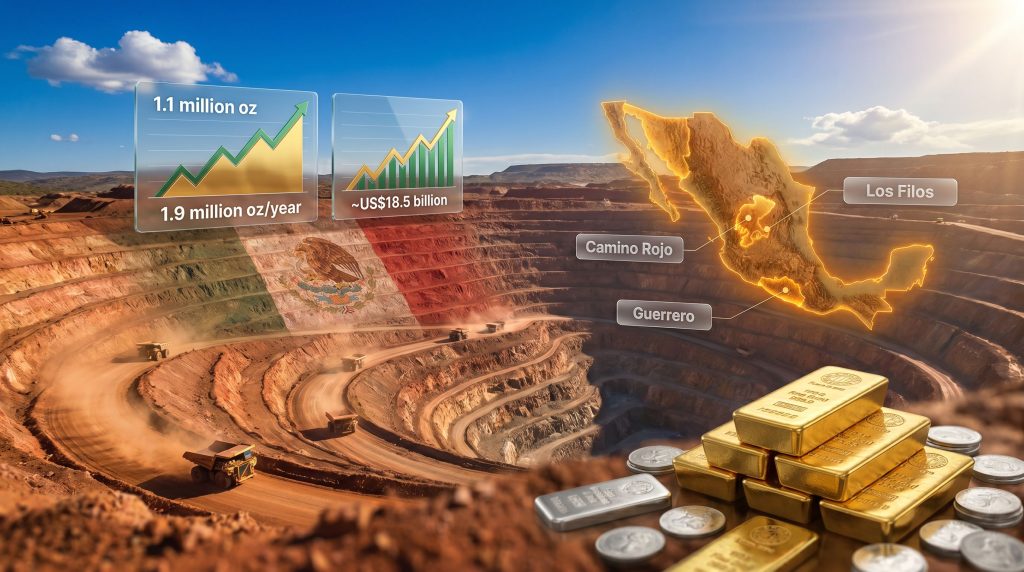
| Combined deal value (Equinox-Orla) | ~US$18.5 billion |
| Projected combined annual gold output | ~1.1 million oz |
| Long-term production potential (post-development) | Up to 1.9 million oz/year |
| Jurisdictions covered in merged portfolio | Mexico, Canada, U.S., Nicaragua |
Note: Production projections and deal valuations are forward-looking estimates and subject to operational, regulatory, and market variables. Investors should not rely on these figures as guarantees of future performance.
When big ASX news breaks, our subscribers know first
What Makes Mexico Strategically Irreplaceable in a Gold Consolidation Strategy?
Mexico's appeal to international consolidators is not simply geological, though the geology is compelling. The country hosts one of Latin America's most significant concentrations of gold and silver mineralisation, with established processing infrastructure, functioning logistics corridors, and a multi-decade operational track record across several states. Crucially, Mexican assets often come at lower acquisition premiums than equivalent assets in Canada or Australia, creating a form of jurisdictional arbitrage that sophisticated acquirers are actively exploiting.
The state of Zacatecas has long been recognised as a premier gold-silver district, while Sonora hosts a range of copper-gold systems. Guerrero, though operationally more complex, contains some of Mexico's highest-grade gold mineralisation. This geographic spread means Mexico's mining endowment is not concentrated in a single geological province, reducing the systemic risk of a regional disruption wiping out a diversified portfolio.
Mexico's Ranking Among Latin American Gold Producers
Mexico consistently ranks among the top five global silver producers and maintains a significant position in gold output across Latin America. The industry association CAMIMEX tracks production rankings across the country's major operators, with Fresnillo plc occupying the dominant position in terms of both silver and gold output from underground and open-pit operations.
What distinguishes Mexico's competitive hierarchy from, say, Peru or Chile is the relatively concentrated structure at the top. A small number of large-scale operators account for a disproportionate share of total production, which means that any M&A transaction involving a top-tier Mexican asset has outsized implications for the sector's overall ranking and competitive dynamics. Consequently, mining industry consolidation trends at the global level are increasingly being shaped by what happens in Mexico.
Key Mexican Assets in the Current M&A Cycle
Two assets have become focal points in discussions of the current Mexico mining M&A wave:
-
Camino Rojo (Zacatecas): This open-pit gold-silver asset brought by Orla Mining into the Equinox transaction holds a substantial defined resource base. Its location in Zacatecas provides infrastructure access and a relatively stable operating environment compared to some other Mexican mining jurisdictions. Camino Rojo represents the cleaner, lower-risk component of the combined entity's Mexican exposure.
-
Los Filos (Guerrero): A high-profile asset with a long production history, Los Filos operates under a more complex social and community relations environment. The Guerrero region presents elevated security considerations alongside more intricate community land-use agreement structures, making it simultaneously one of Mexico's most significant gold assets and one of its most operationally challenging.
The Equinox-Orla Transaction: A Strategic Scenario Analysis
Understanding the Equinox Gold acquisition of Orla Mining requires moving beyond the headline figures and examining the strategic architecture of what is being constructed. This transaction is fundamentally a scale-building exercise, designed to position the combined entity among the world's top-tier gold producers at a moment when institutional capital is actively seeking exposure to producers with the liquidity profile and production scale to support meaningful portfolio positions.
The combined production target of 1.1 million ounces annually, with a defined pathway toward 1.9 million ounces as development assets advance, places the merged company in a tier of production that attracts fundamentally different investor interest than either standalone entity could access independently. In addition, the broader gold price outlook suggests conditions remain favourable for further deal-making throughout the cycle.
Three Strategic Scenarios for the Merged Entity's Mexico Portfolio
The trajectory of the merged entity's Mexican operations is not predetermined. Three distinct scenarios represent the realistic range of outcomes, each carrying materially different valuation implications:
Scenario A: Smooth Integration and Social License Renewal
Land-use agreements with the Carrizalillo community at Los Filos are successfully renegotiated, full production resumes, and Mexico becomes the growth engine of the combined portfolio. Camino Rojo advances on schedule, and the 1.1 million ounce target is met within projected timelines.
Scenario B: Prolonged Community Dispute Creates Valuation Drag
The access impasse at Los Filos extends beyond 12 to 18 months. Institutional investors begin discounting the Mexican component of the portfolio, and management pivots capital allocation toward Canadian and U.S. operations while Mexico-specific challenges persist.
Scenario C: Strategic Divestiture to Unlock Value
The merged entity concludes that Los Filos operational complexity outweighs its strategic contribution, elects to divest the asset to a Mexico-specialist operator, and redirects proceeds toward accelerating Camino Rojo development and other portfolio priorities.
The scenario that materialises at Los Filos is likely to function as the primary determinant of whether Mexico is viewed as a net positive or a strategic liability during the merged entity's first two years of operation. Social license risk is not a peripheral disclosure item — it is a core valuation variable.
Why Social License Has Become the Central Risk Variable in Mexican Mining M&A
The concept of social license to operate has existed in mining discourse for decades, but its practical impact on asset valuations has never been more directly observable than in the current Mexican operating environment. The mechanism is relatively straightforward: under Mexican law, mining companies operating on communal land known as ejido land must maintain active, negotiated access agreements with the community organisations that hold collective title to that land. When those agreements expire or break down, operations can be suspended regardless of the validity of the underlying mining concession.
The Los Filos Case Study: When Community Agreements Determine Asset Value
Los Filos presents a textbook example of how community land-use agreement dynamics can transform a technically sound gold asset into a complex M&A variable. The mine's land-use agreement with the Carrizalillo community had expired and remained unresolved at the time the Equinox-Orla transaction entered public discussion. This situation created material uncertainty around the asset's production contribution to the combined entity's output targets.
From an investor due diligence perspective, an unresolved convenio (the formal land-use agreement structure in Mexico) at a major open-pit operation introduces the following risk categories simultaneously:
- Production volume uncertainty: Inability to quantify contribution to consolidated production guidance.
- Remediation cost uncertainty: Community renegotiations often involve enhanced benefit-sharing commitments, social investment programs, and sometimes retroactive compensation arrangements.
- Timeline uncertainty: There is no fixed legal mechanism that compels community resolution within a defined period, meaning disputes can extend significantly beyond initial estimates.
- Headline and reputational risk: Sustained community access disputes attract regulatory scrutiny and can affect the social license profile of the broader portfolio, not just the asset in dispute.
How Social License Risk Is Being Priced Into Mexican Mining Valuations
Sophisticated acquirers are responding to Mexico's social license complexity by applying higher discount rates to net asset value calculations for assets with unresolved community relations, compared to equivalent assets with clean agreement status. This creates a measurable "social license premium" for assets that can demonstrate long-term, stable community partnerships with documented benefit-sharing frameworks.
Camino Rojo, by contrast, entered the Equinox transaction with a cleaner community relations profile, which partly explains why it anchors the optimistic case for the Mexican portfolio while Los Filos represents the primary risk variable. However, for investors assessing undervalued mining stocks in this space, community relations complexity can sometimes represent mispriced opportunity rather than permanent impairment.
What Best-Practice Community Engagement Looks Like in Mexico's Mining Sector
The International Finance Corporation's Performance Standards on Environmental and Social Sustainability provide a widely adopted framework for community engagement in emerging market mining jurisdictions. Applied to Mexico's ejido system, best practice typically involves the following sequence:
- Early and continuous consultation with both ejido assemblies and individual community members, not only with elected leadership, to avoid agreement invalidation on procedural grounds.
- Transparent benefit-sharing structures tied explicitly to production milestones rather than fixed annual payments, aligning community economic interests with operational performance.
- Third-party mediation mechanisms embedded within land-use agreement terms, providing a structured pathway for dispute resolution before suspension actions are triggered.
- Regular community impact reporting aligned with internationally recognised standards, creating an auditable record of compliance that can withstand regulatory and investor scrutiny.
- Dedicated community relations budget lines expressed as a percentage of operating costs, signalling to communities and investors alike that social investment is structurally embedded rather than discretionary.
How Does Fresnillo Fit Into Mexico's Evolving M&A Landscape?
Any analysis of the Mexico mining M&A wave with Equinox and Fresnillo as central actors must grapple with Fresnillo's unusual dual role: it functions simultaneously as the country's dominant incumbent producer and as the competitive benchmark against which all acquisition targets are measured.
Fresnillo plc, which operates through the Peñoles group's mining assets, produces silver and gold from a portfolio of underground and open-pit operations concentrated primarily in Mexico. Its position at the top of CAMIMEX production rankings means that international acquirers entering Mexico must frame their value proposition relative to Fresnillo's operational standards, cost profiles, and community relations track record.
Could Fresnillo Be Drawn Into the Consolidation Wave?
The strategic question of whether Fresnillo becomes an acquirer, a target, or simply a bystander in the current consolidation cycle is more nuanced than it initially appears. Several dynamics are worth examining:
- Fresnillo's production profile is silver-dominant, which creates a partially complementary rather than directly competitive relationship with the gold-focused acquisitions driving the current M&A wave.
- The company's balance sheet and established Mexican operational infrastructure theoretically position it as a capable consolidator of smaller Mexican operators, though its organisational structure within the Peñoles group creates strategic decision-making considerations that differ from independent publicly listed miners.
- As international consolidators build larger Mexican portfolios, Fresnillo's relative market position may be challenged over time, creating a strategic imperative to either expand or differentiate its production base.
What Are the Regulatory and Political Risks Shaping Mexico Mining M&A in 2026?
Mexico's regulatory environment for mining has evolved considerably over recent years, with amendments to the Ley Minera (Federal Mining Law) introducing changes to concession terms, community consultation requirements, and environmental assessment processes. International acquirers are consequently conducting significantly more detailed legal due diligence on concession security than was standard practice five years ago.
| Risk Category | Impact Level | Mitigation Strategy |
|---|---|---|
| Community / Social License Disputes | High | Proactive benefit-sharing agreements |
| Concession Regulatory Risk | Medium-High | Legal due diligence plus government engagement |
| Political Policy Shifts | Medium | Jurisdictional diversification |
| Currency and Cost Inflation | Medium | USD-denominated offtake structures |
| Security and Logistics in Guerrero | High | Operational security protocols plus community partnerships |
Notably, exploration and drilling activity across Mexico has remained robust despite the regulatory uncertainty, suggesting that capital at the project development stage is not yet deterred. This resilience reflects the geological attractiveness of Mexico's mineralised systems, which continue to generate compelling drill results sufficient to justify exploration expenditure even in a more complex regulatory environment.
The nearshoring trend, driven by supply chain reconfiguration among North American manufacturers, introduces both opportunity and competition for land use in Mexico's industrially active states. Mining-active regions that also attract manufacturing investment may face competing land-use pressures over time, a dynamic that acquirers with long-dated development timelines are beginning to model into their scenario planning.
The next major ASX story will hit our subscribers first
Is More Mexico Mining M&A on the Horizon? A Forward-Looking Assessment
The structural conditions that produced the Equinox-Orla transaction have not dissipated. Gold prices remain elevated, reserve replacement through exploration continues to lag production depletion across the sector, and the institutional re-rating logic that makes consolidation attractive persists. The question is not whether further Mexico mining M&A will occur, but which asset categories and which acquirer profiles will drive the next wave.
Advanced-stage development projects with defined resources, established environmental permits, and clean community relations profiles represent the most immediately acquirable target category. Producing assets with operational challenges, including community disputes or aging infrastructure, may attract Mexico-specialist operators willing to apply local expertise to resolve the issues that larger international acquirers prefer to avoid. For instance, various gold mining stocks that have been overlooked during the current wave may emerge as compelling targets as consolidation accelerates.
What Would Accelerate or Slow Further Consolidation?
Factors likely to accelerate consolidation activity:
- Continued gold price strength sustained above US$2,500 per ounce, maintaining the premium-paying capacity of acquirers
- Successful resolution of community disputes at flagship assets like Los Filos, demonstrating that Mexico's social license challenges are manageable
- Regulatory clarity on concession security under Mexico's current legislative framework
- Nearshoring-driven infrastructure investment improving logistics in mining corridors across Sonora and Zacatecas
Factors likely to decelerate consolidation activity:
- Escalation of community land-access disputes across multiple assets simultaneously, creating systemic rather than asset-specific risk perception
- Adverse amendments to the Ley Minera or changes to foreign ownership structures
- A gold price correction materially below current levels, reducing the economic logic for premium acquisitions
- Heightened security challenges in high-production states that increase operating cost profiles and deter capital commitment
Mexico's multi-metal endowment, encompassing gold, silver, copper, zinc, lead, and copper cathode production relevant to energy transition supply chains, means that the next wave of consolidation may not be exclusively precious metals focused. Diversified mining majors with copper growth mandates may find Mexico's polymetallic geology increasingly compelling as battery metal supply chains continue to develop.
Key Takeaways: Mexico's Position in the Global Gold Consolidation Cycle
- Mexico functions primarily as a target jurisdiction for international consolidators in the current cycle, with deal flow driven by external capital rather than domestic operators
- The Equinox-Orla transaction, at approximately US$18.5 billion, establishes a new scale reference point for North American gold producers, with Mexican assets central to the combined entity's production trajectory toward 1.9 million ounces annually
- Social license risk at assets including Los Filos is a primary valuation variable with direct implications for production guidance, NAV calculations, and investor confidence in the merged portfolio
- Fresnillo remains the incumbent benchmark across Mexico's gold-silver production hierarchy, shaping the competitive context within which all M&A targets are assessed
- Further consolidation is probable if gold prices hold at current levels, but the pace and structure of deals will be determined substantially by how effectively acquirers navigate Mexico's distinctive combination of community relations complexity and geological opportunity
Disclaimer: This article is intended for informational purposes only and does not constitute financial or investment advice. Forward-looking statements, production projections, and deal valuations referenced herein are subject to material risks and uncertainties. Readers should conduct independent due diligence before making any investment decisions. Past commodity price performance is not indicative of future results.
For additional coverage of Latin American mining investment trends, project finance activity, and M&A deal flow, BNamericas provides ongoing industry intelligence at bnamericas.com.
Want to Capitalise on the Next Major Gold Discovery Before the Market Catches On?
Discovery Alert's proprietary Discovery IQ model delivers real-time alerts the moment significant ASX mineral discoveries are announced, transforming complex geological data into actionable investment insights for both short-term traders and long-term investors — explore historic discovery returns on Discovery Alert's dedicated discoveries page to understand the scale of opportunity, and begin your 14-day free trial at discoveryalert.com.au to position yourself ahead of the broader market.