
July 27, 2026
When Energy Security Becomes the Real Engine of EV Adoption
The conventional narrative around electric vehicle adoption frames the transition as a story of climate ambition, green policy mandates, and forward-thinking consumers choosing sustainability over convenience. That framing has always sat awkwardly with African market realities. Across sub-Saharan and North African economies, the drivers accelerating Africa electric ride-hailing and Uber EV expansion have almost nothing to do with carbon targets and everything to do with survival economics.
When geopolitical instability disrupts Middle East oil supply routes, the consequences do not stay contained to commodity trading floors in London or New York. They travel directly into the daily earnings of a ride-hailing driver in Johannesburg, whose fuel costs spike within weeks of any major disruption event. That transmission mechanism, from geopolitical shock to gig-economy income compression, is now reshaping the commercial logic of electric mobility across an entire continent. Furthermore, the broader implications for energy security and critical minerals are becoming increasingly central to how African governments and operators think about transport infrastructure.
When big ASX news breaks, our subscribers know first
The Fuel Price Transmission Mechanism That Changes Everything
South Africa occupies a structurally exposed position in global oil markets. Despite being one of the continent's most industrialised economies, the country imports a significant share of its refined petroleum products. When Middle East supply chains face disruption, South Africa cannot simply redirect to domestic alternatives at scale. Earlier in 2026, the government actively sought alternative fuel suppliers after shipment disruptions threatened domestic availability, simultaneously increasing imports from the United States to cushion the effect, according to reporting by Business Insider Africa.
For the commercial ride-hailing sector, this exposure creates a particularly acute vulnerability. Unlike private car owners who can absorb fuel price increases gradually, gig-economy drivers face an immediate and direct correlation between petrol prices and take-home income. Every rand-per-litre increase in the fuel price compresses their operating margin on the same day it occurs.
The economics of EV adoption in Africa are being reshaped not by green policy mandates but by the financial vulnerability of ride-hailing drivers to volatile imported fuel costs, a structural pressure that geopolitical disruptions have dramatically intensified.
This is why the commercial fleet segment, rather than private consumers, is leading Africa's EV transition. Fleet operators can model the cost differential between petrol and electric operations at scale, quantify the break-even threshold, and build a financially defensible investment case that is entirely independent of any environmental argument. In addition, the wider energy transition trends unfolding globally are beginning to create tailwinds that make the African commercial case even stronger.
Competitive Pressure as an Accelerant
The Johannesburg pilot that sits at the centre of the current expansion story did not emerge purely from strategic foresight. It was also catalysed by competitive pressure. According to Bloomberg, rival ride-hailing platform Bolt introduced lower-cost rides using petrol-powered Bajaj Qute quadricycles, forcing Uber to identify a viable low-cost counter-strategy. The solution was not to cut margins on existing petrol-fleet vehicles. It was to pursue an electric alternative that could structurally reduce per-kilometre operating costs and offer riders competitive fares.
That dynamic reveals something important about how EV adoption curves actually accelerate in emerging markets: competitive necessity often moves faster than policy incentives.
Inside Uber's Africa EV Expansion: Structure, Scale, and Strategy
The operational architecture of Uber's Africa EV push is deliberately built around fleet rental models rather than driver ownership. This design choice is not incidental. It removes the single biggest barrier to EV adoption in lower-income markets: the upfront capital cost of vehicle acquisition.
Durban-based fleet operator Valternative manages the pilot, deploying vehicles under a rental structure that decouples driver income risk from vehicle purchase requirements. Drivers access an electric vehicle without needing to finance one, and Valternative absorbs the acquisition and infrastructure costs in exchange for rental revenue.
Johannesburg Pilot: Key Metrics at a Glance
| Metric | Detail |
|---|---|
| Initial Pilot Scale | ~70 vehicles |
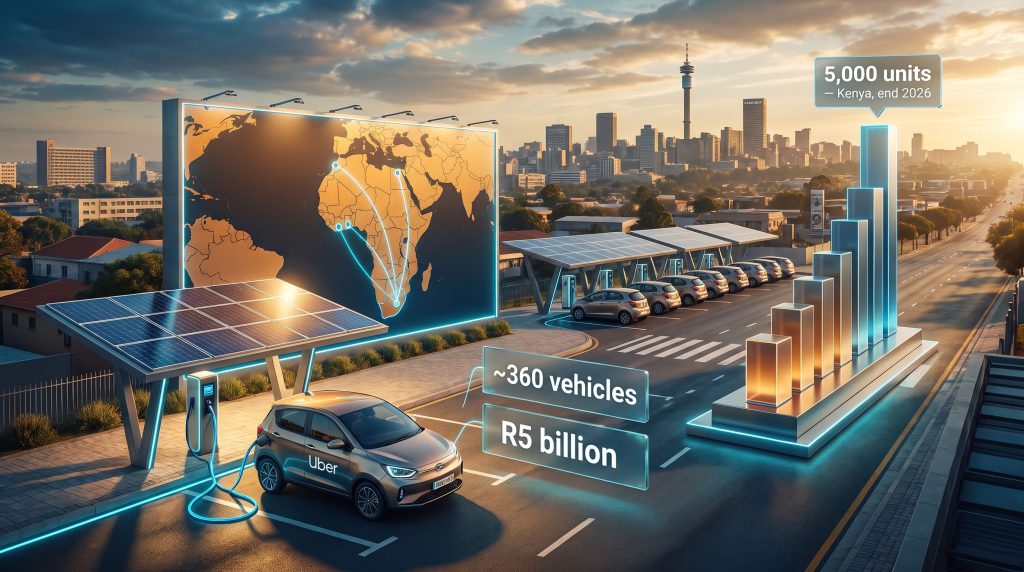
| Current Fleet Target | ~360 Henrey EV4 vehicles |
| Operating Geography | Northern Johannesburg |
| Fleet Structure | Operator rental model |
| Fleet Partner | Valternative (Durban-based) |
| Uber SA Investment Commitment | R5 billion (~USD $298.61 million) over three years |
What Is the Henrey EV4?
The Henrey EV4 is a compact, affordably positioned electric vehicle selected specifically for its suitability to urban African ride-hailing conditions. Its cost positioning relative to premium EV models available in developed markets makes it viable for fleet deployment at scale. This is a critical point that is frequently overlooked in broader EV transition discussions: the African market does not need Tesla-grade electric vehicles. It needs durable, low-maintenance, affordable EVs that can handle high daily utilisation cycles on urban road networks.
Uber's Broader Africa Investment Thesis
The R5 billion ($298.61 million) commitment announced by Uber in March 2026 spans multiple verticals beyond ride-hailing, including delivery operations, charging infrastructure, and EV partnerships. Notably, Uber's global EV partnership with BYD does not extend to African markets, making local fleet operator relationships the critical enablers of the Africa electrification strategy. This structural difference matters for understanding how the expansion will scale: it depends on Valternative and similar local operators building capacity, not on global OEM pipelines.
Beyond South Africa, Uber's Africa EV footprint also includes electric motorcycles. The company launched electric ride-hailing services in Kenya in 2023 using electric boda-bodas and is targeting a fleet exceeding 5,000 units by the end of 2026. The motorcycle segment illustrates how Africa's EV mobility architecture is being built bottom-up, adapted to the specific urban transport modes that dominate different country markets.
Which African Markets Are Next for Electric Ride-Hailing?
Valternative's continental ambitions are concrete and already sequenced. The company plans to expand first into four priority markets before reaching an eight-country footprint.
| Market | Strategic Rationale | Key EV Readiness Factors |
|---|---|---|
| Egypt | Large urban ride-hailing base | State investment in electric transport corridors |
| Morocco | Regional EV manufacturing hub | Battery component production; North Africa supply chain anchor |
| Ghana | Growing urban mobility market | Rising ride-hailing demand; fuel import dependency |
| Côte d'Ivoire | West Africa's economic hub | High urbanisation; emerging digital mobility infrastructure |
Why Morocco and Egypt Are Strategically Critical
Morocco's emergence as a continental EV component and battery manufacturing base gives it a strategic significance beyond just being a ride-hailing market. Its position as a manufacturing anchor for North Africa means that future EV fleet procurement across the continent could increasingly route through Moroccan supply chains, reducing costs and delivery timelines for operators expanding southward.
Egypt's state-level investments in electric transport infrastructure create a different kind of strategic value: a large, dense urban population already familiar with ride-hailing services, combined with an operating environment where government investment is actively building the charging and grid capacity that fleet operators need.
Valternative's co-founder has stated publicly that supply constraints rather than demand are the primary growth bottleneck. In reporting by Bloomberg, the co-founder described the company as completely undersupplied and indicated that continental expansion beyond South Africa would proceed as quickly as Uber's operational capacity allows. Consequently, the battery metals investment landscape is drawing increasing attention from investors tracking this continental shift.
Structural Barriers Slowing the Transition
The momentum is real. The barriers are also real. Understanding both simultaneously is essential for any accurate assessment of the timeline.
The Import Tariff Problem
South Africa's current tariff structure creates a direct financial penalty for EV fleet investment:
- Electric vehicles: 25% import duty
- Petrol and diesel vehicles: 18% import duty
- Net disadvantage: EV acquisition costs are structurally elevated by 7 percentage points relative to conventional alternatives
This asymmetry is a policy misalignment that undermines the unit economics of fleet electrification. Fleet operators like Valternative absorb higher per-vehicle acquisition costs upfront, relying on lower operating costs over the vehicle's life to justify the investment. Any reduction in this tariff gap would materially improve fleet operator returns and accelerate deployment timelines.
Infrastructure Deficits and Grid Dependency
South Africa's electricity generation remains heavily coal-dependent, which partially dilutes the emissions case for EVs on the national grid. However, for operators focused on commercial economics rather than carbon credentials, grid composition is secondary to charging reliability and coverage.
The current public charging network is insufficient to support high-utilisation commercial fleets across wider geographic areas. Drivers in the Johannesburg pilot have raised operational concerns about extended charging cycles and restricted coverage zones, both of which reduce the number of daily trips completable and therefore compress earnings.
The Charging Infrastructure Build-Out Plan
Valternative's response to the infrastructure gap is structured and time-bound:
- Deploy six to seven new charging sites per month over a 12-month period
- Integrate solar-powered charging hubs to reduce coal grid dependency and improve energy resilience
- Retrofit existing vehicles with cabin heaters to address driver comfort and operational reliability concerns
The integration of solar-powered hubs reflects a broader shift toward renewable energy solutions that are reshaping how African operators think about long-term energy resilience.
Operational Challenge: Extended charging cycles and limited charging site coverage are currently compressing driver daily earnings, a friction point that the planned charging network expansion directly targets.
How Africa's Fleet Model Compares to Global EV Ride-Hailing Approaches
Africa's emerging EV ride-hailing architecture is structurally distinct from the models operating in Europe, North America, and China. Understanding those differences clarifies why global EV adoption statistics and timelines do not translate directly to African market projections.
| Dimension | Africa (Emerging Market Model) | Global Mature Markets |
|---|---|---|
| Vehicle Ownership | Fleet rental (operator-owned) | Driver-owned or leased |
| Primary Adoption Driver | Fuel cost economics and energy security | Climate policy and regulatory mandates |
| Charging Infrastructure | Being built concurrently with fleet deployment | Pre-existing public and private network |
| Vehicle Segment | Compact, low-cost EVs | Mixed range from compact to premium |
| Platform-OEM Partnership | Local fleet operators | Global OEM partnerships |
The fleet rental model is arguably the single most important structural innovation in Africa's EV transition. By removing vehicle ownership as a prerequisite for drivers, it transforms EV access from a capital decision into an operating cost decision. That shift makes adoption viable at income levels where direct vehicle purchase would never be feasible. Furthermore, electric vehicles transforming transport across other sectors suggest this model could extend well beyond ride-hailing.
The next major ASX story will hit our subscribers first
Is Africa's Electric Ride-Hailing Expansion Financially Sustainable?
Disclaimer: The following scenario analysis contains forward-looking projections and assumptions. These do not constitute financial advice. Actual outcomes will depend on variables including global oil prices, African government policy decisions, grid infrastructure investment, and fleet operator execution capacity.
Three Scenarios for Africa's EV Ride-Hailing Market
Scenario 1: Accelerated Adoption (Base Case)
- Sustained elevated global fuel prices maintain EV operating cost advantage over petrol fleets
- Charging infrastructure expands on Valternative's published schedule; driver earnings stabilise
- Egypt, Morocco, Ghana, and Côte d'Ivoire expansion proceeds within 24 months of South Africa proof-of-concept
Scenario 2: Constrained Growth (Headwind Case)
- South Africa's 25% EV import tariff remains unreformed; acquisition costs stay elevated
- Grid reliability issues in expansion markets create charging uncertainty for operators
- Continental rollout is delayed; South Africa remains the primary operating market through 2027
Scenario 3: Policy-Catalysed Acceleration (Upside Case)
- African governments reduce EV import duties and introduce fleet electrification incentives
- Morocco-anchored regional manufacturing reduces per-vehicle costs materially
- Uber's Africa EV network scales toward eight countries ahead of internal projections
The unit economics underpinning all three scenarios rest on a straightforward calculation: if daily fuel savings exceed the incremental rental cost premium of an EV over a petrol vehicle, drivers and operators both benefit. As petrol prices become more volatile and EV acquisition costs trend downward through regional manufacturing, that equation is moving in one direction.
Frequently Asked Questions: Africa Electric Ride-Hailing and Uber EV Expansion
What is Uber's current EV strategy in Africa?
Uber is deploying electric ride-hailing through local fleet operator partnerships rather than direct vehicle ownership. The primary active pilot operates in Johannesburg, South Africa, with planned expansion into Egypt, Morocco, Ghana, and Côte d'Ivoire.
How many electric vehicles is Uber currently operating in South Africa?
The Johannesburg pilot launched with approximately 70 vehicles and is scaling toward a target fleet of around 360 Henrey EV4 vehicles managed by fleet operator Valternative.
Why are EVs becoming more economically attractive for African ride-hailing drivers?
Geopolitical disruptions affecting Middle East oil supply have pushed fuel prices higher across African markets. Since fuel is a primary daily operating cost for ride-hailing drivers, EVs offer more predictable and structurally lower per-kilometre expenses. However, the Africa ride-hailing market remains one of the fastest-growing globally, which amplifies the commercial stakes of getting the EV transition right.
Does Uber's global BYD EV partnership apply to Africa?
No. Uber's global EV partnership with BYD does not extend to African markets, making local fleet operator partnerships the critical enablers of Africa's electrification strategy.
What are the biggest obstacles to EV adoption in African ride-hailing markets?
The primary barriers include South Africa's 25% EV import tariff compared to 18% for petrol vehicles, limited public charging infrastructure, coal-dependent electricity generation, and driver concerns about charging time and daily trip capacity.
Is Uber deploying electric vehicles beyond cars in Africa?
Yes. Uber launched electric motorcycles in Kenya in 2023 and is targeting a fleet of more than 5,000 electric boda-bodas by the end of 2026. According to Uber's electric vehicle commitments, the company has outlined ambitious global targets for fleet electrification that are now being pursued through region-specific strategies.
The Commercial Verdict: Why Market Economics Are Already Deciding the Outcome
What makes the current moment in Africa electric ride-hailing distinctly different from earlier waves of EV enthusiasm is that the financial logic is now doing the work that policy frameworks have failed to deliver. The 25% import tariff on EVs has not killed adoption. The absence of a widespread charging network has not stopped fleet operators from building one. The coal-heavy grid has not deterred investment.
Instead, a geopolitical crisis thousands of kilometres from Johannesburg has sharpened the commercial case beyond the point where barriers can hold the transition back indefinitely. When petrol price volatility directly and immediately reduces a driver's take-home earnings, the argument for electric alternatives does not require climate conviction or government subsidy. It requires only a reliable vehicle, an accessible charging point, and a rental model that keeps the entry barrier manageable.
The fleet-rental model Valternative has pioneered solves the affordability problem that has historically blocked EV adoption in emerging markets. The continental expansion blueprint, anchored in South Africa and sequenced through North and West African markets, outlines a credible pathway toward a genuinely African EV mobility architecture, one built on energy security logic rather than borrowed from developed market playbooks.
Whether policy environments across target markets will accelerate or constrain what commercial economics are already beginning to deliver remains the defining uncertainty. What is no longer uncertain is the direction of travel.
For ongoing coverage of Africa's evolving electric mobility landscape and ride-hailing market dynamics, Business Insider Africa tracks developments across African transport, energy, and technology sectors at africa.businessinsider.com.
Want to Track the Mineral Discoveries Powering the EV Revolution?
Africa's shift toward electric mobility is creating surging demand for the battery metals and critical minerals that underpin every EV deployed on the continent — and Discovery Alert's proprietary Discovery IQ model instantly notifies subscribers when significant ASX mineral discoveries are announced, turning complex geological data into clear, actionable opportunities. Explore historic discoveries and their returns to understand the scale of what's possible, then begin your 14-day free trial at Discovery Alert to position yourself ahead of the market.