July 22, 2026
The Rare Earth Processing Ladder: Why Africa's Position Matters More Than Ever
Commodity cycles have a long memory. For decades, the pattern across Africa's extractive industries has followed a familiar and frustrating arc: geological abundance at one end, and industrial dependency at the other. Raw materials leave the continent in their least processed form, while the economic value embedded in refining, manufacturing, and component production accrues elsewhere. As the global energy transition accelerates demand for rare earth elements at an unprecedented rate, the Africa rare earth value chain is being tested as never before.
The International Energy Agency projects that global demand for rare earths used in permanent magnets will rise by 25% between 2025 and 2030, and by more than 80% by 2050. The drivers are well understood: electric vehicle motors, onshore and offshore wind turbines, industrial robotics, and defence electronics all depend on high-performance permanent magnets made from neodymium, praseodymium, dysprosium, and terbium. These are no longer niche industrial inputs. They are load-bearing materials for the physical infrastructure of the energy transition.
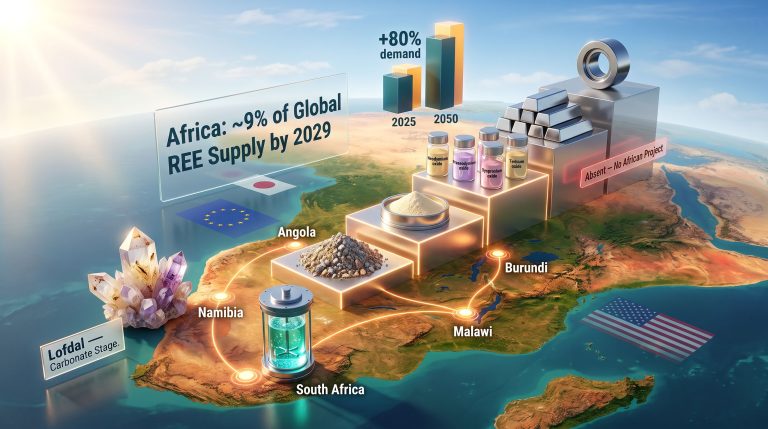
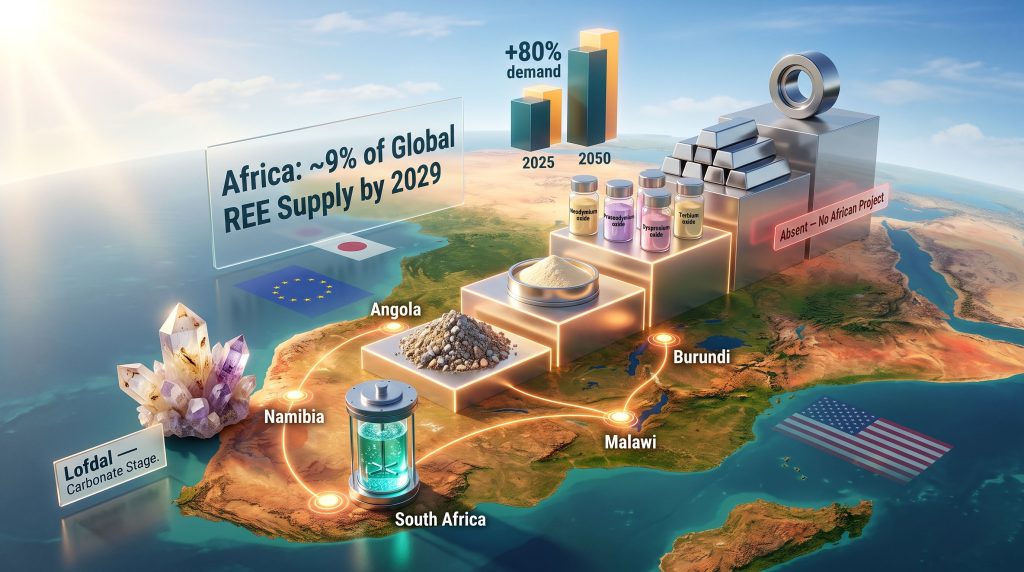
Africa sits on a significant share of the geological endowment that underpins this demand. Nations including South Africa, Namibia, Angola, Malawi, Tanzania, Madagascar, Mozambique, Kenya, Zambia, Burundi, and the Democratic Republic of Congo all host rare earth mineralisation of varying scale and maturity. Furthermore, Benchmark Mineral Intelligence projects that Africa could account for approximately 9% of global rare earth supply by 2029. And yet, despite that resource base, the continent's contribution to processed rare earth output remains marginal. Understanding why requires mapping the full architecture of the Africa rare earth value chain, from the drill bit to the finished magnet.
When big ASX news breaks, our subscribers know first
Understanding the Full Rare Earth Value Chain
Rare earth processing is a staged industrial process, and each stage represents a meaningfully different level of technical complexity, capital intensity, and commercial value. The gap between the lowest and highest stages is not incremental. It is transformational. Consequently, the rare earth supply chains that nations seek to build are defined not just by what they mine, but by how far along that ladder they can process.
The Five-Stage Processing Ladder Explained
Stage 1: Concentrate
Ore is mined and subjected to physical separation techniques including flotation, gravity separation, and magnetic sorting. The output is a mixed rare earth concentrate, typically containing 40 to 60% total rare earth oxide content. This is the commodity floor of the industry: undifferentiated, relatively low-value, and dependent on downstream refiners to unlock the chemistry within it.
Stage 2: Carbonate
Concentrate undergoes initial chemical leaching and precipitation, producing either a light rare earth carbonate (rich in neodymium and praseodymium) or a heavy rare earth carbonate (containing dysprosium and terbium). This is the first meaningful chemical separation step in the chain, and it represents a qualitatively different kind of industrial capability compared to simple physical processing.
Stage 3: Oxide
Individual rare earth elements are separated and purified through solvent extraction, a technically demanding hydrometallurgical process requiring precise chemistry and consistent reagent supply. The outputs include neodymium oxide, dysprosium oxide, terbium oxide, and others. Each has its own price and its own buyer market. This stage transforms a blended intermediate into commercially differentiated products.
Stage 4: Metal and Alloy
Oxides are reduced to individual rare earth metals through high-temperature metallurgical processes, then combined into alloys such as NdFeB (neodymium-iron-boron), the primary alloy used in high-performance permanent magnets.
Stage 5: Permanent Magnet
Alloys are pressed, sintered, and magnetised into finished components. This is the highest-value output in the entire chain and the end-product for EV manufacturers, wind turbine producers, and defence contractors.
| Stage | Output | Typical Value Addition | Africa's Current Status |
|---|---|---|---|
| 1 | Concentrate | Lowest | Active (several projects) |
| 2 | Carbonate | Moderate | Emerging (Lofdal, Longonjo) |
| 3 | Oxide | Significant | Planned only (Songwe Hill, Phalaborwa) |
| 4 | Metal / Alloy | High | None announced |
| 5 | Permanent Magnet | Highest | None announced |
Key Insight: Africa's rare earth projects are clustered at the lowest two stages of a five-stage industrial ladder. The economic value embedded in stages three through five, where China has built overwhelming dominance, remains entirely absent from African soil.
Where Africa's Key Projects Currently Stand
Namibia's Lofdal Project: The Carbonate Threshold
In July 2025, Namibia Critical Metals announced a commitment of C$11 million (approximately USD $7.8 million) toward feasibility work at its Lofdal rare earth project, conducted in partnership with JOGMEC, Japan's state mineral security agency. The study will assess the technical and commercial viability of producing separate light and heavy rare earth carbonate streams through an integrated hydrometallurgical process.
Light rare earth carbonates at Lofdal are primarily composed of neodymium and praseodymium, the key inputs for NdFeB permanent magnets. Heavy rare earth carbonates from the project would contain dysprosium and terbium, which are critical additives for high-temperature magnet performance in electric vehicles and industrial applications. JOGMEC's 40% ownership stake in the project reflects Japan's deliberate national strategy to diversify mineral supply away from Chinese-controlled processing infrastructure.
What makes Lofdal notable within the African context is not simply the investment figure, but the processing ambition. Most African rare earth projects have defaulted to concentrate production for export, routing the majority of value creation to Chinese refiners. However, carbonate production represents a step change from that model, requiring chemical engineering capability, reagent logistics, and process control that are not yet widespread across African mining jurisdictions.
Malawi's Kangankunde: Africa's Most Advanced Near-Term Producer
Kangankunde is positioned to become Africa's first industrial rare earth mine to commence production since Gakara in Burundi, which operated between 2017 and 2021 before being suspended. Kangankunde's production timeline targets end of 2026. However, its planned output model remains concentrate for export, anchoring even the continent's most near-term producer at the lowest stage of the value chain.
This is not a criticism of the project's ambition so much as a reflection of the structural economics of rare earth development. Advancing from concentrate to carbonate to oxide production requires capital investment, technical expertise, and long-term offtake agreements that most African projects have not yet been able to secure. The rare earth processing challenges involved are significant and multifaceted.
Oxide-Level Ambitions: Songwe Hill and Phalaborwa
Both the Songwe Hill project in Malawi and the Phalaborwa project in South Africa have announced plans for oxide-level production, placing them at stage three of the processing ladder. This is meaningfully more ambitious than concentrate or carbonate production. Individual rare earth oxide separation requires solvent extraction circuits, consistent chemical inputs, and precision process management.
Neither project has yet reached commercial production at this stage. Their oxide ambitions represent the current ceiling of stated development aspiration across the African rare earth sector.
Why China's Dominance Is So Difficult to Displace
China controls an estimated 85 to 90% of global rare earth refining capacity, a position built over several decades through deliberate industrial policy, subsidised processing infrastructure, and accumulated technical expertise in hydrometallurgical separation. This is not primarily a geological advantage. China's rare earth strategy has been institutional and industrial rather than purely geological, creating a technical moat that is extremely difficult to replicate.
Solvent extraction, the chemical process used to separate individual rare earth oxides from mixed concentrates, is extraordinarily technically demanding. Separation factors between adjacent rare earth elements are often extremely close, requiring hundreds of stages of liquid-liquid extraction to achieve commercial purity levels. China has refined these processes over generations of operational learning, creating a barrier that cannot be bridged simply by building a facility and importing equipment.
This is a critical point for investors and policymakers assessing African rare earth projects. The challenge of moving up the Africa rare earth value chain is not primarily a question of capital. It is a question of technical capacity accumulation, workforce development, and operational learning that takes years to build.
The Foreign Capital Dilemma
One of the less-discussed structural tensions in African rare earth development is the relationship between the source of foreign investment and the shape of the industrial output it produces. Furthermore, African mining finance trends reveal that the investment thesis driving foreign capital is fundamentally about supply security for foreign domestic industries, not about building African industrial capacity.
Japan, the United States, the European Union, and Canada are all competing to secure African rare earth supply as part of broader strategies to reduce dependence on Chinese-controlled processing. This foreign interest has accelerated financing for several African projects. But the countries financing Africa's rare earth projects are often the same countries seeking to build their own non-Chinese processing hubs.
Analytical Framing: African concentrate and carbonate outputs are being designed to feed Japanese, European, and North American refineries, not African ones.
The Lofdal example illustrates this clearly. JOGMEC's 40% stake brings technical resources and financing credibility to the project. But Japan's strategic interest is in securing carbonate supply for its domestic refining and magnet manufacturing industry. The economic logic of that arrangement does not naturally extend to building a Japanese-funded oxide separation plant, let alone a magnet factory, on Namibian soil.
This is not a reason to reject foreign investment. However, it is a reason for African governments to design investment frameworks that embed value-addition requirements, technology transfer clauses, and beneficiation mandates into the terms under which foreign capital accesses African mineral resources.
Could Regional Integration Change the Equation?
One structural constraint facing individual African nations is scale. A single rare earth project producing concentrates or carbonates may not generate sufficient ore volume to economically justify the capital investment required for a commercial-scale oxide separation facility. However, a regional processing hub drawing feed material from multiple projects across multiple countries could potentially reach the throughput necessary to make downstream processing economically viable.
The African Continental Free Trade Area provides a policy framework under which shared regional processing infrastructure could be coordinated. For instance, a hypothetical Southern African rare earth processing hub, drawing concentrate from Lofdal in Namibia, the Longonjo rare earth project in Angola, and projects in South Africa, could potentially justify a shared hydrometallurgical separation plant producing individual rare earth oxides at commercial scale.
- South Africa offers existing mining infrastructure, chemical engineering expertise, and established port logistics
- Namibia contributes heavy rare earth mineralisation with carbonate-level processing ambitions already underway
- Angola's Longonjo project targets carbonate production, potentially supplying a regional hub
This model would require multilateral investment frameworks, coordinated revenue-sharing agreements, and long-term offtake commitments from international buyers. None of those conditions currently exist. But the logic of regional integration as a mechanism for unlocking downstream processing capability is one that policymakers and development finance institutions are increasingly examining, as the IEA's analysis on stepping up Africa's value chain highlights.
The next major ASX story will hit our subscribers first
The Lessons from Lithium and Cobalt
Africa's rare earth challenge is not without precedent. The continent has watched a nearly identical dynamic play out in lithium and cobalt, where abundant upstream resources have consistently failed to translate into significant downstream value capture.
Zimbabwe's decision to restrict the export of unprocessed lithium ore demonstrated that regulatory levers can shift investment behaviour toward in-country processing. The policy generated controversy and implementation challenges, but it established a principle: geological endowment can be used as negotiating leverage for industrial development, not merely as a commodity export.
Rare earth development is technically more complex and geographically more dispersed than lithium, which complicates direct policy replication. But the core lesson holds. Without deliberate intervention, the default trajectory of African rare earth development will continue to favour concentrate and carbonate export over oxide, metal, and magnet production. In addition, the African Development Bank's REE value chain analysis underscores that without policy-driven beneficiation, the continent's mineral wealth will continue flowing elsewhere.
Frequently Asked Questions
What is the difference between rare earth concentrate and rare earth carbonate?
Concentrate is the direct product of physical mineral processing, containing a blend of rare earth minerals that have not yet been chemically separated. Carbonate is produced after an initial chemical treatment stage, yielding a higher-purity intermediate that separates light and heavy rare earth fractions. Carbonate is significantly more valuable than concentrate and represents a qualitatively different level of industrial processing capability.
Which African rare earth project is furthest along in development?
Kangankunde in Malawi is closest to production, with a target commencement date of end-2026, though its planned output is concentrate. Lofdal in Namibia is conducting feasibility work for carbonate-level production, representing the most advanced processing ambition currently being technically studied on the continent.
Why does China control rare earth refining so completely?
China's dominance reflects decades of deliberate industrial policy and accumulated operational expertise in solvent extraction chemistry, not simply geological advantage. Building equivalent technical capacity requires sustained investment in workforce development and operational learning that takes many years to achieve.
Is permanent magnet manufacturing a realistic near-term goal for Africa?
In the near to medium term, integrated magnet manufacturing on African soil is not a realistic prospect without extraordinary policy intervention and technology transfer agreements. The more achievable near-term pathway involves advancing from concentrate toward carbonate and oxide production, with magnet manufacturing representing a long-horizon industrial aspiration.
The Road Ahead for Africa's Rare Earth Value Chain
| Metric | Current Status | Near-Term Outlook (2026 to 2030) |
|---|---|---|
| Africa's share of global REE supply | Sub-5% | ~9% projected |
| Dominant output stage | Concentrate | Carbonates emerging |
| Oxide production | Planned only | Possible but unconfirmed |
| Metal and alloy production | None | No projects announced |
| Permanent magnet manufacturing | None | No projects announced |
| Primary processing destination | China (85 to 90% of refining) | Diversifying toward Japan, EU, US |
The Africa rare earth value chain is in genuine transition, but that transition must be understood for what it actually is. The continent is moving from a position of near-zero production toward early-stage concentrate and carbonate output. It is not moving from early-stage processing toward manufacturing. The distance between those two realities is vast, and closing it will require more than project development. It will require a deliberate, sustained, and politically coordinated effort to convert geological endowment into industrial capability before the window created by global supply chain diversification narrows.
This article contains forward-looking projections drawn from third-party industry sources including the International Energy Agency and Benchmark Mineral Intelligence. These projections involve assumptions and uncertainties and should not be interpreted as investment advice. Readers are encouraged to conduct independent research before making any investment decisions related to the rare earth sector.
Readers seeking ongoing coverage of Africa's critical minerals sector and broader economic developments across the continent can explore reporting from Ecofin Agency at ecofinagency.com.
Ready to Identify the Next Major Mineral Discovery Before the Market Does?
Discovery Alert's proprietary Discovery IQ model delivers real-time alerts on significant ASX mineral discoveries — turning complex geological data into clear, actionable investment insights for traders and long-term investors alike. Explore how historic discoveries have generated substantial returns on Discovery Alert's dedicated discoveries page, and begin your 14-day free trial today to position yourself ahead of the broader market.