July 22, 2026
The Hidden Complexity Behind Heavy Rare Earth Processing Outside China
Building a functioning heavy rare earth separation facility from the ground up, outside of China, is one of the most technically demanding feats in modern critical minerals development. The chemistry involved in separating individual heavy rare earth elements from one another is notoriously stubborn, requiring specialised solvent extraction circuits that took China decades to perfect at industrial scale. For any producer attempting to replicate this capability in a different regulatory environment, with different labour markets and rare earth supply chains, cost discipline is extraordinarily difficult to maintain. This structural reality forms the essential backdrop for understanding the Lynas Rare Earths cost overrun in Malaysia expansion project, which has become a defining moment for Western rare earth supply chain ambitions.
When big ASX news breaks, our subscribers know first
From A$180 Million to A$294 Million: The Numbers Behind the Budget Blowout
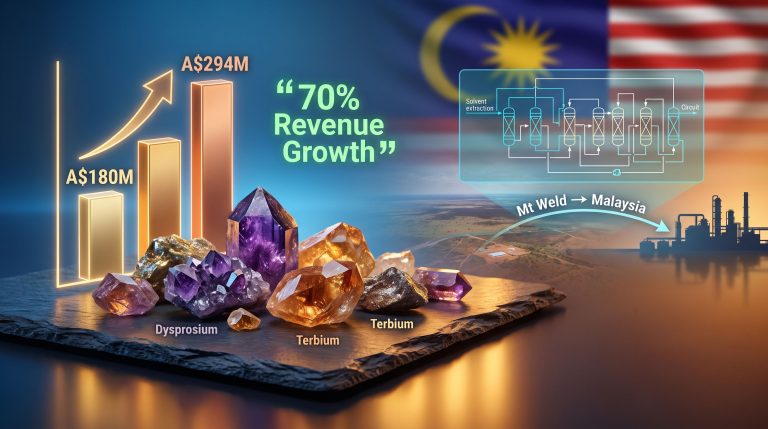
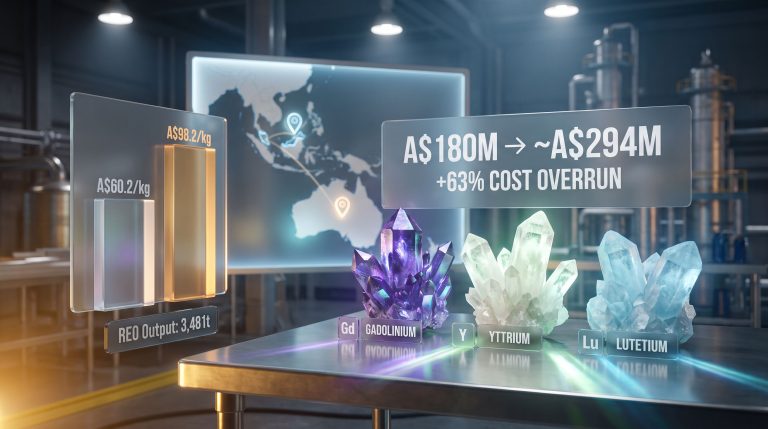
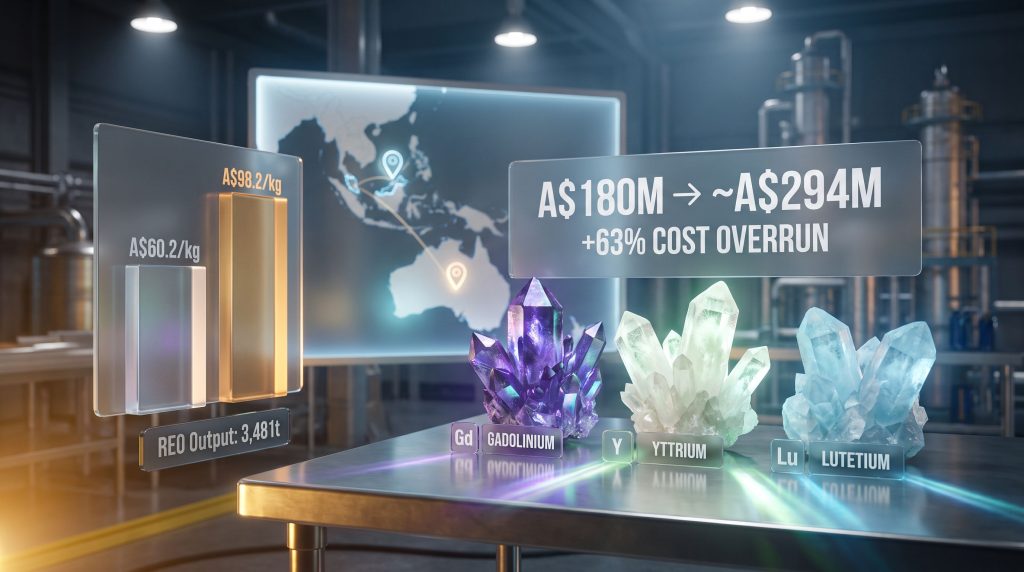
When a capital project exceeds its original budget by approximately 63%, the market takes notice. Lynas Rare Earths disclosed that the estimated cost of its Malaysia heavy rare earths expansion project had escalated from A$180 million to approximately A$294 million, a variance of roughly A$114 million. For investors already watching the stock closely, the announcement landed alongside a quarterly revenue result that came in nearly 20% below Visible Alpha consensus analyst estimates, creating a compounding negative signal that drove shares down as much as 9.1% intraday to A$14.51, the lowest level since February 6 of the same year.
The table below captures the key financial metrics from the most recent quarter alongside the budget escalation:
| Metric | Prior Year | Latest Quarter | Change |
|---|---|---|---|
| Malaysia Project Budget | A$180M (original) | ~A$294M (revised) | +63% |
| Quarterly Sales Revenue | ~A$170M (implied) | A$288.9M | +~70% YoY |
| Average Selling Price | A$60.2/kg | A$98.2/kg | +63% YoY |
| REO Production Output | 3,212 t | 3,481 t | +8.4% YoY |
| Share Price (Intraday Low) | Above A$15 | A$14.51 | -9.1% |
Despite recording its strongest quarterly revenue performance in four years, the combination of the cost overrun and the production shortfall overwhelmed the positive pricing story. Lynas also became the top laggard on the S&P/ASX benchmark on the day of the announcement, even as the broader index edged up 0.1%.
What the Malaysia Facility Is Actually Trying to Achieve
The strategic logic behind the Malaysia facility is easier to appreciate once you understand the difference between light and heavy rare earth elements. Light rare earths, such as neodymium and praseodymium, are the elements most commonly discussed in the context of permanent magnets for electric vehicles and wind turbines. Heavy rare earths occupy a different and arguably more sensitive space in the periodic table, serving applications where no substitutes currently exist at commercial scale.
The three elements targeted by the Malaysia expansion represent distinct and high-value end markets:
-
Gadolinium: Targeted for first production in early fiscal year 2028. Used as a contrast agent in MRI scanning and as a neutron absorber in nuclear reactor control systems. Its separation chemistry is complex due to its position within the lanthanide series.
-
Yttrium: Production expected in early calendar year 2028. Essential for phosphors used in LEDs and flat panel displays, high-temperature superconductors, and certain aerospace alloys. Yttrium is often misclassified as a rare earth by lay audiences since it sits outside the lanthanide series proper, yet it shares deposit associations and processing pathways with the heavier lanthanides.
-
Lutetium: The final production phase target. Increasingly significant in nuclear medicine, particularly in targeted radiopharmaceutical therapies and PET scan diagnostics. Lutetium-based cancer treatments have attracted growing clinical interest, making it one of the more forward-looking elements in the rare earth basket.
China currently dominates global processing capacity for all three elements. The Malaysia facility, once operational, would represent one of the only credible alternatives in the Western-aligned supply chain.
Why Cost Overruns Are Structurally Endemic to This Sector
The Lynas Rare Earths cost overrun in Malaysia expansion project did not emerge from a vacuum. Capital cost discipline in rare earth processing has historically been problematic for projects developed outside China, and several structural forces explain why. Furthermore, understanding these forces is essential for contextualising the scale of the challenge facing the company.
The Solvent Extraction Problem
Heavy rare earth separation relies on solvent extraction, a process that involves passing rare earth-bearing solutions through hundreds of mixer-settler stages to progressively isolate individual elements by exploiting minute differences in their chemical behaviour. The technical challenge is that adjacent heavy rare earths in the lanthanide series are chemically almost identical, requiring far more separation stages than light rare earths. Engineering this at commercial scale outside established facilities involves significant trial-and-error capital expenditure that is difficult to model accurately from desktop estimates. These rare earth processing challenges are well documented across the industry.
Regulatory and Compliance Layers
Lynas's Malaysian operations have a documented history of regulatory scrutiny from local authorities, particularly regarding the management of low-level radioactive waste generated during processing. Thorium and uranium occur naturally in rare earth deposits and must be separated and managed carefully. Compliance infrastructure adds cost layers that are rarely fully captured in initial project estimates.
Construction Cost Inflation Across Asia-Pacific
Original budget estimates for the Malaysia project were prepared in an earlier cost environment. Engineering labour, specialist equipment, and construction materials have all experienced significant price inflation across the Asia-Pacific region since those baselines were set. This is not unique to Lynas but reflects a broader pattern affecting capital-intensive projects across the region.
How the Malaysia Overrun Compares to Industry Norms
| Risk Factor | Lynas Malaysia Project | Typical Greenfield RE Processing Projects |
|---|---|---|
| Cost Escalation Rate | ~63% | 30-80% (documented range) |
| Technical Complexity | High (HREE separation) | High to Very High |
| Regulatory Exposure | Elevated (historical precedent) | Moderate to High |
| Feedstock Consistency Risk | Present (Mt Weld ore quality) | Variable by deposit |
| Timeline to First Production | Multi-year (2028 target) | Typically 3-7 years |
A 63% overrun sits within the documented range for complex rare earth processing projects, but that contextualisation offers limited comfort to investors who absorbed the news alongside a production miss and a revenue shortfall in the same announcement.
The Mt Weld Ore Quality Problem: An Upstream Risk That Flows Downstream
One dimension of this story that deserves closer attention is the geological challenge at Mt Weld in Western Australia. Mt Weld is widely regarded as one of the highest-grade rare earth deposits in the world outside China. However, like all mineral deposits, ore grades are not uniform throughout the orebody. As mining progresses into different zones, the concentration and mineralogical character of the ore can shift, affecting both the volume and the efficiency of downstream processing.
The production shortfall reported for the quarter, with total rare earth oxide output reaching 3,481 tonnes against analyst consensus expectations of approximately 3,870 tonnes, a gap of roughly 10%, was directly attributed to ore quality variability at Mt Weld. This is a geological reality that senior investors in mining companies sometimes underweight when modelling near-term production.
Ore grade variability is one of the most persistently underestimated risks in mining investment. Even a high-quality orebody like Mt Weld will cycle through zones of lower mineralisation, and when processing facilities are calibrated to a certain feedstock quality, even modest grade variation can have outsized impacts on throughput and recovery rates.
A straightforward scenario analysis illustrates the financial magnitude of this shortfall. Had Mt Weld delivered production in line with analyst consensus of approximately 3,870 tonnes, and assuming the realised average selling price of A$98.2/kg, quarterly revenue could have been approximately A$38 million higher, which would have gone a significant way toward closing the gap with analyst revenue expectations of approximately A$361 million implied by the 20% miss.
Pricing Strength Meets Volume Weakness: The Earnings Paradox
There is a nuanced investor lesson embedded in this quarter's results. Average rare earth selling prices rose 63% year-on-year from A$60.2/kg to A$98.2/kg, a substantial improvement driven in part by incentive structures supporting Western producers of rare earths and growing customer urgency around securing non-Chinese supply. Yet quarterly revenue still came in roughly 20% below analyst expectations.
This arithmetic makes a critical point: pricing tailwinds, no matter how favourable, cannot fully compensate for volume shortfalls. In commodity businesses, the intersection of price and volume determines revenue, and when one leg of that equation underperforms, even exceptional pricing cannot rescue the headline number. For Lynas, the constraint was not commercial. It was geological and operational.
The broader geopolitical context driving customer behaviour is significant. Lynas has noted publicly that customers are actively redirecting procurement toward sustainable, outside-China supply chains in response to rare earth geopolitics and the effects of China's export restrictions on rare earth materials. This customer urgency is real and is contributing to improved pricing conditions. However, meeting that demand requires consistent operational execution, which this quarter's results called into question.
The next major ASX story will hit our subscribers first
Three Investor Risk Dimensions That Warrant Close Monitoring
For investors tracking this stock and the broader rare earths sector, the July 2026 announcement crystallises three distinct risk categories that extend beyond the share price move. Consequently, each of these dimensions deserves careful analysis:
-
Capital allocation and governance risk: A budget overrun of this magnitude raises legitimate questions about the robustness of project cost estimation and contingency planning. Investors will reasonably ask whether further revisions to the A$294 million figure are possible before first production in fiscal 2028, and what governance structures are in place to prevent further scope creep.
-
Production timeline risk: With gadolinium targeted for early fiscal 2028, yttrium for early calendar 2028, and lutetium following thereafter, investors face a multi-year window before heavy rare earth revenues make a meaningful contribution to the income statement. The extended pre-revenue period creates balance sheet pressure and leaves the company exposed to further operational surprises before the project begins to pay back its capital.
-
Upstream geological risk: Ore quality challenges at Mt Weld are not a one-off event risk. They reflect the natural variability inherent in any mineral deposit and could recur in future quarters. Investors should watch for management disclosures on ore characterisation, blending strategies, and whether additional capital expenditure at the mine itself may be required to stabilise feedstock quality.
The Broader Stakes: What This Means for Western Rare Earth Strategy
Lynas occupies a unique position in global critical minerals supply chains. As the largest rare earth producer outside China, it carries a weight of strategic expectation that no other company in the sector currently bears at the same scale. The Malaysia facility, once operational, would give Western defence contractors, medical device manufacturers, and advanced technology firms access to heavy rare earths without routing procurement through Chinese processing infrastructure. In addition, the critical minerals demand surge across defence and clean energy sectors means that delivery timelines carry significant strategic weight.
That strategic value is real and undisputed. However, the path from strategic importance to reliable commercial delivery is where the current challenges sit. A 63% cost overrun on a flagship capital project, combined with a production miss and a revenue result that fell short of expectations, creates what might fairly be described as a compounding credibility challenge. Management will need to address this with detailed and transparent remediation disclosures in upcoming quarters to maintain the confidence of both institutional investors and the industrial customers whose supply chain decisions depend on Lynas's delivery track record.
The long-term structural case for heavy rare earth demand remains intact. Defence electronics, clean energy systems, and advanced medical technologies are all growing end markets. What this announcement tests is not the destination but the route, and whether the company can demonstrate the project management discipline required to reach it on a revised budget and timeline. Industry observers have noted that Lynas warned of a cost overrun as pressures across the region became increasingly difficult to absorb, reinforcing the view that this is a sector-wide structural issue as much as a company-specific one.
Frequently Asked Questions
What is the Lynas Malaysia heavy rare earths expansion project?
The project is a purpose-built processing facility in Malaysia designed to separate and refine heavy rare earth elements, specifically gadolinium, yttrium, and lutetium, extracted from the Mt Weld mine in Western Australia. Its strategic purpose is to provide Western technology and defence industries with a reliable heavy rare earth supply source that does not depend on Chinese processing capacity.
How significant is the cost overrun in percentage terms?
The estimated project cost rose from an original budget of A$180 million to approximately A$294 million, representing an increase of roughly A$114 million or approximately 63% above the original estimate. Furthermore, an expansion facility announcement at the original A$180 million figure had already generated considerable investor interest prior to the revision, making the scale of the overrun all the more pronounced.
When will the Malaysia project begin producing heavy rare earths?
Lynas has outlined a phased production schedule, with gadolinium production targeted for early fiscal year 2028, yttrium for early calendar year 2028, and lutetium production following as the final phase of the project.
Why did the share price fall so sharply on the announcement?
The market absorbed two negative signals simultaneously: quarterly revenue approximately 20% below analyst consensus and a major capital cost overrun on the Malaysia project. The combination triggered a reassessment of near-term earnings power and capital expenditure risk, driving shares down as much as 9.1% intraday to A$14.51.
What caused the production shortfall at Mt Weld?
Ore quality variability at the Mt Weld mine in Western Australia reduced the efficiency and throughput of rare earth oxide production. Total output of 3,481 tonnes came in approximately 10% below analyst consensus, despite representing modest year-on-year growth from the prior year's 3,212 tonnes.
Is the Malaysia project still commercially viable despite the overrun?
The structural demand case for heavy rare earths remains compelling, supported by growing end markets in defence, medical technology, and clean energy. However, the Lynas Rare Earths cost overrun in Malaysia expansion project raises legitimate questions about project governance and execution capability that management will need to address with detailed disclosures before investor confidence can be fully restored.
Disclaimer: This article is intended for informational purposes only and does not constitute financial advice. Forecasts, scenario analyses, and financial projections referenced herein are speculative in nature and should not be relied upon as the basis for investment decisions. Readers should conduct their own due diligence and consult a licensed financial adviser before making any investment decisions. Past performance is not indicative of future results.
Want to Stay Ahead of Major ASX Mineral Discoveries Before the Broader Market Does?
Discovery Alert's proprietary Discovery IQ model instantly scans ASX announcements across more than 30 commodities — including critical minerals and rare earths — delivering real-time alerts that turn complex geological data into actionable investment insights. Explore Discovery Alert's discoveries page to understand how historic mineral discoveries have generated substantial returns, and begin your 14-day free trial at Discovery Alert to position yourself ahead of the next major find.