August 22, 2026
The Capital Cost Trap Hiding Inside the World's Most Strategic Rare Earth Business
Rare earth processing is unlike almost any other industrial undertaking. The chemistry is extraordinarily complex, the regulatory environment is unforgiving, and the capital requirements have a persistent tendency to exceed initial estimates. These characteristics are not unique to any single company or project; they define the sector. Understanding this baseline reality is essential before examining what is happening with Lynas Rare Earths Malaysia expansion costs, because the numbers involved tell a story that extends well beyond a single quarterly update.
Furthermore, what makes the current moment particularly instructive is that rising construction costs are colliding with a rare period of genuine revenue strength. That combination creates a nuanced picture for investors, analysts, and policymakers who are closely watching the development of non-Chinese rare earth processing capacity. The strategic importance of rare earths has never been more pronounced, making each capital decision by major processors a matter of global industrial significance.
When big ASX news breaks, our subscribers know first
Why Malaysia Became the Backbone of Lynas's Processing Architecture
When Lynas first designed its processing model, the fundamental challenge was bridging the gap between a remote Australian mining operation and the sophisticated chemical infrastructure required to separate individual rare earth elements. Mining rare earths is relatively straightforward compared to refining them. The separation process involves hundreds of sequential solvent extraction stages, each requiring precise chemical control and substantial capital investment in engineered infrastructure.
Malaysia offered a combination of advantages that were difficult to replicate elsewhere at the time: an established industrial chemicals industry, port infrastructure capable of handling the volumes involved, a skilled technical workforce, and proximity to key Asian end markets. The Lynas Advanced Materials Plant (LAMP), located in Gebeng, Kuantan, became the centrepiece of this strategy.
The ore concentrate mined at Mt Weld in Western Australia, one of the world's highest-grade rare earth deposits with grades exceeding 8% rare earth oxide, is shipped to Malaysia where it undergoes the full separation process. This geographical split between mining and processing is a distinctive feature of the Lynas model and has been both a strategic asset and a source of ongoing complexity.
What the LAMP Actually Does: Separation Science at Commercial Scale
The LAMP is not simply a refinery in the conventional mining sense. It is one of the most chemically sophisticated processing facilities in the critical minerals sector operating outside of China today.
The plant processes rare earth carbonate feed through a multi-stage solvent extraction circuit that isolates individual rare earth elements from a complex mixed concentrate. This includes:
- Light rare earths (LREEs): Primarily neodymium and praseodymium (collectively NdPr), which are the dominant inputs for high-performance permanent magnets used in electric vehicle motors and wind turbine generators.
- Heavy rare earths (HREEs): Including dysprosium and terbium, which are added to NdPr magnets to improve thermal stability and coercivity, making them essential for demanding applications in EV drivetrains and defence electronics.
The distinction between light and heavy rare earth separation matters enormously from both a technical and strategic perspective. Heavy rare earth separation requires different solvent extraction chemistry and is generally more difficult and expensive to execute at commercial scale. Outside of China, the number of facilities capable of producing separated, market-ready dysprosium and terbium at commercial volumes can be counted on one hand.
Solvent extraction circuits for heavy rare earths involve cascading mixer-settler units that must maintain precise aqueous and organic phase ratios across dozens of stages simultaneously. Small deviations in chemistry can result in significant product contamination, making process control systems and operator expertise critically important.
How Does the LAMP Compare to Global Processing Facilities?
The LAMP's scale and technical sophistication place it firmly amongst the most significant non-Chinese rare earth processing assets globally. However, as the rare earth geopolitical impact continues to reshape supply chain decisions, the pressure on facilities like the LAMP to expand capacity has intensified considerably.
The Cost Escalation Timeline: From A$220 Million to A$294 Million
The evolution of the Lynas Rare Earths Malaysia expansion costs represents one of the more instructive case studies in critical minerals project economics. The trajectory is worth examining in detail.
| Project Phase | Disclosed Cost Estimate | Year Reported | Notes |
|---|---|---|---|
| Original Malaysian Plant (with contingency and future expansion infrastructure) | A$220 million | 2007 | Initial capital cost estimate |
| Early Heavy Rare Earth Capex Tranche | A$25 million | ~2022-2023 | First production of two separated HRE products |
| Heavy Rare Earth Separation Facility (revised) | A$180 million (~RM497-500 million) | Late 2025 | Standalone HRE separation facility estimate |
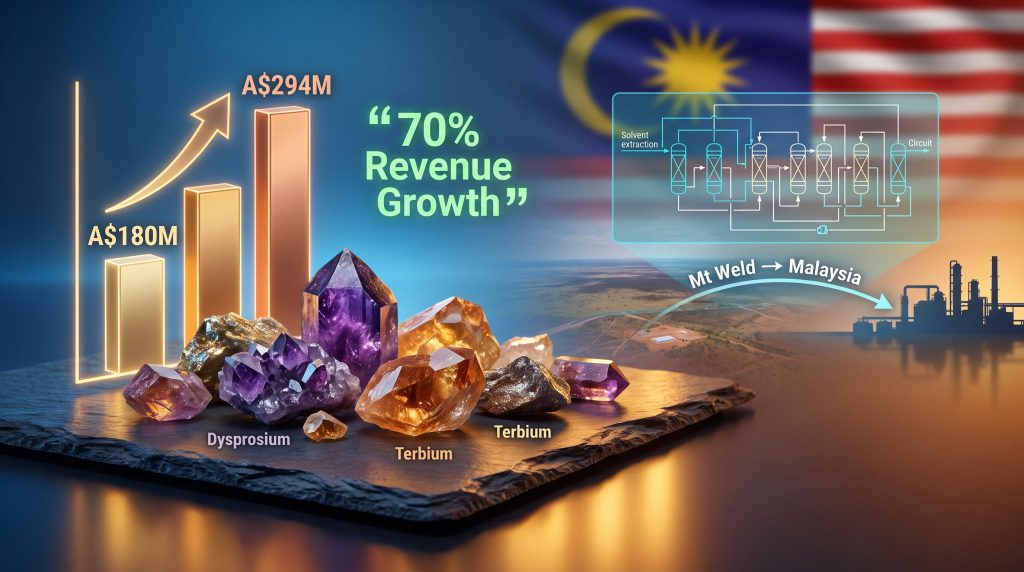
| Latest Expansion Cost Estimate | A$294 million | 2026 | Represents approximately 63% increase above A$180M plan |
The jump from A$180 million to A$294 million within a relatively short window is significant and demands scrutiny. According to Reuters reporting on the new facility, several factors are driving this escalation:
- Specialised engineering complexity: Heavy rare earth separation circuits require bespoke solvent extraction equipment that cannot be sourced off-the-shelf. Lead times and fabrication costs for this equipment have increased materially in recent years.
- Construction labour market pressures in Southeast Asia: Industrial construction costs across Malaysia and the broader region have tracked upward, reflecting broader inflationary trends in materials and skilled labour.
- Radioactive material management infrastructure: Mt Weld ore contains naturally occurring radioactive material (NORM), primarily thorium and uranium co-extracted with the rare earths. Managing these residues requires engineered containment systems that add considerable cost and complexity to any Malaysian processing expansion.
- Currency dynamics: The Australian dollar/Malaysian ringgit exchange rate introduces translation risk when project costs are estimated in ringgit but reported in AUD. A weaker Australian dollar inflates the AUD equivalent of ringgit-denominated construction contracts.
- Scope evolution: As detailed engineering progresses, project scopes frequently expand beyond initial estimates, particularly in chemical processing facilities where interconnected systems create cascading design revisions.
A 70% Revenue Surge: Financial Buffer or Distraction?
Lynas reported a 70% year-on-year revenue increase in its fourth quarter, a figure that demands contextualisation before drawing conclusions about the company's ability to fund its expansion programme. The critical minerals demand surge underpinning this revenue strength reflects genuine structural tailwinds, however investors should be cautious about extrapolating short-term results.
Rare earth pricing is notoriously cyclical. NdPr oxide prices, the primary revenue driver for Lynas, have experienced significant volatility over the past decade, swinging from below US$40/kg to above US$150/kg at various points. A strong quarterly revenue outcome in a rising price environment does not automatically translate into a durable capital expenditure buffer.
Strong revenue performance in commodity-linked businesses can create a misleading sense of financial security. The critical variable is not whether cash is flowing in during a favourable price quarter, but whether the underlying business can sustain sufficient cash generation through the full capital deployment cycle for a multi-year construction programme.
What Financial Variables Will Determine Funding Success?
For context, Lynas's A$294 million expansion commitment represents a substantial capital undertaking relative to the scale of the business. The ability to fund this without materially increasing debt leverage or pursuing dilutive equity raises will depend on several factors:
- Sustained NdPr pricing at levels that generate meaningful free cash flow above operating costs
- The pace of construction drawdowns relative to cash generation
- Whether any further cost revisions emerge as detailed engineering advances
- The performance of Lynas's developing United States processing operations, which have been supported by contracts with the U.S. Department of Defense
Why Heavy Rare Earth Separation Capacity Is Strategically Irreplaceable
The commercial rationale for the Malaysia heavy rare earth expansion is grounded in market structure realities that are unlikely to change quickly. China currently controls an estimated 85-90% of global rare earth separation and refining capacity, with its dominance particularly pronounced in heavy rare earth processing. China's rare earth strategy has long been to maintain this processing dominance as a geopolitical lever, making non-Chinese capacity development a matter of national security for many Western nations.
Dysprosium and terbium, the two elements most critical for high-performance permanent magnets capable of operating at elevated temperatures, are produced at commercial purity grades in only a handful of non-Chinese facilities globally. This concentration creates a structural vulnerability for manufacturers of:
- Electric vehicle drivetrains requiring high-coercivity NdFeB magnets
- Offshore wind turbine generators operating in high-temperature or high-vibration environments
- Defence systems including missile guidance, radar arrays, and advanced communications equipment
- Industrial robotics and precision motors requiring consistent magnetic performance across temperature ranges
The Lynas Malaysia expansion directly targets this gap. By building a dedicated heavy rare earth separation facility, the company positions itself as one of the only non-Chinese suppliers capable of delivering consistent, commercial-scale quantities of separated dysprosium and terbium to Western manufacturers. In addition, the energy transition and critical minerals nexus ensures that demand for precisely these products will only intensify over the coming decade.
The next major ASX story will hit our subscribers first
Benchmarking A$294 Million Against Global Rare Earth Processing Economics
| Metric | Lynas Malaysia (2026 Estimate) | Industry Context |
|---|---|---|
| Total Expansion Capex | A$294 million | Among the largest non-Chinese HREE processing investments |
| Original Budget (Revised) | A$180 million | Disclosed late 2025 |
| Cost Overrun vs. Revised Plan | ~63% above A$180M estimate | Consistent with chemical processing sector norms |
| Processing Focus | Heavy rare earth separation (Dy, Tb) | Strategically scarce outside China |
| Facility Location | Gebeng, Kuantan, Malaysia | Established industrial zone with existing LAMP infrastructure |
It is worth noting that a 63% cost increase above a revised estimate, while significant, is not exceptional by the standards of complex chemical processing projects globally. Studies of major industrial chemical plant construction projects consistently show that final costs frequently exceed initial estimates by 20-80%, driven by the same combination of engineering complexity, contractor market conditions, and scope evolution that appears to be affecting the Lynas expansion.
What distinguishes the Lynas situation is the strategic context. Cost overruns at a conventional commodity processing facility are primarily a shareholder concern. Cost overruns at one of the world's few non-Chinese heavy rare earth separation facilities carry implications that extend into supply chain security calculations for multiple allied nations. Australian Mining reports that demand continues to energise Lynas's profit profile, which provides at least partial insulation against these escalating costs.
The Three Scenarios Investors Should Be Modelling
The range of possible outcomes for the Lynas Rare Earths Malaysia expansion costs is wide enough that scenario planning is more instructive than point forecasting.
Scenario 1: On-Budget Completion at A$294 Million
The expansion delivers on schedule and within the current estimate. Lynas captures first-mover advantage as a Western-aligned supplier of separated dysprosium and terbium, commands premium pricing, and generates sufficient returns to justify the capital deployment. This is the base case but requires sustained pricing and construction execution.
Scenario 2: Further Cost Escalation Beyond A$350 Million
Additional engineering revisions, contractor cost pressures, or scope changes push total capex materially above current estimates. This scenario pressures the balance sheet, potentially requiring debt facility expansion or equity market access, and could delay or reduce investment in other capital priorities including the U.S. processing development programme.
Scenario 3: Regulatory or Geopolitical Disruption in Malaysia
This is the lower-probability but higher-impact scenario. Malaysia has historically been a supportive operating environment for Lynas, but the facility's management of radioactive processing residues has been a recurring point of public and regulatory scrutiny. Any significant shift in the Malaysian regulatory environment could force a fundamental reassessment of the dual-site processing model.
Risk Factors That Investors Often Underestimate
Beyond pure cost escalation, the Malaysia expansion carries several risk dimensions that are sometimes underweighted in standard financial analysis:
- Radioactive waste management: The presence of thorium and uranium in processed residues has historically been a source of community concern and regulatory attention in Malaysia. Managing this aspect of the operation adds both cost and reputational complexity that has no direct equivalent in conventional mining projects.
- Single-site processing concentration: Despite Lynas's efforts to develop U.S. processing capacity, the Malaysian facility remains the primary source of finished rare earth products. Any operational disruption carries disproportionate revenue impact.
- Technical execution risk in HREE separation: Heavy rare earth solvent extraction is more technically demanding than light rare earth processing. Commissioning a new, larger-scale HREE separation circuit introduces process stabilisation risk that could affect the timeline to full production capacity.
- Price cycle timing: If rare earth prices weaken materially during the construction and commissioning period, the return on the A$294 million investment becomes significantly more stretched, even if the facility ultimately performs as designed.
What the Numbers Mean for the Broader Critical Minerals Landscape
The Lynas Malaysia expansion cost story is, in a broader sense, a microcosm of the challenge facing the entire non-Chinese critical minerals processing industry. Building the chemical separation infrastructure needed to compete with China's decades of accumulated expertise, scale, and sunk cost advantage requires capital commitments that frequently prove larger than anticipated, take longer to complete than planned, and generate returns that are highly sensitive to commodity price cycles.
This does not mean the investment is unwise. The strategic case for diversifying rare earth processing capacity outside China remains compelling, and the demand trajectory for NdPr, dysprosium, and terbium across electric vehicles, wind energy, and defence applications supports a long-term constructive view on pricing. However, the path from capital commitment to commercial return is rarely linear, and investors and policymakers alike should calibrate their expectations accordingly.
The Lynas Rare Earths Malaysia expansion costs, now standing at A$294 million, represent both the price of strategic relevance in the global rare earth supply chain and a reminder that in critical minerals processing, complexity always has a cost.
This article contains forward-looking statements and scenario analysis that involve assumptions and uncertainties. Investors should conduct their own due diligence and consider seeking independent financial advice before making investment decisions. Past revenue performance is not necessarily indicative of future results. Capital cost estimates for mining and processing projects are subject to revision as detailed engineering and construction progress.
For further reporting on ASX-listed critical minerals companies and Australian mining sector developments, visit australianminingreview.com.au.
Want to Track the Next Major Critical Minerals Discovery Before the Market Reacts?
Discovery Alert's proprietary Discovery IQ model scans ASX announcements in real time, instantly identifying significant mineral discoveries across rare earths, critical minerals, and more than 30 other commodities — turning complex data into clear, actionable investment insights. Explore historic discoveries and their exceptional returns to understand the scale of opportunity, then begin your 14-day free trial at Discovery Alert to position yourself ahead of the broader market.