
August 21, 2026
Why the Race to Secure Rare Earth Supply Chains Is Reshaping African Mining
The global rare earth industry is experiencing a structural shift that few commodity sectors have witnessed in a generation. For decades, rare earth supply chains were treated as a niche concern, relevant mainly to specialists in materials science and defence procurement. That perception has changed decisively. As the energy transition accelerates demand for permanent magnets and advanced electronics, and as geopolitical tensions tighten access to established supply sources, governments and private capital are scouring the world for credible alternative projects. Africa, with its vast and largely underexplored geological endowment, has emerged as a focal point of that search. Few projects on the continent illustrate this convergence more clearly than the Monte Muambe rare earth project in Mozambique.
When big ASX news breaks, our subscribers know first
A Geological Formation Worth Understanding
Not all rare earth deposits are created equal. The geological host rock of a deposit determines not only its grade and tonnage, but also the complexity and cost of extraction and processing. Monte Muambe belongs to a category of deposits known as carbonatite-hosted rare earth systems, a geological formation type associated with some of the world's highest-grade rare earth occurrences, including Mountain Pass in California and Bayan Obo in Inner Mongolia.
Carbonatites are igneous rocks composed predominantly of carbonate minerals, formed from magma that originated in the Earth's mantle. The key characteristic relevant to rare earth investors is that carbonatite intrusions often concentrate rare earth elements through magmatic and hydrothermal processes over geological time, producing zones of elevated mineralisation that can be economically compelling.
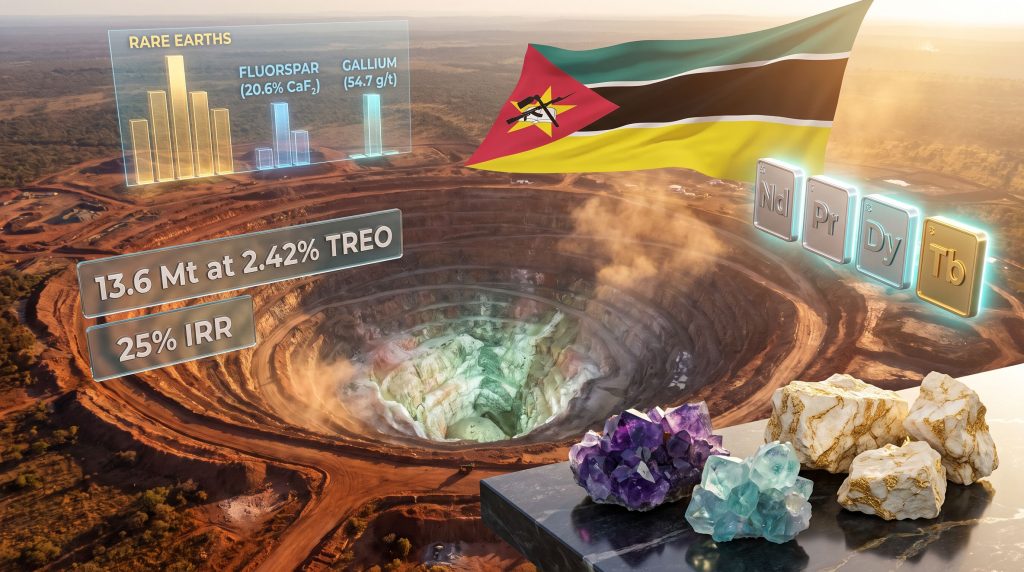
At Monte Muambe, located in the Moatize district of Tete Province in northwestern Mozambique, the carbonatite intrusion displays a spatial zonation that is geologically significant:
- Rare earth mineralisation is concentrated within the central zone of the intrusion
- Fluorspar (calcium fluoride, CaF₂) mineralisation is distributed toward the outer margins
- Gallium oxide mineralisation overlaps with the marginal zones
This spatial arrangement means that a single mining licence area hosts three distinct commodity streams within one geological body — a multi-commodity configuration that could provide meaningful revenue diversification if the project reaches production.
Breaking Down the Resource: Grade, Scale, and Commodity Mix
NeoTerra Group, formerly known as Altona Rare Earths, holds the Monte Muambe project through its Mozambican subsidiary, Monte Muambe Mining Ltda, with a 51% interest and an option to increase that stake to 70%. The company secured a 25-year mining licence in late 2024 or early 2025, providing long-term tenure security as it advances through feasibility studies.
The project's mineral resource estimate, prepared under the internationally recognised JORC reporting standard, covers three separate commodity streams:
| Commodity | Tonnage | Grade | Application |
|---|---|---|---|
| Total Rare Earth Oxides (TREO) | 13.6 Mt | 2.42% TREO | Permanent magnets, technology metals |
| Fluorspar (CaF₂) | 3.48 Mt | 20.6% CaF₂ | Steel, aluminium, chemical manufacturing |
| Gallium Oxide | 11.73 Mt | 54.7 g/t Ga₂O₃ | Semiconductors, defence electronics |
It is important to note that a mineral resource estimate under JORC is not an ore reserve. It demonstrates geological confidence in the mineralisation but does not yet confirm economic extractability under current market and technical conditions. That determination requires the kind of detailed engineering and metallurgical work that the current pre-feasibility study is designed to conduct.
Why the Rare Earth Product Mix Commands Attention
The composition of a rare earth deposit's product mix matters as much as its overall grade. Deposits dominated by cerium and lanthanum, the most abundant rare earths, face structural pricing pressure because demand growth for those elements is limited relative to supply. Monte Muambe's mineralogy, by contrast, is weighted toward the magnet rare earths — the subset of elements driving the most acute supply concerns globally.
| Element | Category | Primary Application | Strategic Status |
|---|---|---|---|
| Neodymium (Nd) | Light REE | NdFeB permanent magnets in EVs and wind turbines | High volume demand |
| Praseodymium (Pr) | Light REE | Permanent magnets, speciality alloys | High volume demand |
| Dysprosium (Dy) | Heavy REE | High-temperature magnet stabilisation | Critical, export-restricted |
| Terbium (Tb) | Heavy REE | Magnet performance enhancement | Critical, export-restricted |
| Gallium | Critical metal | Semiconductors, radar, defence electronics | Strategically sensitive |
The presence of dysprosium and terbium is particularly significant. These heavy rare earth elements (HREEs) are added in small quantities to neodymium-iron-boron (NdFeB) magnets to prevent demagnetisation at elevated operating temperatures — a property that is essential for electric vehicle traction motors and military-grade systems. Without dysprosium and terbium, high-performance EV motors would lose efficiency under sustained load, which is why these elements command substantial price premiums relative to their light rare earth counterparts.
China's rare earth export restrictions in April 2025 specifically targeted seven heavy rare earth elements, including dysprosium and terbium. The practical consequence for Western manufacturers was immediate: supply chains that had relied on Chinese-sourced HREEs faced acute disruption, elevating the strategic urgency of projects like Monte Muambe that host both light and heavy rare earth elements within a single resource envelope.
The Scoping Study Numbers: Promise and Preliminary Caution
NeoTerra released a scoping study in October 2023 that provided an initial economic framework for the proposed mine. The headline figures were encouraging at a preliminary stage:
| Economic Metric | Scoping Stage Estimate |
|---|---|
| Initial Capital Requirement | US$276.3 million |
| Post-Tax Net Present Value (NPV) | US$283.3 million |
| Internal Rate of Return (IRR) | 25% |
| Payback Period (from production start) | 2.5 years |
| Annual Ore Processing Rate | 750,000 tonnes |
| Annual Mixed Rare Earth Carbonate Output | ~15,000 tonnes |
| Projected Mine Life | 18 years |
| Mining Method | Open-pit (Targets 1 and 4) |
Critical Caveat: Every figure in this table is a scoping-stage estimate. Scoping studies are conceptual exercises based on early-stage assumptions about metallurgical recoveries, capital costs, commodity prices, and processing routes. They carry a standard accuracy range of plus or minus 35 to 50 percent, meaning the actual capital requirement could be materially higher or the NPV materially lower once detailed engineering is completed. Investors should treat these numbers as directional indicators, not bankable projections.
The proposed production model centres on open-pit mining feeding an on-site processing facility that would produce mixed rare earth carbonate (MREC) — an intermediate product that would require further downstream separation and refining before becoming usable in magnet manufacturing. The location of that downstream processing and the identity of potential offtake partners remain undisclosed at this stage of development.
Furthermore, the rare earth processing challenges associated with carbonatite-hosted systems mean that metallurgical outcomes at pre-feasibility stage could materially alter the economic picture presented by the scoping study.
The $1.875 Million USTDA Grant: What It Is and What It Is Not
The US Trade and Development Agency (USTDA) is a federal agency with a specific mandate: it finances technical feasibility studies for infrastructure and industrial projects in developing economies, with the objective of helping American companies win contracts for subsequent project development work. The agency's involvement at Monte Muambe follows this model precisely.
The sequence of events leading to the contractor announcement unfolded as follows:
- February 8, 2026: During a US government meeting focused on critical mining projects across sub-Saharan Africa, Washington signalled its intention to support Monte Muambe
- February 27, 2026: USTDA formally executed the US$1.875 million grant agreement with Monte Muambe Mining Ltda
- May 11, 2026: The extended deadline for competitive proposals from qualified US firms closed
- June 2026: Altona Rare Earths rebranded to NeoTerra Group to reflect an expanded commodity mandate
- August 20, 2026: NeoTerra disclosed the selected contractor team through a regulatory filing on the London Stock Exchange
The selected team brings complementary expertise to the study:
- Valentine Enterprises: Lead contractor responsible for overall study coordination and project management
- SGS North America: Technical support covering mineral testing, metallurgy, process engineering, and project development
- New Dominion Consulting: Supply chain analysis, sustainability assessment, procurement strategy, and operational planning
NeoTerra's chief executive, Cedric Simonet, stated publicly that the three firms collectively possess the technical capabilities and familiarity with American supply chains necessary to advance Monte Muambe to the next development threshold.
It bears emphasising that the USTDA grant is not construction funding, an offtake agreement, a government purchase commitment, or a guarantee of project viability. It finances technical work at the pre-feasibility stage. The distinction matters enormously for how investors should interpret the milestone.
What the Pre-Feasibility Study Will Actually Do
The study is expected to commence in September 2026 with a kick-off meeting and a site visit to Tete Province. The technical workplan includes:
- A short drilling campaign to recover representative ore samples from the deposit
- Metallurgical testwork to identify optimal extraction and beneficiation methods for the rare earth, fluorspar, and gallium mineralisation
- Process engineering design to develop a viable flowsheet for producing mixed rare earth carbonate
- Refined capital cost estimation to test the US$276.3 million figure from the 2023 scoping study
- A technical and commercial viability determination that will inform whether NeoTerra proceeds to a full definitive feasibility study
The Development Pathway from Here
Monte Muambe's road from pre-feasibility study to producing mine involves multiple stages, each requiring successful outcomes before the next can proceed:
- Pre-Feasibility Study (current stage): Technical and financial validation of scoping assumptions
- Definitive Feasibility Study: Detailed engineering, environmental impact assessment, bankable economics
- Project Financing: Securing debt and equity capital against DFS outcomes
- Final Investment Decision: Board-level commitment to construction
- Mine Construction and Commissioning: Estimated at approximately US$276 million at scoping stage, subject to revision
- Production Commencement: No confirmed date has been announced by NeoTerra
Given this sequence, production in the early-to-mid 2030s would represent an optimistic but plausible scenario, contingent on study outcomes, financing availability, and regulatory approvals all proceeding without material delay.
The Geopolitical Architecture Behind US Engagement in African Rare Earths
Understanding why Washington is funding a pre-feasibility study in northwestern Mozambique requires understanding the arithmetic of rare earth supply concentration. According to US Geological Survey data cited by the Congressional Research Service, China produced approximately 270,000 tonnes of rare earth oxide equivalent in 2025, compared with approximately 51,000 tonnes in the United States.
That production gap, significant as it is, understates the actual dependency because China's dominance is even more pronounced at the processing and magnet manufacturing stages — the technically complex and commercially valuable portions of the supply chain where Chinese firms have accumulated decades of proprietary expertise.
China's April 2025 export restrictions on seven heavy rare earth elements, subsequently expanded to additional materials, transformed what had been a theoretical vulnerability into an operational problem for US defence contractors and clean energy manufacturers. Rare earth permanent magnets are embedded in the guidance systems of precision munitions, the propulsion systems of military aircraft, the drivetrains of electric vehicles, and the nacelles of wind turbines. Supply disruption at the raw material level propagates rapidly through all of these end markets.
USTDA's engagement at Monte Muambe sits alongside parallel US government involvement in other African critical mineral projects, including the Longonjo rare earth project in Angola and the Phalaborwa development in South Africa. The pattern reflects a deliberate continental strategy rather than a single project bet. Mozambique's inclusion in this framework also connects to US engagement in the country's graphite sector, where American investment in local projects has been separately documented.
The next major ASX story will hit our subscribers first
NeoTerra Group: Corporate Evolution and Strategic Positioning
The rebranding from Altona Rare Earths to NeoTerra Group in June 2026 was not merely a name change. It signals a strategic pivot from being a single-commodity rare earth explorer to positioning as a diversified critical minerals developer with exposure to rare earths, fluorspar, gallium, copper, and silver across its project portfolio.
Monte Muambe remains the flagship asset, but the expanded mandate gives NeoTerra flexibility to pursue additional commodity streams that benefit from the same geopolitical tailwinds driving rare earth demand. The company's London Stock Exchange listing provides a disclosure framework that international investors can monitor for regulatory announcements, ensuring that material developments — including contractor selections, study completions, and resource updates — are communicated through standardised regulatory channels. For a detailed overview of the project's technical specifications, the Monte Muambe project page provides further context on the USTDA grant and its implications.
Risks That Sophisticated Investors Should Weigh Carefully
The Monte Muambe rare earth project in Mozambique carries a risk profile that is typical of early-stage critical mineral projects in frontier jurisdictions, but several specific factors warrant particular attention:
- Metallurgical complexity: Carbonatite-hosted rare earth systems can present processing challenges, particularly where rare earth minerals are finely intergrown with gangue minerals. Recoveries and concentrate grades are sensitive to the specific mineralogy, which is why the metallurgical testwork component of the pre-feasibility study is arguably the most consequential deliverable
- Capital market conditions: Rare earth project financing has historically been difficult to secure at competitive terms, given commodity price volatility, long lead times to production, and the limited number of specialist lenders with appetite for this sector
- Scoping study revision risk: All economic metrics published to date carry material uncertainty; the pre-feasibility study may confirm, improve, or significantly revise the preliminary US$276.3 million capital figure and associated returns
- Sovereign and infrastructure considerations: Tete Province's infrastructure base was developed primarily around coal logistics, and the requirements of a rare earth processing operation — including water, energy, and reagent supply — may necessitate significant additional capital expenditure
- Downstream processing uncertainty: Mixed rare earth carbonate is an intermediate product. The ultimate value realisation depends on access to separation and refining capacity, either locally or through international offtake arrangements, neither of which has been confirmed
Project Timeline at a Glance
| Date | Milestone |
|---|---|
| October 2023 | Scoping study released; US$276.3M capex, 25% IRR, 18-year mine life |
| December 2024 / Early 2025 | 25-year mining licence granted |
| February 8, 2026 | US government signals USTDA support at sub-Saharan Africa critical minerals meeting |
| February 27, 2026 | USTDA formally signs US$1.875M grant agreement with Monte Muambe Mining Ltda |
| May 11, 2026 | Extended deadline for competitive contractor proposals closes |
| June 2026 | Altona Rare Earths rebrands to NeoTerra Group |
| August 20, 2026 | NeoTerra announces contractor selection via LSE regulatory filing |
| September 2026 (expected) | Pre-feasibility study kick-off and site visit to Tete Province |
| TBD | Drilling campaign and metallurgical testwork |
| TBD | Pre-feasibility study completion and results |
| TBD | Definitive feasibility study, financing, FID, construction |
What Monte Muambe's Trajectory Reveals About Africa's Critical Minerals Moment
Tete Province's transformation from a coal-dominated resource corridor into a multi-commodity critical minerals jurisdiction reflects a broader continental repositioning. Western governments have recognised that diversifying rare earth supply chains requires engagement at the feasibility stage — before projects become bankable enough to attract commercial capital independently. USTDA-backed technical studies function as a first step in a longer capital mobilisation sequence: de-risking technical uncertainty to the point where private lenders and equity investors can underwrite the next phase.
For the Monte Muambe rare earth project in Mozambique, the selection of Valentine Enterprises, SGS North America, and New Dominion Consulting marks the transition from strategic aspiration to technical execution. Whether the pre-feasibility study validates the economics suggested by the 2023 scoping study — or surfaces challenges that require the development plan to be materially revised — will be the defining determinant of how this project's story develops. The answers are expected to emerge through the study process that begins in September 2026.
This article contains forward-looking statements and preliminary financial estimates derived from scoping-stage studies. All economic figures are subject to material revision as further technical work is completed. This article does not constitute financial advice. Readers should conduct their own due diligence before making any investment decisions related to the companies or projects discussed.
Want to Track the Next Major Critical Minerals Discovery Before the Market Moves?
Discovery Alert's proprietary Discovery IQ model delivers real-time alerts on significant ASX mineral discoveries — including rare earths, gallium, and other strategically critical commodities — turning complex geological and market data into actionable investment insights the moment they hit the exchange. Explore why early positioning in major discoveries has historically generated substantial returns by visiting Discovery Alert's dedicated discoveries page, and begin your 14-day free trial today to secure a market-leading edge.