August 21, 2026
The Green Energy Paradox Buried Beneath Brazil's Soil
The global push toward clean energy has created one of the most consequential geological contests of the twenty-first century. Rare earth elements, the seventeen metallic substances underpinning everything from wind turbine magnets to electric vehicle drive systems, are no longer merely a materials science concern. They have become a geopolitical instrument, a development promise, and, increasingly, an environmental liability. Brazil rare earths environmental concerns sit at the heart of this tension, nowhere more visibly than across the country's forests, coasts, and Indigenous territories.
Brazil's geology offers something extraordinary: clay-hosted ionic adsorption deposits, carbonatite complexes, and monazite-bearing coastal sands that together constitute the world's second-largest rare earth reserve base. That singular geological reality has transformed the country into the most contested minerals frontier of this decade, drawing capital, diplomatic attention, and environmental scrutiny in equal measure.
When big ASX news breaks, our subscribers know first
Why the Capital Rush Into Brazil Has Been Historically Unprecedented
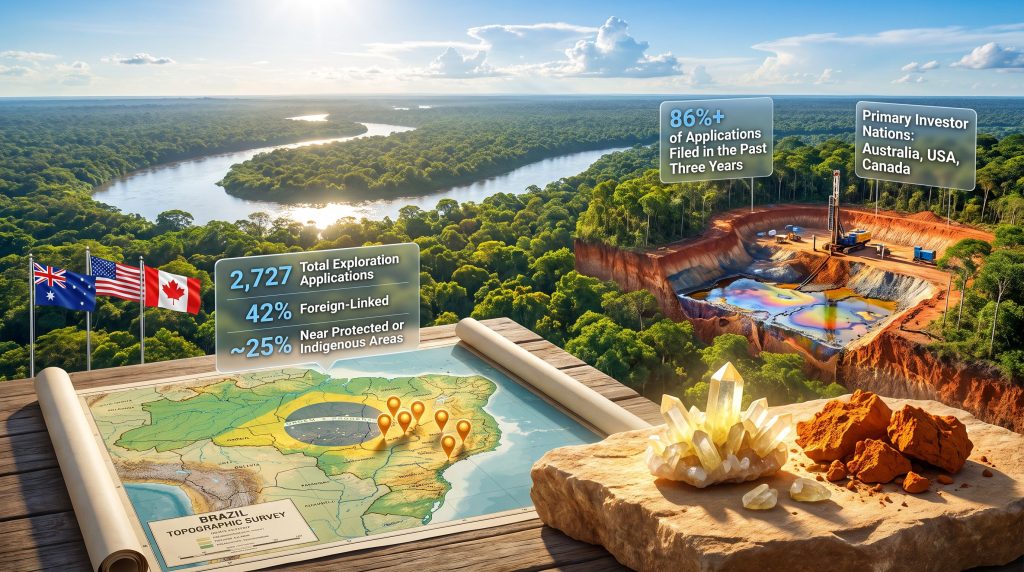
The numbers emerging from Brazil's National Mining Agency reveal a pattern that has few precedents in modern mineral exploration history. As of mid-2026, 2,727 rare earth exploration applications had been lodged across the country. Of those, more than 86% were filed within the past three years, and the first half of 2026 alone generated 268 new applications, suggesting the pace is not moderating.
Foreign-linked interests account for 42% of all filings, with 11 of the top 20 applicants by volume carrying backing from overseas capital, primarily from Australia, the United States, and Canada. This is not incremental portfolio diversification. It represents a structural reorientation of where Western mining capital believes future rare earth supply will originate.
What Is Driving the Surge?
Three converging forces explain this acceleration:
- Energy transition demand for neodymium, praseodymium, dysprosium, and terbium continues to grow structurally as EV and wind energy deployment scales globally, reflecting the broader surge in critical minerals demand across Western economies.
- Supply chain fragility exposed during the 2020s has made Western governments and manufacturers acutely aware of their dependence on Chinese rare earth processing infrastructure.
- Geological opportunity in Brazil's ionic clay deposits, which in many cases mirror the mineralogy of China's prolific Jiangxi province deposits, making extraction chemistry relatively well understood.
A critical but often overlooked point is that Brazil's ionic clay-hosted deposits share mineralogical characteristics with Chinese ionic adsorption clays, the same deposit type that made China's southern provinces globally dominant. This geological familiarity gives Western mining operators a meaningful technical head start compared to developing entirely novel ore body types.
Brazil's Rare Earth Pipeline at a Glance (2026)
| Metric | Figure |
|---|---|
| Total exploration applications filed | 2,727 |
| Share filed in the past three years | 86%+ |
| Applications filed in H1 2026 alone | 268 |
| Foreign-linked application share | 42% |
| Top 20 applicants with foreign backing | 11 of 20 |
| Applications near protected or Indigenous areas | ~25% |
| Primary foreign investor nations | Australia, USA, Canada |
Brazil Rare Earths Environmental Concerns: What Is Actually at Stake
The scale of the exploration surge cannot be discussed in isolation from its ecological context. Approximately 25% of all rare earth exploration applications in Brazil overlap with or fall within ten kilometres of formally protected areas or designated Indigenous territories. In a country containing a significant share of the world's remaining tropical biodiversity, that overlap demands serious scrutiny. As Latin America enters the rare earth rush, the environmental stakes are becoming increasingly difficult to ignore.
The Water Contamination Problem
Rare earth extraction is chemically aggressive. Unlike iron ore or bauxite mining, which rely primarily on mechanical separation, rare earth processing requires chemical leaching, often using ammonium sulfate solutions or acid-based reagents that mobilise target elements from surrounding rock. When containment fails or is insufficient, these chemicals enter surface water systems, aquifers, and ultimately drinking water supplies.
The contamination pathways are multiple and technically distinct:
| Contamination Type | Primary Source | Affected Systems |
|---|---|---|
| Acidic wastewater | Processing and leaching operations | Rivers, aquifers |
| Heavy metal runoff | Ore extraction and tailings | Soil, surface water |
| Nitrogen compounds | Ammonium-based leaching agents | Groundwater, lakes |
| Radioactive leachate | Monazite and thorium-bearing ores | Drinking water, soil |
In regions with limited water treatment infrastructure, which describes many of the frontier zones where exploration is advancing, these risks translate directly into public health consequences rather than abstract environmental statistics. Furthermore, the rare earth processing challenges associated with these ore types compound the difficulty of managing contamination effectively.
The Radioactive Co-Product Challenge
One dimension of Brazil rare earths environmental concerns that receives insufficient attention in mainstream coverage is the radioactive waste problem embedded within certain Brazilian ore chemistries. Monazite-bearing deposits, which are abundant along Brazil's coast and in some inland formations, contain naturally occurring thorium and uranium as co-products of the rare earth mineralisation.
This is not a marginal technical footnote. Thorium in particular is a long-lived radioactive element requiring specialised containment infrastructure and decades-long management commitments. Brazil's regulatory framework for radioactive mining byproducts, while legally established, is inconsistently applied across different jurisdictions and project types.
The radioactive waste legacy of rare earth processing is not speculative. Historical sites in Malaysia, China, and the United States have required multi-decade, multi-billion-dollar remediation programmes. The Lynas Gebeng facility in Malaysia and the Molycorp Mountain Pass site in California both generated contaminated tailings that became long-term regulatory liabilities. Brazil is at risk of replicating that trajectory if thorium waste management standards are not embedded into project approvals from the outset.
Deforestation, Habitat Fragmentation, and Ecosystem Disruption
Open-cut and surface mining operations require vegetation clearance at scale. In ecologically sensitive zones, including areas adjacent to Amazon-connected ecosystems, this clearance fragments habitat corridors, accelerates soil erosion, and increases sediment loading in nearby river systems. The cumulative impact of multiple concurrent projects across the same regional watershed can exceed what any single environmental impact assessment captures. Indeed, rare earth mining in Brazil's rural communities and conservation areas has already raised urgent alarms among ecologists and local advocates alike.
Indigenous Rights and the Free, Prior, and Informed Consent Problem
Brazil's constitution enshrines the rights of Indigenous peoples and Quilombola communities to free, prior, and informed consent (FPIC) before activities affecting their territories proceed. In practice, the speed of exploration application processing has in several documented cases outpaced meaningful consultation.
Federal prosecutors have formally flagged instances where projects advanced without adequate social and environmental impact assessments. Civil society organisations working in affected regions have documented cases involving ancestral lands, subsistence agricultural systems, and culturally significant sites being placed within exploration zones without communities receiving substantive consultation opportunities.
This is not merely a regulatory compliance issue. It represents a structural governance failure with measurable consequences for social stability and legal certainty. Projects that advance without proper FPIC compliance face heightened risk of injunctions, community opposition, and reputational damage to the broader sector.
The Environmental Justice Dimension
There is a profound structural irony embedded in the global positioning of Brazilian rare earth extraction. The narrative presented to international markets frames this mining activity as enabling the green energy transition, reducing carbon emissions, and decarbonising transport and power systems. Yet the communities bearing the immediate environmental burden of that extraction are among Brazil's most economically marginalised, with the least access to legal recourse, environmental monitoring, and political representation.
The economic benefits of the rare earth supply chain accrue predominantly to shareholders, processing facilities, and end-product manufacturers located in Western countries. The ecological costs, however, are localised in Brazil's interior and coastal zones. This geographic asymmetry in who bears risk versus who captures value is a defining feature of the current expansion model.
How Do "Sustainable" Extraction Methods Change the Calculus?
A growing number of exploration companies are marketing in-situ leaching and ionic clay extraction methods as lower-impact alternatives to conventional open-cut mining. These approaches inject leaching solutions directly into the ore body through drilled wells, recovering dissolved rare earth ions without large-scale surface disturbance.
The environmental advantages are real but conditional:
- Surface disturbance is significantly reduced compared to open-cut operations
- Vegetation clearance requirements are lower
- Tailings volumes are smaller
However, in-situ leaching introduces its own contamination risks. Subsurface injection of ammonium sulfate or acid solutions can migrate beyond the targeted ore zone into surrounding aquifers. Nitrogen loading from ammonium compounds has been documented in Chinese ionic clay mining districts as a persistent groundwater contamination problem, sometimes persisting for years after operations cease.
The critical insight here is that in-situ methods reduce visible environmental disturbance while potentially increasing invisible subsurface contamination risk. Regulators assessing these projects need to apply groundwater monitoring frameworks that are specifically designed for the hydrogeological conditions of each site, not generic templates.
Brazil's Regulatory Architecture: Built for Speed or Built for Safety?
Brazil's environmental licensing system is legally sophisticated on paper. The requirement for Environmental Impact Assessments (EIAs) and the involvement of IBAMA (the Brazilian Institute of Environment and Renewable Natural Resources) provide a formal framework that many developing-nation mining jurisdictions lack entirely.
The practical challenge is one of capacity and pace. The volume of applications, 268 in the first six months of 2026 alone, is significantly outrunning the institutional resources available to conduct rigorous, site-specific environmental reviews for each project.
International Regulatory Comparison
| Dimension | Brazil | China | United States |
|---|---|---|---|
| Environmental licensing system | Legally established; capacity-constrained | Historically weak; post-2010 improvements | Robust but slow permitting timelines |
| Radioactive waste regulation | Inconsistently applied | Centrally managed | Federally regulated under NRC oversight |
| Indigenous consultation requirements | Legally mandated; variable enforcement | Limited formal framework | NEPA and tribal consultation required |
| Tailings and water management | Under development for REE-specific rules | Standardised for major operators | Established but compliance is costly |
| Processing capacity | Nascent stage | Dominant globally | Limited; active rebuilding effort |
The comparison reveals that Brazil sits in a challenging middle position: it has stronger legal frameworks than China's historical baseline but lacks the processing capacity and enforcement resources of the United States. Closing that gap before the extraction wave peaks is the central institutional challenge.
The next major ASX story will hit our subscribers first
The Geopolitical Triangle: Brazil, the United States, and China
Robert Muggah of the Igarapé Institute has articulated the view that Brazil's rare earth sector sits at a uniquely complex intersection of resource nationalism, energy transition demand, Western supply-chain diversification, and competitive pressure on Chinese rare earth market dominance. That framing captures something important about why the policy environment around Brazil's minerals sector resists simple characterisation.
Western governments, particularly the United States, are actively encouraging allied-nation critical mineral sourcing to reduce the leverage that China's rare earth export restrictions have exposed across global supply chains. Brazil, with its extraordinary reserve base, is a natural beneficiary of that strategic reorientation.
However, Brazil and China have simultaneously deepened economic ties across trade, infrastructure investment, and diplomatic alignment. The Lula government has pursued a foreign policy posture that deliberately avoids subordination to any single great power bloc. This creates a real tension: Western capital is flooding into Brazilian mineral exploration at precisely the moment when Brazil's government is pursuing economic relationships with China that complicate a straightforward Western supply chain narrative.
A further structural complication is often underappreciated: even if Brazil dramatically expands raw rare earth extraction, processing capacity remains overwhelmingly concentrated in China. The bottleneck in the rare earth supply chains is not ore production but the separation, refining, and alloying steps that convert raw material into usable inputs for magnet manufacturing. Without concurrent investment in Brazilian processing infrastructure, an extraction boom simply exports dependency rather than resolving it.
What Responsible Development Actually Requires
The pathway toward a rare earth sector that delivers genuine economic benefit to Brazil while containing environmental and social risk requires deliberate institutional investment across several fronts:
- Federal standardisation of rare earth-specific environmental regulations covering tailings management, radioactive waste handling, water quality baselines, and post-closure obligations
- Strengthened FPIC implementation with independent monitoring and genuine veto capacity for affected Indigenous and Quilombola communities
- Expanded environmental agency capacity specifically resourced to review rare earth project applications at the pace they are being submitted
- Mandatory beneficial ownership transparency to ensure accountability extends through complex foreign ownership structures to ultimate decision-makers
- Investment in domestic processing infrastructure so that Brazil captures downstream value rather than exporting raw material for value addition offshore
International precedent is instructive here. Australia's lithium sector developed regulatory frameworks that, while imperfect, enabled commercially viable extraction while maintaining environmental standards that preserved social licence. Canada's critical mineral framework has similarly demonstrated that environmental credibility and commercial viability can coexist when institutional investment is made early and deliberately.
Brazil's constitutional mandate to protect its environment and the rights of Indigenous peoples does not diminish under strategic mineral pressure. If anything, the scale and speed of the current exploration wave makes that constitutional commitment more important to enforce, not less. The country's ability to position itself as a credible, responsible supplier to Western markets will ultimately depend on whether its regulatory architecture can evolve as rapidly as its exploration pipeline — a challenge that is institutional and political before it is geological. Brazil rare earths environmental concerns, consequently, are not peripheral to this story. They are the story.
Disclaimer: This article is intended for informational purposes only and does not constitute financial, investment, or legal advice. Statistics and figures cited are sourced from publicly available data including Brazil's National Mining Agency records as reported by the Associated Press and Reporter Brasil. Readers should conduct independent due diligence before drawing investment or policy conclusions from the information presented.
Want to Track the Next Major Critical Minerals Discovery Before the Market Does?
Discovery Alert's proprietary Discovery IQ model delivers real-time alerts on significant ASX mineral discoveries — instantly translating complex geological data into actionable investment insights across critical minerals including rare earths. Explore historic discoveries and their exceptional market returns, then begin your 14-day free trial at Discovery Alert to position yourself ahead of the next major find.