August 21, 2026
Why Rare Earth Separation Technology Is Only as Strong as Its Feedstock Flexibility
The global race to build Western rare earth processing capacity has exposed a fundamental engineering vulnerability that rarely makes headlines: most separation technologies are quietly optimised for a single feedstock type. This creates a fragility that stretches far beyond the processing plant itself, threading through entire magnet supply chains and into the strategic calculations of governments and defence procurement agencies alike. Understanding the strategic importance of rare earths is essential context for appreciating why this matters.
Rare earth element (REE) separation is not a one-size-fits-all discipline. The chemical ratios, mineralogical forms, and impurity profiles of REE feedstocks vary enormously depending on their geological origin. A processing circuit tuned for one ore type can underperform significantly when fed a chemically distinct input, which means that single-feedstock dependency in a separation facility is a structural liability, not merely an operational inconvenience.
This is the context in which Ucore Rare Metals' ongoing demonstration work at its Kingston, Ontario facility carries real technical weight. The company's RapidSX platform has now achieved 99.5% purity neodymium-praseodymium (NdPr) from two chemically distinct feedstock categories, a milestone that speaks directly to the feedstock flexibility challenge at the heart of Western supply chain resilience. Ucore RapidSX NdPr recovery from different feedstocks represents one of the most meaningful technical validations in Western rare earth processing to date.
When big ASX news breaks, our subscribers know first
What Makes NdPr the Fulcrum of the Rare Earth Market?
Before examining the technology itself, it is worth understanding why NdPr commands such outsized strategic importance relative to the broader rare earth element basket.
Neodymium-iron-boron (NdFeB) permanent magnets, which require NdPr as their primary input, are the highest-performance permanent magnets commercially available. They are irreplaceable in the traction motors of electric vehicles, the direct-drive generators of offshore wind turbines, and a wide range of defence and aerospace applications. There is currently no commercially viable substitute material that delivers equivalent magnetic performance at equivalent cost.
Global NdPr production remains heavily concentrated in China, which controls the overwhelming majority of both mining and separation capacity. For Western magnet manufacturers, this creates a single point of failure that extends from the mine to the finished motor. Furthermore, China's rare earth export restrictions have intensified concern about the absence of diversified, high-purity NdPr separation capacity outside China — widely regarded as one of the most acute vulnerabilities in the clean energy transition supply chain.
The Chemistry Behind RapidSX: Familiar Foundation, Different Architecture
How Conventional Solvent Extraction Works
Solvent extraction (SX) has been the dominant method for separating rare earth elements at industrial scale for decades. The process exploits differences in chemical affinity between individual REEs by repeatedly transferring them between an aqueous phase and an immiscible organic phase containing selective extractant compounds. By carefully controlling pH, temperature, and extractant concentration across a series of mixer-settler stages, individual elements are progressively isolated to high purity levels.
The method is proven and effective, but its engineering profile presents challenges. Conventional SX circuits require large physical footprints, significant capital investment, and are typically designed around a specific feedstock chemistry. Reconfiguring a conventional SX plant to process a materially different feedstock input is neither straightforward nor inexpensive — a reality that compounds the broader rare earth processing challenges facing Western nations.
Where RapidSX Breaks from Convention
RapidSX employs the same fundamental chemical principles as conventional solvent extraction but achieves the liquid-liquid mass transfer process through a fundamentally different mechanical architecture. The result is faster kinetics, a substantially smaller equipment footprint for equivalent processing capacity, and critically, a modular, reconfigurable design that allows the platform to be adapted to different feedstock chemistries without rebuilding the core processing infrastructure.
| Feature | Conventional Solvent Extraction | RapidSX Technology |
|---|---|---|
| Processing Throughput | Standard | Equal to or faster |
| NdPr Product Purity | High | Equal to or higher (up to 99.5%) |
| Equipment Footprint | Large | Significantly smaller |
| Feedstock Flexibility | Limited | Multi-feedstock capable |
| Modular Reconfiguration | Difficult and costly | Interchangeable components |
| LREE/HREE Adaptability | Requires separate systems | Single platform, multiple splits |
The ability to perform multiple separation splits across different feedstock chemistries on a single platform, using interchangeable components rather than purpose-built circuits, is what distinguishes RapidSX architecturally from its predecessors.
Ucore RapidSX NdPr Recovery from Different Feedstocks: The Demonstration Results
Feedstock One: Vietnamese Ionic Clay-Derived MREO
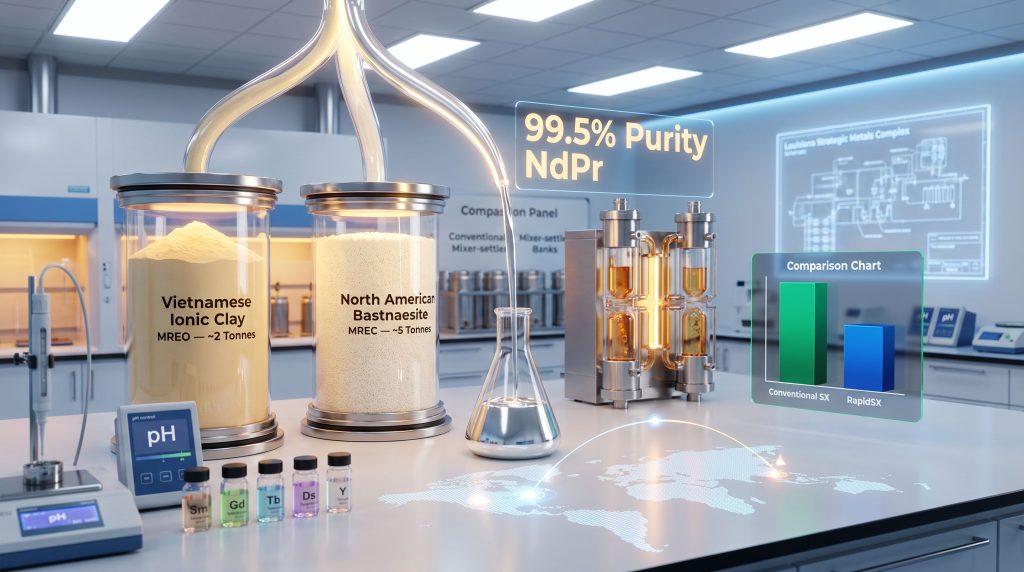
The first feedstock demonstration involved approximately 2 tonnes of mixed rare earth oxide (MREO) sourced from a Vietnamese ionic clay deposit. This material was processed at the Kingston facility, with the programme achieving 99.5% purity NdPr output during Q2 2026.
Ionic clay deposits, concentrated predominantly across Southeast Asia, carry a distinctly different REE distribution profile compared to hard-rock mineral sources. They tend to be enriched in heavy rare earth elements (HREEs) relative to the light rare earth element (LREE) ratios typical of hard-rock ores. This means the chemical matrix through which NdPr must be separated is compositionally different, presenting a genuine technical challenge for any separation platform claiming feedstock versatility.
Ionic clay-hosted REE deposits are among the world's most significant sources of heavy rare earth elements such as terbium and dysprosium. Successfully extracting high-purity NdPr from this ore type validates a separation technology against one of the most chemically complex REE feedstock matrices available.
Feedstock Two: North American Bastnaesite-Derived MREC
The second demonstration involved approximately 5 tonnes of mixed rare earth carbonate (MREC) derived from a North American bastnaesite deposit, processed in early August 2026. This programme also achieved 99.5% purity NdPr, matching the output quality delivered from the ionic clay feedstock.
Bastnaesite is the dominant hard-rock REE mineral globally and forms the mineralogical basis of most significant Western REE projects, including those in the United States. It carries a markedly different REE ratio profile from ionic clay sources, with a stronger emphasis on light rare earth elements and a carbonate-hosted chemical matrix that requires a different approach to solution chemistry.
Side-by-Side Feedstock Comparison
| Parameter | Ionic Clay (MREO) | Bastnaesite (MREC) |
|---|---|---|
| Geographic Origin | Vietnam | North America |
| Input Form | Mixed Rare Earth Oxide | Mixed Rare Earth Carbonate |
| Input Volume | ~2 tonnes | ~5 tonnes |
| NdPr Output Purity | 99.5% | 99.5% |
| REE Composition Profile | Heavy REE-enriched | Light REE-dominant |
| Milestone Timing | Q2 2026 | Early August 2026 |
| Application | Customer qualification samples | Customer qualification samples |
The fact that identical purity levels were achieved across two feedstocks with fundamentally different mineralogical and chemical profiles is the central technical statement of the demonstration programme. It confirms that RapidSX's separation chemistry is not calibrated to a single input type.
The Commercial Logic of Multi-Feedstock Capability
Customer Qualification and What It Actually Requires
In the rare earth supply chain, customer qualification is a rigorous and often protracted process. Magnet manufacturers do not commit to long-term offtake agreements based on a single product sample. They require consistent, high-purity material produced across multiple batches and, ideally, from multiple feedstock sources, before assuming the supply security risk of a new processing partner.
Demonstrating 99.5% NdPr purity from two chemically distinct feedstocks serves a dual commercial purpose. It generates qualification samples for magnet manufacturers while simultaneously signalling that the processing platform is not dependent on a single geographic supply corridor.
The Geopolitical Dimension of Feedstock Sourcing
The rare earth geopolitical impact of feedstock sourcing decisions has become increasingly prominent in policy discussions. Consider the following structural realities:
- Western governments and allied defence procurement agencies have identified rare earth processing dependency as a strategic vulnerability requiring active remediation.
- Single-geography feedstock dependency in a separation facility exposes downstream customers to the same concentration risk that exists in mining, offering no net supply chain diversification.
- A processing technology capable of handling feedstocks from Southeast Asia, North America, and potentially other regions provides downstream customers with genuinely diversified supply optionality.
- Feedstock-agnostic separation capacity is increasingly viewed by investors and policymakers as a prerequisite for commercially sustainable, geopolitically resilient REE refining operations.
The Kingston Facility: De-Risking Before Scaling
The Kingston, Ontario commercialisation and demonstration facility occupies a specific and carefully considered role in Ucore's development programme. It sits between a pilot plant and a full commercial production facility, operating under conditions designed to simulate a commercial processing environment without carrying the full capital exposure of a production-scale operation.
This distinction matters enormously for investors and industry observers attempting to assess the readiness of the RapidSX platform. Pilot-scale results are routinely achieved in controlled laboratory conditions that do not replicate the variability, throughput demands, or engineering tolerances of a commercial plant. A demonstration facility operating at meaningful input volumes across multiple feedstock types provides a qualitatively different level of technical validation.
Beyond technology validation, Kingston serves three additional functions:
- Operator training: Developing a skilled workforce capable of commissioning and running RapidSX production units at the Louisiana Strategic Metals Complex (SMC).
- Co-commissioning experience: Generating practical knowledge of the platform's behaviour under commercial-scale conditions, directly reducing commissioning risk at Louisiana.
- Engineering data generation: Producing the process data required to finalise the engineering specifications for Machine A, the first commercial RapidSX production unit at the Louisiana SMC.
Ucore's COO and VP Mike Schrider has stated that the Kingston facility is executing a deliberate development plan for Machine A, with the demonstration work directly supporting and validating the SMC engineering programme while simultaneously proving the technology platform's effectiveness across multiple feedstock types. He has also described Kingston's ongoing role as a co-commissioning, technology development, and training centre that will continue to de-risk the company's commercial endeavours.
The next major ASX story will hit our subscribers first
Louisiana Strategic Metals Complex: From Demonstration to Production
The Louisiana SMC represents Ucore's first commercial-scale RapidSX deployment. The facility's planned production scope extends beyond NdPr to encompass samarium, gadolinium, terbium, dysprosium, and yttrium, covering both light and heavy rare earth element categories. This breadth of separation capability is strategically significant given that terbium and dysprosium command significant supply concentration risk of their own.
The feedstock supply strategy for the Louisiana facility draws on identified Canadian and U.S. sources totalling an estimated 13 to 15 tonnes of mixed rare earth carbonates and oxides, supplemented by Vietnamese MREO to broaden the facility's feedstock optionality. Consequently, this multi-source approach embeds feedstock diversification into the Louisiana operation from inception rather than attempting to retrofit it later. This also supports the broader development of America's rare earth supply chain at a critical juncture.
What This Means for Western Rare Earth Processing Capacity
The broader implication of demonstrating Ucore RapidSX NdPr recovery from different feedstocks extends beyond a single company's development programme. It contributes to an emerging picture of what commercially viable, geopolitically resilient REE separation capacity in the West must look like.
Several structural realities define this picture:
- Feedstock access is not guaranteed: Western REE mining projects face long development timelines, meaning processors may need to source internationally while domestic supply matures.
- Ore type diversity is inevitable: A processor serving multiple upstream suppliers will encounter varied mineralogies. Separation technologies without feedstock flexibility become bottlenecks rather than solutions.
- Modular architecture reduces capital risk: The ability to reconfigure and scale a separation platform without fundamental redesign compresses the capital expenditure curve and reduces the technology risk premium that investors must price in.
- Purity consistency across feedstocks is a commercial prerequisite: Downstream magnet manufacturers cannot accept variable product quality as a function of feedstock origin. Consistent 99.5% NdPr purity regardless of input source is the minimum threshold for serious commercial engagement.
Disclaimer: This article contains forward-looking statements and analysis based on publicly available information. Readers should not interpret any information herein as financial advice. Investment in junior mining or critical minerals companies carries material risk, and independent financial advice should be sought before making investment decisions.
Frequently Asked Questions: Ucore RapidSX NdPr Recovery
What purity of NdPr has RapidSX achieved from different feedstocks?
RapidSX has produced NdPr at 99.5% purity from both ionic clay-derived mixed rare earth oxide and bastnaesite-derived mixed rare earth carbonate, demonstrating consistent output quality across chemically distinct feedstock types.
What feedstocks has RapidSX been tested on?
The technology has been demonstrated on approximately 2 tonnes of Vietnamese ionic clay-derived MREO and approximately 5 tonnes of North American bastnaesite-derived MREC, both processed at the Kingston, Ontario facility.
How does RapidSX compare to conventional solvent extraction?
RapidSX uses the same fundamental separation chemistry but delivers equivalent or superior purity and recovery rates with faster throughput and a significantly smaller equipment footprint, achieved through a different mechanical architecture that accelerates liquid-liquid mass transfer kinetics.
What other rare earth elements can RapidSX separate?
Beyond NdPr, the platform is designed to separate samarium, gadolinium, terbium, dysprosium, and yttrium, covering both light and heavy rare earth element categories.
Why does feedstock flexibility matter for rare earth processors?
Feedstock flexibility allows a separation facility to source input material from multiple geographic regions and ore types, reducing supply chain concentration risk and enabling the processor to adapt to changes in global REE supply without retooling its core processing infrastructure.
Want to Invest in the Next Major Rare Earth Discovery Before the Broader Market?
Discovery Alert's proprietary Discovery IQ model delivers real-time alerts on significant ASX mineral discoveries — including critical minerals like rare earths — instantly transforming complex geological data into actionable investment insights for both short-term traders and long-term investors. Explore historic rare earth and mineral discoveries and their extraordinary returns, then begin your 14-day free trial at Discovery Alert to position yourself ahead of the market.