August 21, 2026
The Ocean Floor as the Next Resource Frontier
Across the history of industrial civilisation, each era of technological transformation has triggered a scramble for the raw materials underpinning it. The steam age ran on coal. The petroleum century reshaped global power. Today, the clean energy transition is engineering a new hierarchy of critical minerals, and the race to secure Mauritius ocean territory rare earths and similar deep-sea resources is pushing nations beyond their terrestrial borders toward the last great unexplored domain: the deep ocean floor.
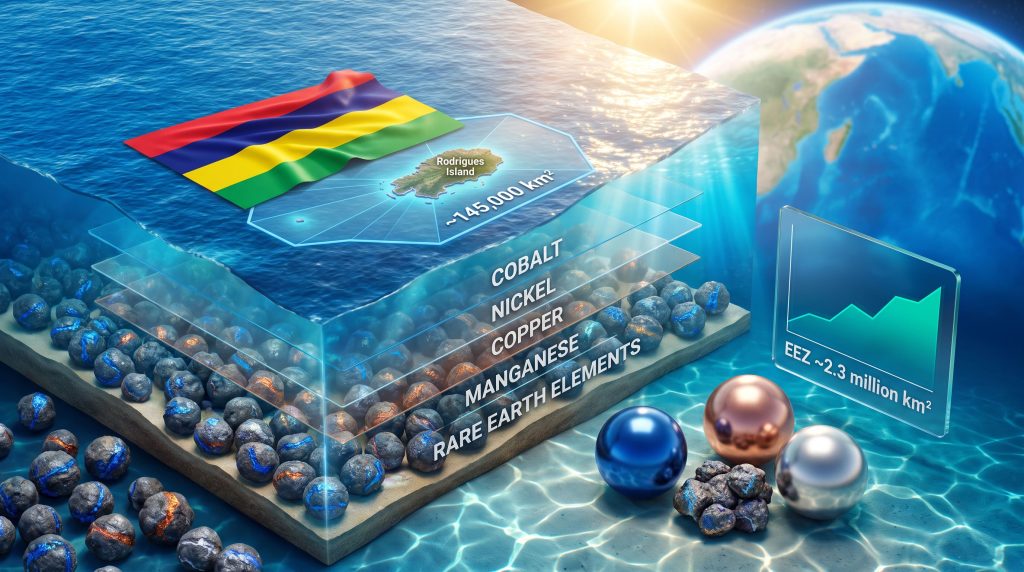
Polymetallic nodules, the potato-sized mineral formations that litter vast stretches of the seabed, have long been recognised as theoretically significant. What has changed is urgency. Cobalt, nickel, copper, manganese, and rare earth elements, all present in these formations, now sit at the centre of battery supply chains, defence electronics, and advanced clean energy infrastructure.
As land-based deposits face the compounding pressures of depletion, escalating extraction costs, and geopolitical concentration, particularly China's rare earth restrictions across production and processing, the ocean floor has transformed from a scientific curiosity into a strategic priority.
It is within this context that a legal ruling approved by the United Nations and formally noted by the Mauritian Cabinet on 14 August 2026 takes on significance that extends well beyond the island nation itself.
When big ASX news breaks, our subscribers know first
How Maritime Law Creates Sovereign Mineral Rights
The Legal Architecture Behind Continental Shelf Claims
Understanding why the Mauritian ruling matters requires familiarity with the international legal framework governing seabed resources. Under the United Nations Convention on the Law of the Sea (UNCLOS), every coastal state automatically holds an Exclusive Economic Zone (EEZ) extending 200 nautical miles from its baseline, granting rights over all resources in both the water column and the seabed below.
However, UNCLOS also provides a mechanism for states to claim sovereign rights over the seabed beyond that 200-nautical-mile limit, where the natural prolongation of their continental margin can be demonstrated through geological and oceanographic evidence. This is the extended continental shelf, adjudicated by the UN Commission on the Limits of the Continental Shelf (CLCS).
A critical distinction applies here: extended continental shelf rights cover only the seabed and its subsoil, not the water column above. This means a nation can hold sovereign mineral extraction rights beneath waters it cannot exclusively manage for fishing or navigation. For resource governance, this distinction carries enormous practical weight.
The process is neither fast nor simple. Nations must compile extensive geoscientific evidence, submit formal claims, and await CLCS review — a body that operates by scientific consensus and moves at the pace of deliberate legal process rather than market cycles.
Mauritius' 17-Year Journey to Seabed Sovereignty
The Mauritian continental shelf extension around Rodrigues Island represents one of the more instructive examples of this process in action. The country's partial submission to the CLCS was first lodged on 6 May 2009, initiating what would become a 17-year regulatory journey.
A formal request to extend the shelf by approximately 183,000 km² was submitted in July 2024, and the CLCS subsequently approved an extension of more than 145,000 km², representing roughly 79–80% of the area requested. The claim was substantiated by geological and oceanographic survey data demonstrating that Mauritius' continental shelf naturally extends beyond the standard 200-nautical-mile boundary.
The Mauritian Cabinet formally acknowledged the decision at its August 14, 2026 session, describing it as a major national milestone in the administration of the country's maritime zones. Former Prime Minister Pravind Jugnauth, whose administration submitted the 2024 proposal, characterised the approval as foundational to the country's sovereignty and long-term economic positioning.
Mauritius Ocean Territory Rare Earths: The Full Maritime Picture
Mapping Mauritius' Ocean Estate
To appreciate what the Rodrigues ruling adds, it is useful to view Mauritius' maritime holdings in their entirety. The country's ocean estate is already disproportionately large relative to its land area — a structural advantage that small island states with widely dispersed territories frequently possess.
| Maritime Zone | Approximate Area |
|---|---|
| Exclusive Economic Zone (EEZ) | ~2.3 million km² |
| Extended continental shelf (jointly managed with Seychelles) | ~396,000–400,000 km² |
| Newly approved Rodrigues shelf extension (2026) | ~145,000–147,000 km² |
The Rodrigues ruling adds to, rather than replaces, existing maritime entitlements. Taken together, Mauritius commands one of the largest ocean footprints in Africa relative to its land mass, positioning it as a significant player in the emerging blue economy. Furthermore, critical minerals geopolitics increasingly make such positioning strategically relevant, regardless of whether seabed mineral extraction ever becomes commercially viable.
What the Ruling Does and Does Not Guarantee
It is essential to separate legal jurisdiction from resource reality. The CLCS approval establishes that Mauritius holds sovereign rights over the seabed and subsoil of the newly designated zone. It does not confirm the presence, grade, or extractability of any mineral deposit. No commercial rare earth mining or polymetallic nodule extraction is currently operational within Mauritius' ocean territory.
Investor note: The Mauritius ocean territory rare earths story is prospective in nature. The CLCS ruling is a legal precondition for future exploration and licensing, not evidence of a producing resource province. Treating it otherwise would fundamentally misrepresent the current state of development.
Polymetallic Nodules: Composition, Value, and Extraction Reality
What the Seabed Around Rodrigues Is Believed to Contain
The expanded seabed zone is believed to host polymetallic nodules — mineral concretions that form over millions of years on the deep ocean floor as metal-rich sediments accumulate in concentric layers around a nucleus, often a shark tooth or fragment of shell. Their mineral content is what makes them strategically relevant to modern industrial supply chains.
| Mineral | Primary Industrial Application |
|---|---|
| Cobalt | EV batteries, aerospace alloys |
| Nickel | Stainless steel, battery cathodes |
| Copper | Electrical wiring, renewable energy infrastructure |
| Manganese | Steel production, battery chemistry |
| Rare Earth Elements (REEs) | Permanent magnets, defence electronics, clean energy systems |
The rare earth elements found in polymetallic nodules — including cerium, lanthanum, and neodymium — differ meaningfully from terrestrial rare earth deposits. Concentrations tend to be lower than in dedicated rare earth ores, but their co-occurrence with cobalt and nickel creates a multi-mineral value proposition. Extracting them, however, introduces metallurgical complexity that conventional processing infrastructure is not yet optimised to handle at commercial scale.
Why China's Dominance Makes Ocean REEs Strategically Attractive
China controls approximately 60–70% of global rare earth production and an even more dominant share of downstream processing and refining capacity. This concentration creates structural vulnerability across Western defence, automotive, and clean energy industries. Consequently, critical minerals demand from alternative sources is rising sharply, making deep-sea nodule deposits in the Indian Ocean one of several potential pathways toward supply chain diversification.
This is why the United States has directed more than $62.8 million toward rare earth projects across four African nations as part of a broader effort to reduce dependence on Chinese-controlled supply. For small island states like Mauritius, this geopolitical dynamic transforms a seabed legal ruling into something with strategic dimensions that exceed its immediate economic value.
The Gap Between Potential and Production
Enthusiasm for seabed mineral wealth must be tempered by an honest assessment of extraction maturity. Deep-sea mining concerns remain significant, and the technology itself remains commercially unproven at scale for nodule-bearing zones. The International Seabed Authority (ISA), the body responsible for licensing extraction in international waters, has not yet finalised a commercial mining code, creating a regulatory vacuum that simultaneously protects and constrains development.
The step-by-step pathway from a CLCS ruling to active production is lengthy:
- Comprehensive geological survey and resource mapping of the approved zone
- Environmental impact assessment, including baseline biodiversity studies
- ISA exploration licence application for any areas beyond national jurisdiction
- Pilot extraction and processing feasibility study
- Commercial licensing negotiation and production commencement
Based on global precedents, this sequence typically spans 10 to 30 years, even under favourable regulatory and market conditions. No nation has yet achieved full commercial-scale polymetallic nodule extraction anywhere on Earth.
Mauritius' Blue Economy Ambitions and a Complicated Environmental Position
Beyond Minerals: The Multi-Sector Ocean Opportunity
The expanded maritime zone creates opportunity across multiple sectors simultaneously. Mauritius, whose economy has historically been anchored by financial services, tourism, and textiles, is actively cultivating a blue economy framework. Mauritius considers ocean mining as just one component of this broader strategy, which also encompasses:
- Sustainable fisheries management and enhanced harvesting rights over a larger seabed zone
- Marine scientific research partnerships with international institutions
- Offshore renewable energy development, including wave, tidal, and wind potential
- Seabed resource exploration and future extraction licensing as regulatory frameworks mature
The country's status as Africa's second-wealthiest economy by GDP per capita — ranking behind only Seychelles in both nominal and purchasing power parity (PPP) terms according to IMF-based estimates — provides a relatively stable institutional base from which to pursue these ambitions.
Mauritius' Contradictory Stance on Deep-Sea Mining
One of the least-discussed tensions in the Mauritius maritime story is the country's own ambivalence toward the very activity its seabed rights could enable. As Fonds Créyol reports, Mauritius has been noted alongside Kenya and other African nations in pushing back against deep-sea mining, citing environmental concerns about seabed disturbance and biodiversity loss.
This creates a paradox that analysts describe as a "secure now, decide later" approach: asserting and defending sovereign rights over the seabed while deferring any commitment to extraction pending regulatory, technological, and environmental clarity. It is a rational strategy for a small nation seeking to preserve optionality without foreclosing future revenue potential, but it does complicate any straightforward resource investment narrative.
The Chagos Archipelago: When Military Geography Meets Resource Rights
A Sovereignty Dispute Decades in the Making
The geopolitical environment surrounding Mauritius' ocean territory cannot be fully understood without accounting for the Chagos Archipelago dispute. The United Kingdom separated the archipelago from Mauritius in 1965, three years before Mauritius gained independence in 1968. The territory has remained under British administration since, hosting the Diego Garcia military installation jointly operated by the United States and the United Kingdom.
Both the International Court of Justice and the United Nations have issued positions supporting the termination of British administration over the territory, lending international legal weight to Mauritius' sovereignty claim. The strategic value of Diego Garcia as a deep-water naval and air base in the Indian Ocean has kept major powers intensely focused on the archipelago's political future.
Reporting from The Telegraph in June 2026 indicated that the United States was evaluating a potential purchase of the Chagos Archipelago from Mauritius as a mechanism for securing long-term control of the Diego Garcia facility. If accurate, this would constitute an unprecedented transfer of disputed island sovereignty through commercial acquisition rather than conventional decolonisation or treaty processes.
The Strategic Convergence in the Indian Ocean
The intersection of military basing rights, prospective seabed mineral wealth, and great power competition creates a uniquely layered geopolitical environment that elevates Mauritius' strategic significance far beyond what its economic scale alone would suggest.
| Dimension | Key Players | Strategic Interest |
|---|---|---|
| Military basing | USA, UK, Mauritius | Diego Garcia facility access |
| Seabed minerals | China, India, USA | Critical mineral supply chains |
| Maritime law | UN, CLCS, ISA | Continental shelf jurisdiction |
| Sovereignty claims | Mauritius, UK | Chagos Archipelago resolution |
China, India, and the United States are all expanding their presence across the Indian Ocean, each with distinct strategic rationales. For Mauritius, this competition provides diplomatic leverage that a small island economy would not ordinarily possess, potentially accelerating the pace at which international partners seek exploration or partnership agreements over the newly designated seabed zone.
The next major ASX story will hit our subscribers first
Scenario Analysis: Three Pathways for Mauritius' Ocean Territory
Scenario 1: Strategic Reserve (Most Probable Near-Term Outcome)
Mauritius secures and defends its legal rights but delays any extraction commitment pending regulatory clarity at the ISA level, advances in extraction technology, and completion of environmental baseline assessments. The territory functions as a sovereign asset held in reserve, accumulating strategic value as Mauritius ocean territory rare earths interest intensifies globally.
Scenario 2: Partnership-Led Exploration
Mauritius enters formal exploration agreements with a major power — whether the United States, India, or Japan — as part of a broader diplomatic alignment in the Indian Ocean. This pathway accelerates geological assessment and feasibility studies without requiring Mauritius to independently finance or manage deep-sea exploration programmes.
Scenario 3: Active Commercial Development
The ISA finalises a commercial mining code, extraction technology achieves cost-competitive maturity, and Mauritius moves toward licensed deep-sea mining operations. Under this scenario, the Rodrigues shelf zone transitions from a prospective mineral frontier to a functioning component of Mauritius' blue economy revenue base. This is the least likely near-term scenario but the most consequential long-term possibility.
What Investors and Policymakers Should Watch
Key Milestones Signalling a Transition from Prospective to Actionable
For those tracking Mauritius ocean territory rare earths developments as an investment or policy theme, the following indicators would signal meaningful progress toward an actionable resource opportunity:
- Issuance of an ISA exploration licence specifically covering areas within or adjacent to the Rodrigues shelf zone
- Release of a formal Mauritius government framework for deep-sea resource governance and licensing
- Entry of a major mining company or sovereign wealth fund into an exploration agreement with Mauritius
- Completion of an independent geological survey quantifying nodule density and mineral concentration across the approved zone
Until these milestones materialise, the investment thesis remains entirely prospective. The legal foundation is now in place, but the distance between a CLCS ruling and a producing mine is measured in decades and billions of dollars of technical and regulatory work.
The ISA Governance Gap: Risk and Opportunity
The ISA's ongoing inability to finalise a commercial deep-sea mining code is simultaneously the biggest constraint on and the most underappreciated opportunity within the seabed mineral sector. Nations and companies that establish strong legal and relational positions during this regulatory limbo period may find themselves advantageously positioned once a framework is eventually agreed.
Mauritius' proactive pursuit of continental shelf extensions, regardless of short-term extraction intent, reflects precisely this logic.
Disclaimer: This article contains forward-looking analysis, scenario projections, and assessments of prospective resource potential. None of the content constitutes financial or investment advice. Readers should conduct independent due diligence before making any investment decisions related to deep-sea mineral development, maritime resource governance, or related sectors.
Frequently Asked Questions
Does Mauritius currently mine rare earths from its ocean territory?
No. As of 2026, no commercial rare earth or polymetallic nodule mining is underway in Mauritius' ocean territory. The CLCS ruling establishes legal jurisdiction over the seabed, but no extraction has commenced and no commercial mining licences have been issued for this zone.
What is the difference between an EEZ and an extended continental shelf?
An Exclusive Economic Zone extends 200 nautical miles from a nation's baseline and grants rights over all resources in the water column and seabed. An extended continental shelf goes beyond 200 nautical miles but grants rights only over the seabed and subsoil, not the water column above. Mauritius' Rodrigues ruling falls into this second category.
What minerals are found in polymetallic nodules?
Polymetallic nodules typically contain cobalt, nickel, copper, and manganese as primary metals, with trace concentrations of rare earth elements including cerium, lanthanum, and neodymium. Their exact composition varies by ocean basin, water depth, and sediment environment.
Why does the Chagos Archipelago matter to the seabed mineral story?
The Chagos dispute is geopolitically linked because it involves the same Indian Ocean maritime region where Mauritius is asserting expanded resource rights. Any resolution of the sovereignty question — including a potential US acquisition of the islands — would reshape the maritime and strategic landscape within which Mauritius' ocean mineral claims sit.
How long does it typically take to move from a CLCS ruling to active seabed mining?
Based on global precedents, the pathway from continental shelf approval to commercial extraction typically spans 10 to 30 years, depending on regulatory framework development, environmental assessment timelines, technology readiness, and investment conditions.
Want to Track the Next Major Mineral Discovery Before the Market Does?
Discovery Alert's proprietary Discovery IQ model delivers real-time alerts on significant ASX mineral discoveries — instantly translating complex resource data into actionable insights for both short-term traders and long-term investors. Explore Discovery Alert's dedicated discoveries page to see how historic mineral discoveries have generated substantial returns, and begin your 14-day free trial today to position yourself ahead of the broader market.