August 20, 2026
The Hidden Economics of Heavy Rare Earth Projects That Most Investors Miss
Not all rare earth projects are created equal. Within the broader critical minerals universe, there exists a fundamental divide between light rare earth elements (LREEs) and heavy rare earth elements (HREEs) that shapes everything from processing complexity and supply chain exposure to geopolitical risk and long-term pricing dynamics. While light rare earths like cerium and lanthanum are relatively abundant and widely produced outside China, heavy rare earths such as dysprosium, terbium, erbium, and yttrium occupy an entirely different risk category. They are scarcer, more technically challenging to separate, and overwhelmingly concentrated within Chinese-controlled processing infrastructure.
It is against this backdrop that the Victory North Stanmore mine plan deserves serious examination, not simply as a corporate milestone for Victory Metals (ASX: VTM), but as a case study in what a credible, large-scale HREE development project can look like at the pre-feasibility stage.
When big ASX news breaks, our subscribers know first
Why Heavy Rare Earths Are Not the Same as Light Rare Earths
A common misconception among general investors is that rare earth projects are broadly interchangeable. In reality, the distinction between light and heavy rare earths is one of the most important technical and commercial factors in the entire sector.
LREEs such as neodymium and praseodymium (together called NdPr) receive enormous attention due to their role in permanent magnets, and multiple non-Chinese producers including MP Materials in the United States and Lynas Rare Earths in Australia have established meaningful LREE supply outside Chinese jurisdiction. However, HREEs remain a largely unresolved problem for Western supply chains, and the heavy rare earth supply chains that exist today are overwhelmingly controlled by Chinese processing infrastructure.
Dysprosium and terbium, the two most commercially critical heavy rare earths, are used as additives in NdFeB permanent magnets to significantly enhance their thermal stability, allowing motors in electric vehicles and wind turbines to function at higher operating temperatures without demagnetising. Without adequate dysprosium and terbium inputs, magnet performance degrades under real-world conditions. Yet according to industry reporting, China accounts for the overwhelming majority of global HREE separation and processing capacity, with very limited alternatives currently operating at commercial scale outside its borders.
This supply concentration is the central strategic vulnerability that projects like North Stanmore are positioned to address.
Breaking Down the Victory North Stanmore Mine Plan: What the PFS Numbers Actually Mean
The pre-feasibility study (PFS) for the North Stanmore project presents a set of economic metrics that warrant careful interpretation rather than surface-level reading.
| Economic Metric | North Stanmore PFS Estimate |
|---|---|
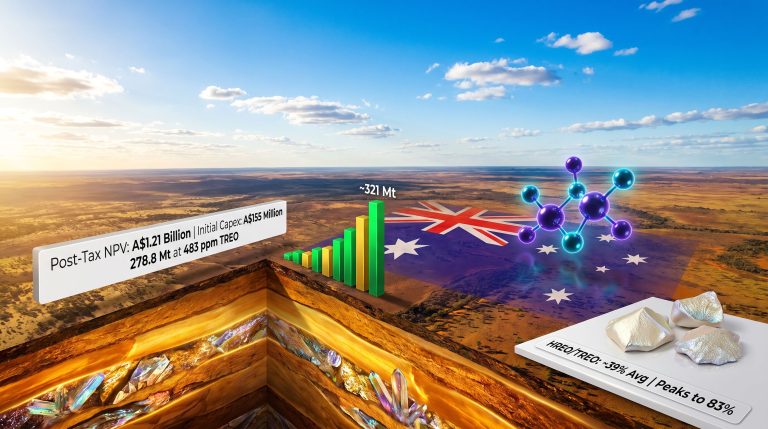
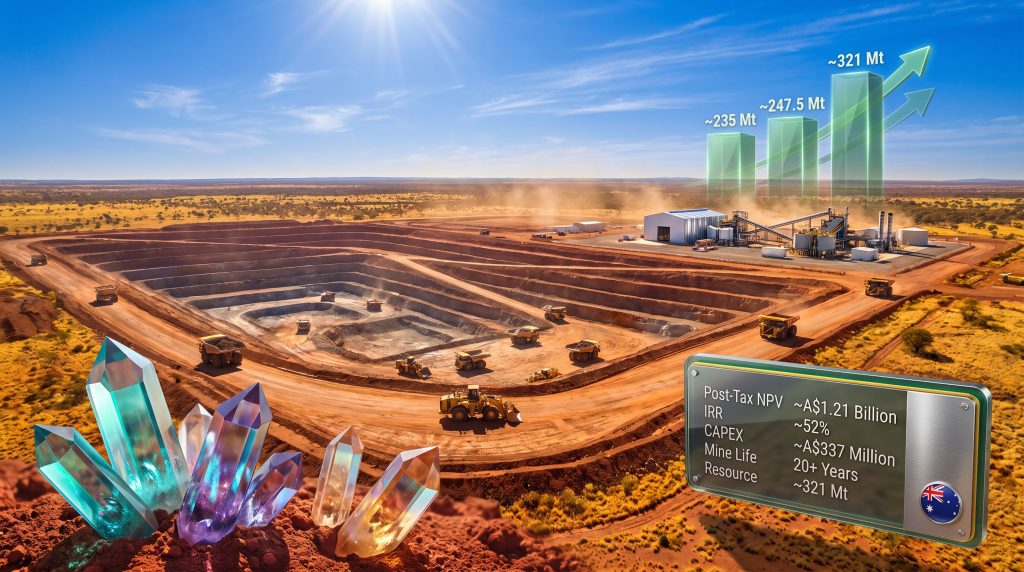
| Post-Tax NPV | ~A$1.21 billion |
| Internal Rate of Return (IRR) | ~52% |
| Estimated Capital Expenditure | ~A$337 million |
| Planned Mine Life (PFS basis) | 20+ years |
| Processing Throughput | 8 Mtpa |
The post-tax NPV of approximately A$1.21 billion is significant when placed against the project's estimated capital expenditure of roughly A$337 million. This capital-to-value ratio suggests that every dollar of upfront construction spend is generating approximately 3.6 times its value in net present terms, which reflects the project's low-cost operating structure and multi-decade production profile.
The 52% internal rate of return is the figure that arguably deserves the most attention. In rare earth project economics, IRRs above 30% are generally considered attractive enough to draw institutional capital. At 52%, North Stanmore sits well above that threshold, and the key driver of that elevated return is the project's geology rather than aggressive price assumptions.
Furthermore, the rare earth processing challenges that typically weigh on project economics are mitigated here by the deposit's favourable physical characteristics, which is discussed in more detail below.
"A high IRR generated by low capital intensity and low operating costs is structurally more durable than one driven purely by commodity price optimism. The former persists through price cycles; the latter collapses when prices soften."
The Free-Dig Advantage: Why Shallow Mineralisation Changes the Project Economics
One of the least-discussed but most commercially important attributes of the Victory North Stanmore mine plan is its free-dig, open-pit mining methodology. Free-dig refers to mineralisation that is soft, weathered, and unconsolidated enough to be excavated directly by mechanical equipment such as front-end loaders and trucks, without the need for drilling and blasting.
This has cascading effects on project economics:
- Blasting consumables, including explosives and associated services, represent a meaningful proportion of operating costs in conventional hard-rock mining and are eliminated entirely in free-dig operations
- Equipment capital requirements are reduced because standard earthmoving machinery replaces specialised drilling rigs and blast-loading equipment
- Safety protocols are simplified, reducing insurance and compliance costs
- Operational ramp-up timelines are typically shorter because there are fewer technical dependencies
The processing plant is planned for construction within approximately one kilometre of the pit, further reducing internal haulage costs and minimising the infrastructure footprint required to sustain operations.
Phase-by-Phase Mining Schedule: The Strip Ratio Story
The mine plan is structured in two distinct operational phases, each with different cost profiles:
Phase 1 (Years 1 to 7): Mining targets the upper, higher-grade ore zones where rare earth grades are at their most economically productive. During this period, the strip ratio is approximately 3:1, meaning three tonnes of waste are moved for every tonne of ore processed. While this is not a low strip ratio in absolute terms, the free-dig nature of both ore and waste material keeps the cost per tonne of waste movement far below what would be seen in a blasting-intensive operation.
Phase 2 (Year 8 Onwards): As the pit deepens and mining transitions into lower-grade material, the strip ratio improves substantially to approximately 1:1. This reversal of the typical mine economics pattern — where costs increase as grades decline — is partially offset here by the improving strip ratio, supporting sustained economic viability across the extended mine life. You can read more about how Victory confirms rare earth potential at North Stanmore in Mining Magazine's dedicated coverage.
The Resource Growth Story: From 235 Mt to 321 Mt and Still Climbing
For long-term project valuation, the trajectory of a resource estimate is often as revealing as its current size. North Stanmore's resource evolution tells a compelling geological story.
| Reporting Period | Resource Estimate |
|---|---|
| Initial Disclosure | ~235 Mt |
| Interim Update | ~247.5 Mt |
| Most Recent Estimate | ~321 Mt |
The resource has grown by approximately 37% from its initial disclosure to the most recent estimate, and critically, the mineralisation remains open in all directions. In geological terms, an open resource means that systematic drilling has not yet reached the boundaries of the ore body, indicating that further drilling programs have a strong probability of delivering additional resource tonnes.
Under broader resource scenarios at lower throughput assumptions, the project carries potential mine life optionality extending beyond 60 years. It is important to interpret this figure carefully. The PFS mine plan is anchored to a 20-plus year schedule based on the defined resource envelope. The 60-plus year figure reflects an indicative scenario based on the totality of the resource and should be treated as long-term upside rather than a confirmed production schedule.
"Investors evaluating development-stage mining projects should distinguish between PFS-based mine plans, which are study-grade estimates, and broader resource scenarios, which are geological statements about potential scale rather than commercial commitments."
In addition, understanding the different mineral deposit tiers is essential for contextualising what this resource growth means for North Stanmore's long-term valuation potential.
Strategic Positioning: Where North Stanmore Sits in the Global HREE Supply Chain
The commercial case for North Stanmore cannot be separated from the geopolitical context in which it is being developed. Western governments across North America, Europe, Japan, and Australia have progressively moved to classify heavy rare earths as critical minerals requiring domestic or allied-nation supply chain development. The ongoing critical minerals demand surge is further amplifying the urgency for governments and industry to secure reliable non-Chinese sources.
Several structural factors make an Australian HREE project of this scale particularly relevant to global supply discussions:
- Japan is heavily dependent on rare earth imports and has historically pursued supply diversification partnerships aggressively since China's 2010 export restriction episode
- The United States has enacted legislation through the Inflation Reduction Act and related executive orders incentivising non-Chinese critical mineral sourcing for battery and defence supply chains
- European Union critical raw materials policy explicitly identifies heavy rare earths among the materials requiring diversified supply routes by 2030
These frameworks create a demand-side pull for projects like North Stanmore to pursue offtake agreements with Japanese, American, and European industrial partners, though it should be noted that no specific offtake agreements or government co-investment arrangements have been confirmed for the project at this stage.
How North Stanmore Compares to Australian HREE Peers
| Project Attribute | North Stanmore (Victory Metals) | Typical Australian HRE Peer |
|---|---|---|
| Mining Method | Open pit / free dig | Open pit or in-situ recovery |
| Post-Tax NPV | ~A$1.21 billion | A$200M to A$1B+ |
| IRR | ~52% | Typically 20% to 40% |
| Resource Size | ~321 Mt (open) | Generally 50 to 300 Mt |
| Processing Location | On-site (~1 km from pit) | On-site or off-site |
| Mine Life Potential | 20+ years (PFS); 60+ years (upside) | 10 to 30 years |
Key Risks That Investors Must Weigh Against the Headline Economics
A 52% IRR and a billion-dollar NPV are compelling numbers, but responsible project evaluation requires equal attention to the risks that sit between a PFS and actual production.
Metallurgical Complexity in Heavy Rare Earth Processing
Processing HREEs is considerably more technically demanding than processing LREEs. Ionic clay-hosted deposits, which host a significant proportion of global HREE resources including many in southern China, require relatively gentle extraction. However, the separation of individual HREE elements from a mixed concentrate involves solvent extraction circuits that are technically complex and capital-intensive at commercial scale.
Metallurgical recovery rates and concentrate quality specifications remain to be fully confirmed at definitive feasibility study stage. This is a standard caveat at PFS level but carries particular weight for HREE projects where downstream processing partnerships and offtake pricing structures are closely tied to concentrate chemistry and purity benchmarks.
Commodity Price Volatility and Chinese Policy Risk
HREO pricing is structurally volatile. China's influence over global supply means that policy decisions around export quotas, processing licences, and environmental enforcement within China's rare earth industry can cause significant price swings within short timeframes. The 2010 to 2012 period, when China restricted rare earth exports and HREO prices rose by multiples before collapsing again, remains the defining historical reference point for this risk.
A rigorous sensitivity analysis at DFS stage will be essential to understand how the A$1.21 billion NPV performs across a range of HREO price scenarios, including stress-test cases that reflect potential Chinese supply releases or demand softening in the EV sector. For more detail on the project's broader strategic context, the North Stanmore project overview on Victory Metals' official website provides a useful reference point.
Financing a A$337 Million Development as a Junior
Capital expenditure of approximately A$337 million is substantial relative to the balance sheet capacity typical of ASX-listed junior developers. The financing pathway to construction will likely require a combination of:
- Strategic equity partnerships with downstream industrial users seeking supply security
- Debt facilities from export credit agencies or multilateral development institutions with mandates to support critical mineral supply chain development in allied nations
- Potential royalty or streaming arrangements as a capital-efficient funding mechanism
- Continued equity raises through the ASX market as study milestones are achieved
The sequencing and structure of this financing pathway will be closely watched by the market as the project advances toward a DFS and eventual final investment decision.
The next major ASX story will hit our subscribers first
The Road From PFS to Production: Critical Milestones Ahead
The Victory North Stanmore mine plan, as outlined in the PFS, represents a significant de-risking milestone. However, the path to first production involves a defined sequence of technical, regulatory, and commercial steps.
- Additional resource drilling to further define and potentially expand the ore body, particularly given that the mineralisation remains open in multiple directions
- Metallurgical test work programs to underpin processing plant design at DFS stage and confirm recoveries at commercial scale
- Environmental impact assessment processes under Western Australia's regulatory framework, including heritage and native title considerations relevant to the Cue region
- Mining lease applications and tenement management aligned with the proposed pit design
- Engagement with potential offtake partners in Japan, the US, and Europe to establish the commercial framework required for project bankability
- Completion of a definitive feasibility study, which would represent the primary value-creation milestone before a final investment decision can be considered
Disclaimer: This article is intended for informational purposes only and does not constitute financial advice. The financial projections, NPV figures, IRR estimates, and resource figures discussed are based on pre-feasibility study outputs and are subject to change as further technical work is completed. Investing in junior mining companies involves significant risk, including the potential loss of capital. Readers should seek independent financial advice before making any investment decisions.
Want to Catch the Next Major Mineral Discovery Before the Market Does?
Discovery Alert's proprietary Discovery IQ model scans ASX announcements in real time, instantly translating complex mineral data — across rare earths and beyond — into clear, actionable investment insights for both short-term traders and long-term investors. Explore how historic mineral discoveries have generated exceptional returns and begin a 14-day free trial today to position yourself ahead of the broader market.