August 14, 2026
The Hidden Bottleneck in the Clean Energy Transition: Why Heavy Rare Earths Are the Minerals the World Cannot Afford to Overlook
Most conversations about the raw materials underpinning electric vehicles and renewable energy systems converge on lithium, cobalt, or nickel. Yet a quieter but far more acute supply constraint is developing within the rare earth sector itself, specifically within the subset of elements classified as heavy rare earths. Unlike their light counterparts, heavy rare earth elements (HREEs) such as dysprosium and terbium are not merely useful additives to permanent magnets. They are functionally irreplaceable in high-performance motors, where they prevent demagnetisation at elevated operating temperatures. Without them, the magnets used in EV drivetrains and wind turbine generators lose their integrity under load.
This distinction between light rare earth elements (LREEs) and HREEs is one of the most consequential and least discussed fault lines in global rare earth supply chains. The market for neodymium and praseodymium, the dominant LREEs in magnet production, is already attracting significant project development activity across multiple continents. However, dysprosium and terbium, which are required in smaller proportions but command substantially higher prices per kilogram, remain overwhelmingly sourced from ionic adsorption clay deposits concentrated in China's Jiangxi Province. Western supply chain planners have increasingly recognised that securing HREE supply from outside Chinese jurisdiction is not merely a commercial preference but a strategic imperative.
It is within this broader context that the Victory Metals North Stanmore rare earth project in Western Australia is generating serious attention from the mining and investment community.
When big ASX news breaks, our subscribers know first
Understanding What Makes Clay-Hosted Heavy Rare Earth Deposits Different
To properly assess North Stanmore's significance, it helps to understand the geological architecture that makes ionic adsorption clay deposits so commercially attractive relative to other rare earth mineralisation styles.
In hard-rock rare earth systems, such as carbonatite-hosted deposits or monazite-bearing mineral sands, the rare earth elements are locked within robust crystal lattices that require energy-intensive processing to liberate. Carbonatite deposits, for example, typically require froth flotation followed by aggressive acid leaching circuits to produce a saleable concentrate. Capital costs are correspondingly high, and the mineralogy often introduces processing complications that elevate technical risk.
Ionic adsorption clay deposits work on an entirely different principle. In these systems, rare earth ions are not chemically bound within minerals but are instead electrostatically adsorbed onto the surface of clay particles, primarily kaolinite and halloysite. This means they can be liberated through a simple ion-exchange process using dilute ammonium sulphate or similar reagent solutions, without the need for high-temperature roasting or complex flotation circuits. The result is a fundamentally simpler and lower-cost processing pathway. For further context on rare earth processing challenges across the sector, the contrast with hard-rock systems is particularly instructive.
"Clay-hosted ionic adsorption deposits represent the global benchmark for heavy rare earth production. China's Jiangxi Province operations, which supply the majority of the world's dysprosium and terbium, are built almost entirely on this deposit style."
Crucially, ionic adsorption clays also tend to yield higher proportions of heavy rare earths relative to total rare earth content. This is because the heavier lanthanides, which carry a higher ionic charge density, adsorb preferentially onto clay mineral surfaces under specific weathering conditions. Projects capable of replicating this HREE enrichment profile outside of China are extraordinarily rare, which is precisely what makes North Stanmore's resource characteristics so noteworthy.
| Feature | Clay-Hosted (e.g., North Stanmore) | Hard-Rock (e.g., Carbonatite) |
|---|---|---|
| Processing complexity | Lower | Higher |
| Capital intensity | Generally lower | Generally higher |
| HREO/TREO ratio | Typically higher | Typically lower |
| Environmental footprint | Smaller surface disturbance | Larger |
| Leaching method | In-situ or heap leach | Flotation + chemical processing |
North Stanmore: Project Location and Infrastructure Advantages
The North Stanmore project sits approximately 6 kilometres north of the town of Cue in Western Australia's Murchison region. This location offers a combination of infrastructure proximity and regulatory familiarity that meaningfully reduces development risk compared to more remote or frontier project locations.
Access to the Great Northern Highway provides a credible logistics corridor for reagent supply and concentrate export without requiring the construction of dedicated haulage infrastructure. Western Australia's mining regulatory framework, underpinned by the Mining Act 1978 and administered by the Department of Mines, Industry Regulation and Safety (DMIRS), is well understood by project developers and financing institutions alike. This regulatory predictability is an asset in itself when assessing development timelines.
The Murchison region has a long history of mining activity, which means skilled labour availability and established service contractor networks are relatively accessible compared to greenfield locations in more remote parts of the continent.
How North Stanmore's Resource Has Evolved: A Story of Consistent Growth
One of the more compelling aspects of the Victory Metals North Stanmore rare earth project from an investor's perspective is the consistent upward trajectory of the resource base through successive drilling and estimation programmes.
| Resource Category | Tonnage | TREO Grade (ppm) |
|---|---|---|
| High-Grade Domain | 53.3 Mt | 1,024 ppm |
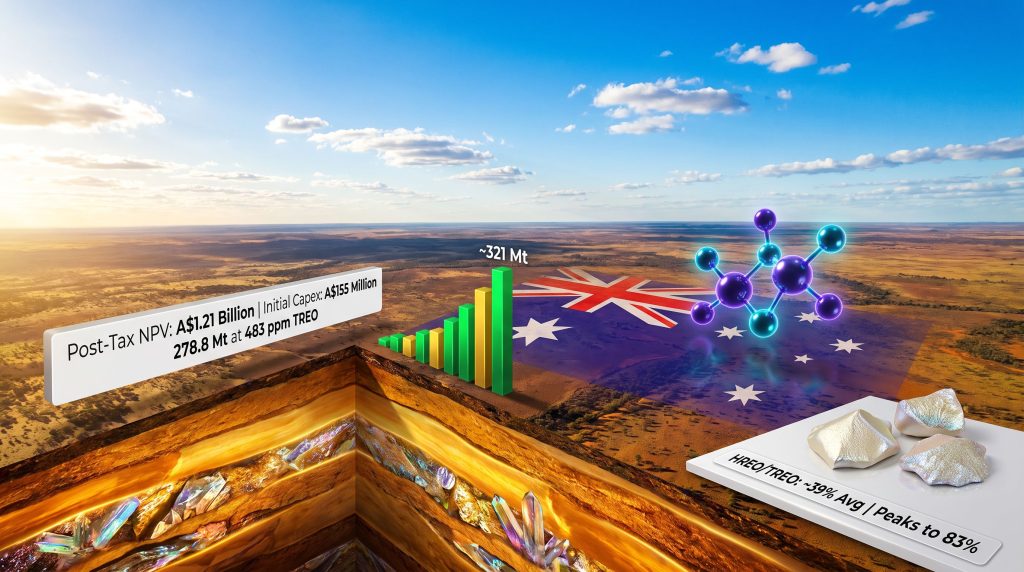
| Total Resource (PFS Base Case) | 278.8 Mt | 483 ppm |
| Measured and Indicated | 154.8 Mt | Not separately stated |
| Full JORC Resource | ~321 Mt | Not separately stated |
The evolution from an initial estimate of 235 million tonnes in 2024 to the current JORC-compliant resource of approximately 321 million tonnes demonstrates that the deposit remains open to further extension. For project financing purposes, the distinction between the full JORC resource and the PFS base case figure of 278.8 million tonnes at 483 ppm TREO is important: the PFS has deliberately used a conservative resource envelope to underpin its economic analysis.
Within the total resource sits a particularly significant high-grade domain of 53.3 million tonnes averaging 1,024 ppm TREO. This internal high-grade zone is more than double the average grade of the broader resource and carries obvious implications for production scheduling. By prioritising the high-grade domain during the early years of operation, the project has potential to front-load revenue and accelerate capital payback, though production sequencing decisions of this nature will be refined through the Definitive Feasibility Study (DFS) process.
The 154.8 million tonnes of Measured and Indicated Resources provides the confidence base typically required for institutional financing discussions. Under the JORC Code 2012, Measured and Indicated Resources carry sufficient geological certainty to be converted to Ore Reserves through appropriate modifying factors, and lenders generally require a meaningful Ore Reserve base before advancing project debt. The current 47 million tonne Probable Ore Reserve represents the bankable foundation on which the PFS economic case is constructed.
Why the 47 Mt Probable Ore Reserve Is the Credibility Anchor
The decision to base the PFS production schedule exclusively on the 47 million tonne Probable Ore Reserve, excluding all Inferred Resources and Exploration Targets, is a deliberate and significant signal to the market. The reserve carries an average grade of 692 ppm TREO and 248 ppm HREO, reflecting a meaningful enrichment above the broader resource average.
Under the JORC Code, an Ore Reserve represents the economically mineable portion of a Mineral Resource after the application of modifying factors including mining, metallurgical, infrastructure, economic, marketing, and regulatory considerations. Basing a pre-feasibility study NPV entirely on a Probable Reserve rather than a more generous resource envelope is a conservative approach that lends credibility to the resulting economic metrics, particularly in conversations with debt providers and potential offtake partners who scrutinise the robustness of underlying assumptions.
Decoding the Pre-Feasibility Study Economics
The PFS results for the Victory Metals North Stanmore rare earth project deliver a set of metrics that are notable both in absolute terms and relative to the capital required to achieve them.
North Stanmore PFS: Key Metrics at a Glance
- Post-Tax NPV: A$1.21 billion
- Initial Capital Cost: A$155 million
- Annual Processing Rate: 2.4 million tonnes per year
- Annual Concentrate Production: ~29,000 wet tonnes per year
- Life-of-Mine Revenue (FOB): A$6.5 billion
- Ore Reserve: 47 Mt Probable at 692 ppm TREO / 248 ppm HREO
- Project Life: ~20 years (initial case)
The ratio of post-tax NPV to initial capital expenditure is particularly striking. An A$1.21 billion NPV supported by an initial capex of just A$155 million implies a capital efficiency ratio that compares very favourably against hard-rock rare earth peers. Most carbonatite-hosted rare earth projects at comparable development stages report initial capital requirements that are multiples higher, often in the A$400 million to A$1 billion range for comparable production scales. The clay-hosted deposit style is directly responsible for this capital efficiency advantage.
The forecast life-of-mine free-on-board revenue of A$6.5 billion across approximately 20 years implies average annual revenues of roughly A$325 million, against which operating costs will need to be assessed during the DFS. The FOB basis means revenue is measured at the point of shipment, before freight and downstream separation costs, which investors should factor into their own return modelling.
The sub-A$200 million initial capital requirement also has important implications for project financing structure. At this scale, the project is potentially amenable to a combination of equity raising, debt facility, and offtake prepayment arrangements without requiring dilutive capital raises of a magnitude that would concern existing shareholders. Comparable projects requiring A$500 million or more in upfront capital face a structurally more challenging financing task in the current junior mining environment.
How the Mine Will Operate: The Two-Phase Approach
The operational model proposed for North Stanmore employs a sequenced approach that is well-suited to the characteristics of clay-hosted rare earth deposits.
The plan involves:
- A mining phase of approximately 10 years, during which ore is extracted and progressively stockpiled.
- A subsequent processing phase of approximately 10.5 years, during which the stockpiled ore is processed through the metallurgical circuit.
- An annual throughput rate of 2.4 million tonnes per year of ore through the processing facility.
- Annual concentrate production of approximately 29,000 wet tonnes per year of HREE-enriched mineral concentrate.
This stockpile-and-process methodology is not uncommon in clay-hosted systems where the soft, friable nature of the ore allows for efficient bulk extraction. It also provides operational flexibility by decoupling mining rates from processing rates, enabling the operation to manage throughput optimisation independently of mining schedules.
Metallurgical Performance: What a 59-Fold Upgrade Really Means
The pilot-scale metallurgical testwork results are one of the most technically significant aspects of the North Stanmore story, and they deserve careful interpretation.
| Metric | Value |
|---|---|
| Concentrate TREO Grade | ~7.1% |
| Metallurgical Upgrade Factor | ~59x |
| HREO Share of Concentrate TREO | ~40% |
| Annual Concentrate Output | ~29,000 wet tonnes/year |
A concentrate grading approximately 7.1% TREO represents a roughly 59-fold upgrade from run-of-mine ore. To contextualise this figure, consider that the feed grade averages 692 ppm TREO in the Ore Reserve, which is approximately 0.069% TREO. Achieving a 7.1% TREO concentrate from a sub-0.1% feed material through a leach-and-recovery process demonstrates strong metallurgical performance by any standard for this deposit style.
The 40% HREO share within the concentrate's TREO content is the commercial heart of this result. It means that approximately two-fifths of the rare earth oxide content in every tonne of concentrate shipped is composed of the high-value heavy rare earth elements that the global market is most urgently seeking. Dysprosium and terbium, in particular, carry price premiums that are substantially higher than the light lanthanides on a per-kilogram basis.
The product forms under consideration include Mixed Rare Earth Oxide (MREO), Mixed Rare Earth Carbonate (MREC), and MREO concentrate, providing commercial flexibility depending on the requirements and technical capabilities of offtake partners.
Furthermore, it is worth noting that the 59-fold upgrade has been demonstrated at pilot scale, not commercial scale. Scaling metallurgical performance from pilot testwork to full commercial throughput is a standard but real risk that the DFS process will need to address through extended testwork and potentially continuous pilot plant campaigns.
The next major ASX story will hit our subscribers first
Competitive Positioning Within Australia's Rare Earth Sector
Australia's rare earth sector has historically been dominated by light rare earth production, most notably through Lynas Rare Earths' Mt Weld operation in Western Australia, which is the largest operating rare earth mine outside of China and primarily produces neodymium, praseodymium, lanthanum, and cerium concentrates. Australia's critical minerals sector is, however, rapidly evolving beyond this light-rare-earth focus.
| Project | Developer | Resource Scale | Primary REE Type | Development Stage |
|---|---|---|---|---|
| North Stanmore | Victory Metals | ~321 Mt JORC | Heavy (HREE) | PFS Complete |
| Mt Weld | Lynas Rare Earths | Established producer | Light (LREE) | Operating |
| Eneabba | Iluka Resources | Mineral sands-hosted | Mixed | DFS/Development |
| Browns Range | Various | Smaller scale | Heavy (HREE) | Earlier stage |
The emergence of clay-hosted HREE projects represents a genuinely new chapter for Australian rare earth development. North Stanmore is described as Australia's largest and most advanced HREE clay project, which is a significant distinction given the global rarity of ionic adsorption clay deposits outside of China. The average HREO/TREO ratio of 39%, with local peaks reaching 83% within the deposit, positions North Stanmore's product profile as directly aligned with the elements most in demand from magnet manufacturers serving the EV and wind energy sectors.
Key Risks Investors and Analysts Should Understand
No assessment of the Victory Metals North Stanmore rare earth project is complete without a candid examination of the risks that remain between the current PFS stage and commercial production.
Metallurgical Scale-Up Risk: Pilot testwork results are encouraging, but translating recovery rates and concentrate grades to commercial-scale throughput involves meaningful uncertainty. Clay mineralogy can vary across a deposit in ways that affect leach kinetics and reagent consumption.
Offtake and Pricing Risk: HREE pricing is notoriously volatile and remains heavily influenced by Chinese production and export policy decisions. Securing long-term offtake agreements at fixed or floor prices will be critical to bankability, but finding counterparties willing to commit to long-dated HREE supply contracts outside of government-supported procurement programmes is a genuine commercial challenge. The broader context of rare earth geopolitics makes this dynamic particularly relevant for project developers.
Downstream Processing Gap: The project produces concentrate, not separated individual rare earth oxides. Australia currently lacks commercial-scale rare earth separation infrastructure outside of Lynas Rare Earths' operations. This means North Stanmore's product will require further processing offshore, most likely in Malaysia, Estonia, or Japan, before it reaches final end-users. This downstream dependency introduces an additional layer of commercial negotiation and cost that does not appear in the FOB revenue figure.
In addition, the following risk factors warrant consideration:
- Environmental impact assessment timelines for a clay operation in Western Australia, which may involve Native Title considerations and groundwater management requirements.
- Capital markets variability and investor appetite for junior rare earth development stories, which has historically been cyclical and sentiment-driven.
- The challenge of securing A$155 million in project financing in a market where rare earth project bankability remains underexplored by mainstream lenders.
The Path to Definitive Feasibility and Beyond
The company has indicated its intention to advance DFS-level work encompassing further process optimisation, extended metallurgical test programmes, and detailed engineering studies. Simultaneously, regulatory approvals and offtake discussions are expected to progress in parallel, a sequencing approach designed to compress the overall timeline to a final investment decision.
The primary demand pool for North Stanmore's HREE concentrate logically includes permanent magnet manufacturers in Japan, South Korea, and Europe who are actively pursuing supply chain diversification strategies, as well as emerging Western magnet producers seeking non-Chinese feedstock. Defence procurement agencies in the United States and allied nations have also become increasingly active in identifying and supporting HREE supply chains that sit outside Chinese jurisdiction, though any formal arrangements of this nature would need to be confirmed through specific agreements rather than assumed from policy frameworks alone.
Why the Global HREE Deficit Makes Projects Like North Stanmore Structurally Significant
The structural supply-demand dynamics for heavy rare earths create a market backdrop that is fundamentally different from most other mined commodities. Unlike bulk commodities where supply can theoretically be expanded relatively quickly in response to price signals, HREE supply is constrained by the extreme geographic concentration of ionic adsorption clay deposits and the multi-decade timeline required to develop new production capacity outside of China.
Western demand for dysprosium and terbium is set to grow substantially as EV production scales globally and as offshore wind turbine installations accelerate. Consequently, the critical minerals demand outlook for HREEs points to sustained structural undersupply well into the next decade. This creates a pricing environment that benefits projects capable of delivering HREE concentrate into Western supply chains.
Australia's positioning as a geopolitically stable, transparent, and rule-of-law jurisdiction adds a layer of strategic value to projects like North Stanmore that goes beyond pure mineral economics. For offtake partners and project financiers seeking to reduce exposure to Chinese supply chain risk, the combination of deposit quality, project scale, and sovereign jurisdiction that North Stanmore offers is a rare convergence in the global HREE development landscape. Industry coverage of this evolving story can be followed via Australian Mining's reporting on Victory Metals, which has tracked the project's technical milestones in detail.
This article contains forward-looking statements and projections based on publicly available information from Victory Metals Limited's pre-feasibility study and ASX announcements. These statements involve assumptions and uncertainties, and actual outcomes may differ materially. This content is provided for informational purposes only and does not constitute financial or investment advice. Readers should conduct their own due diligence and consult a licensed financial adviser before making any investment decisions.
Want to Track the Next Major Mineral Discovery Before the Broader Market?
Discovery Alert's proprietary Discovery IQ model delivers real-time alerts on significant ASX mineral discoveries — including critical and rare earth minerals driving the clean energy transition — turning complex data into actionable insights for investors at every level. Explore how historic discoveries have generated substantial returns on Discovery Alert's dedicated discoveries page, and begin your 14-day free trial today to position yourself ahead of the market.