August 13, 2026
The Geological Arms Race Nobody Is Talking About
Every decade or so, the world rediscovers that the minerals powering its most advanced technologies are anything but evenly distributed. The clean energy transition has accelerated this realisation dramatically. Rare-earth elements, once the quiet domain of academic geochemists and niche industrial buyers, now occupy boardrooms, defence ministries, and diplomatic negotiating tables simultaneously. The Russia rare-earth mineral discovery in the Kola Peninsula, involving a previously unknown mineral species provisionally named Kola Ashcroftine, has arrived at precisely the moment when the geopolitics of critical minerals has reached its most competitive intensity in modern history.
Understanding what this discovery actually means, as opposed to what the headlines suggest, requires separating scientific fact from strategic theatre, and near-term market reality from long-range geopolitical positioning. Furthermore, the broader context of rare earth supply chains adds considerable weight to why this announcement is resonating far beyond scientific circles.
When big ASX news breaks, our subscribers know first
What Kola Ashcroftine Actually Is, and Why the Chemistry Matters
The Khibiny Massif: One of Earth's Most Mineralogically Dense Zones
The Kola Peninsula in Russia's Murmansk region is not a random geological setting. The Khibiny alkaline massif, where Kola Ashcroftine was identified, is among the most mineralogically complex intrusive bodies on the planet. Alkaline massifs of this type form when magma with unusually low silica but high concentrations of sodium, potassium, and rare-earth-bearing fluids crystallises over geological time. The result is an environment where exotic mineral species form under conditions that simply do not exist in more common granitic or basaltic settings.
The specific discovery location, the Kirovsky mine, is an active industrial facility where apatite and nepheline have been extracted for decades. Finding a new mineral species within an already-exploited geological formation is itself noteworthy. It suggests that even well-studied alkaline complexes contain mineralogical surprises when examined with modern analytical tools.
Chemical Architecture: What Makes This Mineral Structurally Unusual
Three Russian institutions — the Kola Science Centre of the Russian Academy of Sciences, Saint Petersburg State University, and the A.E. Fersman Mineralogical Museum — collaborated on the identification. Their combined analytical work revealed a mineral with the following elemental composition:
| Component | Role in Mineral Structure |
|---|---|
| Yttrium (Y) | Primary rare-earth carrier; critical for phosphors, lasers, and superconductors |
| Silicon (Si) | Framework-building silicate component |
| Potassium and Sodium (K, Na) | Alkali elements typical of Khibiny-type mineralogy |
| Calcium (Ca) | Secondary structural stabiliser |
| Manganese (Mn) | Trace transition metal influencing crystal properties |
| Fluorine (F) | Anion component affecting crystal bonding geometry |
| Carbonate groups | Indicator of carbonatite-style geochemical environment |
The crystal structure is reported to be among the most intricate yet mapped in mineralogical science. This is not merely an aesthetic curiosity. Highly complex crystal architectures are directly relevant to ion-exchange capacity, which refers to a mineral's ability to selectively adsorb and release ionic species. In practical terms, this property underpins applications in water treatment, nuclear waste processing, catalysis, and advanced filtration technologies.
The $145 Per Millimetre Figure: What It Means and What It Does Not
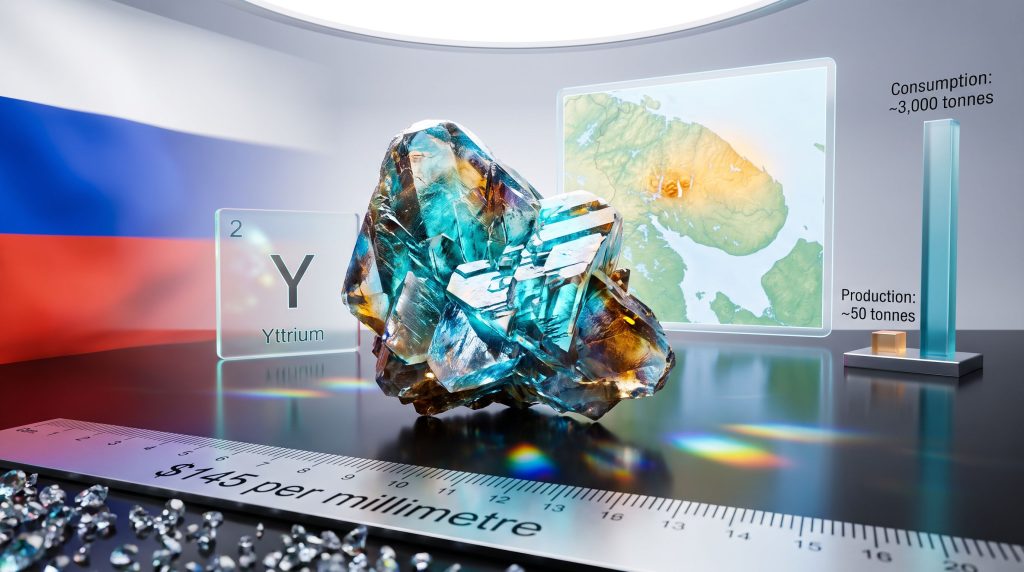
Russian officials have cited a surface coating valuation of approximately $145 per millimetre, a figure reportedly exceeding gold on a volume-equivalent comparison. This number has generated considerable media interest, but it deserves significant contextual qualification. Russian scientists have confirmed the mineralogical significance of this find, though market-ready conclusions remain premature.
Critical Caveat: Per-millimetre specimen valuations reflect the extreme rarity of a newly documented mineral, not a market-tradeable commodity price. This is fundamentally different from how gold, copper, or even refined rare-earth oxides are priced. Treating this figure as an investment-grade indicator would be a significant analytical error.
The mineral currently exists at Stage 1 of a five-stage commercialisation pathway. Movement through subsequent stages requires deposit-scale confirmation, processing feasibility trials, economic modelling, and ultimately capital-intensive development infrastructure. Each stage typically spans years to decades:
- Mineralogical Identification (current stage) — Laboratory confirmation, crystal structure mapping, and composition analysis
- Deposit Assessment — Systematic geological surveys to determine whether economically extractable concentrations exist
- Processing Feasibility — Laboratory and pilot-scale extraction and refinement testing
- Economic Modelling — Full cost-benefit analysis incorporating all capital and operational variables
- Commercial Development — Regulatory approvals, capital deployment, and infrastructure buildout
No confirmed commercial deposit of Kola Ashcroftine has been identified. Its significance in mineral markets is currently zero. Its significance as a scientific and geopolitical signal is considerably larger.
Russia's Rare-Earth Paradox: Rich in Reserves, Poor in Output
The Production-Consumption Gap Is Staggering
To understand why this discovery carries strategic weight, it helps to examine Russia's structural position in global rare-earth markets. Despite holding substantial estimated rare-earth reserves, placing it among the world's top nations by geological endowment, Russia's domestic production capacity is critically underdeveloped. Data cited by Reuters reveals a production-consumption imbalance that few outside the sector appreciate:
| Metric | Figure |
|---|---|
| Annual REE consumption (Russia) | ~3,000 tonnes |
| Annual REE production (Russia) | ~50 tonnes |
| Annual import dependency gap | ~2,950 tonnes |
This means Russia satisfies roughly 98% of its rare-earth consumption through imports, with the majority sourced from China. For a country positioning itself as a resource-sovereign power, this is a profound structural vulnerability. It also explains why domestic discovery announcements, regardless of their immediate commercial viability, carry disproportionate symbolic weight within Russian industrial policy narratives.
Why the Gap Persists Despite Geological Wealth
Several compounding factors explain why Russia's REE sector has remained underdeveloped relative to its geological endowment. In addition, the rare earth processing challenges that afflict many nations apply with particular force here:
- Historical energy priority: Decades of focus on oil and gas export revenues crowded out investment in critical mineral processing infrastructure
- Absence of vertical integration: Russia lacks the downstream rare-earth oxide and metal separation capacity that China has built over 30+ years
- Sanctions constraints: Western economic measures have restricted Russian access to foreign processing technology and international capital markets
- Limited downstream demand history: Without significant domestic rare-earth-intensive manufacturing, there was historically little commercial urgency to develop refining capacity
This final point is shifting. As Russia pursues domestic defence manufacturing and technology production, the demand case for domestically refined rare earths is strengthening, even if supply infrastructure remains years behind.
The Global REE Competitive Landscape: Where Russia Sits
| Country | REE Reserve Position | Processing Capacity | Current Strategic Status |
|---|---|---|---|
| China | Dominant | World-leading | Full supply chain control |
| USA | Significant | Rebuilding | Mid-chain import dependency |
| Australia | Large | Limited | Export-focused ore producer |
| Russia | Substantial | Underdeveloped | ~98% import dependent |
| India | Moderate | Emerging | Growing domestic focus |
China's advantage is not primarily geological. It is infrastructural and technical. China's rare earth strategy has resulted in Chinese companies controlling the majority of global rare-earth processing and separation capacity, meaning that minerals extracted in other countries frequently pass through Chinese refining infrastructure before reaching end markets. This processing chokehold is what Western governments are most urgently trying to replicate or circumvent.
Africa as the Primary Arena: Where the Real Competition Is Playing Out
Why African Minerals Have Become the Central Prize
While the Russia rare-earth mineral discovery in the Kola Peninsula is geologically interesting, the more consequential battleground for global critical mineral supply is across the African continent. The critical minerals demand surge has elevated Africa's geological endowment to the forefront of strategic planning. Africa holds reserves that dwarf what any single national geological discovery can offer:
- The Democratic Republic of Congo accounts for an estimated 70%+ of global cobalt reserves
- Tanzania, Malawi, South Africa, and Mozambique host significant rare-earth deposits at various stages of development
- The DRC-Zambia copper belt represents one of the world's most important concentrations of copper resources
- Guinea holds some of the planet's largest undeveloped bauxite deposits
- Multilateral economic assessments have placed Africa's aggregate critical mineral wealth in the trillions of dollars
China, the US, and Russia: Three Distinct Playbooks
Each of the three major powers pursuing African mineral access is deploying a meaningfully different strategic toolkit. The broader geopolitical minerals race playing out across multiple continents makes this African dimension all the more consequential:
| Dimension | China | United States | Russia |
|---|---|---|---|
| Primary instrument | Direct investment plus infrastructure financing | Offtake agreements and state-backed financing | Energy partnerships and security ties |
| Supply chain depth | Full, from mining through processing | Partial, primarily mining-stage | Limited, early-stage engagement |
| African presence | Extensive, multi-decade relationships | Growing rapidly | Selective, deepening in specific regions |
| REE-specific focus | High priority | High priority | Emerging priority |
| Processing capability | World-leading | Rebuilding domestically | Underdeveloped |
China's edge lies in its full supply chain integration. Its involvement in Africa encompasses direct mining investment, port and railway infrastructure financing, processing facility construction, and long-term offtake agreements. This depth of engagement creates dependency relationships that are difficult for African governments to unwind even when they wish to diversify.
The United States is competing primarily through financing mechanisms and offtake agreements, as reported by Reuters in February, deploying state-backed capital to rival Chinese investment in countries including the DRC, Zambia, and Guinea. The Lobito Corridor project, linking mineral-producing regions of the DRC and Zambia to Angola's Atlantic coast, has emerged as the most visible expression of this approach, explicitly designed to route critical minerals to non-Chinese markets.
Russia's strategy is distinct in its dual structure. Domestically, the Kola Ashcroftine discovery exemplifies an accelerated geological exploration programme. Externally, Moscow is expanding resource partnerships across Africa with a reach that now extends beyond traditional energy commodities. A $1.2 billion Russia-backed uranium project recently launched in Tanzania, and Russia has made moves to expand influence in uranium-producing Niger by advancing nuclear energy partnership proposals.
The Value-Capture Problem: Africa's Most Important Unresolved Question
For African nations, the intensification of external competition creates genuine but conditional opportunity. The critical analytical distinction is between access competition and structural leverage. More foreign investors competing for African mineral rights does not automatically translate into better outcomes for host nations.
The economic differential between raw ore and processed rare-earth compounds can exceed 10 to 100 times in value terms. African governments that export unprocessed ore capture only the lowest-margin segment of a value chain whose highest returns accrue to refiners and manufacturers, overwhelmingly located in China.
Policy Consideration: The variable that will determine whether Africa's critical mineral wealth generates lasting economic development is not the number of foreign powers competing for access. It is the structural terms that African governments can negotiate, specifically covering local processing rights, equity participation, technology transfer obligations, and domestic employment commitments.
Increasingly, African governments are demanding exactly these terms. This shift in negotiating posture fundamentally changes the economics of resource extraction agreements and creates a new risk calculus for foreign investors who assumed the old transactional model would persist indefinitely.
Arguments that greater foreign competition benefits African nations:
- Multiple competing investors give host governments greater negotiating leverage and alternative options
- Competing capital sources reduce dangerous dependency on any single foreign partner
- Infrastructure investment in ports, railways, and processing facilities generates broader economic spillovers
Arguments that competition does not automatically improve outcomes:
- Geopolitical rivalry can pressure governments to sign agreements quickly, potentially at the expense of long-term value optimisation
- Processing and technology transfer commitments are frequently promised but inconsistently delivered
- Security-linked resource partnerships can compromise sovereign decision-making on unrelated policy matters
What Kola Ashcroftine Signals Beyond Its Own Geology
Reading the Discovery as a Strategic Communication
In the current geopolitical environment, a domestic mineral discovery serves purposes that extend well beyond its immediate scientific value. For a nation navigating Western sanctions and seeking to position itself as a resource-capable technology partner for emerging economies, demonstrating active geological research capacity has diplomatic utility.
The multi-institutional nature of the Kola Ashcroftine discovery — drawing on expertise from three separate Russian scientific bodies — signals continued state investment in fundamental geological science. The Kola Peninsula's geological record underscores why this region remains one of Russia's most strategically important research zones. This matters because scientific credibility is itself a negotiating asset when Russia seeks resource partnerships with African governments evaluating competing offers from Chinese, American, and European counterparts.
The Yttrium Factor: Why This Particular REE Matters
Among the rare-earth elements, yttrium occupies a strategically important position that is often underappreciated by non-specialist observers. Its applications span:
- Phosphors in LED lighting and display technologies
- Yttrium-iron garnets used in microwave filters and radar systems
- Yttrium barium copper oxide (YBCO) superconductors with defence and medical imaging applications
- Yttrium-stabilised zirconia used in thermal barrier coatings for jet engines and industrial turbines
- Cancer treatment via yttrium-90 radioisotopes in targeted radiotherapy
The breadth of yttrium's application profile across defence, energy, and medical sectors means that any credible domestic source of yttrium-bearing mineralogy carries strategic interest regardless of immediate commercial viability. Consequently, the Russia rare-earth mineral discovery in the Kola Peninsula is likely to attract sustained institutional attention well beyond its initial announcement cycle.
The next major ASX story will hit our subscribers first
Key Takeaways for Investors and Policy Analysts
- Kola Ashcroftine is a scientific milestone, not a market catalyst. No commercial deposit has been confirmed, and the mineral's near-term impact on global REE supply is effectively zero
- Russia's 2,950-tonne annual REE import gap is structural and will not be resolved by a single geological discovery. Closing this gap requires decade-scale investment in processing infrastructure, not specimen-stage mineralogy
- The real competitive arena is Africa, where China maintains a commanding advantage through full supply chain integration that mining-stage competitors cannot rapidly replicate
- African agency is the defining variable in whether the global scramble for critical minerals generates development outcomes or simply replicates historical extraction patterns under new geopolitical branding
- Specimen valuations like $145 per millimetre are scientific curiosity metrics, not investment indicators. Readers encountering these figures in coverage of new mineral discoveries should apply significant analytical scepticism before drawing commercial conclusions
Disclaimer: This article is intended for informational and educational purposes only and does not constitute investment advice. Statements regarding mineral valuations, reserve estimates, and production forecasts involve inherent uncertainty. Readers should conduct independent research before making any investment decisions related to rare-earth elements, critical minerals, or related sectors.
Want to Identify the Next Major Mineral Discovery Before the Market Does?
Discovery Alert's proprietary Discovery IQ model scans ASX announcements in real time, instantly translating complex mineral data across 30+ commodities into clear, actionable insights — the same analytical edge that has helped subscribers capitalise on transformative discoveries like those made by De Grey Mining and WA1 Resources. Explore Discovery Alert's discoveries page to understand how historic mineral finds have generated substantial returns, and begin a 14-day free trial to position yourself ahead of the market.