August 13, 2026
The Processing Bottleneck That Defines Western Rare Earth Strategy
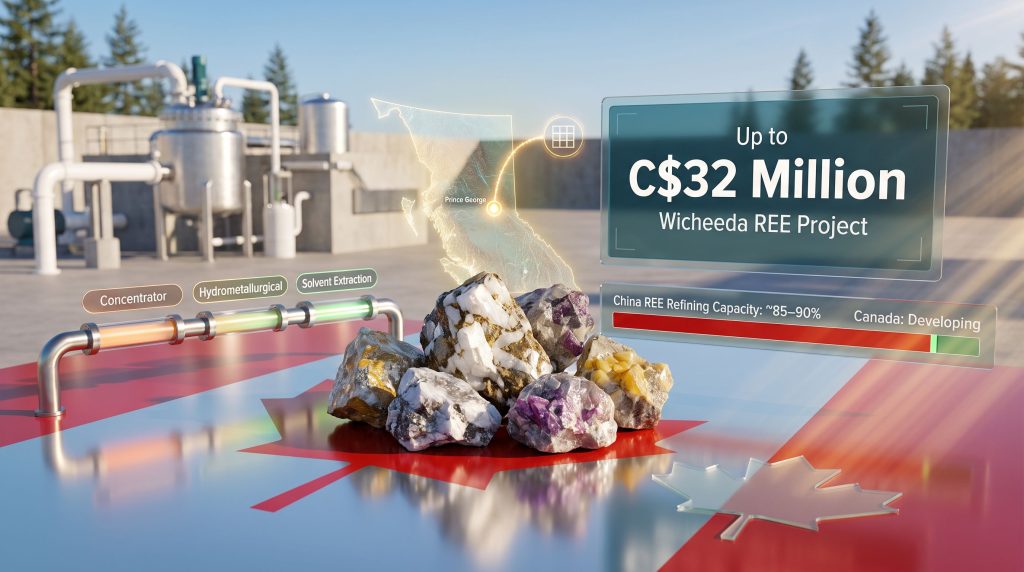
Rare earth supply chain security is not primarily a mining problem. The world has no shortage of rare earth deposits scattered across politically stable, resource-rich nations. The problem is what happens after ore comes out of the ground. Converting raw mineral concentrate into separated, purified rare earth oxides requires a highly specialised sequence of chemical processing steps that, at commercial scale, remains almost entirely concentrated in one country. Understanding rare earth supply chains is essential here: China controls an estimated 85 to 90 percent of global rare earth refining and separation capacity, a dominance built over decades of deliberate industrial policy and infrastructure investment.
For Canada, this reality creates a specific and uncomfortable vulnerability. The country holds significant undeveloped rare earth resources, but possesses virtually no domestic midstream processing infrastructure capable of converting those resources into the separated oxide streams that magnet manufacturers, defence contractors, and clean energy supply chains actually require. Addressing that gap is precisely where the NRCan Defense Metals Wicheeda proposal intersects with Canada's broader critical minerals ambitions.
When big ASX news breaks, our subscribers know first
Understanding Canada's Rare Earth Processing Gap
To appreciate why the Wicheeda feasibility programme matters, it helps to understand exactly where Canada's supply chain breaks down. Rare earth production involves three distinct and technically demanding stages:
| Processing Stage | Description | Canada's Current Capacity |
|---|---|---|
| Mining and Concentration | Physical extraction and separation of REE-bearing minerals from host rock | Limited but developing |
| Hydrometallurgical Processing | Chemical leaching to produce mixed rare earth compounds from concentrate | Near-absent at commercial scale |
| Separation and Refining | Solvent extraction to isolate individual rare earth oxides | Effectively non-existent domestically |
The midstream gap is the most strategically acute. A Canadian mining operation could theoretically produce rare earth concentrate and then be forced to ship it offshore for processing, recreating exactly the supply chain dependency that Western governments are trying to eliminate. Canada's critical minerals strategy has explicitly identified rare earth processing as a priority investment domain, recognising that in-ground resources alone do not constitute supply chain security.
Furthermore, what makes this challenge technically difficult — and therefore commercially interesting for projects that can credibly address it — is that hydrometallurgical processing and solvent extraction are not generic chemical engineering tasks. They require project-specific process chemistry development, tailored to the mineralogy of each individual deposit. A process flowsheet validated for one ore body may be entirely unsuitable for another. These rare earth processing challenges are a core reason why so few Western projects have reached commercial scale.
What Makes Wicheeda Technically Distinctive
Located approximately 80 kilometres northeast of Prince George, British Columbia, the Wicheeda Rare Earth Element Project covers an 11,800-hectare land package and is wholly owned by Defense Metals Corp (TSXV: DEFN). What separates Wicheeda from the broader universe of early-stage rare earth projects is the depth of process development work already completed, as detailed on the Wicheeda property page.
Most undeveloped rare earth deposits in North America have characterised their geology and perhaps completed preliminary metallurgical test work. Wicheeda has advanced significantly further, with technical work specifically targeting the concentrator circuit, hydrometallurgical processing, and solvent extraction stages. These are precisely the process steps that represent Canada's most critical capability gap, and they are also the most technically complex and capital-intensive components of any rare earth production system.
How Does the 2025 Pre-Feasibility Study Factor In?
A 2025 pre-feasibility study produced a mineral resource estimate for the property, though Defense Metals has been explicit that this estimate carries material uncertainties and that no certainty exists that its projections will be achieved. This level of disclosure is important context for any investor or analyst assessing the project's development trajectory.
The project's British Columbia location carries practical infrastructure advantages that are easy to underestimate. In March 2025, Natural Resources Canada provided up to C$853,825 through the Critical Minerals Infrastructure Fund to support feasibility studies for a proposed 46-kilometre transmission line connecting Wicheeda to the provincial power grid. Grid connectivity is not a peripheral consideration for rare earth processing. Hydrometallurgical operations are energy-intensive by nature, and reliable, affordable grid power is a prerequisite for any commercially viable processing facility. That earlier federal engagement with Wicheeda's infrastructure requirements establishes a foundation of institutional familiarity with the project.
How the NRCan Invitation Process Actually Works
The federal critical minerals funding pathway is structured and sequential, and understanding each step is essential to correctly interpreting the significance of the current NRCan Defense Metals Wicheeda development. The Advanced Materials Energy Defence call for proposals from NRCan outlines the broader programme context within which this invitation sits.
The process follows six distinct stages:
- Expression of Interest submission — Company provides a high-level project overview and rationale for federal support
- EOI assessment by NRCan — Evaluation of strategic alignment, technical credibility, and programme fit
- Invitation to submit a full project proposal — Issued only to projects that pass the EOI screening threshold (current stage for Wicheeda)
- Full proposal review — Detailed technical, financial, and environmental assessment
- Contribution agreement negotiation — Formal funding terms are negotiated and executed if the proposal is approved
- Milestone-based disbursement — Funds released against defined project milestones
Defense Metals has confirmed that NRCan's invitation is not a funding commitment. The binding threshold is the contribution agreement at Step 5. The EOI-to-full-proposal transition is a meaningful screening milestone, confirming that the project has passed initial eligibility and strategic alignment assessments conducted by NRCan. It is not, however, a guarantee of funding or a commercial endorsement.
"The distinction between a funding invitation and a funding commitment matters enormously for investors. Many junior mining companies have received expressions of federal interest that never translated into executed agreements. The critical path runs through full proposal review, contribution agreement execution, and then multiple further development stages."
The Scope of the Proposed C$32 Million Feasibility Programme
The full project proposal that Defense Metals is preparing will seek up to C$32 million in federal support through two NRCan programmes with distinct but complementary mandates:
- Critical Minerals Research, Development and Demonstration (CMRDD): Targets domestic technology readiness and process validation at the pilot-to-feasibility stage. Contributions under this programme are typically structured as non-repayable contributions against eligible costs, subject to milestone-based disbursement, matching co-investment requirements, and Canadian commercialisation conditions for any intellectual property developed.
- Global Partnerships Initiative (GPI): Focuses on international supply chain alignment and integration with allied nations, supporting projects with cross-border strategic relevance beyond purely domestic commercial considerations.
The proposed programme scope covers three integrated technical workstreams:
- Concentrator circuit development — Optimising the physical separation of REE-bearing minerals from host rock, which directly determines the quality and composition of concentrate fed into downstream processing
- Hydrometallurgical processing validation — Chemical leaching to extract rare earth compounds from concentrate, requiring deposit-specific process chemistry that must be validated at scale before a definitive feasibility study can be completed
- Solvent extraction development — The chemical separation stage that produces individual purified rare earth oxide streams, which is the most technically demanding step and the one with the least existing Canadian expertise
The output of this programme, if funded and executed, would be validated process data and engineering parameters suitable for incorporation into a definitive feasibility study. This is process validation infrastructure, not production infrastructure.
What Remains Between Wicheeda and Production
Even a successful outcome from the proposed feasibility programme would leave several substantial development milestones outstanding before any production decision could be made. Investors and industry observers should understand this critical path clearly:
- Completion of a full Definitive Feasibility Study incorporating validated process data from the feasibility programme
- Advancement through British Columbia's Environmental Assessment process under the BC Environmental Assessment Act
- Potential federal Impact Assessment Act review depending on project thresholds and trigger criteria
- Meaningful Indigenous consultation and accommodation with affected First Nations communities in the project area, a process that runs in parallel with technical work but carries its own timeline and complexity
- Securing project financing for construction and commissioning, which for a rare earth processing facility of meaningful scale would represent a capital commitment well beyond what federal feasibility funding addresses
- Execution of offtake or partnership agreements with downstream processors or end-users capable of absorbing separated rare earth oxide production
Each of these milestones carries independent timeline and execution risk. The progression from a federal funding invitation to a producing rare earth processing facility is a multi-year journey with numerous potential interruption points.
The next major ASX story will hit our subscribers first
The Geopolitical Dimension: Why Allied Nations Are Watching
The GPI component of the NRCan invitation reflects a dimension of the Wicheeda proposal that extends well beyond domestic Canadian industrial policy. Canada's Five Eyes partners and NATO allies have collectively identified rare earth supply chain security as a defence-critical priority, and recent actions by China restricting exports of certain rare earth processing technologies and compounds have accelerated allied-nation urgency around developing independent processing capacity.
The North American rare earth supply landscape is consequently shifting, with a Canadian midstream rare earth processing facility validated through a credible, federally-assessed feasibility programme representing exactly the kind of supply chain infrastructure that allied demand frameworks are designed to support. The Canada-U.S. Critical Minerals Action Plan and related bilateral cooperation mechanisms create a policy environment in which projects demonstrating processing-stage technical credibility carry strategic relevance that purely mining-stage projects do not.
This geopolitical context does not reduce the commercial and technical risks that Wicheeda still faces. However, it does help explain why projects capable of demonstrating processing feasibility — not just resource definition — are attracting a qualitatively different level of institutional attention than was the case even five years ago.
Key Considerations for Investors and Industry Observers
The NRCan Defense Metals Wicheeda proposal represents a genuinely meaningful development signal within the Canadian rare earth sector, but it must be interpreted with appropriate precision. Several points deserve particular attention:
- The invitation to submit a full project proposal confirms that Wicheeda's EOI passed NRCan's initial strategic and technical screening, a threshold that not all applicants clear
- The C$32 million funding target, if approved through a contribution agreement, would represent one of the more significant federal investments in rare earth processing technology validation in Canadian history
- CMRDD contributions are typically structured with co-investment requirements, meaning Defense Metals would need to demonstrate matching private capital alongside any federal contribution
- The 2025 PFS mineral resource estimate remains subject to material uncertainties, and no production economics should be treated as reliable projections at this stage
- British Columbia's regulatory environment, including both provincial environmental assessment and federal impact assessment processes, adds layers of timeline uncertainty that technical progress alone cannot resolve
"The distance between a federal funding invitation and a producing rare earth processing facility remains substantial. The current milestone is encouraging as a screening outcome, but the commercial inflection points lie considerably further along the development timeline."
Canada's rare earth processing deficit is real, strategically significant, and increasingly recognised at both federal and allied-nation policy levels. The NRCan Defense Metals Wicheeda proposal process is one of the more concrete expressions of federal intent to address that deficit through private-sector partnership. Whether that intent translates into an executed contribution agreement, and ultimately into validated processing infrastructure, will depend on outcomes that are still months of technical and administrative work away from resolution.
Readers seeking ongoing coverage of Canada's critical minerals policy and rare earth sector developments can explore reporting from the Canadian Mining Journal at canadianminingjournal.com.
Want to Stay Ahead of Significant Rare Earth and Critical Mineral Discoveries on the ASX?
Discovery Alert's proprietary Discovery IQ model delivers real-time alerts on significant ASX mineral discoveries — including rare earths and other strategic commodities — instantly translating complex geological data into actionable investment insights for both short-term traders and long-term investors. Explore how historic mineral discoveries have generated substantial returns on Discovery Alert's dedicated discoveries page, and begin your 14-day free trial today to position yourself ahead of the broader market.