
August 12, 2026
The Processing Bottleneck at the Heart of the Critical Metals Crisis
The global scramble for critical metals has exposed a problem that mines alone cannot solve. Even where deposits exist, the metallurgical infrastructure required to transform raw ore into usable metal is decades behind demand. Hydrometallurgical and pyrometallurgical processing routes, refined over a century of industrial practice, were designed for simpler, more consistent feedstocks. They were not built for the heterogeneous complexity of modern secondary materials, low-grade ores, or the politically inconvenient reality that much of today's refining capacity sits within a single country's borders.
This structural gap between what the world needs and what existing processing technology can economically deliver is precisely the environment in which Metallium Flash Joule Heating technology has emerged as a candidate for disruption. Furthermore, understanding the broader critical minerals demand landscape helps contextualise why this processing gap has become so urgent.
When big ASX news breaks, our subscribers know first
What Flash Joule Heating Actually Does — And Why It's Different
The Physics in Plain Terms
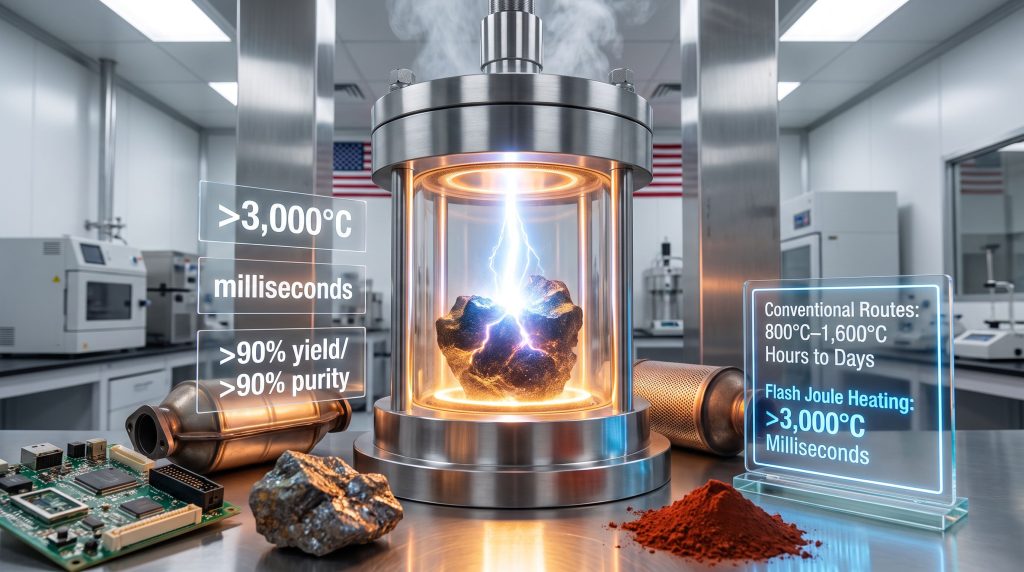
At its core, Flash Joule Heating (FJH) is a deceptively simple concept executed at extraordinary extremes. A high-voltage electrical current is passed directly through a resistive feedstock material. The material itself becomes the heating element. Its internal electrical resistance generates temperatures exceeding 3,000°C within milliseconds, a thermal regime that sits well beyond the operating envelope of any conventional industrial furnace.
The significance of this is not merely the temperature achieved, but the speed at which it is achieved and released. Conventional pyrometallurgical furnaces ramp up and sustain heat over hours or days. FJH delivers an extreme thermal shock and withdraws it almost immediately. This ultra-rapid thermal cycle creates conditions for selective phase transformation that simply do not exist in slower, sustained-heat processes.
At temperatures above 3,000°C, materials behave in ways that open entirely new separation pathways. Certain metal compounds volatilise, migrating away from the bulk feedstock matrix. Others remain behind in concentrated form. The result is a chemistry-driven separation mechanism that does not depend on large volumes of acid, extended leaching time, or complex upstream beneficiation.
Atmosphere Control: The Hidden Technical Differentiator
One aspect of Metallium Flash Joule Heating technology that receives less attention than the temperature figures is the role of atmospheric control within the reactor. By introducing specific gas environments during the heating cycle, the selectivity of the process can be tuned to target particular metals.
Under chlorination conditions, non-target metals such as iron and aluminium form volatile chloride compounds that migrate out of the residue. Target metals, particularly rare earth elements, remain concentrated in the remaining material as a high-grade chloride intermediate. This is not simply heating material to extreme temperatures and hoping for separation. It is controlled thermochemical engineering at millisecond timescales.
Research published through Rice University's FJH program, where the technology was originally developed, has reported yields exceeding 90% and product purities above 90% at laboratory scale when applying FJH-chlorination to rare earth magnet waste. These are laboratory-scale outcomes, and commercial-scale validation remains an active and critical development objective.
FJH vs. Conventional Processing: Key Metrics Compared
| Processing Parameter | Conventional Routes | Flash Joule Heating |
|---|---|---|
| Peak Temperature | 800°C to 1,600°C | Above 3,000°C |
| Heating Duration | Hours to days | Milliseconds to seconds |
| Front-End Beneficiation | Extensive (crushing, flotation, leaching) | Potentially minimal |
| Separation Mechanism | Chemical leaching or smelting | Thermal volatilisation and chlorination |
| Feedstock Flexibility | Typically feedstock-specific | Multi-feedstock capable |
| Emissions Profile | High (fossil fuel combustion) | Potentially lower (electrically driven) |
From Rice University to Commercial Reactor: The Technology's Origins
Academic Foundations and the Commercialisation Gap
FJH was pioneered at Rice University, initially as a mechanism for producing flash graphene from carbon-bearing materials. Researchers subsequently recognised that the extreme thermal conditions achievable through resistive heating had far broader applications across metal recovery from waste streams and low-grade ores.
Metallium holds a licence to deploy flash joule heating technology for metal recovery applications, representing a direct transfer from academic research into industrial development. This lineage matters for investors and industry observers because it carries both an advantage and a caveat. The advantage is that the scientific foundations of the process are grounded in peer-reviewed university research.
The caveat is that the distance between a controlled laboratory environment and a continuous commercial processing operation is substantial. The critical engineering challenges in this transition include reactor unit replication at scale, managing feedstock variability in real-world secondary materials, heat management across parallel units, and achieving consistent throughput rates that make the economics work at commercial volumes. Metallium has been running three reactor units simultaneously at its Texas development facility, a meaningful step toward demonstrating that the process can be parallelised, though this remains distinct from full commercial-scale continuous processing.
The Feedstock Universe: Where FJH Has Been Successfully Applied
Electronic Waste: The Primary Commercial Entry Point
E-waste is Metallium's stated near-term commercial priority, and the logic is straightforward. Global e-waste generation is estimated at 50 to 60 million tonnes per year, with formal recycling rates below 25% in most jurisdictions according to United Nations University research. The metal value density in e-waste, including gold, silver, copper, gallium, indium, and germanium, is significantly higher per tonne than most primary ore grades.
Regulatory pressure is simultaneously tightening around responsible e-waste disposal in North America, Europe, and key Asia-Pacific markets. Consequently, this creates both a feedstock availability signal and a compliance-driven motivation for industrial operators to seek processing solutions. In addition, the battery recycling process represents a closely related secondary materials opportunity that FJH could similarly address.
Rare Earth Ores: Simplifying the Front-End Flowsheet
Perhaps the most technically striking result in Metallium's recent development campaigns is the demonstration that FJH-chlorination can produce a high-grade rare earth chloride intermediate directly from raw, un-beneficiated ore. In conventional rare earth processing, this is not how the flowsheet works.
Standard practice requires multiple upstream steps before any meaningful separation can begin: crushing, grinding, flotation concentration, and chemical leaching. Each step adds capital cost, operating cost, and processing time. Compressing or eliminating the front end of the flowsheet would represent a meaningful economic advantage, though whether this holds at commercial scale remains to be validated independently. The rare earth processing challenges that have long constrained the industry make this potential simplification particularly significant.
Germanium from Industrial Waste Streams
Germanium is classified as a critical material across the US, EU, and allied nations, with supply chains heavily concentrated in China, which imposed export controls on germanium in mid-2023. The metal is essential for fibre optic cables, infrared optics, and certain solar cell architectures. Indeed, China's rare earth export restrictions have accelerated the search for alternative processing solutions across allied nations.
FJH testing has demonstrated recovery potential from germanium-bearing industrial waste streams that are currently under-utilised or discarded. The ability to recover germanium from secondary sources is particularly relevant given that primary germanium production is rarely economically standalone; it is almost always a by-product of zinc smelting, meaning supply is structurally constrained by zinc production rates rather than germanium demand.
Platinum Group Metals from Spent Catalytic Converters
Spent automotive catalytic converters represent one of the highest-value secondary materials streams by metal content, containing platinum, palladium, and rhodium. Current recovery relies predominantly on energy-intensive smelting, typically at facilities in South Africa, Belgium, and the United Kingdom.
FJH-based processing offers an alternative thermal pathway that could reduce the energy intensity and geographic concentration of PGM recycling infrastructure.
Red Mud: A 150-Million-Tonne Annual Problem
Red mud, the alkaline residue of aluminium refining from bauxite ore, is generated at approximately 150 to 180 million tonnes per year globally according to estimates from the International Aluminium Institute. It contains elevated concentrations of rare earth elements, iron, titanium, and aluminium, but its fine particle size, high alkalinity, and chemical complexity have made economic processing exceptionally difficult for decades.
FJH's capacity to handle heterogeneous, complex feedstocks without extensive pre-treatment positions it as a potential solution for red mud valorisation, a challenge that has attracted research interest globally without yielding a commercially deployed solution.
The Commercial Architecture: How FJH Reaches the Market
Owned Operations Plus Capital-Light Licensing
Metallium is pursuing a dual-track commercial model that reflects the different capital profiles of its potential markets. The first track is owned processing operations, with e-waste as the primary feedstock, providing direct exposure to metal recovery margins. The second track is technology licensing, where FJH technology is deployed into existing industrial or mineral processing operations without Metallium needing to construct and own the processing infrastructure itself.
The licensing model is particularly relevant for industrial operators who already manage complex feedstocks, such as smelters handling spent catalytic converter scrap or aluminium refineries dealing with red mud accumulation. Embedding FJH capability within an existing operation reduces deployment capital and allows faster market penetration. Furthermore, Metallium's completed licence agreement demonstrates that this commercial pathway is already being activated.
Demand-Pull Dynamics: Industry Is Approaching the Technology
A commercially significant detail in Metallium's recent announcements is that an increasing proportion of its testing campaigns are being initiated at the request of external industry participants. This demand-pull structure, where industrial operators bring their feedstocks to the technology seeking processing solutions, is a qualitatively different validation signal than a company seeking feedstocks to test its technology against.
It suggests that the technology's reputation within the processing industry is generating inbound commercial interest, though the critical next step is converting successful testing outcomes into binding commercial agreements with named counterparties. For instance, Metallium's successful multi-unit operations represent exactly the kind of milestone that builds industrial confidence in the technology.
Semiconductor Supply Chain Integration
Metallium Flash Joule Heating technology's engagement with Indium Corporation and major semiconductor industry suppliers on strategic sourcing initiatives for gallium, germanium, indium, and other technology metals positions FJH within one of the most geopolitically scrutinised supply chains currently operating. Semiconductor manufacturing is acutely exposed to supply disruptions for these materials, and the industry's interest in securing alternative upstream sources is structurally motivated rather than opportunistic.
Risk Factors Every Investor Should Understand
The Scale-Up Validation Gap
The most material risk associated with any university-origin processing technology is the gap between controlled pilot performance and continuous commercial throughput. Laboratory and pilot-scale results, even impressive ones, do not guarantee equivalent outcomes when feedstock variability increases, throughput volumes rise, and engineering tolerances are stress-tested over extended operating periods.
Key engineering challenges that remain to be fully demonstrated at commercial scale include:
- Consistent reactor performance across multiple parallel units with real, variable feedstocks
- Heat management and electrical system reliability at sustained commercial throughput
- Downstream integration of FJH-produced intermediates with conventional refining infrastructure
- Feedstock supply security and quality consistency over multi-year operational periods
Environmental and Regulatory Considerations
Chlorination-based high-temperature processing generates chloride by-products requiring careful environmental management. Permitting for facilities operating at these temperature regimes and using reactive gas atmospheres involves specific regulatory requirements that vary across jurisdictions. These are manageable considerations for a well-resourced operator but represent real timelines and costs in the development pathway.
Investor Note: The performance data publicly available for FJH technology is largely company-reported or derived from academic partnership research. Independent third-party validation of commercial-scale economics, throughput rates, and product quality specifications remains a critical due diligence item for any investor evaluating exposure to this technology.
The next major ASX story will hit our subscribers first
Where FJH Sits Among Competing Processing Technologies
| Technology Category | Examples | FJH Position |
|---|---|---|
| Conventional Hydrometallurgy | Acid leaching, solvent extraction | FJH requires less pre-processing; avoids large acid volumes |
| Conventional Pyrometallurgy | Smelting, roasting | FJH operates at higher temperatures with shorter cycle times |
| Biometallurgy | Bacterial leaching | FJH is faster; applicable to a wider range of feedstocks |
| Electrometallurgy | Electrowinning, electrorefining | FJH produces intermediates for downstream electro-refining |
| Emerging Thermal Processes | Microwave-assisted processing | FJH achieves higher peak temperatures; millisecond-scale heating |
Key Milestones That Will Define FJH's Commercial Trajectory
Investors and industry observers assessing Metallium Flash Joule Heating technology should monitor the following progression milestones:
- Transition to continuous commercial feedstock processing across multiple reactor units simultaneously, moving beyond inert-material parallel operation testing
- Execution of binding commercial agreements, whether technology licensing deals, processing services contracts, or feedstock supply agreements with named counterparties
- Independent third-party validation of metal recovery rates, product purity, and processing economics at pilot or commercial scale
- Progression of semiconductor supply chain partnerships from strategic sourcing discussions into formal commercial agreements with defined volumes and timelines
- Downstream integration milestones, confirming that FJH-produced intermediates meet the quality specifications required by solvent extraction or ion exchange separation systems
FJH Technology at a Glance
| Dimension | Detail |
|---|---|
| Technology Origin | Rice University (licensed to Metallium) |
| Core Mechanism | Electrical resistance heating above 3,000°C in milliseconds |
| Primary Feedstocks Tested | E-waste, rare earth ores, germanium waste, spent catalytic converters, red mud |
| Key Target Metals | Rare earth elements, germanium, gallium, indium, platinum group metals, gold |
| Commercial Models | Owned processing operations and technology licensing |
| Current Development Stage | Advanced pilot and early commercialisation |
| Key Performance Benchmark | Above 90% yield and above 90% purity at laboratory scale for REEs from magnet waste |
| Primary Near-Term Market | Electronic waste processing |
| Key Risk Factor | Commercial-scale continuous throughput validation with real feedstocks |
The deeper story behind Metallium Flash Joule Heating technology is not simply about one company's processing innovation. It reflects a broader structural reality: the critical metals supply chains that underpin energy transition, defence manufacturing, and semiconductor production cannot be secured through primary mining alone. Secondary processing, feedstock flexibility, and processing technologies capable of handling the complex, heterogeneous materials that conventional methods cannot economically address are becoming structurally necessary components of any credible supply chain strategy. Whether FJH proves to be that technology at commercial scale is a question that the next phase of development will answer.
This article is intended for informational purposes only and does not constitute financial advice. Readers should conduct their own research and consult a qualified financial adviser before making any investment decisions. Past performance and laboratory-scale results are not indicative of future commercial outcomes.
Want to Spot the Next Major Mineral Discovery Before the Market Does?
Discovery Alert's proprietary Discovery IQ model scans ASX announcements in real time, instantly identifying significant mineral discoveries across critical metals, rare earths, and beyond — converting complex data into clear, actionable opportunities for investors at every experience level. Explore historic discoveries and the substantial returns they generated, then begin your 14-day free trial at Discovery Alert to position yourself ahead of the market.