August 11, 2026
The Geological Rarity That Makes Carbonatite-Hosted Rare Earths So Strategically Valuable
Most people who follow the energy transition narrative focus on the demand side of the rare earths equation: how many electric vehicles will be produced, how many wind turbines will be erected, how much neodymium-praseodymium will be consumed. Far fewer stop to consider the supply side's fundamental geological constraint. Carbonatite-hosted rare earths deposits, the architecture that underpins the world's two largest producing rare earths mines outside China, are among the rarest igneous rock formations on Earth. Fewer than 600 carbonatite complexes have been identified globally, and only a small fraction of those host economically meaningful concentrations of rare earth elements alongside co-mingling critical minerals like niobium.
This geological scarcity is precisely why the St George Mining Araxá rare earths resource expansion announced in August 2026 carries strategic weight that extends well beyond the company's market capitalisation. The updated Mineral Resource Estimate (MRE) at the Araxá Project in Minas Gerais, Brazil, does not simply represent incremental tonnage growth. It repositions the deposit within a very short list of globally significant, hard-rock carbonatite rare earths projects that Western supply chain strategists, offtake partners, and project financiers are actively targeting as alternatives to Chinese production dominance.
Understanding why requires examining the deposit's geology, its resource confidence trajectory, its dual-commodity structure, and the three realistic development scenarios now open to St George Mining (ASX: SGQ).
When big ASX news breaks, our subscribers know first
What Makes the Araxá Deposit Structurally Distinct
The Carbonatite Architecture and the Barreiro Complex
Carbonatites are igneous rocks composed of more than 50% carbonate minerals, formed from unusually carbon-rich mantle melts that intrude into the crust under specific tectonic conditions. The Barreiro Carbonatite Intrusive Complex, which hosts the Araxá Project, is a classic example of this deposit style, sharing its fundamental geological architecture with Mountain Pass in California and Mt Weld in Western Australia, the two largest producing hard-rock rare earths mines outside China.
What distinguishes the Barreiro complex, and makes it particularly attractive from a development economics standpoint, is the near-surface weathering profile. Carbonatite intrusions in tropical and sub-tropical climates undergo intense chemical weathering over geological timescales, producing a soft, friable saprolite zone that can extend tens of metres to over a hundred metres below surface. At Araxá, all of the resource within the upper 120 metres sits within this weathered profile.
This is not a minor technical detail. Weathered carbonatite mineralisation is typically:
- Significantly softer than fresh rock, reducing grinding energy requirements and processing costs
- More amenable to conventional hydrometallurgical extraction pathways, including leaching-based rare earths separation
- Accessible via open-pit mining geometries that avoid the capital intensity of underground or deep open-pit operations
- Associated with residual enrichment processes that can actually concentrate rare earth-bearing minerals like monazite relative to the unweathered parent rock
The primary ore minerals at Araxá are niobium-bearing pyrochlore and rare earth-bearing monazite. The co-occurrence of both within the same weathered profile is a geological fingerprint of a high-quality carbonatite system and is one reason why Araxá's niobium inventory, at current resource grades, is independently material rather than a minor by-product.
Why Dual-Commodity Deposits Attract Fundamentally Different Capital
Most rare earths development projects carry a single primary commodity with minor by-products. Araxá's structure is, however, fundamentally different. The niobium content, at 0.57% Nb₂O₅ across the total resource, is large enough to generate standalone economic value, not merely offset processing costs.
Niobium's primary demand driver is high-strength low-alloy steel, where small additions of ferroniobium dramatically improve tensile strength, toughness, and weldability. According to the United States Geological Survey's Mineral Commodity Summaries, Brazil accounts for approximately 80 to 85 percent of global niobium supply, with the vast majority of that production concentrated in the Araxá district of Minas Gerais, where Companhia Brasileira de Metalurgia e Mineração (CBMM) operates the world's dominant niobium mine. (USGS Mineral Commodity Summaries 2024: Niobium)
For investors and offtake partners evaluating project economics, a deposit where niobium revenues can partially or fully fund rare earths processing infrastructure during ramp-up represents a materially different risk profile than a single-commodity rare earths project where revenue generation is entirely dependent on NdPr oxide pricing.
How the August 2026 Resource Upgrade Repositions Araxá Globally
Breaking Down the MRE Numbers and What They Actually Signal
The raw statistics of the August 2026 MRE upgrade are significant, but the strategic implications require unpacking the numbers rather than simply reporting them.
| Metric | March 2026 MRE | August 2026 MRE | Change |
|---|---|---|---|
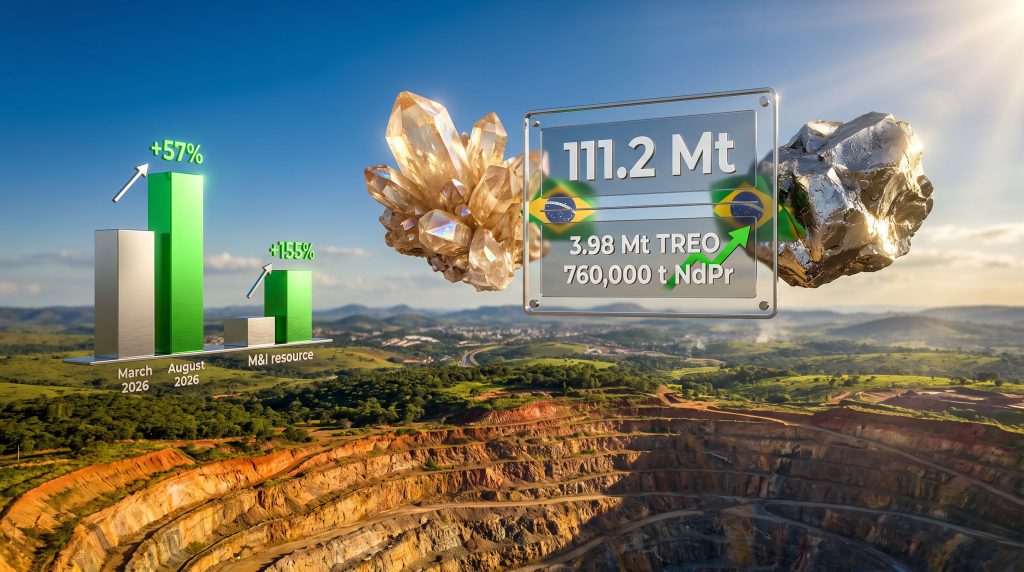
| Total Resource Tonnage | 70.91 Mt | 111.2 Mt | +57% |
| TREO Grade | 4.06% | 3.57% | Grade dilution from volume growth |
| Nb₂O₅ Grade | 0.62% | 0.57% | Consistent with volume expansion |
| M&I Resource (Mt) | ~29.5 Mt (est.) | 75.2 Mt | +155% |
| Total TREO Content | ~2.88 Mt (est.) | 3.98 Mt | Significant absolute uplift |
| NdPr Oxide Content | Not separately reported | 760,000 t | First standalone NdPr disclosure |
| Nb₂O₅ Content | Not separately reported | 630,000 t | First standalone Nb₂O₅ disclosure |
| M&I NdPr Oxides | Not separately reported | ~520,000 t | Higher-confidence inventory |
| M&I Nb₂O₅ | Not separately reported | ~440,000 t | World's largest undeveloped Measured Nb resource |
The headline 57% total resource increase is meaningful, but the figure that carries the greatest strategic weight is the 155% expansion in Measured and Indicated (M&I) resources to 75.2 million tonnes. This distinction matters because of how the JORC Code, which governs resource classification on the ASX, defines confidence levels:
- Inferred resources are based on limited data and carry significant geological uncertainty. They cannot be used as the primary basis for bankable feasibility studies or project financing.
- Indicated resources are supported by sufficient data to allow reasonable assumptions of grade and tonnage continuity, enabling their use in pre-feasibility and feasibility studies.
- Measured resources represent the highest confidence classification, with tight drill spacing and robust geological modelling, and form the foundation of Definitive Feasibility Studies and project finance packages.
When M&I resources grow by 155%, it does not simply mean more tonnes. It means that the project has crossed a fundamental threshold separating an exploration story from a development-stage asset capable of supporting bankable economic studies, mine scheduling, and formal financing discussions.
The High-Grade Subset: Early-Stage Cash Flow Optionality
Within the broader MRE, a higher-grade mineralisation envelope has been identified containing 830,000 tonnes of TREO at grades above 6.29% and 120,000 tonnes of Nb₂O₅ at grades above 0.90%. In open-pit mining, identifying a high-grade starter zone within the weathered profile has direct implications for early-year cash flow modelling.
High-grade starter pits allow operators to prioritise the most economically attractive ore in the initial years of production, generating revenue while the broader resource is progressively delineated and mined. In the context of Araxá's 120-metre weathered profile, a high-grade starter zone furthermore benefits from:
- Lower strip ratios, meaning less waste rock needs to be moved per tonne of ore processed
- Reduced pre-production capital expenditure relative to deeper or harder-rock operations
- Faster payback periods on initial capital, improving project-level internal rate of return metrics
Competitive Benchmarking: Where Araxá Sits Among Producing Peers
Araxá vs. Mountain Pass and Mt Weld
St George Mining's executive chair John Prineas has noted that the updated Araxá MRE compares increasingly favourably in both scale and grade to the world's two largest producing hard-rock rare earths operations outside China, both of which share the same carbonatite-hosted mineralisation style. (Proactive Investors, 11 August 2026)
| Deposit | Operator | Country | Style | Status | TREO Grade (approx.) |
|---|---|---|---|---|---|
| Mountain Pass | MP Materials (NYSE: MP) | USA | Carbonatite | Producing | ~7-8% TREO |
| Mt Weld | Lynas Rare Earths (ASX: LYC) | Australia | Carbonatite | Producing | ~8-9% TREO |
| Araxá | St George Mining (ASX: SGQ) | Brazil | Carbonatite | Development | 3.57% total; 3.64% M&I |
Araxá's grade sits below both producing peers on a percentage basis, but this comparison requires important qualification. Total contained metal is ultimately a more meaningful development-stage metric than grade alone, because it determines the total production capacity and revenue-generating life of a future operation.
At 3.98 million tonnes of contained TREO and 760,000 tonnes of NdPr oxides, Araxá's absolute metal content is now comparable in scale to both Mountain Pass and Mt Weld. Crucially, the geological profile at all three deposits is sufficiently similar that the processing pathways developed and refined at Mountain Pass and Mt Weld provide directly applicable technical analogues for Araxá's metallurgical programme. This is a significant de-risking factor that is rarely available to rare earths developers working with ionic clay (laterite) deposits, which have very different and often more complex processing characteristics.
The Niobium Claim That Institutional Capital Will Notice
The August 2026 MRE establishes Araxá as hosting the world's largest undeveloped Measured niobium resource, with approximately 440,000 tonnes of Nb₂O₅ in the M&I category. For institutional investors and project finance lenders, the Measured classification is the critical threshold. It is the confidence level at which resource tonnes can be directly incorporated into Definitive Feasibility Study mine plans and used to underpin debt financing from development banks and export credit agencies.
Given that CBMM's Araxá niobium operations represent the dominant global supply source, the proximity of St George Mining's project to established niobium processing infrastructure, an experienced regional workforce, and well-developed logistics networks is a genuine, verifiable location advantage. This positioning also reinforces the broader importance of rare earth supply chains in a world increasingly focused on critical minerals security.
Three Development Pathways Now Available to St George Mining
Scenario A: High-Grade Starter Operation
The most capital-efficient near-term pathway would prioritise the high-grade mineralisation envelope, targeting the 830,000-tonne TREO subset grading above 6.29% in the earliest mining phases. This approach:
- Minimises pre-production capital requirements by focusing on the highest-value, lowest-strip-ratio ore
- Generates early revenue to fund progressive expansion into the broader resource
- Reduces financing risk by shortening the payback period on initial capital
Scenario B: Integrated Full-Scale Operation
The second pathway develops the entire 111.2 million tonne resource as an integrated rare earths and niobium operation from the outset. This scenario maximises long-term net present value and total production volume, but requires higher upfront capital and a more complex financing structure. It is the pathway most aligned with the production volumes required to satisfy large-scale, long-term offtake arrangements from industrial partners seeking geographic diversification from Chinese supply chains.
Scenario C: Phased Expansion Anchored by East Araxá
The most strategically flexible pathway combines staged development of the main Araxá deposit with the progressive incorporation of the East Araxá discovery. High-grade intercepts already reported from East Araxá, including intersections of 207 metres and 199.5 metres of mineralisation, suggest the East Araxá zone could be material in its own right. A maiden MRE for East Araxá is targeted for Q4 2026, subject to drilling completion, assay turnaround, and geological modelling.
A phased scenario is particularly relevant given the A$60 million capital raise completed in mid-2026, which provides a funded runway for concurrent drilling, metallurgical test work, and feasibility study advancement without requiring near-term equity dilution or project-level debt.
Minas Gerais as a Mining Jurisdiction: Infrastructure and Context
The Araxá Project is located approximately 5 kilometres from the city of Araxá in Minas Gerais, one of Brazil's most established mining states. The immediate district context is important because Minas Gerais hosts not only CBMM's niobium operations but a broader network of mining-related infrastructure including:
- Paved road networks and established logistics corridors connecting to major Brazilian ports
- A skilled regional workforce with direct experience in carbonatite mineral processing
- Existing utility infrastructure capable of supporting industrial-scale operations
- A long regulatory history of commercial mining that provides relative permitting clarity compared to greenfield jurisdictions
Brazil's position as the holder of approximately 90% of known global niobium reserves (USGS Mineral Commodity Summaries 2024) also means that the Araxá region has developed institutional knowledge of niobium processing that is genuinely rare globally. From a project development standpoint, this reduces the technical risk associated with commissioning a new niobium processing circuit.
The next major ASX story will hit our subscribers first
Why NdPr Demand Creates a Structural Urgency for Projects Like Araxá
The Permanent Magnet Supply Chain and Its Concentration Risk
Neodymium-praseodymium oxides are the critical feedstock for NdFeB permanent magnets, which are the enabling technology for both EV traction motors and direct-drive wind turbine generators. China's rare earth strategy currently dominates not only rare earths mining but the downstream processing and magnet manufacturing supply chain, creating a structural concentration risk that governments in the United States, European Union, Japan, South Korea, and Australia have explicitly identified in critical minerals policy frameworks.
Araxá's 760,000 tonnes of NdPr oxide content, with 520,000 tonnes in the higher-confidence M&I category, positions the project as a potential future contributor to ex-China NdPr supply at a scale that matters. Western offtake partners and government-affiliated project finance vehicles have consistently expressed a preference for hard-rock carbonatite deposits when evaluating supply chain investment targets, primarily because:
- Carbonatite processing pathways are technically proven at scale via Mountain Pass and Mt Weld
- Grade consistency in carbonatite deposits is generally higher than in ionic clay systems, reducing processing variability risk
- The environmental profile of carbonatite operations is typically better understood and more manageable than certain ionic clay extraction methods
In addition, the rare earth processing challenges that have historically constrained new project development are considerably more manageable for carbonatite-hosted deposits with established metallurgical analogues, further strengthening Araxá's competitive positioning.
Development Milestone Tracker
| Milestone | Status |
|---|---|
| 57% resource upgrade to 111.2 Mt | Completed (August 2026) |
| A$60 million capital raise | Completed (mid-2026) |
| Worley appointed as feasibility technical advisor | Completed |
| East Araxá maiden MRE | Targeted Q4 2026 |
| Metallurgical test work and pilot plant programmes | Ongoing |
| Mine planning and economic studies | Advancing |
The appointment of Worley as feasibility technical advisor is a notable signal about the company's development ambitions and timeline. Worley is a globally recognised engineering and project management firm with deep experience in large-scale minerals processing projects. Its involvement at this stage of Araxá's development trajectory indicates that the transition from resource delineation to formal feasibility study work is an active, near-term objective rather than a distant aspiration.
Frequently Asked Questions: St George Mining Araxá Rare Earths Resource Expansion
What is the current size of the Araxá Mineral Resource Estimate?
The August 2026 MRE totals 111.2 million tonnes at 3.57% TREO and 0.57% Nb₂O₅, representing a 57% increase from the March 2026 figure of 70.91 million tonnes. The resource contains 3.98 million tonnes of total rare earth oxides, including 760,000 tonnes of NdPr oxides and 630,000 tonnes of Nb₂O₅.
Why is the 155% increase in Measured and Indicated resources more important than the total resource growth?
M&I resources have grown to 75.2 million tonnes at 3.64% TREO, 0.69% NdPr and 0.58% Nb₂O₅. Under the JORC Code, M&I classification is the threshold required for bankable feasibility studies, mine planning, and formal project financing discussions. Inferred tonnes, while contributing to the total resource, cannot carry the same weight in economic studies or debt financing packages.
What is the significance of the niobium resource at Araxá?
The updated MRE establishes Araxá as holding the world's largest undeveloped Measured niobium resource, with approximately 440,000 tonnes of Nb₂O₅ in the M&I category. This classification level is sufficient to underpin Definitive Feasibility Study mine plans, making it directly relevant to project finance discussions.
What is East Araxá and when will it be incorporated into the resource?
East Araxá is a separate discovery area outside the main deposit footprint, with high-grade intercepts including intersections of 207 metres and 199.5 metres of mineralisation already reported. A maiden MRE is targeted for Q4 2026, subject to drilling completion and geological modelling.
How does Araxá compare to Mountain Pass and Mt Weld?
All three deposits share carbonatite-hosted mineralisation. Mountain Pass and Mt Weld are currently producing; Araxá is in advanced development. Araxá's total contained TREO of 3.98 million tonnes and NdPr content of 760,000 tonnes position it as comparable in scale to both producing peers, while its shared geological architecture provides directly applicable processing analogues. Consequently, the mineral deposit tiers framework places Araxá firmly amongst the most strategically significant undeveloped carbonatite assets globally.
Key Strategic Takeaways for the Rare Earths Supply Chain
- Scale confirmation: At 111.2 Mt and 3.98 Mt of contained TREO, Araxá has crossed the threshold of global significance, not merely regional relevance
- Confidence uplift: The 155% increase in M&I resources is the more strategically decisive metric, enabling the next phase of development studies and financing discussions
- Dual-commodity resilience: The world's largest undeveloped Measured niobium resource within the same deposit envelope provides economic diversification and offtake optionality that most rare earths development projects cannot offer
- Open resource geometry: Mineralisation remaining open in all directions and at depth, combined with the pending East Araxá maiden MRE, means the current 111.2 Mt figure is unlikely to represent the terminal resource size
- Development readiness: The concurrent advancement of metallurgical test work, pilot plant programmes, and mine planning, supported by Worley as feasibility advisor and A$60 million in capital, marks a project transitioning from exploration into pre-development in practical, observable terms
The St George Mining Araxá rare earths resource expansion represents one of the most significant resource delineation milestones recorded by an ASX-listed rare earths developer in recent years. Furthermore, the major resource upgrade announcement details precisely why this project is now firmly on the radar of institutional capital and offtake partners seeking credible alternatives to Chinese rare earths supply.
This article contains forward-looking statements and references to forecasts, development timelines, and resource estimates that are inherently uncertain. Mineral Resource Estimates are not production targets. Readers should conduct their own due diligence and seek independent financial advice before making investment decisions. Proactive Investors has a commercial relationship with St George Mining Ltd.
Want to Stay Ahead of the Next Major Rare Earths Discovery on the ASX?
Discovery Alert's proprietary Discovery IQ model scans ASX announcements in real time, instantly identifying significant mineral discoveries — including carbonatite-hosted rare earths and critical minerals projects — and translating complex resource data into actionable investment insights for both short-term traders and long-term investors. Explore how historic discoveries have generated substantial returns on Discovery Alert's dedicated discoveries page, and begin your 14-day free trial today to position yourself ahead of the broader market.