August 11, 2026
The Quiet Revolution in Rare Earth Processing: Why Pilot-Scale Validation Changes Everything
Across the global critical minerals landscape, a fundamental shift is underway. Nations that once relied on single-source supply chains for rare earth elements are now actively cultivating domestic alternatives, driven by the strategic importance of rare earths to electric vehicle motors, wind turbine generators, and advanced defence systems. Yet for all the policy ambition and exploration activity that has followed, the most consequential developments rarely happen in the ground. They happen in processing facilities, where the gap between geological promise and commercial reality is either closed or exposed.
It is within this context that the Australian Rare Earths Koppamurra pilot processing program at ANSTO's Sydney facility deserves careful attention. Not simply as a corporate milestone, but as an illustration of how rare earth projects must evolve from benchtop chemistry to continuous, engineering-grade operation before investors, offtake partners, and financiers will commit serious capital.
When big ASX news breaks, our subscribers know first
Understanding Ionic Clay Rare Earth Deposits: A Different Kind of Resource
Most public understanding of rare earth mining centres on hard-rock deposits, where rare earth elements are locked within mineral structures such as bastnäsite or monazite and must be liberated through energy-intensive crushing, grinding, and chemical digestion. Ionic clay-hosted deposits represent a fundamentally different geology, and one that is increasingly attracting commercial interest for reasons that extend well beyond mineralogy.
In ionic clay systems, rare earth elements are not chemically bonded within mineral lattices. Instead, they are loosely adsorbed onto the surface of clay minerals, most commonly kaolinite and halloysite, through electrostatic attraction. This adsorption mechanism means the rare earths can be displaced and recovered using relatively mild leaching solutions, without the need for high-temperature roasting or concentrated acid digestion circuits that characterise hard-rock processing.
The practical implications of this distinction are significant:
- Lower processing energy intensity compared to hard-rock rare earth systems
- Ambient-temperature leaching reduces reagent and utility costs
- Shallower ore bodies typically allow for simple open-pit or even in-situ recovery approaches
- Capital requirements tend to be meaningfully lower than conventional milling circuits
- Environmental footprint is generally reduced due to lower chemical intensity
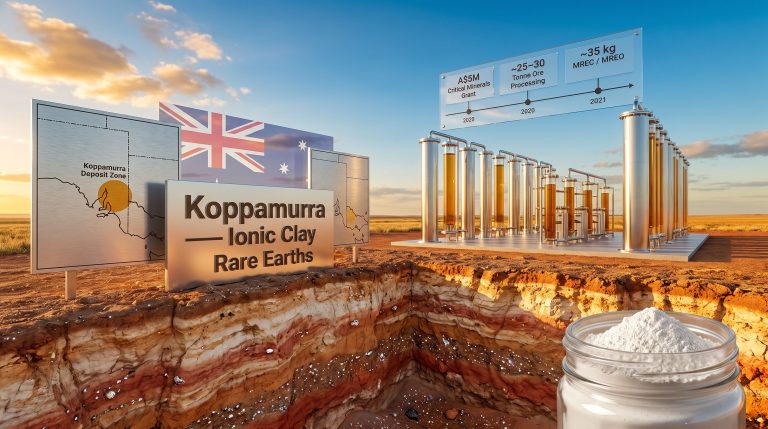
The Koppamurra project overview in South Australia sits within this ionic clay category, positioning it alongside a style of mineralisation that has been commercially developed most extensively in southern China, where ionic clay deposits have supplied a significant proportion of the world's heavy rare earth elements for decades.
Ionic clay deposits in China's Jiangxi Province have historically supplied the majority of global heavy rare earth elements, including dysprosium and terbium, which are critical for high-performance permanent magnets. Western ionic clay projects represent a genuine diversification opportunity for supply chains currently concentrated in a single jurisdiction.
The Koppamurra Process Flowsheet: From Raw Ore to Mixed Rare Earth Oxide
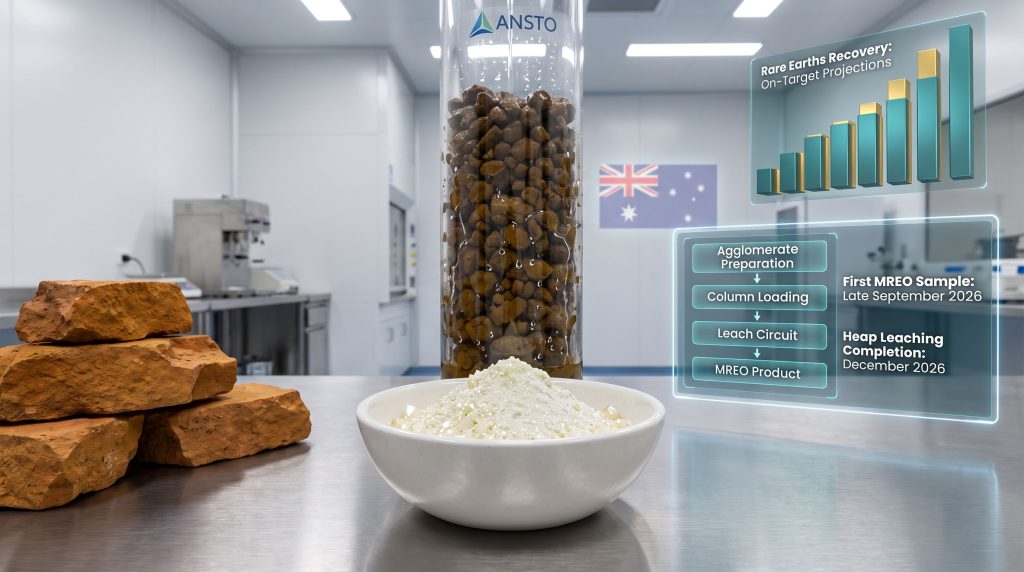
The processing approach being validated at ANSTO follows a logical sequence designed to maximise rare earth recovery while minimising capital intensity. Understanding this flowsheet is essential for assessing what the Australian Rare Earths Koppamurra pilot processing program is actually testing and what its successful completion means for project advancement.
| Process Stage | Description | Key Output |
|---|---|---|
| Agglomerate Preparation | Ore binding and physical preparation for heap leaching | ~940 kg agglomerates produced during commissioning |
| Column Loading and Irrigation | Lixiviant application at above-design flow rates | Validated irrigation approach with no flow degradation |
| Leach Circuit | Continuous pilot-scale leach operation | Rare earths recovery tracking in line with projections |
| Downstream Processing | Calcination and oxide conversion | Mixed Rare Earth Oxide (MREO) product |
The agglomeration step deserves particular attention because it is often underestimated in heap leach design. When fine-grained ionic clay material is stacked without prior agglomeration, preferential flow paths develop through the heap, reducing reagent contact with the ore and dramatically cutting recovery efficiency.
Producing 940 kilograms of stable agglomerates during commissioning, with no observed flow degradation during irrigation at above-design rates, confirms that the ore preparation methodology is sound at this scale.
This is not a trivial result. Clay-rich materials are notoriously problematic in heap leach environments. Their tendency to swell, compact, and restrict permeability has caused significant technical setbacks in other projects globally. Furthermore, the fact that Koppamurra material has demonstrated stable hydraulic behaviour under continuous operation is a meaningful technical validation.
ANSTO's Role: Purpose-Built Infrastructure for a Specialised Problem
The Australian Nuclear Science and Technology Organisation occupies a unique position in Australia's scientific infrastructure. As a Commonwealth research organisation with internationally recognised expertise spanning nuclear science, minerals processing, and advanced materials, ANSTO brings institutional credibility that is difficult to replicate in private-sector pilot facilities.
Critically, the pilot facility at ANSTO's Sydney campus was purpose-built for clay-hosted rare earth mineralisation, a design choice that reflects the growing recognition of ionic clay deposits as a distinct processing challenge requiring specialised infrastructure. Australian Rare Earths is the first industry partner to utilise this facility, which itself signals both the relative novelty of dedicated clay rare earth processing infrastructure in Australia and the project's readiness to engage with serious technical validation.
The advantages of using established third-party pilot infrastructure rather than constructing a proprietary pilot plant are worth articulating clearly:
- Reduced capital expenditure during the pre-feasibility phase, preserving balance sheet capacity
- Access to specialised expertise resident within ANSTO's technical teams
- Independent validation of process performance, which carries greater weight with potential offtake partners and project financiers
- Faster mobilisation by eliminating the need to design, procure, and commission a standalone pilot facility
- Engineering data quality generated through ANSTO's established instrumentation and process monitoring protocols
For a project seeking to build credibility with sophisticated institutional investors and industrial offtake partners, conducting pilot operations within a nationally recognised research facility adds a layer of technical authority that in-house testing simply cannot replicate. In addition, the rare earth processing challenges associated with clay-hosted mineralogy make this kind of independent validation especially valuable.
Technical Milestones: What the Commissioning Phase Actually Confirmed
The commissioning phase of any pilot program serves a specific purpose: confirming that the design basis holds under real operating conditions before the circuit transitions to continuous production mode. The results achieved at the Australian Rare Earths Koppamurra pilot processing program during commissioning established several important benchmarks.
Key commissioning outcomes:
- Production of 940 kg of agglomerates without structural degradation, confirming ore preparation methodology
- Successful column loading without operational disruption, validating the loading and irrigation configuration
- Irrigation rates achieved above design specifications, demonstrating process robustness that exceeds the engineering assumptions
- Rare earths recovery performance tracking in line with pre-commissioning projections, confirming the leach chemistry model
The significance of achieving above-design irrigation rates without flow degradation cannot be overstated for a clay-rich ore. In conventional heap leach operations with coarser, more permeable materials, this would be unremarkable. However, with ionic clay mineralisation, it represents a genuine technical achievement that reduces one of the primary scale-up risks for the project.
The transition from commissioning to continuous circuit operation represents the most important inflection point in pilot-scale testwork. Static batch tests can confirm chemistry; only continuous operation reveals how the system behaves over time, under sustained hydraulic loading, and through the natural variability present in real ore samples.
The MREO Sample: Why a Physical Product Changes Commercial Conversations
The first mixed rare earth oxide sample from the Koppamurra pilot program is expected in late September 2026. For observers focused on technical milestones, this may appear to be simply another data point. For those familiar with how rare earth supply chains actually function, it represents something considerably more significant.
Rare earth customers, whether rare earth processors, permanent magnet manufacturers, or advanced materials producers, do not enter binding commercial agreements based on assay results and flowsheet models alone. They require physical product samples to conduct their own independent metallurgical and purity assessments. This qualification process typically examines:
- Total rare earth oxide content and its consistency across production batches
- Rare earth distribution profile, particularly the proportion of magnet-critical elements such as neodymium and praseodymium
- Contaminant levels, including radionuclides such as thorium and uranium, which affect handling classification and downstream processing options
- Physical characteristics of the oxide product relevant to downstream dissolution and processing
The distribution of the MREO sample to potential offtake partners will initiate a qualification process that runs in parallel with the technical program. This parallelism is strategically important: it means that by the time the bankable feasibility study is advancing, the company may already have preliminary customer feedback on product quality, potentially accelerating the path to a formal offtake agreement.
Offtake agreements carry particular weight in the project financing context. Lenders evaluating debt facilities for critical minerals projects place considerable emphasis on contracted revenue streams as evidence that the product has a defined market at a known price structure. A qualified offtake partner effectively de-risks the revenue side of the project economics, which in turn influences the terms and availability of project finance.
The next major ASX story will hit our subscribers first
Timeline to Investment-Ready Outcome: A Structured Path Forward
The program's key milestones form a logical progression toward a bankable feasibility study and ultimately a final investment decision:
| Milestone | Target Date | Significance |
|---|---|---|
| Pilot operations commence; 30 t of ore prepared | Q2 2026 | Marks transition to engineering-grade data generation |
| Continuous pilot circuit operating | August 2026 | Time-series process data generation begins |
| First MREO product sample available | Late September 2026 | Customer qualification process initiated |
| Heap leaching activities completed | December 2026 | Active pilot phase concluded |
| Flowsheet finalisation and BFS advancement | Post-December 2026 | Investment-ready outcome targeted |
The December 2026 completion target for heap leaching activities is a natural boundary condition for the active pilot phase. What follows is the analytical and engineering work of translating continuous circuit data into the design parameters required for a bankable feasibility study, including lixiviant consumption rates at scale, reagent recovery efficiency, process water management requirements, and product purity specifications across sustained operation. Notably, AR3's pilot processing announcement outlines these progression steps in further detail.
Koppamurra in the Broader Australian Rare Earths Context
Australia has positioned itself as one of the most consequential jurisdictions for rare earth development outside of China, supported by a combination of geological endowment, established mining regulation, and proximity to the Indo-Pacific supply chains that are actively seeking alternatives to Chinese-dominated processing. Within this landscape, ionic clay projects occupy a distinct strategic niche.
Unlike the hard-rock rare earth projects that have attracted the most capital and attention, ionic clay deposits offer a development pathway characterised by lower upfront capital intensity, simpler processing chemistry, and faster timelines from resource definition to production readiness. These characteristics make them particularly relevant for supply chain participants seeking near-to-medium-term production volumes rather than decade-long development cycles.
The global context amplifies this relevance. China's rare earth export restrictions have intensified focus on supply chain diversification, particularly given that China currently controls an estimated 85 to 90 percent of global rare earth processing capacity. This concentration has repeatedly drawn attention from governments and industrial users across North America, Europe, Japan, and South Korea. Consequently, Australian ionic clay projects, with their capital-light development models and comparatively straightforward processing routes, represent a credible near-term contribution to diversification efforts, particularly for the magnet rare earths, neodymium and praseodymium.
The broader critical minerals demand surge further underscores why projects like Koppamurra are attracting serious attention from investors and policymakers alike. Furthermore, those seeking broader context on rare earth exploration insights will find that ionic clay systems are emerging as a priority focus across multiple jurisdictions.
Key Risk Factors Investors Should Monitor
While the Australian Rare Earths Koppamurra pilot processing program has delivered encouraging commissioning results, investors approaching this project should maintain a clear-eyed assessment of the risks that remain:
- Whether heap leaching activities are completed on the December 2026 schedule, given the sensitivity of clay materials to seasonal and hydrological variables
- The purity profile of the first MREO sample relative to customer specification thresholds, which will determine the speed and depth of offtake qualification discussions
- The timeline from pilot program completion to formal bankable feasibility study announcement, which depends on both internal engineering work and third-party data processing
- Broader rare earth price dynamics, particularly for neodymium-praseodymium, which will influence the economic assumptions underpinning the feasibility study
This article is intended for informational purposes only and does not constitute financial advice. Readers considering investment decisions in the critical minerals sector should conduct their own due diligence and seek independent professional advice. Forward-looking statements and timeline projections involve inherent uncertainty and actual outcomes may differ materially from those described.
Frequently Asked Questions: Koppamurra Pilot Processing
What is the Koppamurra rare earths project?
Koppamurra is an ionic clay-hosted rare earths deposit located in South Australia, being advanced by ASX-listed Australian Rare Earths. The project is targeting a capital-light development model using heap leaching and offsite processing through ANSTO's Sydney facility.
Why is the ANSTO pilot program significant?
The program validates Koppamurra's full processing flowsheet under continuous operating conditions, generates engineering-grade data for the bankable feasibility study, and produces physical MREO product samples for customer qualification — steps that cannot be replicated through laboratory-scale testwork alone.
How much ore is being processed?
Approximately 30 tonnes of Koppamurra ore has been prepared and is being processed through the continuous pilot circuit at ANSTO's Sydney facility.
When will the first rare earth oxide product be available?
The first mixed rare earth oxide sample is expected in late September 2026, after which it will be distributed to potential offtake partners for independent evaluation.
What is heap leaching and why is it suited to Koppamurra?
Heap leaching is a hydrometallurgical process where ore is stacked and irrigated with a lixiviant solution to extract target metals. It is well-suited to ionic clay rare earth deposits because it operates at ambient temperature, requires lower capital investment than conventional milling circuits, and is compatible with the adsorption-hosted mineralogy of clay systems.
What happens after pilot completion?
Pilot program outputs feed directly into flowsheet finalisation and advancement of the bankable feasibility study, targeting an investment-ready outcome for the Koppamurra project.
Want to Track the Next Major ASX Rare Earth Discovery Before the Market Moves?
Discovery Alert's proprietary Discovery IQ model delivers real-time notifications on significant ASX mineral discoveries — including critical rare earth announcements — translating complex geological and processing milestones into actionable insights for investors at every level. Explore historic discoveries and their exceptional returns, then begin your 14-day free trial to position yourself ahead of the market.