August 11, 2026
The Processing Gap That Separates a Rare Earth Discovery From a Rare Earth Business
In the global race to build rare earth supply chains outside of China, the most consequential bottleneck has never been the ore in the ground. It has always been the ability to transform that ore into a product that downstream manufacturers will actually buy. Across lithium, cobalt, and rare earths alike, the history of critical minerals development is littered with deposits that proved geologically sound but commercially stranded because the processing pathway was never properly validated.
This is precisely why the Australian Rare Earths Koppamurra pilot processing program, now underway at ANSTO's dedicated rare earth column leach facility, deserves careful attention from anyone tracking where Australia's critical minerals push is actually heading.
When big ASX news breaks, our subscribers know first
Understanding the Koppamurra Deposit and Why Deposit Geology Drives Everything Downstream
Ionic Clay Mineralogy: A Fundamentally Different Starting Point
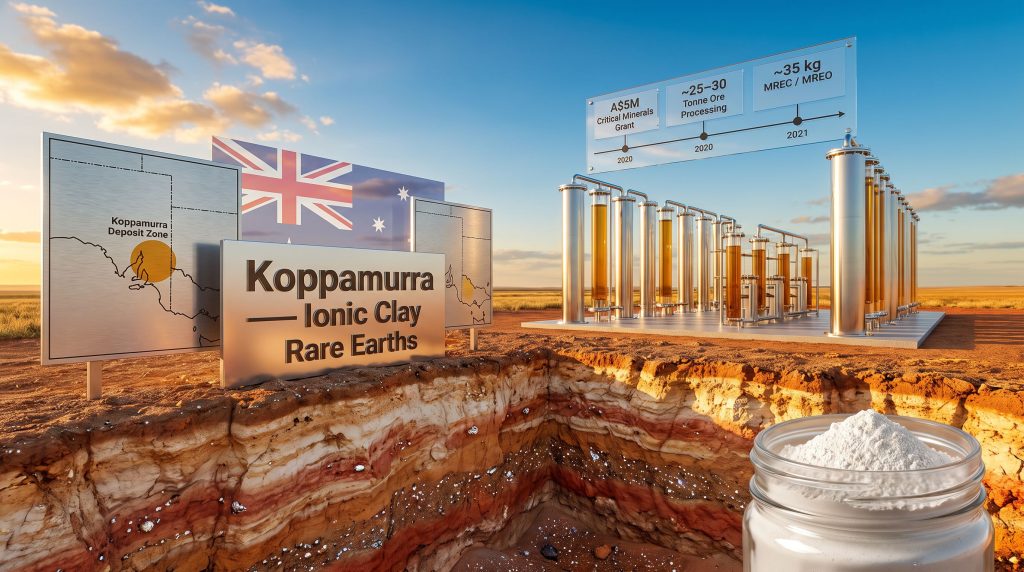
The Koppamurra project rare earth deposit sits on the border between South Australia and Victoria, a geography that offers meaningful logistical advantages for both domestic processing and future export. However, what makes Koppamurra technically distinctive is its deposit type: ionic clay-hosted rare earth mineralisation.
Unlike hard-rock rare earth systems, where rare earth elements are locked within the crystalline lattice of minerals such as bastnäsite or monazite, ionic clay deposits host rare earth ions adsorbed onto the surface of clay minerals, primarily halloysite and kaolinite. This adsorption chemistry is the critical point of difference. Because the rare earth elements are not chemically bonded within a mineral structure, they can be released using relatively mild leaching reagents at near-ambient temperatures, without the aggressive roasting, cracking, or flotation stages that hard-rock systems require.
This processing simplicity has significant economic implications:
- Lower reagent consumption relative to hard-rock flowsheets
- Reduced energy intensity across the extraction circuit
- Shorter hydrometallurgical processing chains before reaching saleable product
- Lower capital intensity for processing infrastructure at equivalent throughput scales
The ionic clay deposit type has been commercially proven at scale in southern China's Jiangxi Province for decades, but it remains largely underdeveloped outside of Asia. Koppamurra represents one of a very small number of ionic clay rare earth projects globally that has reached pilot-scale processing, which itself signals meaningful progress.
Where AR3 Sits in Australia's Critical Minerals Development Landscape
Australian Rare Earths Limited (AR3) is the operator of the Koppamurra project and has been advancing it through successive stages of technical validation. The project is not at the exploration stage. Furthermore, the company has completed earlier bulk sample work with ANSTO and generated proof-of-concept validation of the processing flowsheet before committing capital to the current, more substantial pilot program.
How ANSTO's Column Leach Facility Changes the Development Calculus
What Column Leach Piloting Actually Involves
The term pilot processing can mean very different things depending on the context. In this case, it refers to column leach piloting, a methodology that physically loads ore into large vertical columns and passes leach solution through the material under controlled conditions, closely replicating what would happen in a full-scale heap leach or tank leach operation.
The value of column leaching at pilot scale is that it captures phenomena that small-scale laboratory bottle roll or agitation leach tests often mask. These include:
- Permeability behaviour of the ore as column depth increases
- Channelling effects within the ore bed that reduce effective reagent contact
- Time-dependent reagent consumption profiles across an extended leach cycle
- Solid-liquid separation characteristics of the pregnant leach solution
- Reagent bleed-through and recovery at the column base
None of these variables can be reliably modelled from laboratory data alone. They require physical testing at a scale that generates statistically meaningful engineering data.
AR3's First-Mover Position at ANSTO's Rare Earth Pilot Facility
AR3 is reported to be the first industry partner to access ANSTO's newly commissioned dedicated rare earth pilot facility. This positioning matters beyond symbolic significance. Early access to specialised sovereign infrastructure means AR3 is generating proprietary process performance data at a stage when peer projects are still working at bench scale.
That data gap compounds over time: it feeds directly into DFS-level engineering design, reagent supply agreements, and the specifications that underpin offtake conversations. In addition, ANSTO's role as a national research institution also reduces the overhead cost of building pilot-scale infrastructure in-house, which for a junior developer could represent a capital commitment that materially affects its funding strategy.
The 25 to 30 Tonne Ore Batch: Why Scale Selection Is Not Arbitrary
Engineering Data Quality Is a Function of Sample Mass
The decision to process approximately 25 to 30 tonnes of Koppamurra ore is not simply a logistical convenience. It reflects the minimum mass required to generate statistically robust engineering data across multiple leach cycles while also producing enough mixed rare earth product to support customer qualification testing.
At this scale, the pilot program is designed to deliver two parallel commercial outputs:
- Process engineering data covering leach recovery rates, reagent consumption, residence time requirements, solid-liquid separation efficiency, and precipitation kinetics
- Approximately 35 kilograms of mixed rare earth product, either as mixed rare earth carbonate (MREC) or mixed rare earth oxide (MREO), for dispatch to potential downstream customers
The distinction between MREC and MREO is commercially significant. Mixed rare earth carbonate is a more straightforward precipitation product and is typically the first saleable form generated from a hydrometallurgical circuit. Mixed rare earth oxide requires an additional calcination step but commands broader applicability as a feedstock for separation facilities that produce individual rare earth oxides used in permanent magnets, catalysts, and phosphors.
The Development Stage Logic: How Each Phase Builds Commercial Confidence
| Development Stage | Activity | Primary Output |
|---|---|---|
| Early metallurgical testwork | Small-scale lab leach and precipitation | Initial flowsheet concept |
| Prior ANSTO bulk sample work | Smaller pilot MREC production | Proof-of-concept validation |
| Current pilot program (2026) | 25-30 tonne ore column leach processing | ~35 kg MREC/MREO + engineering dataset |
| Next stage | DFS engineering and cost modelling | Bankable project parameters |
Each stage serves a distinct de-risking function. The current program is materially larger and more integrated than the prior ANSTO work, reflecting the project's advancement toward a definitive feasibility study-ready status. Pilot operations commenced in August 2026, consistent with the Q2-Q3 2026 targeting that AR3 had previously indicated.
The A$5 Million Grant and What It Actually Represents
International Partnerships in Critical Minerals Program
The pilot program is partially funded through a A$5 million Australian Government grant under the International Partnerships in Critical Minerals Program. This funding stream is specifically designed to support projects that can contribute to allied-nation supply chains for critical minerals, reflecting the Australian Government's broader policy objective of building domestic processing capability rather than simply exporting unprocessed ore.
It is important to be precise about what this grant represents and what it does not. The funding supports the pilot processing program specifically. It does not constitute project approval, accelerated permitting, or any form of construction endorsement. It is co-investment in a technical validation program that serves both commercial and strategic objectives.
For AR3 as a junior developer, the grant serves a meaningful financial function: it reduces the equity capital required for the pilot program, which in turn limits dilution at a stage when the project's valuation is still being established by technical milestones rather than bankable economics.
Australia's Processing Sovereignty Ambition
Australia has historically been an exporter of rare earth concentrate rather than processed rare earth products. The gap between mining and processing represents significant value left offshore, and it has been a persistent vulnerability in allied supply chain planning. ANSTO's expanding role as a pilot processing partner for Australian rare earth developers is part of a broader effort to build domestic processing knowledge and infrastructure before commercial-scale operations are required.
Rare earth processing sovereignty matters not because Australia needs to replicate Chinese separation capacity overnight, but because demonstrating a credible domestic processing pathway changes the conversation with potential offtake partners and project financiers fundamentally.
The rare earth processing challenges involved in moving from concentrate to saleable product remain one of the most underappreciated hurdles facing Australian developers. Consequently, programs like the Koppamurra pilot carry significance well beyond a single project's commercial timeline.
Technical Risks That Will Define Whether the Pilot Delivers Bankable Data
The Four Variables That Matter Most
Pilot programs for ionic clay rare earth deposits carry specific technical risks that differ from those of hard-rock systems. Investors and technical observers should watch for the following:
- Leach recovery variability: Laboratory predictions of total rare earth recovery often diverge from column leach results because of clay mineralogy heterogeneity across the ore body. Consistent recovery rates across the full 25-30 tonne batch is the primary validation test.
- Reagent consumption profiles: Ammonium sulphate has historically been the leaching reagent of choice for ionic clay deposits in China, but its use carries environmental management considerations. Reagent consumption rates at pilot scale directly feed into operating cost modelling.
- Impurity management: The pregnant leach solution extracted from ionic clay ore contains not only rare earth ions but also aluminium, iron, and other metals that must be selectively removed before precipitation. How cleanly the circuit manages impurities at pilot scale determines product purity and ultimately price realisation.
- Solid-liquid separation efficiency: Clay-bearing ore tends to generate fine particles that complicate filtration and separation of the leach liquor. This is one of the most commonly underestimated bottlenecks in clay-hosted rare earth flowsheet design.
The Four Milestones That Signal Program Success
- Consistent leach recovery rates maintained across the full ore batch
- Production of on-specification MREC or MREO meeting customer qualification thresholds
- Sufficient engineering data captured to support DFS-level capital and operating cost estimation
- Validated liquor-to-product conversion efficiency through the precipitation and calcination steps
The next major ASX story will hit our subscribers first
How Koppamurra Compares Within Australia's Rare Earth Development Pipeline
Project Benchmarking at a Critical Juncture
| Project | Developer | Deposit Type | Current Processing Stage |
|---|---|---|---|
| Koppamurra | Australian Rare Earths (AR3) | Ionic clay | Pilot processing at ANSTO (August 2026) |
| Nolans | Arafura Rare Earths | Phosphate-hosted | Construction phase |
| Araxá | International developer | Carbonatite | Advanced development stage |
Arafura's Nolans project has received substantial government loan support and is progressing toward construction, making it the most advanced Australian rare earth project in terms of development stage. The Arafura rare earth offtake agreements already secured further underscore how critical commercial partnerships are at this stage of development. However, Nolans is a phosphate-hosted deposit requiring a substantially more complex processing circuit than an ionic clay system.
Koppamurra's processing simplicity advantage is real but not unlimited. Ionic clay deposits in Australia operate in a different regulatory and environmental context than those in China, where simpler reagent management standards have historically applied. Demonstrating environmentally acceptable processing performance at pilot scale is, consequently, as important as demonstrating technical recovery performance.
The Global Supply Chain Context Applying Pressure to the Timeline
China currently controls an estimated 85 to 90 percent of global rare earth processing capacity, a concentration that allied governments have identified as a critical vulnerability. Japan's recent move to establish its first rare earth supply partnership in Africa underscores the urgency with which consuming nations are pursuing diversification.
Australian projects that can demonstrate a credible pathway to producing processed rare earth intermediates, rather than just ore or concentrate, occupy a materially more attractive position in allied supply chain planning. The Australian Rare Earths Koppamurra pilot processing program, by targeting mixed rare earth oxide production at pilot scale, is positioning the project within the segment of the supply chain that downstream customers and allied governments most urgently need to develop outside of China.
What Comes Next and What Investors Should Be Watching
The Path From Pilot Results to Feasibility Engineering
Successful pilot outcomes feed directly into the DFS process through several specific data pathways:
- Reagent consumption rates become direct operating cost inputs for the processing plant model
- Leach recovery rates determine the revenue assumptions underpinning project economics
- Product purity data establishes the price realisation assumptions used in cash flow modelling
- Processing rate and solid-liquid separation performance drive plant sizing and capital cost estimation
Beyond the technical data, the approximately 35 kilograms of mixed rare earth product generated by the pilot serves an equally important commercial function. Rare earth buyers require qualification testing before entering binding offtake negotiations. The pilot product provides the physical material needed to initiate those conversations, which in turn creates the offtake term sheet pathway that project financiers require before committing debt capital.
Strategic Implications of a Successful Outcome
A pilot program that delivers consistent recovery rates, on-specification product, and comprehensive engineering data would significantly shift Koppamurra's risk profile in the eyes of both institutional investors and potential strategic partners. It would also position AR3 to commence DFS engineering with a validated flowsheet, rather than the provisional flowsheet assumptions that characterise projects at an earlier stage.
The combination of government grant co-investment, first access to sovereign pilot infrastructure, and a deposit type with inherent processing simplicity advantages creates a development pathway that is meaningfully de-risked compared to many peer rare earth projects. According to AR3's latest ASX announcement, the Australian Rare Earths Koppamurra pilot processing program reflects the company's commitment to advancing the project through rigorous technical validation. Whether the pilot results confirm the deposit's commercial potential will become clear as the program progresses through the second half of 2026.
This article contains forward-looking statements and analysis based on publicly available information. It does not constitute financial advice. Investors should conduct their own due diligence before making investment decisions.
Want to Stay Ahead of the Next Major ASX Critical Minerals Discovery?
Discovery Alert's proprietary Discovery IQ model delivers real-time alerts the moment significant mineral discoveries are announced on the ASX, transforming complex data across more than 30 commodities into clear, actionable insights for both traders and long-term investors. Explore Discovery Alert's discoveries page to see the historic returns major mineral discoveries have generated, then start your 14-day free trial at discoveryalert.com.au to position yourself ahead of the broader market.