August 11, 2026
The Hidden Materials Science Behind Mine Haulage Electrification
Every major technology transition eventually reaches a point where the underlying materials, not the engineering concepts, become the binding constraint. The electrification of heavy mine haulage is arriving at exactly that threshold. While headlines focus on battery capacity ratings, charging infrastructure costs, and fleet decarbonisation targets, the real performance story lives deeper inside the drivetrain — written in the atomic structure of a handful of rare earth elements that most procurement teams have never been asked to specify.
Understanding how electric mining trucks rare earth elements interact at a materials level is no longer an academic exercise. As deployment accelerates across all payload classes in 2025 and 2026, organisations that grasp the physics-to-performance chain — from magnet grade selection through to end-of-life reclamation — will be structurally better positioned than those still treating REEs as a procurement footnote.
When big ASX news breaks, our subscribers know first
How Electrification Rewires Open-Pit Haulage Operations
Diesel-powered haul trucks shaped every aspect of open-pit mine design for decades. Fuel storage facilities, ventilation shaft requirements for underground access, engine overhaul schedules, and refuelling logistics were all organised around the combustion cycle. Electric mining transport doesn't simplify operations so much as it relocates the complexity.
Where diesel haulage is constrained by fuel delivery, oil consumption, and exhaust management, electrified fleets are constrained by grid reliability, charging scheduling, thermal margin management across the drivetrain, and power demand peaks that must be managed against tariff structures. The operational pressure points shift, but they don't disappear.
OEM product roadmaps now cover three broad payload categories, each with distinct electrification architectures:
- 100 to 150 tonne class: Battery-electric configurations with onboard energy storage and MW-class fast charging infrastructure
- 200 to 240 tonne class: Hybrid battery and trolley-assist architectures that draw power dynamically from overhead lines on designated haul segments
- 290-plus tonne class: Emerging electrification approaches, including trolley-dominant configurations for sites where loaded haul grades are consistent and predictable
Greenfield mine designs are increasingly incorporating power studies and electrification infrastructure from the planning stage rather than retrofitting later. This shift matters because the drivetrain architecture chosen at the design stage determines, almost entirely, how rare earth intensive the fleet will be.
What Rare Earth Elements Actually Do Inside an Electric Mining Truck
Traction Motors: Where the Majority of REE Mass Is Concentrated
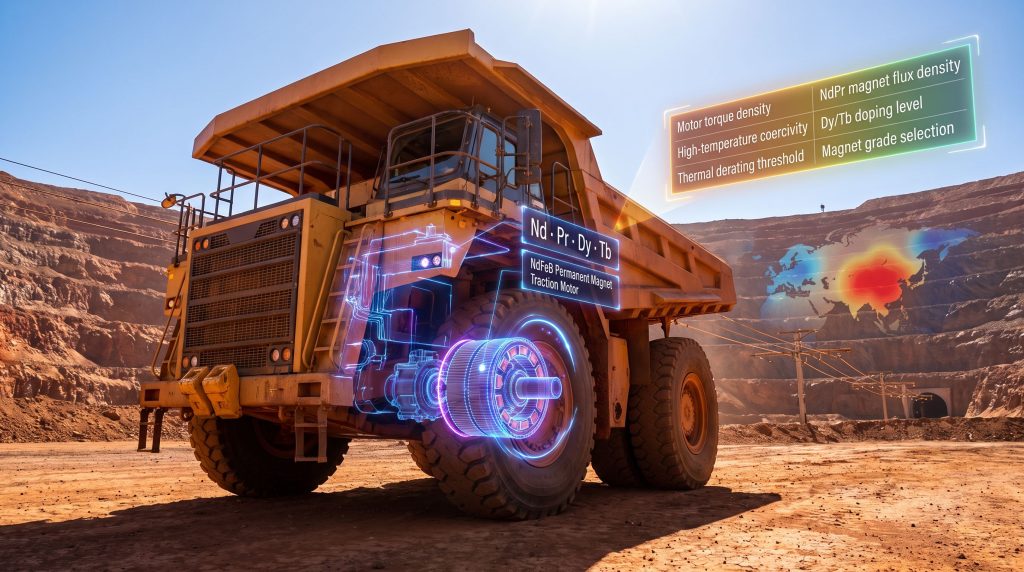
The permanent magnets inside traction motors represent the single largest concentration of rare earth material in an electric mining truck. These magnets are overwhelmingly neodymium-iron-boron (NdFeB) formulations, with neodymium (Nd) and praseodymium (Pr) serving as the primary magnetic elements. The IEA's critical minerals reporting and the USGS Mineral Commodity Summaries 2026 both confirm this elemental mapping as the dominant design choice across high-torque traction applications.
Two performance variables govern magnet selection for heavy traction: magnetic flux density, which determines how much force the motor generates per unit volume, and coercivity, which measures the magnet's resistance to losing its magnetism under heat and opposing magnetic fields.
On a loaded uphill haul, rotor temperatures in enclosed wheel motors can approach the limits of standard NdFeB grades. Manufacturers address this by adding dysprosium (Dy) or terbium (Tb) — heavy rare earth elements that raise the magnet's coercive force at elevated temperatures. A 220-tonne truck climbing a sustained 10% grade is essentially a real-world stress test for thermal coercivity performance.
If the magnet grade is undersized for the duty cycle, the motor controller activates thermal derating, automatically reducing power output and extending cycle times.
Procurement specifications that define acceptable thermal derating thresholds only after fleet deployment miss the most important intervention point. Thermal exposure definitions must be tied to measured site duty cycles before contract award.
When Samarium-Cobalt Replaces NdFeB
In subsystems where cooling airflow is severely restricted — such as tightly packaged e-axle assemblies or integrated generator units — samarium-cobalt (SmCo) magnets may be specified instead of NdFeB grades. SmCo magnets tolerate higher temperatures without demagnetising, but samarium is less abundant than neodymium and praseodymium, and material costs reflect that scarcity. ASM International materials handbooks document this design trade-off in detail, noting that SmCo selection is typically driven by thermal packaging constraints rather than performance preference.
Sensors, Encoders, and Rotor Position Feedback
Magnetic encoder assemblies, which often incorporate REE-enabled magnets, feed continuous rotor position data to the inverter. This feedback loop enables precise torque delivery, reduces tyre slip on variable haul road surfaces, and improves traction stability during incline starts. Encoder degradation over time introduces position error, which manifests as torque instability and increased variability in cycle times — a performance degradation that can be difficult to attribute without detailed drivetrain telemetry.
Display Phosphors, LED Backlighting, and Cab Safety Systems
Yttrium (Y), europium (Eu), and terbium (Tb) appear as phosphor components in ruggedised cab displays, alarm indicators, and LED lighting systems. The mass contribution from phosphors is smaller than from traction magnets, but the operational consequences of display failure in a dusty, vibration-heavy mine environment carry direct safety implications. U.S. Department of Energy solid-state lighting materials briefings document these phosphor compositions as the basis for stable colour rendering and brightness consistency across wide temperature ranges.
Upstream Manufacturing Inputs: Cerium and Lanthanum
Cerium (Ce) and lanthanum (La) appear in the manufacturing bill of materials even though they are not visible in the finished truck. Ce-based polishing compounds are used in the precision finishing of optical components, and both elements play roles in certain catalyst or additive applications during component manufacturing. Their presence upstream means mine operators indirectly consume these elements through every motor and display unit, even without explicit specification.
The Physics-to-Performance Connection
The relationship between REE selection and truck productivity is direct and measurable. The table below maps each REE dependency to the operational variable it governs:
| Performance Variable | REE Dependency | Operational Impact |
|---|---|---|
| Motor torque density | NdPr magnet flux density | Payload capacity per unit drivetrain mass |
| High-temperature coercivity | Dy/Tb doping level | Sustained power on long uphill hauls without derating |
| Rotor position accuracy | REE encoder magnets | Traction control on wet or loose haul roads |
| Display readability | Y/Eu/Tb phosphors | Operator visibility during dust events and night shifts |
| Thermal derating threshold | Magnet grade selection | Cycle time consistency under peak ambient heat |
Thermal derating deserves special attention because it is the mechanism through which magnet grade choice becomes a productivity variable. When rotor temperatures exceed design limits, motor controllers reduce power output automatically. On sites with high ambient temperatures, steep grade profiles, or restricted motor cooling, the frequency and severity of derating events can differ substantially between magnet grades — even where nameplate power ratings are identical.
From Ore Body to Finished Magnet: The REE Supply Chain
The path from rare earth ore to a functioning traction motor involves ten distinct manufacturing steps, each with its own quality control requirements and potential for delay. Furthermore, understanding the rare earth supply chains that underpin these steps is essential for any procurement team managing fleet risk:
- Mining and concentration — Hard-rock or ion-adsorption clay ore is extracted, crushed, and upgraded into mineral concentrate
- Chemical separation — Solvent extraction circuits isolate individual rare earth oxides, including NdPr oxide and Dy oxide, from mixed concentrate streams
- Metal reduction and alloying — Oxides are reduced to metals and blended into magnet-grade alloys with precise compositional control
- Powder preparation and pressing — Alloy is milled to fine powder, pressed into green compacts, and prepared for sintering
- Sintering and heat treatment — High-temperature consolidation produces dense magnet blocks with target magnetic properties
- Protective coating application — Corrosion-resistant coatings protect magnets from moisture, abrasion, and chemical exposure
- Precision machining — Magnet blocks are machined to dimensional tolerance for rotor subassembly
- Rotor assembly — Machined magnets are assembled into rotor configurations and checked for balance
- Motor-level testing — Demagnetisation margin, rotational balance, and thermal performance are validated before drivetrain integration
- Truck assembly and end-of-line validation — Integrated drivetrain and display systems are validated against site-specific duty cycle specifications
Critical Chokepoints Procurement Teams Must Understand
- Heavy REE separation complexity: Dy and Tb require multi-stage solvent extraction with high-purity output requirements. Capacity constraints here propagate directly into motor lead times, as documented in IEA critical mineral supply chain analyses.
- Magnet-grade sintering: This IP-sensitive, narrow-tolerance step can become a bottleneck independent of oxide availability — a risk well recognised in critical minerals industry literature.
- Heavy REE structural scarcity: Dy and Tb are geologically and geographically less abundant than light REEs. Motor specifications requiring high Dy/Tb content face structurally tighter supply and greater price volatility, as detailed in USGS Mineral Commodity Summaries 2026.
- Coating integrity in mining environments: Wet, abrasive, and chemically aggressive conditions make coating failure a practical operational risk. Failures can cascade into rotor imbalance and unplanned motor service events.
- Geographic concentration: China holds a dominant share of global rare earth separation capacity and sintered magnet production — a risk consistently documented in IEA critical minerals assessments.
Vendors should be required to declare magnet grade, coating specification, supply continuity guarantees, and acceptable substitute grades during qualification — not after contract award.
Quantifying the Rare Earth Footprint of Electric Mining Trucks
| Subsystem | Primary REEs | Relative Mass Contribution | Key Performance Role |
|---|---|---|---|
| Traction motors (permanent magnets) | Nd, Pr, Dy, Tb | Highest | Torque generation and thermal stability |
| Auxiliary motors (steering, cooling fans) | Nd, Pr | Moderate | Ancillary system reliability |
| Rotor position sensors and encoders | REE magnet alloys | Low | Inverter control accuracy |
| Cab displays and LED indicators | Y, Eu, Tb | Low | Operator visibility and safety |
| Manufacturing inputs (upstream) | Ce, La | Trace | Optical polishing and process chemistry |
Energy consumption benchmarks for electric haul trucks vary significantly by duty cycle. The key variables are grade profile, payload, altitude, and ambient temperature — with field study ranges reported at SME and CIM conferences in 2025 and 2026 spanning measurable differences in kilowatt-hours per tonne moved depending on site conditions.
The most operationally meaningful performance benchmarks are cost per tonne moved and truck availability rates, not nameplate battery capacity or range. Dispatch strategy, charging queueing efficiency, and haul-road variability dominate realised performance far more than laboratory specifications.
The next major ASX story will hit our subscribers first
Engineering Innovations Reducing Rare Earth Dependency
Grain-Boundary Diffusion: Achieving More With Less Heavy REE
One of the most significant near-term supply risk mitigations available to motor manufacturers is grain-boundary diffusion — a technique that concentrates Dy or Tb at magnet grain surfaces rather than distributing them uniformly through the bulk material. By targeting the heavy REE precisely where coercivity enhancement is needed most, manufacturers can achieve comparable thermal performance with substantially less Dy or Tb content. IEA materials notes and industry technical literature consistently describe this as among the most impactful process-level innovations currently scaling toward wider commercial adoption.
Alternative Motor Architectures
Not every application of electric mining trucks rare earth elements need follow the same design path. Two alternative architectures exist:
- Induction motors eliminate NdPr magnet requirements entirely but carry efficiency and mass penalties in high-torque traction applications where space and thermal margins are constrained
- Electrically excited synchronous motors remove permanent magnets through electromagnetic excitation, but introduce excitation system complexity and packaging trade-offs that can limit deployment in weight-sensitive applications
For the highest-demand traction applications, permanent-magnet designs currently retain the torque density and efficiency advantages that justify their REE intensity. The competitive balance may shift as alternative architectures mature.
Recycling Infrastructure as Secondary Supply
Magnet recycling processes — including hydrogen decrepitation and hydrometallurgical recovery — are moving from pilot scale toward early commercialisation. The U.S. Department of Energy and EU critical materials programmes are tracking this scale-up trajectory closely. For fleet planners, formalising recycling contracts and end-of-life take-back agreements now creates access to secondary REE feedstock that can meaningfully reduce exposure to primary supply volatility over a five to ten year fleet lifecycle.
Geopolitical Risk and the REE Supply Chain
The geographic concentration of rare earth processing is not a theoretical risk. Rare earth geopolitics increasingly shape how procurement teams approach vendor qualification and supply chain due diligence. China holds a dominant share of global separation and sintered magnet production capacity — a fact consistently documented in IEA critical minerals assessments and USGS Mineral Commodity Summaries 2026.
Export controls, sanctions compliance frameworks, and origin-tracing requirements are entering procurement due diligence processes with increasing regularity, particularly for heavy REEs and finished magnet components where supply chain transparency is structurally harder to achieve.
Policy responses active in 2025 and 2026 across the United States, European Union, Canada, and Australia include critical minerals funding programmes, permitting reform initiatives, and recycling incentives. However, these measures do not resolve near-term bottleneck risks in separation and magnet manufacturing capacity. The gap between policy intent and midstream processing capacity remains the critical variable for procurement teams to monitor.
In addition, the broader critical minerals demand driven by the global energy transition continues to intensify pressure across the entire REE midstream. Understanding this context is essential for any organisation managing long-term fleet procurement risk. Consequently, the battery metals landscape is also shifting rapidly, with investor and policy attention converging on the same supply bottlenecks that affect traction motor components.
Furthermore, as analysts at Rare Earth Exchanges have noted, electric haul truck procurement is increasingly entangled with REE sourcing strategy — a dynamic that procurement teams can no longer treat as separate workstreams.
Building a Rare Earth-Aware Procurement Specification
What to Request During Vendor Qualification
- Bill-of-materials declaration by subsystem, including magnet grade, REE composition, and coating specification
- Thermal derating curves tied to measured duty-cycle heat loads at the intended site, not laboratory assumptions
- Supply continuity documentation covering primary and alternate magnet suppliers and geographic origin of REE inputs
- Coating qualification data matched to the specific moisture, abrasion, and chemical exposure profile of the target mine environment
- Charge acceptance performance data across the full ambient temperature range of the operating site
End-of-Life Planning: Formalising Before Deployment
- Warranty terms that define responsibilities for motor refurbishment and magnet reclamation
- Take-back clauses specifying recycling partner qualifications and environmental compliance documentation
- Battery end-of-life pathways covering second-life stationary storage eligibility criteria versus direct recycling routing
- Documentation requirements for REE recovery chain-of-custody compliance
Frequently Asked Questions: Rare Earth Elements in Electric Mining Trucks
Are Rare Earth Elements Essential in Every Electric Mining Truck Design?
No. Permanent-magnet motors that rely on NdFeB and related formulations are the dominant choice for high-torque, thermally constrained traction applications, but induction and electrically excited synchronous motor designs exist that reduce or eliminate REE dependence. The trade-off involves efficiency, mass, and packaging complexity. REE intensity varies substantially by drivetrain architecture and payload class, which is why bill-of-materials disclosure should be part of any vendor qualification process.
Which Rare Earth Elements Are Present in the Largest Quantities?
Traction motor magnets — primarily containing Nd, Pr, Dy, and Tb — represent the dominant REE mass in a truck. As z2data's supply chain analysis highlights, rare earths are becoming the greatest chokepoint in EV-adjacent supply chains. Auxiliary motors contribute moderate quantities of Nd and Pr, while sensors and display phosphors containing Y, Eu, and Tb contribute smaller amounts. Exact quantities require bill-of-materials disclosure from OEMs rather than reliance on industry-average estimates.
How Does Heavy REE Scarcity Affect Truck Lead Times?
Separation and sintering capacity for Dy and Tb are structurally constrained and geographically concentrated. Shortages at these midstream steps propagate directly into motor and component lead times, independent of raw ore availability. Mitigation approaches include dual sourcing, critical spares stocking, and pre-qualifying alternate magnet grades before supply disruptions occur.
What Is Thermal Derating and Why Does It Matter?
Thermal derating is the automatic reduction of motor power output that occurs when component temperatures exceed design limits. On high-temperature sites with steep grade profiles, derating events can extend haul cycle times significantly and reduce tonnes moved per shift. The magnet grade, cooling architecture, and duty-cycle heat load definition together determine how frequently and severely derating occurs in practice.
What Happens to Rare Earth Magnets at End of Life?
Motor refurbishment and magnet reclamation pathways exist, with REE recovery processes including hydrogen decrepitation and hydrometallurgical approaches currently scaling toward broader commercialisation. Battery end-of-life options include second-life stationary storage and direct recycling, depending on battery condition and local regulatory frameworks. Procurement teams that formalise these pathways through warranty terms and take-back clauses before deployment are better positioned for cost recovery and compliance.
How Are Mining Companies Managing Geopolitical Risk in REE Supply Chains?
Multi-source magnet qualification, geographic diversification of magnet supply, and recycling feedstock contracts are the primary operational strategies currently in use. Policy-supported diversification programmes in the United States, European Union, Canada, and Australia are developing alternative processing and manufacturing capacity. However, lead times for new midstream facilities mean near-term risk reduction depends on procurement-level strategies. Consequently, understanding the full scope of electric mining trucks rare earth elements dependencies — from ore body through to finished drivetrain — remains the most actionable starting point for any procurement team operating in this environment.
Want to Know Which ASX Companies Are Making the Next Major Mineral Discovery?
Discovery Alert's proprietary Discovery IQ model delivers real-time alerts the moment significant ASX mineral discoveries are announced — including across the critical and rare earth minerals driving the electrification of heavy industry — turning complex data into actionable insights for both short-term traders and long-term investors. Explore Discovery Alert's dedicated discoveries page to see how historic ASX discoveries have generated substantial returns, and start your 14-day free trial today to position yourself ahead of the market.