August 10, 2026
The Element That Cannot Be Replaced: Why Scandium Is Becoming the West's Most Urgent Supply Problem
Most metals become important because of scale. Iron, copper, aluminium, lithium: each commands attention proportional to the millions of tonnes consumed annually across global industry. Scandium operates by entirely different logic. Its market is measured in tens to low hundreds of tonnes per year, yet its absence from critical technology supply chains would be catastrophic in ways that no substitute material can prevent. Understanding this inversion of conventional importance is the starting point for understanding why the Sunrise Energy Metals scandium project at Syerston in New South Wales has attracted the intensity of investor, government, and defence industry attention it has in recent years.
When big ASX news breaks, our subscribers know first
Why Scandium Defies Normal Commodity Logic
Scandium occupies atomic number 21 on the periodic table, classified as a transition metal. In its pure elemental form, it is brittle and carries almost no practical industrial value as a standalone material. This characteristic actually makes it unusual among metals of strategic importance: scandium's entire value proposition rests on what it enables in other materials rather than what it can do independently.
The mechanism through which scandium creates value falls across three distinct industrial domains, each with very different demand profiles and strategic implications. Furthermore, the geological significance of scandium deposits helps explain why so few economically viable sources exist outside China.
Aluminium-Scandium Alloys: Strength at Fractional Addition Rates
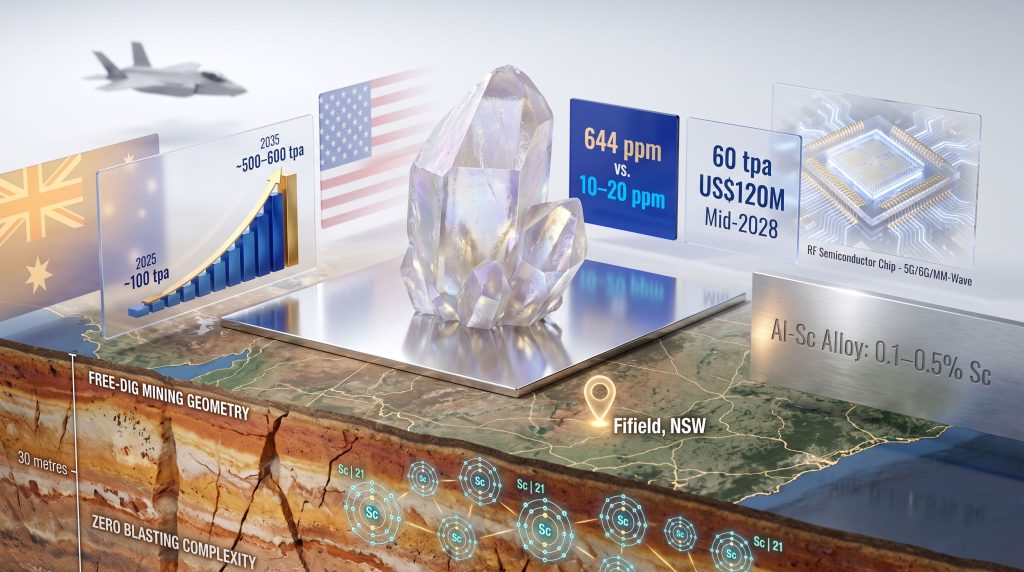
When scandium is introduced into aluminium at concentrations of only 0.1% to 0.5% by weight, the resulting alloy exhibits substantially improved tensile strength, corrosion resistance, weldability, and ductility. No other known element produces comparable improvements at such low addition rates, which is why scandium is considered pound-for-pound the most effective alloying agent available for aluminium.
This relationship drives growing demand across aerospace, precision manufacturing, and increasingly, defence hardware including drone airframes and components used in advanced fighter programs such as the F-35.
Solid Oxide Fuel Cells: Scandium's Largest Current Market
Solid oxide fuel cells, which convert natural gas into electricity through a controlled catalytic process, rely on scandium to stabilise that reaction and extend the operational life of the cell. The technology was originally developed through NASA research programs before being commercialised by U.S. manufacturers. Today, solid oxide fuel cells represent the single largest end-use market for scandium oxide globally, and as AI data centre power demand intensifies, this application is expected to grow substantially over the coming decade.
Semiconductor Chips: The Application With No Exit Strategy
The transition from 3G to 5G wireless infrastructure was made possible partly by scandium-doped aluminium in radio frequency filtering chips. Scandium nitride enables a level of signal filtering performance in these chips that no other known element can replicate at the required specification. Chip manufacturers including major U.S. semiconductor fabricators now depend entirely on scandium-doped materials for this application.
When industry participants have been asked directly about contingency planning in the event of a supply disruption, the consistent answer has been that there is no alternative: the only fallback is to revert to older wireless standards with significantly lower performance. The forthcoming 6G transition will deepen this dependency further.
"This is not a situation where a degraded alternative exists. The outcome for semiconductor manufacturers is binary: scandium is either available, or the technology fails. There is no middle path."
The Supply Concentration Problem and China's Export Restrictions
China currently accounts for approximately 85% to 90% of global scandium supply. Unlike many other critical minerals where Chinese dominance is primarily a cost-competitiveness issue, in scandium it reflects near-total control over the only commercially active production sources. The majority of Chinese scandium is recovered as a byproduct or co-product of titanium and rare earth processing, extracted from waste streams at concentrations of roughly 10 to 20 parts per million.
For pure scandium metal, used in semiconductor manufacturing, there is currently no commercially operational non-Chinese source anywhere in the world. This means every 5G and 6G radio frequency chip manufactured outside China depends on Chinese metallisation capacity for a material with no viable substitute.
China's introduction of scandium export quota restrictions in 2024 transformed this from a latent vulnerability into an active supply chain emergency. The geopolitical risks in critical minerals have never been more apparent, as the trajectory since those restrictions were implemented has moved toward tighter controls, not relaxed ones. Western technology manufacturers are now confronting a structural dependency they cannot resolve through conventional supply chain diversification because no alternative primary supply source currently exists.
How Large Is the Scandium Market, and Where Is It Going?
The official figures published by bodies such as the U.S. Geological Survey place annual global scandium oxide demand at around 40 to 50 tonnes. Industry analysis suggests the real figure is considerably higher, likely exceeding 100 tonnes per annum, because much of the scandium consumed as a dopant or alloying trace element in finished products is simply not captured in reported statistics.
| Metric | Official Estimates | Industry-Adjusted View |
|---|---|---|
| Annual scandium oxide demand | 40-50 tonnes | 100+ tonnes |
| Pure scandium metal demand | ~5 tonnes | ~5 tonnes (high value) |
| Primary supply source | China (~85-90%) | China (~85-90%) |
Demand forecasts through the mid-2030s project substantial growth across all three end-use categories:
| Year | Projected Sc₂O₃ Equivalent Demand |
|---|---|
| 2025 (current) | ~100+ tonnes per annum |
| 2030 | ~300 tonnes per annum |
| 2035 | ~500-600 tonnes per annum |
The drivers behind this projected growth trajectory include:
- Expanding aluminium-scandium alloy adoption in defence manufacturing and drone production
- Growth in solid oxide fuel cell deployments supporting AI data centre power infrastructure
- 5G infrastructure buildout across developing markets and continued densification in existing networks
- 6G development and deployment timelines beginning in the early 2030s
- Increased procurement focus by Western defence departments on domestically sourced or allied-nation sourced materials
In addition, it is worth noting that demand growth projections of this scale depend partly on whether stable Western supply becomes available. The absence of reliable non-Chinese supply has itself historically suppressed demand by discouraging manufacturers from committing to scandium-intensive designs they cannot guarantee sourcing for. This dynamic is central to the broader critical minerals demand surge reshaping global supply chain strategy.
The Syerston Project: Geological Characteristics and Grade Advantage
The Syerston scandium project, the primary asset of the Sunrise Energy Metals scandium project development, is located approximately 200 to 300 kilometres west of Sydney near Fifield in central-west New South Wales. The region is an established Australian mining jurisdiction with existing infrastructure, a skilled workforce, and multiple operating mines in close proximity.
The deposit's geological characteristics are central to its competitive position. Syerston is a laterite deposit, but its mineralogy differs meaningfully from the laterite profiles commonly found across Southeast Asia and the Philippines. The ore body is free-dig: there is no requirement for blasting or hard rock mining methods, and the resource sits from surface to approximately 30 metres depth. The mining operation therefore resembles a strip mine in terms of complexity and cost, making it the least technically challenging component of the overall project.
The grade differential between Syerston and current Chinese production sources is the project's most strategically significant characteristic:
| Parameter | Reported Figure |
|---|---|
| Proven and probable ore reserves | 2.03 million tonnes |
| Reserve grade | ~644 ppm scandium |
| Contained scandium in reserves | ~1,311 tonnes |
| Total Sc₂O₃ across full resource | 30,000+ tonnes |
| Chinese waste-stream extraction grade | 10-20 ppm scandium |
The grade advantage is approximately 30 to 65 times higher at Syerston than in Chinese waste-stream operations. This differential is not merely a technical curiosity: it materially reduces per-unit extraction costs, improves the project's resilience across a range of market pricing scenarios, and provides flexibility to scale production up or down in response to demand changes in ways that byproduct operations structurally cannot.
Importantly, Syerston's scandium is concentrated as a high-grade halo around the nickel-cobalt resource rather than being a separate deposit. The mine plan focuses exclusively on the highest-grade zones, which contain approximately 2,000 tonnes of scandium within the reserve boundary. The broader resource contains over 30,000 tonnes of scandium oxide that could be extracted either as a primary product in future phases or as a byproduct if nickel-cobalt market conditions eventually justify reactivating that pathway.
The Nickel Pivot That Unlocked the Scandium Strategy
Syerston was for many years evaluated as one of the largest nickel-cobalt laterite resources in the Western world. Extensive feasibility work, permitting efforts, and capital planning were directed at producing nickel sulfate and cobalt sulfate for the battery supply chain. The thesis underlying that direction, that global electric vehicle growth would create sustained nickel and cobalt demand that justified a new primary mine, proved directionally correct but was undermined by the speed at which Indonesian nickel capacity expanded.
The volume of new supply brought to market through Indonesian operations in a compressed timeframe created a structural oversupply that made the nickel-cobalt economics unworkable for a new market entrant at Syerston's scale. That strategic reversal, however painful at the time, ultimately positioned the company to redirect decades of geological knowledge, permitting infrastructure, and process metallurgy work toward the scandium opportunity at the precise moment when market conditions were turning in its favour.
Feasibility Economics: What the Numbers Actually Show
The 2024 feasibility study, subsequently updated in 2025 for revised capital estimates and resource adjustments, outlines the following project parameters:
| Parameter | Reported Figure |
|---|---|
| Initial development capital | ~US$120 million |
| Nameplate production capacity | 60 tonnes per annum (Sc₂O₃) |
| C1 cash cost | ~US$534/kg scandium oxide |
| Project operating life | ~32 years |
| Active mining phase | ~21 years |
| Target first commercial production | Mid-2028 |
The US$120 million capital requirement covers mine construction and an on-site refinery producing saleable scandium oxide. It does not include downstream metallisation infrastructure, which would be required to produce the ultra-high-purity scandium metal needed for semiconductor applications. Engineering work on a U.S.-based metallisation facility is ongoing, with the intent of establishing a domestic American processing capability that would bring the Sunrise Energy Metals scandium project into direct alignment with semiconductor supply chain security objectives.
The feasibility study also identifies a pathway to a second 120 tonne per annum production train, which would bring total capacity to approximately 180 tpa if market conditions and financing support expansion.
"Sixty tonnes of scandium oxide per annum is a quantity that could physically fit within a single room. Yet at the pricing levels this material commands in Western markets, that output is capable of generating revenue that fully justifies the project's capital structure and positions it as a high-margin operation."
The next major ASX story will hit our subscribers first
Offtake Strategy and the Lockheed Martin Agreement
The absence of a formal exchange-traded scandium market creates distinct challenges for project financing that do not apply to conventional base or precious metals projects. There is no widely recognised benchmark price for Western-sourced scandium oxide. The only available index pricing derives from a Chinese domestic commodity platform that does not reliably reflect what Western market participants would pay for supply secured outside China.
This structural opacity means that the conventional project financing approach of securing long-term offtake agreements to underwrite debt does not translate cleanly to the scandium market. The strategy employed involves cultivating high-value anchor customers in defence and semiconductor sectors where supply security is a first-order concern, using those relationships to demonstrate credible demand and begin establishing Western market pricing signals.
The agreement with Lockheed Martin, announced in late 2025, covering options over up to 15 tonnes of scandium oxide across a five-year term, represents the first major commitment by a Western defence prime contractor to a non-Chinese scandium supply source. Its significance extends beyond the commercial terms: it validates the project's strategic positioning and demonstrates alignment with U.S. defence industrial base priorities. Consequently, this development also aligns closely with Australia's critical minerals push to establish sovereign and allied supply chain capabilities at a time when government scrutiny of critical mineral dependencies has reached unprecedented intensity.
Engagement with the U.S. Export-Import Bank regarding project financing is active, with a reported US$400 million loan announcement made in August 2026 reflecting the level of government financing interest in establishing this supply chain.
Share Price Performance: Four Converging Catalysts
The Sunrise Energy Metals scandium project has been a focus of intense investor attention, with the company's share price moving from approximately A$1 to A$15 across a twelve-month period. Four distinct factors explain this compression of years of value creation into a comparatively short timeframe:
1. Investor Education Reaching Critical Mass
For years, the strategic importance of scandium was understood within a narrow circle of materials scientists and defence procurement specialists. As the semiconductor dependency on scandium-doped aluminium became more widely discussed, and as the AI infrastructure build-out brought solid oxide fuel cells into mainstream investor awareness, the narrative connecting scandium to critical technology supply chains became accessible to a broader market audience.
2. Grade and Minability Are Genuinely Unmatched
No comparable primary scandium resource exists globally at Syerston's combination of grade and surface-accessible geometry. The 30 to 65 times grade advantage over Chinese waste-stream sources is not a marginal improvement: it is a structural cost and flexibility advantage that no other development-stage project can replicate.
3. China's Export Restrictions as a Supply Shock Trigger
When China imposed export quota restrictions on scandium in 2024, the theoretical supply risk that analysts had been discussing became a present reality. The expectation that China would quickly remove restrictions to reassert its position as a reliable supplier has not materialised. If anything, the direction of travel suggests further tightening in strategically sensitive commodity categories, not liberalisation.
4. Zero Substitutability Creates Binary Risk for End Users
Unlike most critical minerals, where a degraded alternative exists even if at greater cost or lower performance, scandium has no functional substitute in RF chip filtering or certain aerospace alloy applications. The risk calculation for end-users is not a gradual performance trade-off: it is a binary choice between functional technology and non-functional technology.
Construction Progress and the Path to First Production
Construction activities at Syerston are underway, with long-lead capital equipment orders placed and the project's owner's team being assembled. Infrastructure works supporting the site are progressing, and a Clean TeQ Water engineering contract has been awarded for process water management systems. Furthermore, Sunrise Energy Metals continues to advance stakeholder engagement across government, community, and industry partners to support project delivery on schedule.
| Milestone | Target Timing |
|---|---|
| Financing initiatives (U.S. government programs) | H2 2025-2026 |
| U.S. metallisation facility scoping | Ongoing |
| Construction completion | 2027-2028 |
| First commercial scandium oxide production | Mid-2028 |
| Expansion train decision | Post-commissioning |
Risk Factors Investors Should Evaluate
No analysis of the Sunrise Energy Metals scandium project is complete without a clear-eyed assessment of the risks that remain. Australia's defence critical materials strategy acknowledges many of these same challenges at a policy level, underscoring that even government-backed frameworks must navigate genuine uncertainty in this space.
- Market depth risk: Scandium remains one of the world's smallest metal markets by volume. Growth forecasts are directionally well-supported but depend on adoption rates in defence, semiconductor, and energy sectors that are not fully contracted.
- Financing execution risk: The US$120 million capital requirement for the base project remains subject to finalisation of government and commercial financing arrangements.
- Pricing transparency risk: The absence of a Western benchmark price creates genuine uncertainty in revenue modelling. Pricing will be established through negotiation with end-users rather than by reference to an observable market.
- Geopolitical dependency (inverse): A portion of the project's value proposition depends on China maintaining or escalating supply restrictions. A return to open Chinese supply would reduce the urgency premium embedded in Western-sourced scandium.
- Construction and schedule risk: Standard for any greenfield mining and processing project.
Against these risks, the structural advantages are significant: first-mover status as the world's only planned primary scandium mine, a resource with no comparable global equivalent, demonstrated interest from defence prime contractors, and active engagement with government financing programs aligned with critical mineral supply chain security objectives.
This article is intended for informational purposes only and does not constitute financial advice. Investing in mining and exploration companies involves significant risk, including the potential loss of principal. Forward-looking statements, demand forecasts, and project timelines referenced in this article are subject to material uncertainty and should not be relied upon as guarantees of future outcomes. Readers should conduct their own due diligence and consult a licensed financial adviser before making investment decisions.
Want to Be First When the Next Critical Mineral Discovery Hits the ASX?
Discovery Alert's proprietary Discovery IQ model scans ASX announcements in real time, instantly identifying significant mineral discoveries across scandium, rare earths, and 30+ other commodities — turning complex data into actionable investment insights before the broader market reacts. Explore how historic discoveries have generated substantial returns on Discovery Alert's discoveries page, then begin your 14-day free trial to position yourself ahead of the next major find.