
August 7, 2026
The Processing Bottleneck That Defines the Real Rare Earth War
Rare earth supply chains are not won or lost at the mine face. They are won or lost inside the hydrometallurgical separation plants, the oxide refineries, and the sintering furnaces that transform raw ore into functional industrial materials. This distinction sits at the heart of why the Madagascar rare earths U.S.-China rivalry has become one of the defining resource competitions of the mid-2020s, and why a modest island nation in the southwestern Indian Ocean now occupies an outsized position in Washington's strategic calculations.
Understanding why requires unpacking how the rare earth supply chains actually function, and where genuine vulnerability is concentrated.
When big ASX news breaks, our subscribers know first
How China Built an Unassailable Processing Lead
The rare earth value chain operates across four discrete industrial stages: primary extraction, chemical separation, oxide refining, and finished magnet manufacturing. China's dominance is not evenly distributed across these stages. It is catastrophically concentrated in the latter three.
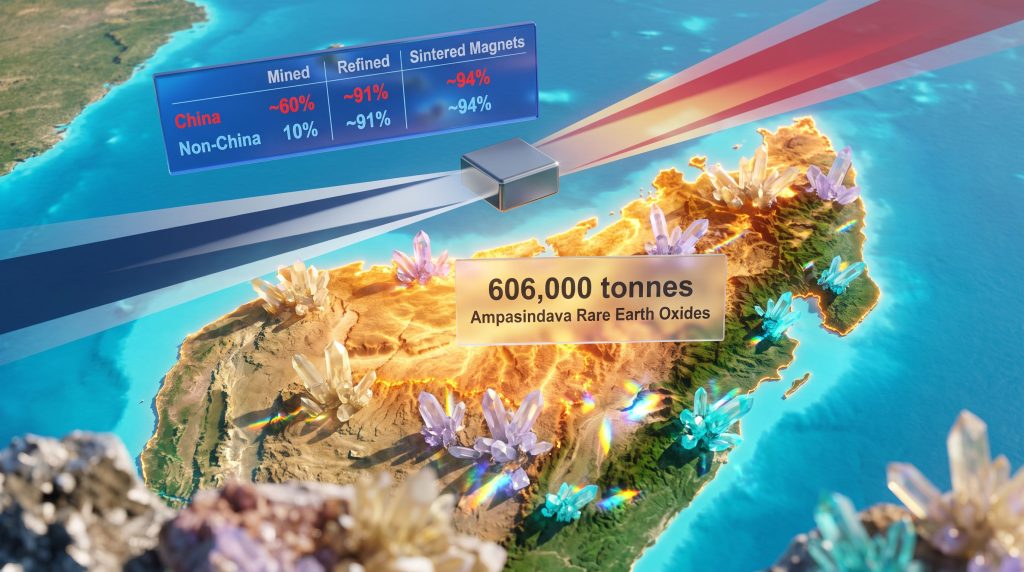
According to International Energy Agency estimates for 2024, China's share at each stage reveals a striking escalation of control as materials move downstream:
| Supply Chain Stage | China's Global Share (2024) | Non-China Capacity |
|---|---|---|
| Mined magnet rare earths | ~60% | ~40% |
| Refined magnet rare earths | ~91% | ~9% |
| Sintered permanent magnets | ~94% | ~6% |
Source: International Energy Agency, 2024 estimates
These figures carry a critical implication: discovering and funding new mines outside China does relatively little for Western supply chain security if the extracted ore must still pass through Chinese separation and refining infrastructure before it becomes a usable industrial input. A rare earth deposit in Madagascar, Australia, or Greenland provides no meaningful independence if the processed oxide and the finished magnet are still manufactured in Ganzhou or Baotou.
This is the processing paradox that Washington is now spending billions to resolve. The four magnet rare earth elements driving the most intense competition are neodymium (Nd), praseodymium (Pr), dysprosium (Dy), and terbium (Tb). Together, they underpin the permanent magnets found in electric vehicle drivetrains, offshore wind turbine generators, precision-guided munitions, autonomous robotics, and consumer electronics. Demand projections across each of these sectors point consistently upward through the 2030s, reflecting a critical minerals demand surge that has made controlling this supply chain a national security priority in Washington, Brussels, and Tokyo simultaneously.
Why Ionic-Clay Deposits Represent a Strategically Distinct Category
Not all rare earth deposits are geologically equivalent. Hard-rock carbonatite deposits, such as those at Mountain Pass in California or Mount Weld in Australia, require energy-intensive crushing, grinding, and flotation processes before rare earth concentrates can be extracted. The capital intensity and processing complexity of hard-rock operations create substantial cost barriers and long construction timelines.
Ionic-clay deposits, by contrast, host rare earth ions adsorbed onto clay mineral surfaces rather than locked within crystalline rock matrices. This means extraction can often be achieved through relatively low-cost in-situ leaching or heap-leach methods using ammonium sulfate or similar lixiviants, without the need for large grinding circuits. The trade-off is that grades are typically much lower by weight, but the recoverable rare earth profile often skews toward the higher-value heavy rare earths, including dysprosium and terbium, which command significant price premiums over light rare earths like cerium and lanthanum.
The overwhelming majority of known ionic-clay rare earth deposits are concentrated in the weathered granite belts of southern China's Jiangxi, Fujian, and Guangdong provinces. That geographic concentration is a key reason why China's processing dominance is so deeply entrenched; for decades, it was the only country with large-scale ionic-clay production experience. The identification of comparable geology outside China, including in Madagascar, therefore carries strategic significance that extends well beyond individual project economics.
Madagascar's Ampasindava: Geology, Scale, and Projected Output
The Ampasindava deposit, situated in Madagascar's northern region and wholly owned by Harena Rare Earths, holds an estimated mineral resource of approximately 606,000 tonnes of total rare earth oxides. The DFC has characterised it as one of the largest ionic-clay rare earth deposits identified outside China, a designation that reflects both resource scale and the relative scarcity of this deposit type beyond Chinese borders.
Key project parameters from the January 2025 pre-feasibility study include:
- Annual production target: approximately 4,000 tonnes of total rare earth oxides
- Magnet rare earth fraction: approximately 1,700 tonnes per annum of neodymium, praseodymium, dysprosium, and terbium
- Pre-production capital estimate: approximately $142 million
- Target production commencement: approximately 2028, subject to permitting, further feasibility work, and full financing
The deposit's composition is particularly important. The presence of both light magnet rare earths (neodymium and praseodymium, which form the base alloy in NdFeB magnets) and heavy magnet rare earths (dysprosium and terbium, which are added to enhance high-temperature coercivity in demanding applications) makes Ampasindava a more complete magnet-material source than deposits offering only light rare earth dominance.
Madagascar's broader mineral economy provides useful context. The country ranked as the world's largest mica producer and second-largest graphite producer in 2024, according to U.S. Geological Survey data, and also produces nickel, cobalt, ilmenite, and zircon. The 2023 lifting of a long-standing moratorium on new mining licences opened the door to rare earth sector development and signalled a structural shift in the country's resource governance posture.
The DFC Commitment: Signal Value vs. Financing Reality
On August 7, 2025, the U.S. International Development Finance Corporation formally announced a commitment of up to $4.84 million in project development funding for Ampasindava. The agency described this as its first mining investment in Madagascar. Funds are allocated toward environmental and social impact studies, permitting processes, and the development of a proof-of-concept pilot plant as the project advances toward a definitive feasibility study.
The DFC's chief executive stated publicly that securing critical mineral supply chains had been designated a national priority under the current administration, reinforcing the framing of the investment as a strategic act rather than a purely commercial one. Furthermore, the announcement formed part of Washington's broader response to China's rare earth export restrictions, which have accelerated the urgency of supply chain diversification efforts across Western-aligned nations.
The significance of the DFC's $4.84 million commitment is not what it funds today. It is what it signals about the institutional momentum behind Western supply chain diversification in Africa, and the political risk coverage it provides to subsequent private capital.
The arithmetic of the financing gap, however, demands clear-eyed assessment. The pre-feasibility study estimated pre-production capital requirements of approximately $142 million. The committed DFC funding represents roughly 3.4% of that figure. Ampasindava is nowhere near construction-ready financing, and the path from development-stage support to full project funding involves completing additional technical studies, securing environmental approvals, and attracting substantially larger institutional or private capital commitments. None of these outcomes are assured.
Washington's Integrated Supply Chain Strategy: Beyond the Mine
The Ampasindava commitment did not arrive in isolation. It formed part of a broader package of approximately $3 billion in U.S. government critical minerals investments announced in August 2025. The portfolio's structure reveals that Washington has absorbed the central lesson of China's supply chain model: vertical integration across extraction, processing, and manufacturing is what creates durable strategic independence, not individual mines.
| Recipient / Project | Allocation | Strategic Purpose |
|---|---|---|
| Sila Nanotechnologies | $1.4 billion (conditional loan) | Advanced battery materials |
| Sunrise Energy Metals (Australia) | $400 million | Scandium development |
| Niron Magnetics | $150 million | Magnet manufacturing capacity |
| Harena Rare Earths – Ampasindava | Up to $4.84 million | Project development / pilot plant |
| Strategic minerals reserve | $12 billion | National stockpile establishment |
The investment in Niron Magnetics alongside upstream mining projects is particularly instructive. Niron is developing iron-nitride magnet technology as an alternative to conventional NdFeB permanent magnets, seeking to reduce or eliminate rare earth content in some magnet applications. The simultaneous funding of upstream rare earth mining and downstream magnet alternatives reflects a hedged strategy: secure the conventional rare earth supply chain while also funding potential technological substitutes.
The $12 billion strategic stockpile commitment adds a third dimension, providing a demand buffer that can sustain domestic processing operations through the inevitable price volatility cycles that characterise rare earth markets.
The next major ASX story will hit our subscribers first
Comparative Western Strategies: Who Is Doing What
The U.S. approach is one of several competing frameworks for rare earth supply chain reconstruction. Each reflects different institutional capabilities and political constraints. Consequently, America's rare earth supply chain strategy has evolved into one of the most closely watched policy experiments in the critical minerals sector.
- United States: DFC-led bilateral project financing, domestic manufacturing incentives, and strategic stockpiling. Strengths include institutional reach and financial scale. Limitations include the speed of bureaucratic capital deployment versus China's state-directed model.
- European Union: The Critical Raw Materials Act establishes domestic processing benchmarks and enables state co-investment in third-country projects. The EU's approach is more regulatory in structure, using market design and strategic reserve targets to create commercial pull for alternative supply.
- Japan: Decades of bilateral resource diplomacy with resource-rich nations, combined with strategic stockpiling and investment through JOGMEC (Japan Organization for Metals and Energy Security). Japan's model is arguably the most mature among Western-aligned nations, though it has not eliminated processing dependence.
- Australia: Increasingly positioning itself as a mid-stream processing hub, leveraging its substantial hard-rock rare earth reserves and growing separation capacity to serve both U.S. and European customers.
None of these approaches, individually or in combination, can replicate China's integrated supply chain position within a five-year horizon. The realistic objective is meaningful diversification of processing capacity, not parity.
Africa's Strategic Leverage: Real But Conditional
Madagascar is not the only African nation finding itself at the intersection of competing great-power mineral strategies. The DFC's $553 million loan to the Lobito Atlantic Railway, connecting the copper and cobalt belts of the Democratic Republic of Congo and Zambia with Angola's Atlantic coast, illustrates the infrastructure dimension of Washington's African minerals strategy. China has simultaneously maintained and in some cases deepened its own engagement across the continent's mineral sector, creating genuine bilateral competition that gives host governments meaningful leverage they did not possess a decade ago.
The economic question this raises for Madagascar and its peers is not whether foreign capital will arrive, but whether the terms of its arrival can be structured to generate domestic industrial development rather than raw material extraction alone.
The historical pattern is instructive and cautionary. African mineral economies have repeatedly supplied bulk commodities to overseas industrial systems while value-added processing, refining, and manufacturing occurred elsewhere. Rare earths intensify both the risk and the opportunity embedded in this pattern. The processing margin for rare earths, particularly for separated oxides versus run-of-mine concentrate, can represent multiples of the mining margin.
For Madagascar to capture a meaningful share of this value, its regulatory and industrial policy framework would need to incorporate processing requirements, domestic value-addition incentives, or negotiated equity participation in downstream stages. Foreign competition for the deposit creates leverage; however, translating leverage into industrial outcomes requires deliberate policy design that goes well beyond welcoming inbound investment. Indeed, the rare earth processing challenges faced by emerging producer nations like Madagascar underscore just how difficult it is to move up the value chain without substantial institutional support.
Risks That Could Delay Ampasindava's Development
Several material risk factors stand between the current development stage and the 2028 production target:
- Financing gap: The distance between $4.84 million in committed development funding and approximately $142 million in required pre-production capital is substantial. Closing this gap will require additional feasibility work, favorable commodity price conditions, and competition among potential capital providers.
- Environmental and permitting complexity: Northern Madagascar's ecosystem sensitivity, combined with the country's developing institutional capacity for large-scale mining governance, creates permitting timelines that are difficult to predict with precision.
- Community relations: Madagascar has a documented history of local community opposition to large-scale mining projects. Social licence is not guaranteed by project economics or government approval alone.
- Commodity price volatility: Rare earth prices, particularly for magnet rare earths, have demonstrated significant cyclical volatility. Project economics modelled at current price assumptions can deteriorate sharply if prices soften during the construction and ramp-up period.
- Geopolitical variables: The broader Madagascar rare earths U.S.-China rivalry that is elevating Ampasindava's strategic profile could also expose the project to retaliatory economic measures or competitive countermoves by Chinese-backed investors seeking to establish positions in the same deposit category. Analysts tracking the US-China rare earth rivalry note that such countermoves have historically intensified as Western commitments grow more visible.
Frequently Asked Questions
What rare earth elements does Madagascar's Ampasindava deposit contain?
Ampasindava hosts neodymium, praseodymium, dysprosium, and terbium, all of which are classified as magnet rare earths essential to permanent magnet manufacturing for electric vehicles, wind turbines, and advanced defence applications. The deposit's combination of both light and heavy magnet rare earths makes it more strategically complete than single-category deposits.
How much has the U.S. committed to Madagascar's rare earth development?
The DFC has committed up to $4.84 million for project development activities covering environmental studies, permitting, and pilot plant work. This represents early-stage support and accounts for approximately 3.4% of the estimated $142 million pre-production capital requirement.
Why does China dominate rare earth processing more than mining?
China invested several decades building integrated separation, refining, and magnet manufacturing infrastructure, initially at low cost by accepting environmental externalities that Western regulatory frameworks would not permit. By the time the strategic value of this industrial base became widely understood, the capital and knowledge gap had grown to a scale that is extremely difficult to close quickly.
When could Ampasindava begin producing rare earths?
Harena Rare Earths is targeting production commencement around 2028, contingent on completing further feasibility studies, obtaining regulatory approvals, and securing the full capital requirement.
Does the DFC investment guarantee Ampasindava will become a producing mine?
It does not. The DFC's commitment provides early development funding and political risk signalling, but the project remains subject to a substantial financing gap, permitting approvals, community acceptance, and commodity price conditions that will collectively determine whether it reaches production. The Madagascar rare earths U.S.-China rivalry context does, however, increase the likelihood that further institutional backing materialises if early-stage milestones are met.
Disclaimer: This article contains forward-looking statements, projections, and scenario analyses based on publicly available information and third-party estimates. Nothing in this article constitutes financial or investment advice. Project timelines, capital requirements, and production targets are subject to material risks and uncertainties. Readers should conduct independent due diligence before making any investment decisions related to companies or projects mentioned herein.
Want To Track the Next Major Mineral Discovery Before the Market Catches On?
Discovery Alert's proprietary Discovery IQ model delivers real-time alerts on significant ASX mineral discoveries across rare earths and critical minerals, transforming complex geological data into actionable investment insights for both new and experienced investors. Explore historic examples of exceptional discovery returns and begin your 14-day free trial today to position yourself ahead of the market.