August 5, 2026
The Invisible Metal That Could Reshape American Air Power
Most investors tracking the critical minerals demand space instinctively think of lithium, cobalt, or rare earth elements like neodymium when considering strategic supply chain vulnerabilities. Yet one of the most consequential materials in next-generation defence manufacturing barely registers on commodity radar screens. Scandium, a silvery-white metal so scarce in commercial terms that total global consumption fits inside a single shipping container, is quietly becoming one of the most strategically contested materials in the US defence industrial base.
The NioCorp Lockheed Martin scandium supply agreement, announced in August 2026, sits at the intersection of materials science, geopolitical competition, and domestic industrial policy. Understanding what this agreement actually means, and what it does not yet guarantee, requires pulling apart several distinct layers of strategic logic.
When big ASX news breaks, our subscribers know first
Understanding the Agreement: Intent Versus Obligation
The arrangement between NioCorp and Lockheed Martin is structured as a non-binding Memorandum of Understanding (MOU), a critical legal distinction that investors and industry observers must not overlook. An MOU establishes a shared framework for future negotiation, not a commercially enforceable supply commitment. No product changes hands, no revenue is guaranteed, and no delivery timeline is locked in until a definitive binding offtake contract is executed by both parties.
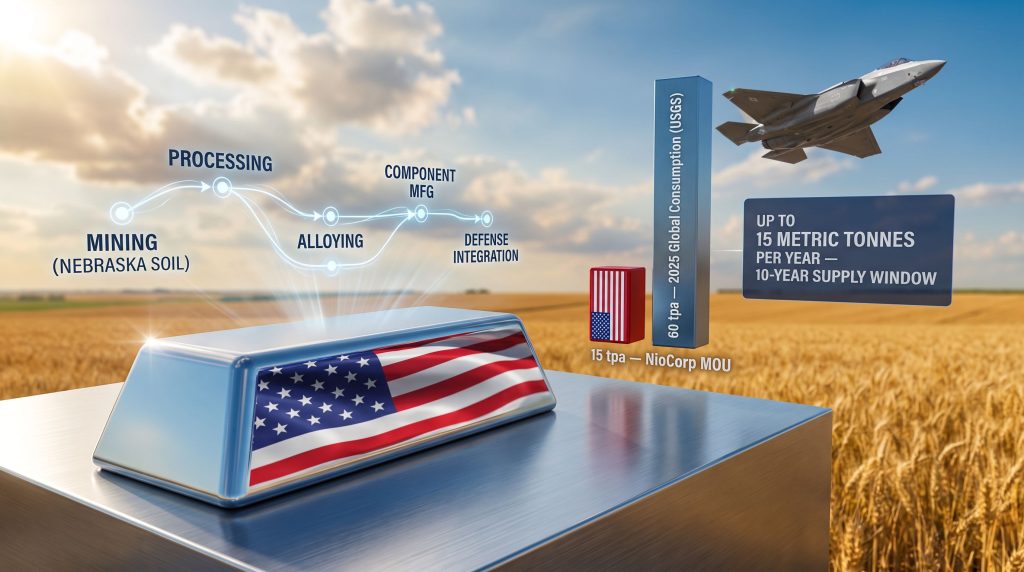
Within that framework, the MOU contemplates the potential purchase of up to 15 metric tonnes per year of scandium oxide or aluminium-scandium alloy products across a period of up to 10 years. Importantly, the agreement preserves flexibility on product form, meaning NioCorp could fulfil supply obligations as refined scandium oxide or as finished aluminium-scandium alloy ingots, depending on the status of downstream manufacturing capacity at the time of delivery.
An MOU is best understood as a formal handshake with documented intent. It signals commercial alignment and shared strategic priorities, but the pathway from MOU to first delivery involves financing milestones, construction completion, regulatory approvals, and a binding contract that has not yet been signed.
The relationship between the two companies actually predates this supply MOU. A joint development program between NioCorp's subsidiary Elk Creek Resources and Lockheed Martin's Skunk Works advanced development division has been active since October 2025, funded by a Pentagon-backed award of $10 million from the US Department of Defense. That programme is focused on developing scandium-enhanced aluminium alloy components suitable for integration into modern fighter aircraft platforms.
| Relationship Layer | Description | Current Status |
|---|---|---|
| Joint Development Program | DoD-funded R&D via Lockheed Skunk Works | Active since October 2025 |
| DoD Funding Award | $10 million to Elk Creek Resources | Confirmed |
| Scandium Supply MOU | Non-binding intent for up to 15 tpa over 10 years | Announced August 2026 |
| Binding Offtake Contract | Definitive commercial supply agreement | Not yet executed |
Why Scandium's Tiny Market Creates Outsized Strategic Risk
To appreciate why the NioCorp Lockheed Martin scandium supply agreement carries strategic weight far exceeding its modest tonnage, it helps to understand just how small this market actually is.
According to the US Geological Survey (USGS), approximately 60 metric tonnes of scandium oxide were consumed globally in 2025. That figure makes scandium one of the lowest-volume critical minerals traded internationally. For context, the global lithium market operates in hundreds of thousands of tonnes annually. The proposed NioCorp supply of up to 15 metric tonnes per year would represent roughly one-quarter of total 2025 global scandium oxide consumption, making a single bilateral agreement potentially transformative for market structure.
This miniature market size is not a sign of low commercial value. Furthermore, it reflects several compounding realities:
- Scandium does not form concentrated ore deposits in nature, making economically viable extraction genuinely rare
- Most scandium currently produced globally arrives as a byproduct of titanium, uranium, or iron ore processing, predominantly in China and Russia
- Industrial adoption has historically been constrained by price volatility and supply unpredictability, creating a circular dependency where limited supply discourages demand growth
- The aerospace and defence sectors, which have the greatest technical motivation to use scandium alloys, have been reluctant to commit to scandium-intensive designs without reliable long-term supply guarantees
This last point is particularly important. Defence contractors do not design supply chain dependencies into next-generation platforms without credible supply commitments. The MOU may be non-binding today, but its role in signalling supply availability to Lockheed Martin's engineering teams could unlock design decisions that cement scandium demand for decades.
What Scandium Actually Does to Aluminium
Key Metallurgical Advantages
The metallurgical case for scandium in defence applications rests on a small number of well-documented but frequently underappreciated properties. When added to aluminium alloys in concentrations as low as 0.1 to 0.4 percent by weight, scandium produces a remarkable set of improvements:
- Grain refinement: Scandium additions inhibit recrystallisation during welding and heat treatment, producing a finer grain structure that substantially improves fatigue resistance
- Strength-to-weight improvement: Scandium-aluminium alloys can achieve tensile strengths significantly higher than conventional 7000-series aerospace aluminium grades while maintaining similar density
- Weldability: Unlike many high-strength aluminium alloys, scandium-enhanced compositions can be fusion-welded without significant strength degradation in the heat-affected zone
- Corrosion resistance: The refined microstructure reduces susceptibility to stress corrosion cracking, a major failure mode in aircraft structural components
For Lockheed Martin's Skunk Works division, which has historically pioneered some of the most demanding aerospace materials applications in history, these properties translate directly into structural components that are lighter, stronger, and more tolerant of the extreme stress environments encountered in high-performance fighter aircraft.
The shift toward scandium-enhanced alloys in defence applications is not purely theoretical. The joint development programme between Elk Creek Resources and Lockheed's Skunk Works is actively translating these metallurgical advantages into engineered components, with the explicit goal of qualifying scandium alloy use across modern fighter aircraft platforms.
The Elk Creek Project: Production Architecture and Timeline
NioCorp's Elk Creek Critical Minerals Project in Nebraska represents the production backbone behind the NioCorp Lockheed Martin scandium supply agreement. The project is designed to produce approximately 100 metric tonnes of scandium oxide per year at full production, a volume that would fundamentally alter global scandium supply dynamics if achieved.
Several aspects of Elk Creek's design deserve closer examination:
Co-product economics: Scandium at Elk Creek is extracted as a co-product of niobium and titanium processing. This co-product structure is economically significant because a portion of the mine's operating costs is effectively attributed to the primary commodities, reducing the standalone cost burden on scandium production. This makes Elk Creek potentially competitive on a cost basis even against producers with access to higher-grade scandium sources.
Vertical integration: NioCorp's December 2025 acquisition of scandium-alloy manufacturing assets positions the company to produce finished aluminium-scandium alloy ingots, not just refined oxide. This mine-to-alloy capability removes a critical processing dependency on foreign intermediaries, which has historically been a vulnerability in rare earth and specialty metal supply chains.
Bridging production: Before Elk Creek reaches commercial output, NioCorp is already producing a 4% aluminium-scandium master alloy using market-sourced scandium oxide. This approach allows the company to develop manufacturing expertise, refine product specifications, and begin engaging customers before the mine is operational.
Target timeline: Elk Creek is targeted for production commencement around 2028, contingent on completing project financing, construction, and regulatory approvals. That timeline creates a meaningful window of execution risk between the current MOU and the first domestic scandium delivery.
From MOU to Binding Contract: What Still Needs to Happen
The transition from strategic intent to commercial reality involves a sequential series of milestones, each carrying its own uncertainty:
- Negotiation of a definitive binding supply agreement between NioCorp and Lockheed Martin, with agreed pricing mechanisms, delivery schedules, and product specifications
- Completion of Elk Creek project financing, which remains the most critical near-term execution risk for the entire development programme
- Construction and commissioning of the Elk Creek processing facilities to designed production capacity
- Regulatory and environmental approvals for full-scale mining and processing operations in Nebraska
- Qualification of NioCorp's alloy products against Lockheed Martin's aerospace-grade material specifications, which are among the most demanding in any industry
- Ramp-up to target production volumes sufficient to meet contracted delivery obligations
Each of these steps represents a potential delay or disruption point. Investors monitoring the NioCorp Lockheed Martin scandium supply agreement as a commercial catalyst should track progress against this sequential checklist rather than treating the MOU announcement as confirmation of future revenue.
The next major ASX story will hit our subscribers first
Policy Architecture: How Washington Is Structuring Domestic Demand
The strategic context for this agreement extends well beyond the two companies involved. The current US administration has pursued an increasingly aggressive posture on critical minerals and energy security, with direct implications for how defence contractors source materials.
Recent executive orders have tightened the conditions under which US defence contractors can obtain waivers to purchase critical minerals from restricted foreign suppliers, including Chinese entities. This regulatory tightening creates a structural procurement incentive for companies like Lockheed Martin to secure domestic supply relationships, regardless of whether foreign-sourced material might be temporarily cheaper or more readily available.
The USGS continues to document significant US import dependence across critical mineral categories. For scandium specifically, the absence of any meaningful domestic production prior to Elk Creek's development means that essentially all US scandium consumption has historically flowed through supply chains with Chinese or Russian origin exposure.
The combination of tightening waiver restrictions and growing defence platform demand for scandium-enhanced alloys creates a structural pull for domestic producers that operates independently of spot price dynamics. This policy-driven demand floor is qualitatively different from commodity market demand signals.
Moreover, the broader US critical minerals strategy is increasingly shaping how defence primes approach long-term sourcing decisions, making early-stage partnerships like the Elk Creek–Lockheed arrangement strategically relevant well beyond their immediate commercial terms.
Benchmarking the Deal Against Broader Critical Minerals Offtake Structures
| Feature | NioCorp-Lockheed MOU | Typical Critical Minerals Offtake |
|---|---|---|
| Agreement Type | Non-binding MOU | Binding offtake contract |
| Volume Commitment | Up to 15 tpa | Fixed annual tonnage |
| Duration | Up to 10 years | 5 to 15 years typical |
| Product Form Flexibility | Oxide or finished alloy | Typically single product form |
| Buyer Category | Defence prime contractor | Industrial processor or battery manufacturer |
| Upstream R&D Integration | DoD-funded joint development program | Rarely included |
| Policy Alignment | Consistent with executive order procurement frameworks | Varies by commodity |
The defence prime contractor buyer profile is an unusual feature in critical minerals offtake structures. Most upstream producers sell to processors or manufacturers who then supply into end-use industries. The direct relationship between NioCorp and Lockheed Martin compresses the supply chain and, if converted to a binding agreement, would create a traceable mine-to-platform provenance that aligns with emerging defence procurement documentation requirements.
The Broader Race to Secure Domestic Scandium and Critical Minerals
NioCorp is not operating in isolation. Across the US critical minerals sector, a wave of pre-production developers is pursuing domestic output expansion with varying degrees of government engagement. What distinguishes the Elk Creek model is the combination of a DoD-funded R&D partnership with a major defence prime, a vertically integrated production strategy spanning from mine output to finished alloy, and a scandium resource that benefits from co-product economics rather than relying entirely on scandium pricing to justify development.
The broader pattern visible across the sector is one of defence prime contractors increasingly engaging upstream in supply chains that were previously considered outside their strategic perimeter. In addition, early-stage MOU frameworks, even non-binding ones, serve the important function of signalling credible downstream demand to project financiers, which in turn can accelerate the financing processes that pre-production developers need to advance toward construction.
Consequently, for the scandium market specifically, Elk Creek reaching its targeted 100 tonne per year production capacity would effectively double or triple current global supply, with cascading implications for pricing, industrial adoption rates, and the competitive positioning of other potential scandium producers worldwide. Furthermore, defence critical materials policy settings across allied nations are increasingly mirroring Washington's approach, amplifying the strategic significance of any credible domestic supply development in this space.
Frequently Asked Questions
Is the NioCorp Lockheed Martin scandium agreement a confirmed commercial deal?
No. The arrangement is a non-binding MOU that establishes intent to negotiate a future supply contract. A definitive binding agreement has not been executed.
How much scandium is covered under the MOU?
The MOU contemplates potential purchases of up to 15 metric tonnes per year of scandium oxide or aluminium-scandium alloy products over a period of up to 10 years.
How large is the global scandium market?
The USGS estimated approximately 60 metric tonnes of scandium oxide were consumed globally in 2025, making it one of the smallest-volume critical minerals markets globally.
When could Elk Creek begin delivering scandium?
The project targets production commencement around 2028, subject to financing completion, construction, and regulatory approvals.
Why is scandium valuable for defence applications?
Scandium-enhanced aluminium alloys deliver superior strength-to-weight ratios, improved weldability, and better fatigue resistance — properties that are directly applicable to critical minerals for defence manufacturing and structural components in advanced fighter aircraft.
How is the joint development programme funded?
The DoD awarded $10 million to NioCorp's subsidiary Elk Creek Resources to fund the joint R&D programme with Lockheed Martin's Skunk Works division.
Key Takeaways for Investors and Industry Observers
- The NioCorp Lockheed Martin scandium supply agreement is a strategic signal, not a commercial certainty, and should be evaluated accordingly
- At up to 15 metric tonnes annually, the MOU would represent approximately one-quarter of 2025 global scandium oxide consumption, underscoring how structurally thin this market remains
- The transition from MOU to first delivery requires completing six sequential execution milestones, each carrying independent risk
- Co-product economics at Elk Creek give NioCorp a structural cost advantage over standalone scandium producers, a factor that could support long-term pricing competitiveness
- The mine-to-alloy vertical integration strategy, if fully executed, would create a defence-grade domestic scandium supply chain with no current equivalent in the United States
- Policy-driven procurement restrictions are actively structuring demand for domestic critical minerals supply, creating a regulatory tailwind that operates independently of spot market dynamics
Disclaimer: This article is intended for informational purposes only and does not constitute financial or investment advice. Statements relating to project timelines, production targets, and commercial agreements involve forward-looking elements subject to material execution risk. Readers should conduct their own due diligence before making investment decisions. For further market intelligence on aerospace, defence, and critical minerals pricing dynamics, Fastmarkets provides coverage across these sectors at fastmarkets.com.
Want to Spot the Next Major ASX Critical Minerals Discovery Before the Market Does?
Discovery Alert's proprietary Discovery IQ model delivers real-time alerts on significant ASX mineral discoveries — including critical materials reshaping defence and aerospace supply chains — instantly turning complex data across 30+ commodities into actionable insights. Explore how historic discoveries have generated substantial returns on Discovery Alert's dedicated discoveries page, and begin your 14-day free trial today to position yourself ahead of the market.