August 5, 2026
The Hidden Bottleneck Shaping the Energy Transition
The global pivot toward electrification has exposed a structural flaw that neither clean energy targets nor manufacturing ambition can paper over: the West does not control the processing of the materials that make the energy transition physically possible. Rare earth elements, particularly the magnet-grade quartet of neodymium, praseodymium, dysprosium, and terbium, flow through a supply chain that is overwhelmingly concentrated in a single geography. Estimates consistently place China's share of global rare earth processing capacity above 85%, and in certain refining and separation stages, the concentration is even higher.
This is not merely an economic inconvenience. For industries dependent on NdFeB permanent magnets, including electric vehicle manufacturers, offshore wind developers, defence contractors, and robotics producers, the absence of a credible alternative supply pathway represents genuine strategic exposure. The Ionic Rare Earths Belfast rare earths recycling plant is one of the most advanced Western attempts to change that calculus, and its development trajectory offers a revealing window into both the opportunities and complexities of building a domestic rare earth processing industry from scratch.
When big ASX news breaks, our subscribers know first
Why Recycling Rare Earths Is Fundamentally Different from Mining Them
Understanding the Belfast plant requires first grasping why magnet recycling occupies a distinct and increasingly valued position in the rare earth supply debate. Primary mining of rare earth elements involves extracting ore bodies that, despite their name, are rarely concentrated in easily recoverable deposits. Furthermore, the separation of individual rare earth elements from mixed concentrates demands sophisticated hydrometallurgical processing that has historically been mastered and scaled almost exclusively in China.
Secondary recovery from spent magnets, by contrast, begins with a feedstock that is already chemically enriched in exactly the elements the market wants most. End-of-life NdFeB magnets from EV motors and wind turbine generators contain neodymium, praseodymium, dysprosium, and terbium in concentrations that would be considered exceptional in a primary ore body. This is why industry observers increasingly describe magnet recycling as a form of urban mining, treating the accumulated stock of deployed clean energy hardware as an above-ground resource waiting to be reclaimed.
The environmental case reinforces the commercial one. Rare earth primary mining carries a substantial environmental footprint, including radioactive byproduct management where thorium and uranium occur alongside target elements. Recycling avoids this entirely, operating on already-refined material and generating a fraction of the waste associated with primary extraction.
What Is the Ionic Rare Earths Belfast Plant?
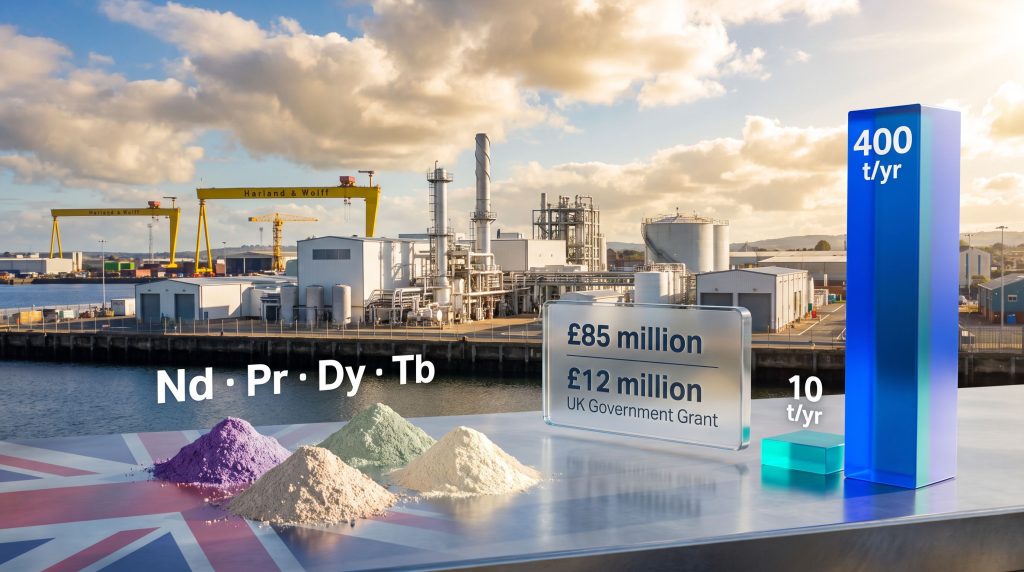
The Ionic Rare Earths Belfast rare earths recycling plant is a commercial-scale facility under development within the Belfast Harbour precinct, in the historic Harland and Wolff industrial zone of Northern Ireland. It is operated by Ionic Technologies, a subsidiary of ASX-listed Ionic Rare Earths. The project's stated commercial objectives are clearly defined:
| Parameter | Detail |
|---|---|
| Facility Type | Commercial magnet rare earth recycling plant |
| Location | Belfast Harbour / Harland and Wolff precinct, Northern Ireland |
| Operator | Ionic Technologies (subsidiary of Ionic Rare Earths, ASX-listed) |
| Planned Annual Feedstock Throughput | ~1,200 tonnes per year |
| Planned Annual Output | ~400 tonnes of separated rare earth oxides |
| Estimated Project Capital Cost | ~£85 million |
| Target Products | Nd, Pr, Dy, Tb separated high-purity oxides |
| Projected Construction Completion | Late 2026 |
| Targeted First Production | Early 2027 |
A critical distinction for understanding this project is the difference between what is already operating and what is being planned. Belfast already hosts a working demonstration plant, commissioned in 2024, that runs on a continuous 24-hour, seven-day basis at an output of approximately 10 tonnes of rare earth oxides per year. The proposed commercial plant would scale that output to 400 tonnes annually, representing a roughly 40-fold increase in productive capacity. That scale-up is the central technical and financial challenge the project now faces.
The Step-by-Step Recycling Process: From Spent Magnet to Separated Oxide
The technology at the heart of the Belfast plant involves a multi-stage hydrometallurgical recovery sequence. Understanding this process helps contextualise both the technical achievement the demonstration plant represents and the engineering complexity involved in scaling it to commercial throughput.
-
Feedstock Collection and Sourcing — End-of-life permanent magnets are gathered from decommissioned EV motors, wind turbine generators, industrial machinery, and manufacturing process scrap. This feedstock sourcing step is itself a logistical challenge given the fragmented nature of current magnet collection infrastructure across Europe.
-
Pre-Processing and Demagnetisation — Physical preparation of incoming feedstock reduces it to a form suitable for chemical treatment, including demagnetisation to allow safe handling and size reduction to increase surface area for leaching.
-
Dissolution and Leaching — The prepared magnet alloy material is dissolved in acid solutions, releasing the rare earth elements into an aqueous phase. The chemistry must be carefully controlled to maximise rare earth recovery while managing impurities, particularly iron, boron, and residual metallic elements that are abundant in NdFeB alloys.
-
Separation and Purification — Individual rare earth elements are isolated from the leach solution using solvent extraction or ion exchange techniques. This is the most technically demanding stage, as the chemical similarity between rare earth elements makes complete separation exceptionally challenging. Achieving high-purity separated fractions of neodymium, praseodymium, dysprosium, and terbium requires precise process control and significant reagent management.
-
Oxide Production — The purified rare earth solutions are converted into solid oxide powders through precipitation and calcination. The resulting products must meet stringent purity specifications to qualify as direct feedstock for magnet remanufacturing.
The production of separated rare earth oxides, as opposed to mixed concentrates, is the critical commercial differentiator. Mixed concentrates require further downstream processing before they can re-enter the magnet supply chain, reducing their value and increasing the burden on buyers. High-purity separated oxides can feed directly into alloy production, commanding materially higher prices and making the recycler a true supply chain partner rather than an intermediate concentrate seller.
Development Timeline and Engineering Milestones
The Belfast project is progressing through a structured development sequence, with several gates already cleared and others in progress.
| Milestone | Status |
|---|---|
| Demonstration Plant Commissioning | Completed, continuous operation since 2024 |
| Front-End Engineering Design (FEED) | Advanced with Tenova Advanced Technologies |
| Public Consultation | Completed without reported objections |
| Planning Application | Expected to follow public consultation |
| UK Government Grant Offer | £12 million offer in principle received |
| Final Investment Decision (FID) | In progress, supported by ongoing capital raise |
| Construction Completion Target | Late 2026 |
| First Commercial Production Target | Early 2027 |
The involvement of Tenova Advanced Technologies in the Front-End Engineering Design phase carries specific significance. FEED represents the engineering validation gate at which process flowsheets are translated into detailed equipment specifications, layout designs, and capital cost estimates with sufficient accuracy to support a credible investment decision. Reaching advanced FEED with a recognised engineering partner confirms that the process is no longer conceptual and that the capital cost estimate of approximately £85 million rests on substantive technical foundations rather than preliminary assumptions.
The public consultation process, completed without reported objections, removes one layer of permitting uncertainty. The planning application, expected to follow, will determine the formal regulatory approvals needed for construction to commence.
Funding the Commercial Plant: The A$8 Million Capital Raise
Ionic Rare Earths has secured binding commitments for an A$8 million placement designed to advance the Belfast plant toward its final investment decision. The capital raise involves a deliberately diversified investor base, a structural choice that signals something important about how the company is managing project risk and building stakeholder confidence.
| Component | Amount |
|---|---|
| Total Placement | A$8 million |
| Strategic Investment (Argentem Creek Partners) | A$2 million |
| Director Participation | A$500,000 |
| New Shares Issued | ~30.8 million shares |
| Issue Price Per Share | A$0.26 |
| Dilution to Existing Capital | ~13.6% |
Argentem Creek Partners, a US-based firm specialising in critical minerals and strategic resource investment, has contributed A$2 million as a strategic rather than purely financial participant. The distinction matters. Financial investors respond primarily to return projections. Strategic investors, however, bring sector knowledge, network access, and sometimes commercial relationships that can accelerate project development or offtake discussions. The entry of US institutional capital into a Western rare earth recycling project at the pre-FID stage reflects a level of conviction about both the technology and the market opportunity that purely speculative investors rarely demonstrate at this development phase.
Director participation of A$500,000 adds a further layer of credibility. Management co-investment is a well-established signal of insider confidence in project outcomes, and at a 13.6% dilution level, existing shareholders are being asked to accept meaningful dilution in exchange for progress toward a significant capital milestone.
The placement sits alongside a £12 million UK government grant offer in principle. It is important to understand what that designation means in practice. An offer in principle confirms that the project has passed an initial assessment for grant funding eligibility, but the conversion of that offer into committed funds typically requires the satisfaction of specific conditions. These may include reaching defined development milestones, demonstrating matched private funding, or achieving planning approvals. The grant reduces the equity burden for the project if and when those conditions are met, improving the overall cost of capital and the returns available to equity investors.
The next major ASX story will hit our subscribers first
The Strategic Logic of Belfast as a Location
The choice of Belfast Harbour as the facility location reflects several overlapping practical and strategic considerations. The Harland and Wolff precinct offers established heavy industrial infrastructure, deep-water port access, and a legacy of large-scale manufacturing that provides both physical and workforce foundations rarely available to greenfield industrial projects.
From a feedstock logistics perspective, Belfast's position offers meaningful proximity to European manufacturing clusters where NdFeB magnets are produced and deployed at scale. The EV manufacturing base in Germany, wind turbine production across Northern Europe, and consumer electronics assembly operations across the UK and continent all represent potential feedstock sources as end-of-life collection infrastructure matures.
The UK's Critical Minerals Strategy explicitly identifies domestic processing capability as a national priority, framing reduced import dependency in processed rare earths as both an economic and security objective. The growing critical minerals demand across Western economies makes rare earth recycling fit naturally within that framework, complementing rather than competing with primary mining supply chains by adding a secondary recovery loop that reduces total system dependency on Chinese processing.
Target Markets: Where the Output Goes
The four rare earth oxides the Belfast plant is designed to produce occupy specific and high-value positions within the NdFeB magnet supply chain.
| Rare Earth Element | Primary End-Use Applications |
|---|---|
| Neodymium (Nd) | NdFeB permanent magnets for EV motors and wind turbines |
| Praseodymium (Pr) | NdPr alloys for high-performance magnet production |
| Dysprosium (Dy) | High-temperature performance enhancement in demanding magnets |
| Terbium (Tb) | Coercivity improvement for magnets used in high-stress environments |
Dysprosium and terbium deserve particular attention. These heavy rare earth elements are added to NdFeB magnets specifically to maintain magnetic performance at elevated operating temperatures, a critical requirement for EV traction motors and direct-drive wind turbine generators where heat management is a design constraint. Both elements are significantly rarer and more geographically concentrated in supply than neodymium and praseodymium, and their supply chains are even more tightly controlled.
A recycling facility capable of recovering and separating dysprosium and terbium at commercial scale would consequently occupy a genuinely differentiated market position. Planned output of 400 tonnes per year of separated oxides positions the Belfast plant as a meaningful contributor to Western magnet supply chains in a market where existing non-Chinese separation capacity remains limited.
Risk Factors Investors and Observers Should Understand
A balanced assessment of the Belfast project requires acknowledging the material risks that remain at this stage of development.
Technology scale-up risk is the most fundamental. Moving from 10 tonnes per year of demonstrated output to 400 tonnes involves not merely replicating existing equipment at larger scale, but managing the non-linear complexity that hydrometallurgical processes exhibit as throughput increases. Solvent extraction circuits, reagent management systems, and effluent treatment infrastructure all behave differently at commercial scale. Indeed, historical precedents from rare earth processing challenges globally include multiple instances where scale-up timelines and capital costs exceeded initial projections.
Feedstock supply risk reflects the current fragmentation of end-of-life magnet collection across Europe. Extended producer responsibility regulations are evolving across multiple jurisdictions, and their implementation pace will partly determine when sufficient volumes of end-of-life magnets become available to feed a 1,200 tonne per year throughput requirement. Manufacturing scrap from magnet producers offers a nearer-term feedstock bridge, but its availability is subject to separate commercial negotiations.
Capital and financing risk centres on the conditionality attached to the UK government grant offer and the dependency on continued equity market access for an ASX-listed critical minerals developer. Equity market conditions for junior and mid-tier critical mineral developers can shift rapidly, and future capital raises may be needed at less favourable terms if project timelines extend.
Competitive landscape risk encompasses both emerging Western recycling projects targeting similar feedstock streams and the potential for China's rare earth restrictions to reshape pricing dynamics across global markets. China has demonstrated willingness to use rare earth pricing strategically, and a sustained period of suppressed primary oxide prices could challenge the commercial case for Western recycling operations.
Investors considering exposure to the Belfast project should treat it as a pre-revenue development stage asset carrying the execution risks typical of first-of-kind commercial scale-up projects. The combination of demonstrated technology, advanced engineering work, and diversified funding participation reduces but does not eliminate those risks. This article does not constitute financial advice.
Comparative Position Within the Western Recycling Landscape
| Project | Location | Technology Focus | Scale | Development Stage |
|---|---|---|---|---|
| Belfast Plant (Ionic Technologies) | Northern Ireland, UK | Magnet recycling to separated REOs | 400 t/yr REO | FEED / Pre-FID |
| Various EU initiatives | Multiple EU member states | Mixed recycling and refining | Variable | Various stages |
| US programmes | United States | Magnet-to-magnet and oxide recovery | Pilot / Demo scale | Early commercial |
(Note: Table reflects publicly available information as of mid-2026; individual project parameters subject to change)
The combination of an already-operational continuous demonstration plant and advanced FEED work places the Belfast project ahead of many comparable Western initiatives still operating at conceptual or early pilot stages. The focus on producing separated rather than mixed rare earth oxides as a direct magnet-grade feedstock represents a deliberate commercial positioning choice aimed at capturing the highest-value segment of the recycled rare earth market. Broader rare earth supply chains across the West remain heavily import-dependent, which is precisely the gap projects like Belfast are designed to address.
Frequently Asked Questions
What rare earth elements will the Belfast plant produce?
The facility targets separated high-purity oxides of neodymium, praseodymium, dysprosium, and terbium, the four rare earth elements most critical to NdFeB permanent magnet manufacturing.
How much will the commercial plant cost to build?
Total capital investment is estimated at approximately £85 million, drawn from ASX equity placements, strategic investor contributions, and a £12 million UK government grant offer in principle.
When is production expected to begin?
Construction is targeted for completion in late 2026, with first commercial production anticipated in early 2027, subject to final investment decision and planning approval outcomes.
What distinguishes the demonstration plant from the planned commercial facility?
The demonstration plant, operational since 2024, produces around 10 tonnes of rare earth oxides annually. The commercial plant is designed to process approximately 1,200 tonnes of feedstock per year, producing 400 tonnes of separated oxides, a roughly 40-fold output increase.
Why does the participation of a US strategic investor matter?
Argentem Creek Partners' A$2 million contribution signals that specialist critical minerals investment capital from outside the UK and Australia views the project's technical and commercial thesis as credible at this pre-FID stage, representing a form of institutional third-party validation.
What the Belfast Project Signals for Western Rare Earth Independence
The Ionic Rare Earths Belfast rare earths recycling plant is more than a single industrial project. It represents an attempt to prove that the Western world can build the processing infrastructure needed to close the loop on rare earth materials already deployed within its own borders, reducing the chronic dependency on a single nation's processing dominance without waiting for new primary mines to come online.
Whether it succeeds will depend on executing a demanding technical scale-up, navigating the regulatory and financing pathway to a final investment decision, and competing in a market where pricing dynamics remain subject to geopolitical as well as commercial forces. The rare earth processing challenges involved in scaling hydrometallurgical operations are well documented, and Belfast will need to navigate them carefully. What is already established, however, is that the demonstration technology works, the engineering pathway to commercial scale is being formally validated, and a diversified group of investors from multiple geographies has committed capital to advance that pathway.
For an industry accustomed to decades of false starts in Western rare earth processing, that combination of demonstrated technology and committed capital represents meaningful, if still incomplete, progress. Readers seeking further context on global rare earth supply chain dynamics can find relevant reporting at Mining Weekly, which covers developments across the critical minerals sector, and the Critical Minerals Association, which tracks policy and industry developments relevant to Western processing ambitions.
Want to Capitalise on the Next Major Critical Minerals Discovery Before the Market Moves?
Discovery Alert's proprietary Discovery IQ model scans ASX announcements in real time, instantly identifying significant mineral discoveries across rare earths, critical minerals, and over 30 other commodities — turning complex data into clear, actionable opportunities for investors at every level. Explore historic discoveries and the returns they generated, then start your 14-day free trial at Discovery Alert to position yourself ahead of the market.