August 4, 2026
The Industrial Economy Question Reshaping Southeast Asia's Critical Minerals Map
Rare earth supply chains do not fail suddenly. They erode gradually, through decades of concentrated production, limited investment in processing diversity, and the slow accumulation of geopolitical dependency. By the time a crisis becomes visible, the structural choices that created it are already years in the past. This is the lens through which Malaysia easing rare earth export curbs deserves to be understood: not as a routine trade adjustment, but as a foundational decision about what kind of industrial economy the country intends to build over the next decade.
The question at the centre of this debate is deceptively simple. Should Malaysia allow limited exports of unprocessed rare earth materials under conditional terms, or should it hold the line on its 2024 moratorium until domestic processing capacity is robust enough to justify relaxation? The answer carries consequences well beyond Kuala Lumpur's policy corridors, touching rare earth supply chains that feed electric vehicle motors, defence guidance systems, wind turbine generators, and advanced semiconductor manufacturing across four continents.
When big ASX news breaks, our subscribers know first
Why the 2024 Moratorium Existed in the First Place
To understand where Malaysia is heading, it helps to understand where it has been. The 2024 decision to ban exports of raw rare earth materials was not a reactive measure. It was a deliberate attempt to replicate a development model that Indonesia applied successfully to nickel: refuse to export raw ore, force foreign buyers to invest in domestic processing infrastructure, and capture more of the value chain rather than simply supplying commodity inputs to other nations' industrial ecosystems.
The logic is sound in theory. A country that exports refined neodymium oxide commands significantly more economic value per tonne than one that ships mixed rare earth carbonate to overseas separators. Processing, separation, and downstream manufacturing progressively multiply the economic return from the same underlying geology. Malaysia recognised this and acted on it.
The moratorium also responded to a genuine concern about dependency. If a single foreign partner supplies both the capital and the technology to process Malaysia's rare earths, the country risks trading one form of dependency for another. The 2024 policy framework was therefore as much about negotiating leverage as it was about industrial ambition.
What Is Actually Being Considered and What Is Not
Malaysia's current policy review does not signal an intention to abandon the moratorium's underlying rationale. What is being assessed, according to statements from the Deputy Minister of Natural Resources and Environmental Sustainability, is whether a narrow, conditional export pathway could accelerate the very outcomes the moratorium was designed to achieve.
The distinction matters enormously for investors and policymakers alike. The difference between full export liberalisation and a conditional export permit framework is the difference between dismantling an industrial strategy and using selective access as a negotiating instrument.
Under the conditional model being evaluated, any permission to export raw or minimally processed rare earth materials would require:
- A binding commitment to invest capital in Malaysian processing infrastructure
- Restrictions limiting exported material to research and development applications only
- Technology transfer obligations designed to build domestic technical capability
- Demonstrated compliance with environmental impact assessments, particularly for deposits in or near protected forest zones
This architecture more closely resembles a strategic investment incentive than an export liberalisation programme. The moratorium's core intent, prioritising domestic value addition, would remain intact. What would change is the use of conditional export access as a tool to unlock foreign capital that Malaysia currently struggles to attract without offering some form of near-term material access.
The External Pressure Driving the Review
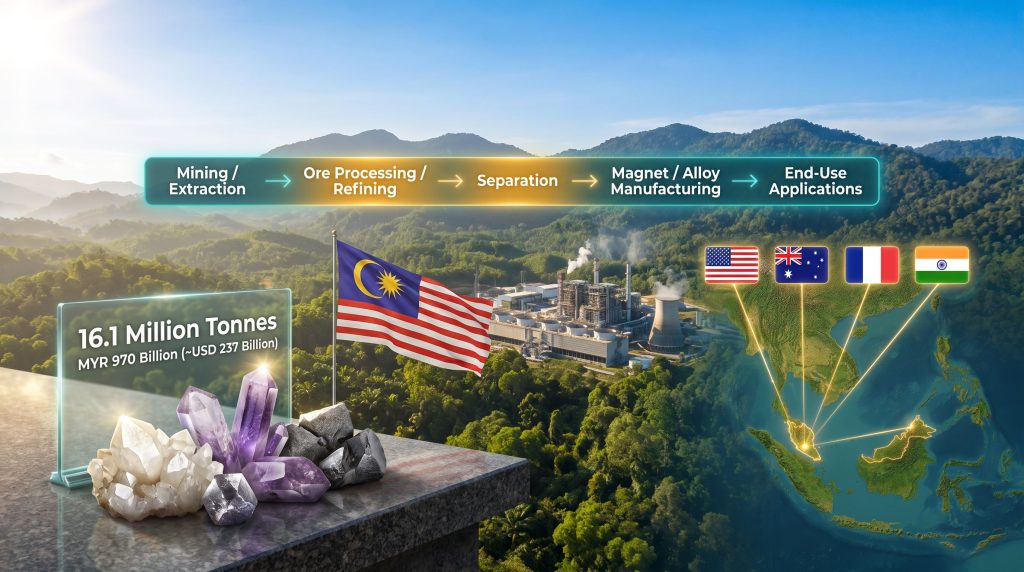
Four countries have been specifically identified as actively seeking access to Malaysian rare earth materials: the United States, Australia, France, and India. Each brings a distinct supply chain rationale.
The United States requires rare earth feedstock for defence applications, permanent magnet production, and the clean energy transition. Its domestic mining base is growing but remains insufficient to meet processing demand at scale. For a deeper understanding of the US rare earth strategy, the structural gaps driving Washington's interest in Malaysian supply become readily apparent.
Australia has significant rare earth mining assets but limited domestic separation and processing capacity. France, through Carester SAS, is building rare earth separation infrastructure and needs reliable non-Chinese feedstock. India is expanding its electric vehicle manufacturing ambitions and faces the same supply concentration risks as Western partners.
The pressure these nations are applying is not merely diplomatic. State-level governments within Malaysia and domestic private investors are also pushing Kuala Lumpur to reconsider the moratorium, recognising commercial opportunity in the gap between global demand and available supply. This convergence of external geopolitical interest and internal commercial pressure is what has elevated this from a theoretical policy discussion to an active review.
The broader catalyst is well understood. China's export restrictions on rare earth minerals, introduced during its trade dispute with the United States, tightened the global supply of materials that had previously flowed with minimal restriction. Countries that had grown accustomed to Chinese rare earth supply at competitive prices suddenly faced both scarcity and political exposure. Malaysia, holding approximately 1% of global recognised rare earth reserves against China's more than 50%, became strategically relevant not because of reserve scale but because of what it has already built.
Malaysia's Rare Earth Infrastructure: Strengths and Gaps
The most important asset in Malaysia's rare earth ecosystem is not in the ground. It is the Lynas Rare Earths processing facility in Pahang, operated by ASX-listed Lynas Rare Earths (ASX: LYC). This refinery is one of the largest rare earth processing operations outside China, capable of producing separated rare earth oxides including neodymium and praseodymium, the elements critical for permanent magnet manufacturing.
The facility currently processes ore shipped from Lynas's Mount Weld mine in Western Australia, not from Malaysian domestic deposits. This creates an important distinction: Malaysia has demonstrated world-class processing capability, but that capability is currently disconnected from its own geology. Closing this gap, by developing domestic ore supply to feed existing and planned processing infrastructure, is the central challenge of Malaysia's 2030 critical minerals hub ambition.
Beyond Lynas, the investment pipeline is growing:
| Company | Origin | Project | Location |
|---|---|---|---|
| Lynas Rare Earths | Australia | Rare earth refining and separation | Pahang, Malaysia |
| Berjaya Corp Bhd | Malaysia | Rare earth project exploration | TBC |
| Carester SAS | France | Rare earth separation plant (JV with Malaco Mining Group) | Perak, Malaysia |
Carester's planned separation facility in Perak represents a particularly significant development. Separation is the technically demanding step between processed ore and the individual rare earth oxides used in manufacturing. Having multiple separation facilities operating from Malaysian soil would meaningfully advance the country's position in the value chain.
The value chain structure currently looks like this:
- Mining and extraction: Largely undeveloped from domestic deposits; environmental constraints significant
- Ore processing and refining: Lynas facility operational, using imported Australian ore
- Separation: Lynas operational; Carester JV in development phase
- Magnet and alloy manufacturing: Not yet present at commercial scale in Malaysia
- End-use applications: Served by downstream manufacturers in partner countries
Malaysia's processing competence is real. Its upstream development remains the critical bottleneck.
The Reserve Paradox: Scale Versus Capability
Malaysia's estimated 16.1 million tonnes of inferred rare earth reserves, valued by the government at approximately MYR 970 billion (around USD 237 billion), represent a significant geological endowment. However, raw reserve figures can be misleading in the rare earth sector, where the location, mineralogy, and extractability of deposits matter as much as tonnage.
A substantial portion of Malaysia's rare earth resources sits within protected forest areas, creating a tension between resource development and environmental governance that no straightforward policy fix can resolve. The government's current approach involves detailed deposit mapping combined with research into low-impact extraction methodologies, but this is a slow and methodologically complex process.
This geological reality has an underappreciated consequence for the policy debate. Even if Malaysia easing rare earth export curbs occurs tomorrow, the domestic ore required to generate significant export volumes is not immediately available at scale. The moratorium's relaxation, if it occurs, would initially benefit projects already at or near production readiness rather than opening a broad export pipeline.
For context, here is how Malaysia's reserve position compares globally:
| Country | Approximate Share of Global Rare Earth Reserves | Key Strategic Advantage |
|---|---|---|
| China | ~50%+ | Dominant reserves plus full value chain control |
| Vietnam | ~18% | Large deposits, growing processing interest |
| Brazil | ~17% | Significant reserves, limited processing |
| Russia | ~10% | Reserves plus established processing |
| Malaysia | ~1% | Processing infrastructure and regional logistics positioning |
Malaysia's competitive position in global rare earth markets rests not on the size of its reserves but on the quality of its processing infrastructure and its geopolitical neutrality. These are advantages that took years to build and could be diluted by poorly sequenced export liberalisation.
The next major ASX story will hit our subscribers first
The China Technology Question: Pragmatism Versus Dependency Risk
One of the less discussed dimensions of Malaysia's policy review is its posture toward Chinese rare earth processing technology. Advanced separation and processing techniques remain areas where Chinese industrial expertise is unmatched globally, developed over decades of domestic rare earth production at scale.
Malaysian officials have signalled openness to engaging Chinese companies for technology access, framing this as mutually beneficial rather than strategically compromising. The reasoning is pragmatic: if China is willing to share processing technology, Malaysia could accelerate its downstream development timeline significantly.
The risk, however, is structural. Acquiring Chinese technology under commercial arrangements creates dependency in the processing stage even if Malaysia retains control over its raw materials. Furthermore, the diversification imperative that the government has articulated, specifically the intention to reduce reliance on any single technology source, requires active management across both Western-aligned and Chinese partnerships simultaneously.
This balancing act is not unique to Malaysia. It reflects broader rare earth geopolitics facing resource-rich nations attempting to position themselves within a bifurcating global technology landscape, where the most capable processing technology and the most politically desirable investment partners do not always align.
Environmental Governance as a Competitive Asset
Rare earth extraction carries well-documented environmental risks. The processing challenges associated with rare earth ores include the generation of radioactive thorium and uranium as byproducts, alongside tailings management, water contamination, and habitat disruption that are recurring issues across global operations. Malaysia's experience with Lynas has made these issues politically salient domestically.
The government's commitment to deposit mapping and low-impact extraction methodology research is therefore not merely regulatory process. It is a component of Malaysia's pitch to ESG-sensitive international capital. Institutional investors from Europe, Australia, and North America are increasingly unwilling to fund mining operations that cannot demonstrate credible environmental management frameworks.
If Malaysia can develop a rare earth sector with a stronger environmental governance track record than competing jurisdictions, this becomes a genuine commercial differentiator. It is a longer path to production but a more durable foundation for attracting the quality of investment that aligns with the 2030 hub ambition.
Three Policy Pathways and Their Consequences
Scenario 1: Status Quo Maintained
The moratorium holds without modification. Domestic processing investment continues to grow organically through Lynas expansion and new entrants like Carester. Malaysia retains full policy leverage but risks losing competitive advantage as Vietnam, Brazil, and other jurisdictions accelerate their own supply development.
Scenario 2: Conditional Export Liberalisation
Limited raw exports are permitted under strict investment and technology transfer conditions. This is the most likely outcome given current policy signals. Malaysia attracts foreign capital tied to domestic processing commitments, accelerating the upstream development gap. Lynas and new entrants gain clearer pathways to domestic ore supply. The moratorium's industrial rationale is preserved while its commercial friction is reduced.
Scenario 3: Full Export Liberalisation
An unlikely outcome that would contradict the explicit framing of the policy review. Full liberalisation without conditions would undermine Malaysia's negotiating leverage with foreign investors and risk reversion to raw commodity exporter status, the precise outcome the 2024 moratorium was designed to prevent.
Frequently Asked Questions
What rare earth export restrictions does Malaysia currently have?
Malaysia introduced a moratorium on exports of unprocessed rare earth materials in 2024. The policy was designed to encourage investment in domestic refining and processing rather than shipping raw ore for value addition overseas.
Has Malaysia confirmed it will ease its rare earth export curbs?
No confirmed policy change has been announced. As of mid-2026, the government is reviewing the feasibility of limited, conditional export access linked to foreign direct investment and technology transfer requirements. This remains a policy assessment rather than a finalised decision.
Which nations are seeking access to Malaysian rare earths?
The United States, Australia, France, and India have been identified as countries actively pursuing Malaysian rare earth material access, each driven by supply chain diversification needs following tightening Chinese export controls.
How large are Malaysia's rare earth reserves?
The government estimates 16.1 million tonnes of inferred reserves, valued at approximately MYR 970 billion (around USD 237 billion). A significant proportion of these resources sits within protected forest areas, complicating near-term development timelines.
What role does Lynas Rare Earths play?
Lynas operates one of the largest rare earth processing facilities outside China in Malaysia's Pahang state. It currently processes ore imported from its Australian mining operations, making it a critical processing asset but not yet a driver of domestic ore development.
What conditions would apply to any export relaxation?
Proposed conditions include mandatory capital investment in Malaysian processing infrastructure, restrictions limiting exported materials to research and development use, and technology transfer obligations that build long-term domestic industrial capability. According to recent industry analysis, these conditions reflect a broader pattern of resource-rich nations seeking to maximise domestic value capture before opening export pathways.
The Decision That Will Define Malaysia's Industrial Trajectory
The debate over Malaysia easing rare earth export curbs is ultimately a debate about sequencing. Done well, conditional export access can serve as the mechanism that attracts the foreign investment needed to develop the very domestic processing capacity the moratorium was intended to build. Done poorly, it becomes the first step in dismantling a coherent industrial strategy before it has had time to produce results.
Every percentage point of value chain participation that Malaysia adds, from ore processing through separation to magnet precursor manufacturing, compounds into long-term economic and strategic returns that raw material exports cannot replicate. The nations watching this policy review most closely understand this. So, it appears, does Kuala Lumpur.
This article contains forward-looking analysis and scenario projections based on publicly available information as of August 2026. Readers should note that policy outcomes, investment decisions, and market developments may differ materially from the scenarios described. This content does not constitute financial or investment advice.
Want to Capitalise on Critical Minerals Discoveries Before the Broader Market?
As geopolitical shifts reshape rare earth and critical minerals supply chains across Southeast Asia and beyond, Discovery Alert's proprietary Discovery IQ model delivers real-time alerts on significant ASX mineral discoveries, transforming complex geological and market data into actionable investment insights — explore historic discoveries and their returns to see what early positioning can mean, then begin your 14-day free trial to stay ahead of the next major find.