August 4, 2026
The Hidden Scarcity Driving Junior Miner Strategy in 2026
Most investors tracking the critical minerals space focus on lithium or nickel, but a quieter and arguably more consequential supply problem is unfolding in the heavy rare earth elements sector. Unlike lithium, which has multiple geologically diverse sources under development globally, heavy rare earth elements such as dysprosium, terbium, and holmium are concentrated in a remarkably small number of economically viable deposits worldwide. The combination of geological rarity, processing complexity, and near-total Chinese market dominance has created a structural supply gap that Western-aligned governments and industries cannot easily bridge in the short term.
This is the backdrop against which the AuKing Mining Machinga HREE project acquisition needs to be evaluated. The strategic logic is not simply about acquiring ground in Africa; it is about positioning within one of the most supply-constrained segments of the global critical minerals market at a time when critical minerals demand from electric vehicle motors, wind turbine generators, and advanced defence systems continues to accelerate.
When big ASX news breaks, our subscribers know first
Why HREE Deposits Are Fundamentally Different From Light Rare Earth Projects
A common misconception in retail investor circles is that all rare earth projects are broadly equivalent. In practice, the rare earth elements divide into two commercially distinct groups: light rare earth elements (LREE), which include cerium, lanthanum, and neodymium, and heavy rare earth elements (HREE), which include dysprosium, terbium, erbium, and holmium.
The distinction matters enormously because:
- LREE deposits are relatively more common globally, with significant projects in Australia, Canada, and Africa at various stages of development
- HREE deposits with economically meaningful concentrations are exceptionally rare, and the majority of current global production originates from ionic clay deposits in southern China
- Processing pathways for HREE-enriched hard rock deposits differ from ionic clays, requiring different metallurgical approaches that add technical complexity but also create barriers to entry that protect early movers
- Pricing dynamics for dysprosium and terbium are structurally different from neodymium and praseodymium, driven more acutely by Chinese export policy decisions than by global mine supply changes
China currently controls an estimated 85% or more of global heavy rare earth processing capacity, a figure that has remained stubbornly high despite years of Western policy attention. This concentration creates a vulnerability that manufacturers of permanent magnets, particularly those supplying the EV and defence industries, are increasingly motivated to address through rare earth supply chains diversification.
The Chilwa Alkaline Province: A Geological Setting That Commands Attention
Southern Malawi's Chilwa Alkaline Province is not a randomly selected exploration frontier. Alkaline igneous systems are globally recognised as geological environments capable of producing rare earth deposits with distinctly elevated HREE profiles, in contrast to carbonatite-hosted deposits that tend to be dominated by lighter elements.
The geological mechanism behind this HREE enrichment is worth understanding. In alkaline igneous complexes, the late-stage magmatic and hydrothermal fluids that crystallise rare earth-bearing minerals tend to preferentially concentrate the heavier members of the lanthanide series. This fractionation process, governed by the relative ionic radii and geochemical behaviour of individual rare earth elements, produces mineral assemblages with HREE-to-TREO ratios that can significantly exceed those found in carbonatite or ionic clay settings.
Geological Context: The Machinga project's alkaline igneous host draws comparisons to the Bokan-Dotson Ridge project in southeastern Alaska, one of the most studied HREE-enriched alkaline complexes in North America. Both systems share structural characteristics that have historically correlated with elevated dysprosium and terbium concentrations relative to total rare earth content.
The Chilwa Province also hosts Lindian Resources' Kangankunde project approximately 40 km to the west of Machinga, providing a regional reference point for rare earth mineralisation styles in the area. However, Kangankunde's profile is predominantly light rare earth-dominated, making Machinga's HREE weighting a meaningful differentiator within the same province.
Decoding the Machinga HREE Project: What the Historical Data Reveals
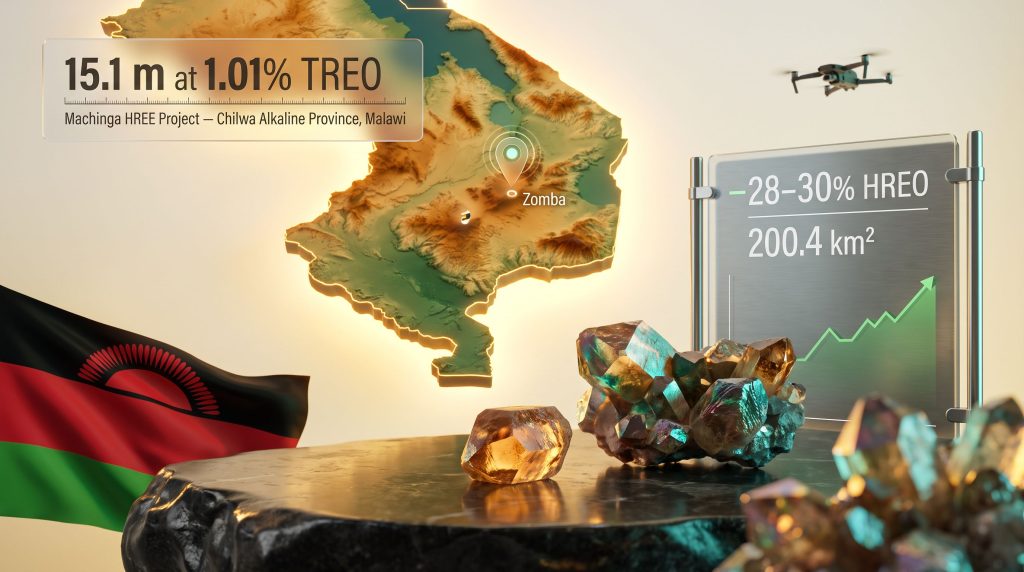
The exploration record at Machinga, assembled through work conducted by DY6 Metals and Tusker Minerals prior to the AuKing Mining Machinga HREE project acquisition, provides a substantive dataset for technical evaluation. The key metrics are summarised below:
| Metric | Detail |
|---|---|
| Total Licence Area | ~200.4 km² across two licences |
| Location | ~20 km north of Zomba, southern Malawi |
| Defined Strike Length | ~2 km |
| Best Drill Intercept | 15.1 m at 1.01% TREO + niobium |
| Grade Range Across Holes | 0.6% to 1.4% TREO |
| HREO as % of Total REE | ~28 to 30% |
| Geological Host | Alkaline igneous system |
| Surface Exposure | Yes, supporting open-pit potential |
The 28 to 30% HREO proportion deserves particular emphasis. Most ionic clay deposits currently supplying global HREE markets report HREO fractions in the range of 15 to 25% of total rare earth content. Machinga's alkaline igneous system appears to consistently deliver above-average heavy rare earth enrichment, which translates directly into higher contained value per tonne of mineralised material when dysprosium and terbium prices are factored into any preliminary economic modelling.
The presence of associated critical minerals including niobium, tantalum, zirconium, and uranium further expands the project's multi-commodity optionality. Niobium, in particular, is a high-value critical mineral used in high-strength steel alloys, with its own supply concentration risk given Brazil's near-monopoly on global production.
How the Acquisition Is Structured: A Risk-Calibrated Approach
The financial architecture of the AuKing Mining Machinga HREE project acquisition reflects a deliberate effort to balance vendor compensation with the exploration risk inherent in a pre-resource stage asset. Rather than a single upfront payment, the deal employs a staged consideration framework:
- Exclusivity Payment: A$5,000 non-refundable, paid to secure exclusive access during the due diligence phase
- Completion Cash Payment: A$750,000 payable upon MMRA regulatory approval and licence transfer to an AuKing subsidiary
- Completion Share Issuance: A$750,000 in ordinary shares at a fixed price of A$0.025 per share
- Deferred Cash Payment: A$1.25 million payable within 12 months of completion
- Performance Shares: A$1.25 million, contingent on achieving a defined JORC resource milestone within three years
Total maximum consideration: up to A$4 million
The performance share mechanism is particularly instructive from an investor perspective. The milestone requires AuKing to report a JORC 2012-compliant mineral resource of at least 10 million tonnes at 0.65% TREO within three years of completing the acquisition. Furthermore, understanding mineral deposit tiers is essential context for appreciating why this threshold represents a commercially meaningful starting point in the global HREE landscape.
Investor Note: The 10 Mt at 0.65% TREO threshold, while modest in absolute scale, represents a commercially meaningful starting point. At those parameters, a deposit would contain approximately 65,000 tonnes of total rare earth oxide, of which roughly 18,000 to 19,500 tonnes would be HREO at the reported enrichment ratio. That contained HREO tonnage, if confirmed, would attract serious attention from offtake and strategic investors. These figures are illustrative based on the stated parameters and should not be taken as a confirmed resource estimate.
The primary closing condition remains approval from Malawi's Mining and Minerals Regulatory Authority (MMRA) for the transfer of the two exploration licences. Until that approval is secured, the transaction remains conditional.
AuKing's Malawi Strategy: Building Jurisdictional Depth
The Machinga acquisition does not exist in isolation. It forms the second pillar of a deliberate geographic concentration strategy in Malawi, sitting alongside the company's existing Tundulu REE Project in the same country. This dual-asset approach within a single jurisdiction creates operational and strategic advantages that a scattered multi-country portfolio cannot replicate.
| Attribute | Machinga HREE Project | Tundulu REE Project |
|---|---|---|
| Primary Focus | Heavy rare earths + niobium | Rare earth elements |
| Geological Host | Alkaline igneous system | Chilwa Alkaline Province |
| HREO Enrichment | ~28 to 30% of TREO | Not specified |
| Exploration Stage | Historical drilling, pre-resource | Advanced exploration |
| Licence Area | ~200.4 km² | To be confirmed |
Building expertise and relationships within a single regulatory jurisdiction reduces per-project administrative overhead, accelerates community engagement, and creates the potential for shared infrastructure development across projects. For an ASX-listed junior explorer operating with limited capital, these jurisdictional efficiencies can be the difference between a sustainable exploration programme and a cash-constrained stall.
Beyond Malawi, AuKing separately announced in March 2025 an agreement to acquire up to a 50% shareholding in Orion Resources, the proposed owner of the Cloncurry Gold Project in northern Queensland. This dual-commodity structure provides the company with exposure to both the energy transition minerals demand cycle and the more established precious metals market.
The next major ASX story will hit our subscribers first
Key Risk Factors Every Investor Should Assess
The AuKing Mining Machinga HREE project acquisition carries a risk profile typical of frontier jurisdiction, pre-resource exploration. Investors should evaluate the following categories carefully:
- Regulatory and jurisdictional risk: Malawi is a frontier mining jurisdiction. While the country has historically demonstrated openness to foreign mining investment, processing timelines at the MMRA can vary and are not subject to predictable scheduling
- Exploration and resource definition risk: No JORC-compliant resource exists at Machinga. Historical drilling results are encouraging but do not constitute a formal mineral resource under any internationally recognised reporting standard
- Commodity price risk: HREE pricing, particularly for dysprosium and terbium, is highly sensitive to Chinese export policy. A shift in Chinese export controls or a relaxation of restrictions could materially affect the economic case for non-Chinese HREE development
- Financing risk: The deferred A$1.25 million cash payment due within 12 months of completion, combined with the capital requirements of a meaningful drilling programme, will test AuKing's access to equity and debt markets
- Metallurgical risk: Hard rock alkaline igneous deposits present different processing challenges compared to ionic clay deposits. While the HREE enrichment profile is advantageous, metallurgical testwork will ultimately determine the recovery rates and processing costs that govern economic viability
The Exploration Roadmap: What Comes After MMRA Approval?
Assuming MMRA approval is obtained in the second half of 2026, AuKing has outlined a systematic exploration methodology designed to efficiently advance Machinga toward a JORC resource estimate. Completing a definitive feasibility study remains a longer-term objective, but the near-term programme establishes the technical foundations necessary to reach that stage.
| Milestone | Expected Timing | Significance |
|---|---|---|
| MMRA Licence Transfer Approval | H2 2026 | Primary closing condition |
| Historical Data Integration | Post-completion | Establishes unified geological model |
| Drone Magnetic Surveys | Post-completion | Maps subsurface structural controls |
| LiDAR Topographic Surveys | Post-completion | Supports drill targeting and mine planning |
| Initial Drilling Campaign | Late 2026 (subject to approvals, rig availability, and weather) | First new resource data under AuKing ownership |
| JORC Resource Estimate | Within 3 years of completion | Performance share conversion trigger |
The deployment of drone magnetic surveying and LiDAR (Light Detection and Ranging) technology represents an increasingly standard toolkit for modern rare earth exploration. Drone magnetics can rapidly map the subsurface expression of alkaline intrusive bodies at a fraction of the cost of conventional fixed-wing surveys, while LiDAR produces centimetre-scale topographic datasets that are invaluable for planning drill collar locations in areas with significant surface cover or irregular terrain.
How Machinga Stacks Up Against Global HREE Benchmarks
To contextualise Machinga's significance, it is useful to compare its HREE enrichment profile against the broader landscape of global projects:
| Project | Location | Geological Host | HREO Enrichment | Development Status |
|---|---|---|---|---|
| Machinga | Malawi | Alkaline igneous | ~28 to 30% TREO | Pre-resource, exploration |
| Bokan-Dotson Ridge | Alaska, USA | Alkaline igneous | Elevated HREO | Advanced exploration |
| Kangankunde | Malawi | Carbonatite/alkaline | Light REE dominant | Advanced |
| Southern China ionic clays | China | Ionic clay weathering | 15 to 25% HREO (typical) | Active production |
The comparison with Chinese ionic clay deposits is especially relevant because those deposits currently set the price reference for HREE supply globally. A deposit delivering 28 to 30% HREO-to-TREO ratios from a hard rock alkaline system offers a potentially superior grade profile on a relative basis, though processing costs for hard rock systems are generally higher than for ionic clays, which can be processed using simple in-situ leaching techniques.
This processing cost differential is one of the less-discussed risks in HREE project evaluations outside China. Ionic clay deposits benefit from extremely low-cost extraction chemistry, which partially offsets their lower HREE grades. Hard rock HREE projects must demonstrate that their metallurgical recoveries and processing economics can compete with this low-cost baseline, and that work has not yet commenced at Machinga.
Frequently Asked Questions: AuKing Mining Machinga HREE Project Acquisition
What is the Machinga HREE Project?
The Machinga Heavy Rare Earth Elements Project is a 200.4 km² exploration-stage asset in southern Malawi, comprising two exploration licences approximately 20 km north of Zomba. It sits within the Chilwa Alkaline Province and is characterised by heavy rare earth enrichment of approximately 28 to 30% HREO as a proportion of total rare earth oxide content, with associated niobium, tantalum, zirconium, and uranium mineralisation.
Who is selling the Machinga project?
The project is being acquired from Tusker Minerals, which conducted exploration at Machinga in partnership with DY6 Metals prior to the transaction, providing an independent geological dataset for AuKing's due diligence process.
What is the total consideration for the acquisition?
Maximum total consideration is up to A$4 million, structured across an upfront cash payment, shares at completion, deferred cash within 12 months, and performance shares tied to a JORC resource milestone.
What triggers the performance share conversion?
AuKing must define a JORC 2012-compliant mineral resource of at least 10 million tonnes at 0.65% TREO within three years of completing the acquisition for the A$1.25 million in performance shares to convert.
When could drilling begin at Machinga?
Subject to MMRA regulatory approval, rig availability, and seasonal weather conditions in southern Malawi, AuKing has indicated that initial drilling could commence in late 2026.
Strategic Takeaways
The AuKing Mining Machinga HREE project acquisition is best understood not as a single transaction, but as a deliberate portfolio construction decision within one of the world's most geologically prospective alkaline rare earth provinces. Consequently, several dimensions stand out for investors assessing the opportunity:
- The 28 to 30% HREO-to-TREO ratio positions Machinga above the typical range for ionic clay deposits that currently dominate global HREE supply, representing a genuine geological differentiator
- The staged consideration structure limits upfront capital exposure while performance-linked payments align vendor incentives with resource definition outcomes
- The Chilwa Alkaline Province cluster strategy, combining Machinga and Tundulu under a single ASX-listed vehicle, creates jurisdictional depth and operational efficiency advantages
- MMRA approval and late 2026 drilling results are the two near-term catalysts that will define the pace and trajectory of value creation at the project
- The associated niobium and tantalum mineralisation provides commodity diversification within a single project footprint, potentially supporting multiple revenue streams at the feasibility stage
This article is intended for informational purposes only and does not constitute financial advice. Statements regarding future events, timelines, resource estimates, and economic outcomes are forward-looking in nature and subject to material risks and uncertainties. Readers should conduct their own independent research and consult a licensed financial adviser before making any investment decisions. All financial figures are denominated in Australian dollars unless otherwise stated.
Want to Catch the Next Major Mineral Discovery Before the Market Does?
Discovery Alert's proprietary Discovery IQ model delivers real-time ASX alerts on significant mineral discoveries — including critical minerals like rare earths — instantly converting complex geological data into actionable investment insights for both short-term traders and long-term investors. Start your 14-day free trial today and explore historic discoveries that have generated exceptional returns to understand why early positioning in transformative finds can be so consequential.