August 4, 2026
The Hidden Bottleneck Threatening America's Drone Ambitions
Every technological race eventually runs into a materials problem. The semiconductor era exposed the world's dependence on advanced fabrication concentrated in Taiwan. The electric vehicle transition revealed how deeply battery supply chains were embedded in Chinese processing capacity. Now, as autonomous aerial systems move from novelty to strategic necessity, a quieter but equally consequential vulnerability is coming into focus: the rare earth permanent magnets that make drone motors spin.
This is not a peripheral concern. It sits at the physical heart of every drone that lifts off, from commercial delivery platforms to military surveillance assets. Unlike software or sensor technology, however, you cannot iterate your way around a magnet supply chain problem with a firmware update.
Understanding why MP Materials Project Swarm drone magnets represent a structural response to a structural problem requires examining both the physics of drone propulsion and the industrial geography of rare earth production simultaneously.
When big ASX news breaks, our subscribers know first
Why Drone Motors Cannot Compromise on Magnet Quality
The Physics of Permanent Magnets in Electric Propulsion
At the most fundamental level, every brushless electric motor in a drone relies on the interaction between a rotating magnetic field and a permanent magnet to generate torque. The efficiency of that conversion, measured in watts of mechanical output per gram of motor weight, determines how long a drone can fly, how much it can carry, and how precisely it can manoeuvre.
Neodymium-iron-boron (NdFeB) permanent magnets deliver the highest energy density of any commercially available magnet material. Their exceptional performance derives primarily from the crystalline structure formed by the light rare earth elements neodymium (Nd) and praseodymium (Pr), which generates the intense magnetic flux density required for high-efficiency energy conversion in compact form factors.
For drone applications specifically, this matters enormously. Every gram added to a motor magnet assembly directly reduces available payload capacity or shortens flight duration. No substitute material currently available approaches NdFeB performance at comparable weight, which makes these magnets functionally irreplaceable in high-performance drone design.
The Role of Heavy Rare Earths: Performance Versus Supply Chain Risk
Where the materials science becomes particularly nuanced is in the addition of heavy rare earth elements to the NdFeB base composition. Two elements dominate this application:
| Heavy Rare Earth Element | Primary Function | Drone-Specific Benefit |
|---|---|---|
| Dysprosium (Dy) | Increases coercivity, resists demagnetisation | Maintains motor performance during sustained or high-temperature flight |
| Terbium (Tb) | Enhances thermal stability and peak magnetic strength | Critical for military-grade and high-endurance autonomous platforms |
The tension here is real. Adding dysprosium or terbium to an NdFeB magnet improves its resistance to demagnetisation at elevated temperatures, which directly extends motor lifespan in demanding operational conditions. Furthermore, both elements add weight, increase cost, and introduce exposure to arguably the most geopolitically constrained segment of the rare earth supply chains. China's dominance over heavy rare earth production exceeds even its already commanding position in light rare earths.
This trade-off between performance and supply chain resilience is one of the central engineering challenges that MP Materials is attempting to resolve through its grain boundary diffusion (GBD) process under development at the planned 10X facility. Rather than distributing heavy rare earth elements uniformly throughout the magnet bulk, GBD concentrates them specifically at the crystallographic grain boundaries where demagnetisation originates. The result, if successfully commercialised at scale, could achieve equivalent or superior coercivity using a fraction of the heavy rare earth content required by conventional sintering methods.
The Supply Concentration Problem in Hard Numbers
The scale of China's control over the rare earth processing and magnet supply chain is difficult to overstate. According to International Energy Agency data for 2024, the concentration across the full production chain looks like this:
| Supply Chain Stage | China's Estimated Global Share (2024) |
|---|---|
| Rare earth mining output | ~60% |
| Refined rare earth production | ~91% |
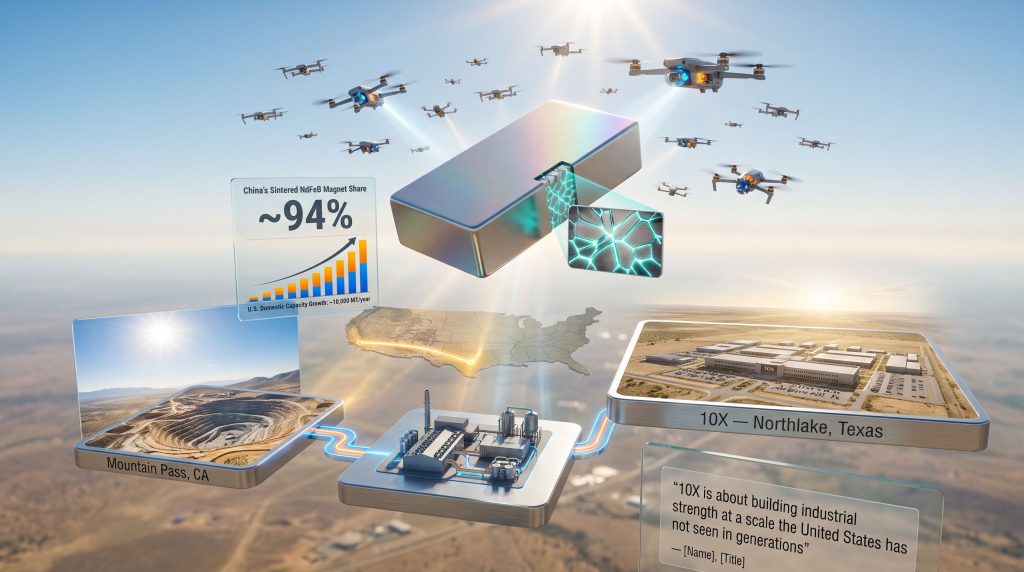
| Sintered NdFeB permanent magnet manufacturing | ~94% |
The sintered NdFeB figure is the one that matters most for drone manufacturers. Sintered magnets, produced by compacting and heat-treating rare earth alloy powder under precisely controlled conditions, deliver the highest magnetic performance and are the standard production method for drone motor magnets. With approximately 94% of global sintered NdFeB production concentrated in a single country, the supply chain for high-performance drone motors effectively passes through one chokepoint.
For defence planners, this represents exactly the kind of single-point-of-failure vulnerability that strategic supply chain analysis is designed to identify and mitigate. A disruption to sintered magnet exports from China would not gradually degrade U.S. drone production capacity; it would halt it.
What MP Materials Project Swarm Actually Does
Demand Aggregation as an Industrial Mechanism
The core insight behind the MP Materials Project Swarm drone magnets initiative is that the drone sector's supply chain problem is not primarily a production problem. It is a demand coordination problem, and consequently one that requires a coordinated market solution.
Building a world-class domestic NdFeB magnet manufacturing facility requires multi-year demand visibility. A producer investing over a billion dollars in sintering capacity needs confidence that customers will actually purchase the output when the facility comes online. In mature industries like automotive, a handful of large OEMs can provide that demand signal. In the drone sector, however, demand is distributed across potentially hundreds of manufacturers, most of whom individually lack the purchasing scale to anchor a domestic supply chain investment.
America's rare earth supply chain challenge is precisely what Project Swarm addresses, by pooling non-binding capacity reservations across the entire U.S. and allied drone manufacturing ecosystem. The participating companies span drone manufacturers, electric motor developers, propulsion system designers, defence technology firms, and commercial autonomous aircraft operators, collectively creating a demand signal that no individual company could generate independently.
The Non-Binding Reservation Architecture: Why Flexibility Is the Point
One of the more technically sophisticated aspects of the Project Swarm design is its deliberate avoidance of binding upfront purchase commitments. This is not a concession to market weakness; it is a recognition of how drone technology actually evolves.
Drone platforms at the design stage in 2026 may look substantially different by 2028 when the 10X campus is scheduled to begin commissioning. Motor geometries change. Power requirements shift. Magnet specifications that are optimal today may be suboptimal in two years. Traditional supply contracts, which require precise volume and specification commitments years in advance, are structurally incompatible with this rate of technological change.
The Project Swarm reservation model allows participating companies to:
- Secure priority access to domestic magnet production capacity without locking in specifications prematurely
- Retain the ability to refine technical requirements as their drone programmes mature
- Access MP Materials' engineering team for ongoing magnet design optimisation
- Potentially receive preferential access to earlier magnet output from the existing Independence facility in Fort Worth, Texas, ahead of 10X commissioning
This architecture mirrors, in conceptual terms, how advanced semiconductor foundries use capacity reservation frameworks to align long-term fab investment with customer demand, applied for the first time to rare earth magnet production at meaningful scale. For further context on this approach, MP Materials' official announcement outlines the strategic rationale behind the programme in detail.
The 10X Facility: Industrial Infrastructure at a Generational Scale
Site Selection and Investment Commitment
MP Materials selected a 120-acre site in Northlake, Texas, for its 10X campus in February 2026. The location places the new facility within 10 miles of the existing Independence metals and magnets plant in Fort Worth, a geographic decision with significant industrial logic behind it.
Locating magnet manufacturing within close proximity to the upstream metals processing facility eliminates inter-facility logistics costs, reduces transit-related quality risks for sensitive rare earth alloy materials, and creates the kind of integrated industrial clustering that has historically given vertically integrated rare earth producers a structural cost advantage.
The key parameters of the 10X investment are:
- Planned capital investment: More than $1.25 billion
- Target NdFeB magnet capacity: Approximately 10,000 metric tons annually (combined U.S. total)
- Commissioning schedule: Targeted to begin in 2028
- Key technology: MP-developed grain boundary diffusion process for heavy rare earth reduction
- Current status: Engineering and equipment procurement underway as of mid-2026
The Integrated Supply Chain Architecture
What distinguishes the MP Materials approach from standalone magnet manufacturing proposals is the mine-to-magnet integration that gives the system genuine supply chain sovereignty. Each stage in this chain is domestically controlled, eliminating the dependency on Chinese processing at any intermediate step. This is the aspect of the MP Materials model that most directly addresses the defence establishment's concerns about systemic supply chain vulnerability, and it reflects a broader shift in how policymakers are approaching rare earth geopolitics at a national level.
Drone Magnet Demand: Small Today, Strategically Large Tomorrow
Current Market Size and the Fragmentation Discount
S&P Global reported in April 2026 that the drone sector consumed an estimated 3,000 to 8,000 metric tons of rare earth permanent magnets in 2025, drawing on Rare Earth Exchanges data. At current global rare earth magnet demand of approximately 200,000 to 250,000 metric tons annually, this represents roughly 3% of total consumption.
That figure, however, understates the sector's strategic significance in several important ways. The 3% share reflects a highly fragmented purchasing base where hundreds of manufacturers each consume modest volumes. It also reflects a sector that is still in the early stages of its scaling trajectory, with critical minerals demand set to accelerate sharply across multiple end markets through the late 2020s.
The Scale Mathematics of Drone Production
Using a conservative estimate of approximately 50 grams of magnet content per drone, a figure MP Materials has used in its own illustrative analysis, the volume implications of drone production growth become clear:
| Annual Drone Production Volume | Estimated Magnet Requirement |
|---|---|
| 100,000 drones | ~5 metric tons |
| 1,000,000 drones | ~50 metric tons |
| 10,000,000 drones | ~500 metric tons |
| 100,000,000 drones | ~5,000 metric tons |
The drone sector's magnet demand curve is fundamentally different from mature end markets. Unlike electric vehicles, where demand growth is driven by a relatively small number of large OEMs with established procurement infrastructure, drone demand will emerge from hundreds of manufacturers across dozens of application verticals simultaneously.
As an independent analysis from the Columbia University Energy Policy programme notes, the MP Materials model marks a significant shift in how U.S. rare earths policy is being operationalised at an industrial level.
The next major ASX story will hit our subscribers first
The 2027 Defence Procurement Deadline: A Hard Catalyst
What the Expanded NdFeB Restriction Means in Practice
Effective January 1, 2027, U.S. defence procurement restrictions for NdFeB magnets expand significantly. The new rules extend coverage to the entire mine-to-magnet supply chain in designated covered countries, meaning that a magnet produced using Chinese-sourced rare earth materials fails the compliance test regardless of where final magnet manufacturing occurred.
This is a materially stricter standard than previous procurement rules, which focused more narrowly on the manufacturing origin of finished magnets. The 2027 expansion closes the processing-stage loophole that allowed some manufacturers to claim compliance whilst still relying on Chinese rare earth refining and alloying.
Implications for Defence Drone Programmes
For drone manufacturers with defence customers or aspirations, the timeline pressure is significant:
- Qualification timelines for new magnet suppliers typically run 12 to 24 months, meaning manufacturers who have not begun supply chain transition work by mid-2026 face genuine risk of disqualification from defence contracts starting January 2027.
- Programme documentation requirements for defence procurement now require traceability through the entire supply chain, increasing the administrative burden of demonstrating compliance.
- Non-compliant inventory sourced before the deadline does not automatically grandfather programmes into compliance for ongoing production requirements.
Project Swarm's reservation model consequently provides a mechanism for defence-adjacent drone manufacturers to establish documented supply chain intent with a compliant domestic producer, without requiring immediate fixed-volume commitments during a period when programme volumes may still be uncertain.
Comparing Supply Chain Models: Traditional Procurement vs. Project Swarm
| Dimension | Traditional Procurement | Project Swarm Architecture |
|---|---|---|
| Commitment structure | Binding volume contracts | Non-binding capacity reservations |
| Specification flexibility | Fixed at contract execution | Adjustable as technology evolves |
| Engineering support | Typically transactional | Integrated design optimisation access |
| Domestic supply priority | Unguaranteed | Reserved priority access |
| Barrier to entry | High (favours large OEMs) | Lowered through collective aggregation |
| Supply chain transparency | Partial | End-to-end U.S. mine-to-magnet visibility |
| Defence procurement compliance | Manufacturer's responsibility | Inherently structured for compliant sourcing |
The comparison illuminates why the traditional procurement model has failed to produce domestic rare earth magnet capacity for the drone sector despite years of recognised supply chain vulnerability. Individual companies operating under traditional procurement frameworks simply cannot generate the demand signal required to justify billion-dollar domestic manufacturing investment. Project Swarm, however, changes the economic calculus by aggregating that demand before the facility exists.
Standardisation: The Underappreciated Benefit of Aggregated Demand
One aspect of Project Swarm that receives less attention than its supply security function is its potential to drive magnet specification standardisation across the U.S. drone industry.
Currently, the hundreds of drone manufacturers active in the U.S. market specify magnet geometries, grade requirements, and coating specifications independently, resulting in an enormous proliferation of custom magnet variants. For a domestic producer attempting to manufacture at scale, this fragmentation creates significant production complexity, reduces throughput efficiency, and inflates per-unit costs.
A coordinated participant base gives MP Materials a platform to work with drone designers toward rationalised specification families that reduce manufacturing complexity whilst maintaining or improving performance requirements. This standardisation benefit compounds over time: as more manufacturers align around common specifications, domestic production economics improve, which in turn makes domestic sourcing more cost-competitive relative to Chinese alternatives.
Key Takeaways for Industry Stakeholders
- China controls approximately 94% of global sintered NdFeB magnet manufacturing, creating a critical single point of failure for U.S. autonomous systems dependent on high-performance motors
- The drone sector consumed an estimated 3,000 to 8,000 metric tons of rare earth permanent magnets in 2025, representing only the beginning of a rapidly accelerating demand curve
- The MP Materials Project Swarm drone magnets initiative addresses a market coordination failure by aggregating non-binding capacity reservations across hundreds of manufacturers, creating the demand visibility needed to justify over $1.25 billion in domestic manufacturing investment
- The January 1, 2027 defence procurement deadline creates urgent compliance pressure for drone manufacturers serving military customers, with qualification timelines that make immediate supply chain action necessary
- The grain boundary diffusion technology under development at 10X could substantially reduce heavy rare earth content requirements for high-performance drone magnets, addressing both cost structure and supply chain resilience simultaneously
- The Project Swarm model has potential applicability beyond drones to ground robotics, underwater autonomous vehicles, and industrial automation platforms that share the same fundamental magnet requirements
Disclaimer: This article contains forward-looking statements regarding manufacturing timelines, capacity targets, and market projections. These involve inherent uncertainties and should not be construed as investment advice. Readers should conduct independent research before making any investment decisions related to companies or sectors discussed herein.
Want to Track the Next Major Rare Earth or Critical Minerals Discovery Before the Market Moves?
Discovery Alert's proprietary Discovery IQ model scans ASX announcements in real time, instantly identifying significant mineral discoveries across rare earths, critical minerals, and over 30 other commodities — turning complex data into actionable investment insights. Explore historic discoveries and their market returns to understand the scale of opportunity, then begin your 14-day free trial at Discovery Alert to position yourself ahead of the broader market.