August 3, 2026
The Invisible Bottleneck: Why Heavy Rare Earth Scarcity Is Reshaping Global Industrial Strategy
The global rare earth industry is undergoing a structural transformation that few outside specialist circles fully appreciate. For most of the past three decades, the conversation centred on a single, overwhelming fact: China controlled the overwhelming majority of the world's rare earth mining, processing, and separation capacity. That reality has not disappeared, but it has changed considerably, and the nature of the vulnerability has shifted in ways that carry profound implications for manufacturers of electric vehicles, wind turbines, guided missiles, and aerospace systems.
Understanding where that vulnerability now sits, and why Malaysia's ongoing Malaysia rare earth export review sits at the heart of efforts to address it, requires stepping back from the headline policy announcements and examining the underlying supply chain architecture.
When big ASX news breaks, our subscribers know first
From Near-Monopoly to One-Third: How Ex-China Production Has Grown
Approximately fifteen years ago, China accounted for somewhere between 85% and 97% of global rare earth mine production, depending on the year measured, according to U.S. Geological Survey data. That degree of concentration was extraordinary by any commodity standard and reflected decades of deliberate industrial policy, low-cost production, and limited competition from outside Chinese borders.
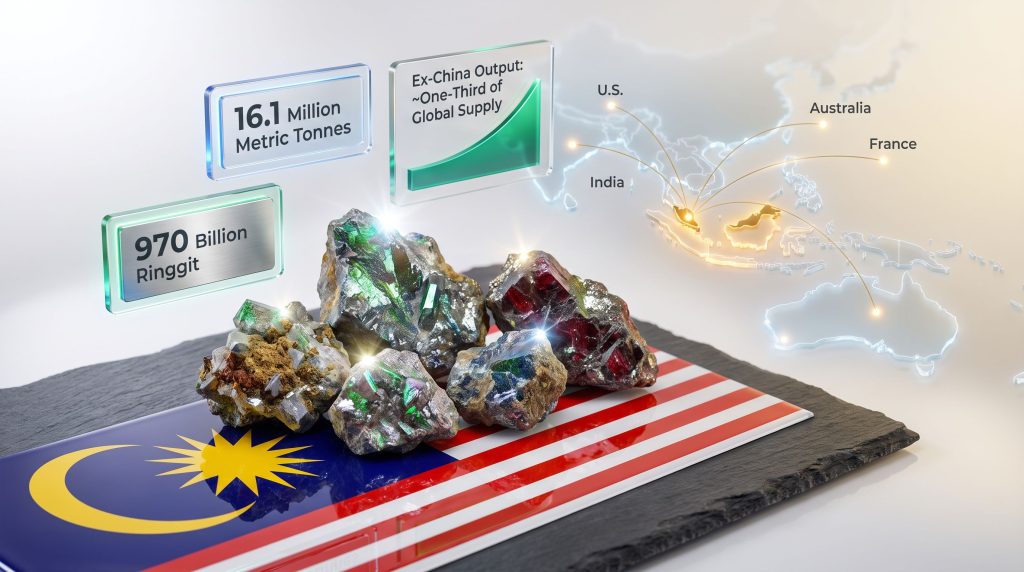
Today, the picture is meaningfully different. Ex-China production now accounts for nearly one-third of global rare earth output, a structural shift built on a combination of geopolitical pressure from Western governments, corporate supply chain resilience strategies following China's 2010 rare earth export quota crisis, and the maturation of projects in Australia, the United States, and elsewhere.
The USGS data tracking China's share of global rare earth mine production between 2020 and 2025 confirms a clear downward trajectory in China's dominance at the mining stage. However, the more revealing story lies not in the headline production figures, but in which rare earth elements are being produced outside China, and which remain concentrated inside it.
The Split That Most Investors Miss
Not all rare earths face the same supply dynamics, and conflating them into a single category obscures where the real strategic risk lies. The rare earth family of 17 elements divides broadly into two groups with very different market realities:
- Light rare earth elements (LREEs): Neodymium (Nd) and praseodymium (Pr) are the most commercially significant, used in neodymium-iron-boron (NdFeB) permanent magnets. Ex-China supply of these elements has expanded substantially, with multiple producers now operational outside China.
- Heavy rare earth elements (HREEs): Dysprosium (Dy), terbium (Tb), and samarium (Sm) are produced in far smaller volumes globally and have seen very limited commercial separation capacity develop outside China until very recently.
The critical insight here is that as ex-China light rare earth supply expanded, it actually reduced China's ability to exert leverage over neodymium and praseodymium specifically, because those elements became too widely available to restrict effectively. China's strategic leverage consequently migrated toward the heavier, scarcer elements where alternative supply remained virtually absent. Understanding heavy rare earth supply chains is therefore essential to grasping the full scope of this challenge.
Why Heavy Rare Earths Are Functionally Irreplaceable
The reason dysprosium and terbium command such strategic attention is rooted in physics rather than politics. NdFeB magnets, which power the traction motors in electric vehicles and the generators in direct-drive wind turbines, lose magnetic performance as operating temperatures rise. The addition of dysprosium and terbium to the magnet alloy maintains coercivity (resistance to demagnetisation) at elevated temperatures, which is a non-negotiable requirement for high-performance applications.
Without dysprosium doping in particular, EV motors operating under sustained load conditions risk partial demagnetisation, which translates to performance degradation and potential failure. There is no commercially viable substitute for this function at scale. Samarium, furthermore, underpins samarium-cobalt (SmCo) magnets, which operate at even higher temperatures and are preferred in defence and satellite applications where size, weight, and thermal tolerance are paramount.
| Rare Earth Type | Key Elements | Ex-China Supply Status | Strategic Risk Level |
|---|---|---|---|
| Light Rare Earths | Neodymium (Nd), Praseodymium (Pr) | Expanding, multiple ex-China producers operational | Moderate and declining |
| Heavy Rare Earths | Dysprosium (Dy), Terbium (Tb), Samarium (Sm) | Very limited, commercial separation outside China only recently emerging | High and persistent |
"The functional irreplaceability of heavy rare earths in high-temperature magnetic applications means that supply diversification efforts which focus solely on light rare earth production address only part of the structural vulnerability facing Western manufacturers."
The Malaysia Rare Earth Export Review: What Is Actually Being Decided
Against this backdrop, Malaysia's ongoing policy deliberations take on considerable significance. Malaysia's Ministry of Natural Resources and Environmental Sustainability (NRES) is currently reviewing a conditional export framework that would permit limited exports of unprocessed rare earths, but only where tied to concrete investment commitments, technology transfer agreements, and research or development obligations from the importing party.
This is an important distinction. Malaysia is not considering a simple resumption of open rare earth exports. The framework under review is designed as a negotiating instrument, one that extracts downstream industrial value in exchange for access to Malaysian ore. It is closer in concept to Indonesia's approach to nickel, where raw ore export restrictions were used to compel foreign investment in domestic smelting and processing infrastructure, than it is to a conventional commodity export policy.
The rare earth processing challenges inherent in developing viable domestic refining capacity make this conditional framework even more consequential for the region's long-term industrial ambitions.
The Timeline of Malaysia's Rare Earth Export Policy
| Year | Policy Development |
|---|---|
| 2023 | Government announces intention to prohibit raw rare earth exports to incentivise domestic processing |
| 2024 | Moratorium on unprocessed rare earth exports formally implemented |
| October 2025 | Raw export ban confirmed as remaining in place despite a bilateral U.S. critical minerals agreement; policy stated to apply universally to all nations |
| 2026 | NRES initiates review of conditional export framework; foreign interest cited from the U.S., Australia, France, and India |
A detail worth noting: the October 2025 confirmation that the moratorium applies to all countries equally, including the United States despite an existing bilateral critical minerals agreement, signals that Malaysia is not prepared to offer preferential raw material access through diplomatic side arrangements. Any access must come through the formal conditional framework, with investment and technology transfer as the price of admission.
The Scale of Malaysia's Resource Base
Malaysia holds an estimated 16.1 million metric tonnes of inferred rare earth resources, with a government-cited value of approximately 970 billion ringgit. Several important caveats apply to these figures.
First, inferred resources represent the lowest confidence category in the standard mineral resource classification system (JORC or CRIRSCO-equivalent frameworks). They indicate geological plausibility rather than economically extractable reserves, which require significantly more drilling, metallurgical testing, and economic assessment to confirm.
Second, Malaysia's rare earth deposits are predominantly ionic clay deposits, particularly concentrated in the states of Pahang, Kelantan, and Terengganu. Ionic clay deposits present a specific processing profile: they tend to be enriched in heavy rare earth elements relative to hard rock deposits like those found in Australia. This mineralogical characteristic is precisely what makes Malaysia's resource base strategically interesting to ex-China processors who are specifically trying to secure HREE feedstock.
"The heavy rare earth enrichment profile of Malaysia's ionic clay deposits distinguishes them from many other ex-China rare earth resources and explains why nations with advanced processing ambitions, rather than simply mining interests, are most actively pursuing access."
According to research published on rare earth processing in Malaysia, the country's processing history and mineralogical profile position it uniquely within the global supply chain, reinforcing why the Malaysia rare earth export review carries implications well beyond its borders.
Which Ex-China Processors Are Building Separation Capacity
The growth in ex-China production is not evenly distributed across the rare earth value chain. Mining has diversified faster than separation, and separation has diversified faster than magnet alloy production. The most strategically consequential bottleneck today is at the separation stage, where ore concentrates are chemically processed into individual rare earth oxides suitable for downstream manufacturing.
Four processors represent the most advanced ex-China separation capacity currently:
- Lynas Rare Earths (Australia/Malaysia): Already the most significant ex-China rare earth processor globally, with operations in Malaysia and an expanding facility in Western Australia. Lynas processes predominantly light rare earths from its Mount Weld mine but has been developing heavy rare earth capabilities.
- Neo Performance Materials (Estonia/Canada): Has reached commercial production outside China, with separation operations in Europe that contribute meaningfully to ex-China processing diversity.
- MP Materials (United States): Targeting commercial startup within months, representing a significant expansion of U.S.-based rare earth processing capacity at the Mountain Pass facility in California.
- Carester SAS (France): A European processor also targeting commercial rare earth separation production within months, adding geographic diversification to ex-China capacity and serving the European industrial supply chain.
The critical observation here is that these milestones, measured in actual tonnes of separated oxide produced commercially, provide a more reliable signal of genuine supply diversification than policy announcements, which can be revised, delayed, or reversed. Commercial production is a fact; a policy review is a process.
Malaysia's Conditional Framework: Scenarios and Implications
The absence of an implementation timeline for Malaysia's conditional export framework is the primary source of uncertainty in this analysis. NRES has not confirmed when, or whether, the framework will be formally adopted, leaving the policy catalyst indeterminate.
Base Case: Conditional Framework Adopted
- Malaysia opens a portion of its 16.1 million metric tonne resource base to foreign refiners under structured investment and technology-transfer conditions
- HREE-enriched ionic clay feedstock becomes available to ex-China processors, including those targeting commercial startup
- The U.S., Australia, France, and India gain structured access to Malaysian materials under bilateral arrangements embedded within the conditional framework
- Ex-China supply diversification accelerates, particularly for the heavy rare earth feedstock that remains most constrained
Bear Case: Framework Remains Under Review
- The moratorium continues without an implementation timeline, maintaining feedstock constraints for ex-China processors
- Ex-China supply diversification proceeds more slowly, reliant on existing feedstock sources that are predominantly light rare earth enriched
- Heavy rare earth supply vulnerability persists, sustaining China's residual strategic leverage over the most critical technology supply chains
- Malaysia risks allowing competing jurisdictions, including parts of Southeast Asia and Sub-Saharan Africa with emerging ionic clay rare earth potential, to develop more responsive foreign mineral access policies
The Precedent Question
A less-discussed but potentially significant dimension of Malaysia's policy is the precedent it would set for other resource-holding nations. If the conditional framework is adopted and successfully links technology transfer obligations to raw material access, it would validate a model that several other nations with underdeveloped rare earth processing infrastructure are watching closely.
Countries like Madagascar, Tanzania, and those with Greenland critical minerals potential, which hold rare earth resources but lack domestic processing capability, could adopt similar conditional frameworks, gradually restructuring how Western processors source their feedstock globally.
The next major ASX story will hit our subscribers first
The Global Context: Why Multiple Nations Are Competing for Malaysian Access
The stated interest from the United States, Australia, France, and India in accessing Malaysian rare earth materials reflects each nation's distinct strategic posture rather than a coordinated Western approach. Furthermore, the broader critical minerals demand surge across clean energy and defence sectors is intensifying competition for access to any credible ex-China feedstock source.
- The United States is pursuing rare earth supply security as part of a broader critical minerals strategy aimed at reducing import dependency, particularly for defence-relevant materials including dysprosium and samarium.
- Australia is simultaneously a rare earth producer and a processor-in-development, with interests in both securing complementary HREE feedstock for domestic processing facilities and maintaining strategic alignment with Western supply chain partners.
- France, through Carester SAS, represents European industrial interests in securing rare earth separation capacity that serves the EU's automotive and defence manufacturing base, consistent with the objectives of the EU critical raw materials transition framework.
- India is developing its own rare earth processing ambitions through state-owned enterprises and is seeking feedstock access to reduce its own dependence on Chinese-processed materials for its growing electronics and defence sectors.
Analysis from the East Asia Forum on Malaysia's rare earth strategy underscores that balancing sustainability concerns with industrial ambition will be central to how effectively Malaysia leverages its position in this competitive environment.
Key Metrics to Monitor: Malaysia Rare Earth Export Review Watchlist
For those tracking the Malaysia rare earth export review and its implications for global supply chain diversification, the following indicators represent the most meaningful near-term signals:
| Metric | Current Status | What to Watch For |
|---|---|---|
| NRES conditional export framework | Under review, no implementation date | Announcement of a formal timetable |
| MP Materials commercial production | Targeting startup within months | Commercial production confirmation |
| Carester SAS commercial production | Targeting startup within months | First commercial separation output confirmed |
| Malaysia-U.S. bilateral rare earth arrangement | Expressed interest, no formal agreement | Signed agreement embedding technology-transfer conditions |
| Malaysia-Australia bilateral arrangement | Expressed interest, no formal agreement | Structured feedstock access arrangement announced |
| Metric | Figure |
|---|---|
| Malaysia's inferred rare earth resources | 16.1 million metric tonnes |
| Estimated resource value | 970 billion ringgit |
| Ex-China share of global rare earth output | ~One-third |
| Nations expressing formal interest | U.S., Australia, France, India |
| Year moratorium on unprocessed exports implemented | 2024 |
| Ex-China processors at or near commercial production | 4 (Lynas, Neo Performance Materials, MP Materials, Carester SAS) |
Frequently Asked Questions: Malaysia Rare Earth Export Review
What is Malaysia currently doing with its rare earth exports?
Malaysia implemented a moratorium on unprocessed rare earth exports in 2024. As of mid-2026, the government is reviewing a conditional export framework that would permit limited unprocessed exports where the importing party commits to investment, technology transfer, and research obligations within Malaysia. No implementation date has been set.
Why do heavy rare earths matter more than light rare earths for supply chain security?
Light rare earths like neodymium and praseodymium now have meaningful ex-China supply, reducing China's leverage over those materials. Heavy rare earths including dysprosium, terbium, and samarium remain concentrated in Chinese supply chains, with commercial separation capacity outside China only beginning to emerge. Their functional role in maintaining high-temperature magnetic performance makes them irreplaceable for EV motors, wind turbine generators, and defence applications.
Are Malaysia's rare earth resources confirmed reserves?
No. The 16.1 million metric tonne figure represents inferred resources, the lowest confidence classification in standard mineral resource reporting frameworks. Inferred resources indicate geological plausibility based on limited sampling, not economically extractable reserves confirmed through detailed drilling and economic assessment.
What makes Malaysia's deposits particularly attractive to foreign processors?
Malaysia's rare earth deposits are predominantly ionic clay in type, a deposit category that tends to be enriched in heavy rare earth elements relative to hard rock deposits. This HREE enrichment profile is specifically valuable to ex-China processors seeking to build separation capacity for dysprosium, terbium, and samarium, which remain the most strategically constrained materials in global rare earth supply chains.
How does Malaysia's policy compare to Indonesia's approach to nickel?
The conceptual parallel is strong. Indonesia restricted raw nickel ore exports to compel foreign investment in domestic smelting and processing infrastructure, successfully attracting significant Chinese and Korean industrial capital. Malaysia appears to be pursuing a similar value-chain capture strategy with rare earths, using export restriction as leverage to attract processing technology and investment rather than simply monetising raw ore. The CSIS analysis on rare earth export restrictions provides a useful comparative framework for evaluating how such policies have performed globally over recent years.
Readers seeking further analysis on global rare earth supply chain dynamics and ex-China production trends can access the Analyst's Notes series at cruxinvestor.com.
Want to Stay Ahead of the Next Major Mineral Discovery on the ASX?
Discovery Alert's proprietary Discovery IQ model scans ASX announcements in real time, instantly identifying significant mineral discoveries — including critical and rare earth minerals — and delivering actionable alerts to subscribers before the broader market reacts. Explore historic examples of exceptional discovery returns or start your 14-day free trial today to secure a market-leading edge in one of the most strategically important commodity sectors of the decade.