August 3, 2026
The Mid-Stream Bottleneck Nobody Talks About
The global conversation around rare earth supply chains has, for years, focused almost exclusively on mining. Who digs the ore, who processes the concentrate, and which nation controls the largest deposits. Yet the most consequential chokepoint in the entire permanent magnet supply chain sits not at the mine face, but in an industrial building where molten metal meets a spinning copper wheel at speeds precise enough to determine whether a motor in an electric vehicle will demagnetise under heat stress.
That process is NdFeB alloy production, and it is where Chinese industrial dominance is most deeply entrenched, most technically sophisticated, and most difficult for Western-aligned nations to replicate quickly. Understanding this bottleneck is essential context for evaluating what Australian Strategic Materials (ASX: ASM) is building at its Korean Metals Plant, and why the ASM Korean Metals Plant expansion to twelve furnaces represents a structurally significant step in the architecture of a non-Chinese permanent magnet supply chain.
When big ASX news breaks, our subscribers know first
Why the Alloy Stage Is the Hardest Link to Rebuild
Rare earth mining has attracted billions in investment across Australia, the United States, and Canada over the past decade. Processing capacity for rare earth oxides has followed. However, the conversion of rare earth oxides into NdFeB alloy, and then into sintered permanent magnets, has remained overwhelmingly concentrated in China. By most industry estimates, China controls somewhere between 85% and 92% of global NdFeB alloy and sintered magnet manufacturing capacity.
This concentration is not accidental. It reflects decades of coordinated industrial policy, significant capital accumulation, and the quiet development of process know-how that is exceptionally difficult to transfer. The rare earth processing challenges involved in strip-cast NdFeB alloy — including precise control of rare earth ratios, cooling rates, and microstructural outcomes — represent knowledge that took China's magnet industry thirty years to refine.
What Is NdFeB Alloy, and Why Does It Matter?
Neodymium-iron-boron alloy is produced by melting rare earth oxides, primarily a neodymium-praseodymium (NdPr) blend, together with iron and boron in a vacuum induction furnace. The molten material is then rapidly solidified via strip casting into thin flakes with a specific microstructure. These flakes are the direct precursor material fed into sintered magnet production lines. Without high-quality NdFeB alloy, permanent magnet manufacturing cannot occur, regardless of how much rare earth oxide is available upstream.
The implication is critical: a country or company can mine rare earths, process them into oxide, and still remain entirely dependent on China for the conversion step that actually determines magnet performance.
Korean Metals Plant: Architecture of a Mid-Stream Hub
Location Logic and Strategic Positioning
The Korean Metals Plant sits inside the Ochang Foreign Investment Zone, approximately 115 kilometres south of Seoul. This location was not chosen arbitrarily. South Korea is home to some of the world's most sophisticated Tier 1 automotive suppliers and a rapidly expanding EV motor manufacturing sector. Positioning a NdFeB alloy plant within this industrial ecosystem means finished alloy can reach magnet manufacturers and motor assembly lines with minimal logistics friction.
Ochang furthermore benefits from South Korea's advanced industrial infrastructure, including reliable power supply, precision engineering services, and proximity to port facilities capable of handling both inbound oxide feedstock and outbound alloy product. The KMP was officially commissioned in May 2022, making it one of the earliest non-Chinese NdFeB alloy facilities to reach commercial operation in the post-2020 supply chain restructuring period.
Phase 1 Baseline: Proving the Process Works
Phase 1 of the KMP established a nameplate production capacity of 1,300 tonnes per annum of NdFeB alloy. The initial configuration used a core furnace and strip caster arrangement designed to validate commercial-scale production before committing expansion capital. This proof-of-concept stage is often underappreciated by investors but is technically indispensable.
NdFeB alloy production at commercial scale introduces process variables — including furnace lining wear rates, alloy composition drift, and strip caster roll maintenance — that cannot be fully anticipated at pilot scale. Achieving consistent oxide-to-alloy conversion with repeatable microstructural quality across sustained production runs is the technical hurdle that separates a demonstration plant from a qualified commercial supplier.
Phase 2 Expansion: What Twelve Furnaces Actually Means
The Mechanical Expansion Programme
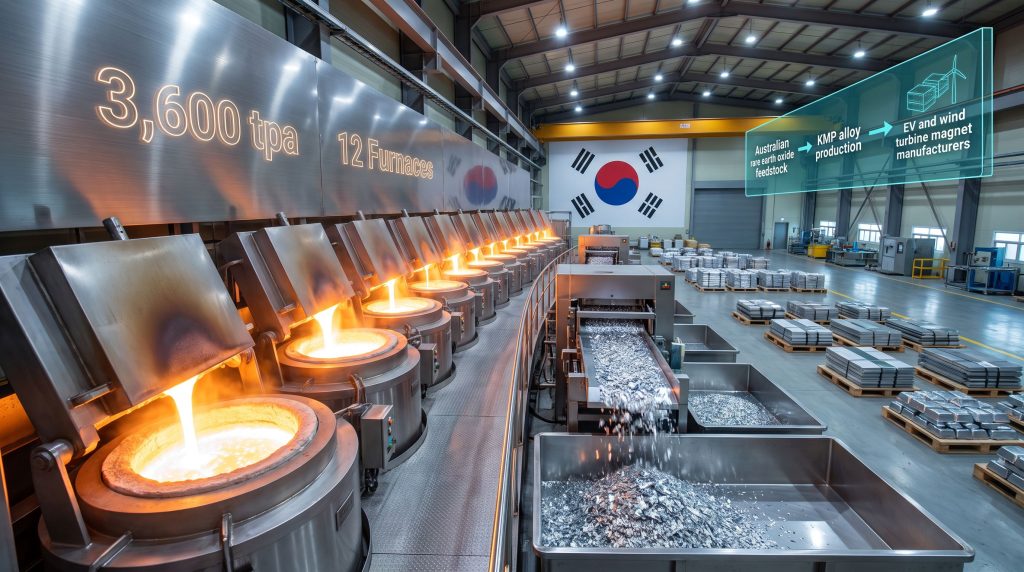
ASM has completed the installation of eight additional furnaces at the KMP, bringing the total operational furnace count to twelve units. This expansion forms the primary mechanical basis for the facility's capacity uplift toward a designed nameplate output of 3,600 tonnes per annum of NdFeB alloy, representing a 177% increase over the Phase 1 baseline.
The furnace expansion alone, however, is not the complete picture. Each furnace in a NdFeB alloy plant produces molten alloy that must then pass through a strip caster to be converted into the thin flake form required by downstream magnet manufacturers. A single strip caster has a defined throughput ceiling. Consequently, adding eight furnaces to a facility with only one caster would simply shift the bottleneck rather than resolve it.
The Strip Caster: The Rate-Limiting Variable
The installation of a second strip caster is a critical path item in the Phase 2 scope. Strip casting is a technically demanding continuous process in which molten NdFeB alloy is poured onto a rapidly rotating water-cooled copper wheel, solidifying into flakes within milliseconds. The speed of the wheel, the pour rate of the melt, and the cooling curve all influence the microstructure of the final flake product.
What is not widely understood outside the rare earth magnet industry is that NdFeB alloy flake microstructure directly determines magnet performance. Specifically, the distribution of the rare-earth-rich grain boundary phase within the alloy matrix affects both the remanence (magnetic strength) and coercivity (resistance to demagnetisation) of the finished magnet. A strip caster operating outside its optimal parameters can produce alloy that is technically within composition specification but microstructurally unsuitable for high-performance motor applications.
This is why the second strip caster installation is not simply a capacity addition; it is a quality assurance enabler for the expanded furnace bank.
Capacity Trajectory at a Glance
| Phase | Furnace Count | Nameplate Capacity (tpa) | Status |
|---|---|---|---|
| Phase 1 | ~4 units | 1,300 tpa | Commissioned May 2022 |
| Phase 2 | 12 units | 3,600 tpa | Ramp-up 2025 to 2027 |
| Phase 3 | TBC | ~5,600 tpa | Under evaluation |
Full Phase 2 nameplate capacity is targeted to be operational by 2027, with the ramp-up spanning the 2025 to 2026 period as the second strip caster is installed and the expanded furnace bank reaches steady-state utilisation. Phase 3, which would lift capacity to approximately 5,600 tpa, remains under evaluation and has not been formally sanctioned.
Capital Efficiency: A Modular Scaling Advantage
Funding Confirmation and Capex Profile
The Phase 2 expansion is fully funded, underpinned by a A$55 million capital raise. The estimated capital expenditure for the Phase 2 expansion itself is approximately US$8 million, a figure that reflects the modular architecture of the KMP's furnace-based design.
Capital Efficiency Context: Scaling from 1,300 tpa to 3,600 tpa for roughly US$8 million in incremental capex is a remarkably capital-light expansion by rare earth processing standards. For comparison, greenfield rare earth oxide separation facilities of comparable output scale have historically required capital investment in the range of hundreds of millions of dollars.
The KMP's modular furnace addition model sidesteps the enormous fixed-cost burden of greenfield construction by leveraging already-commissioned civil infrastructure, utilities, and site permitting. This capital efficiency dynamic is significant for investors assessing the economics of mid-stream rare earth processing, as the ability to add production capacity at marginal cost substantially improves the return profile of expansion decisions. In addition, ASM secured $55M to support this programme, further reinforcing confidence in the facility's commercial trajectory.
Heavy Rare Earths: The Dysprosium and Terbium Dimension
Beyond NdFeB: The Dopant Metals That Define Magnet Performance
One of the less widely discussed aspects of the KMP's operational scope is its capability in heavy rare earth metal production. In 2025, ASM achieved first commercial sales of both dysprosium and terbium metals produced at the facility. These are not minor ancillary products; they are among the most geopolitically sensitive materials in the entire rare earth complex.
Dysprosium and terbium function as performance dopants in sintered NdFeB magnets. Added in small quantities — typically between 0.5% and 2% by weight for dysprosium and 0.1% to 0.5% for terbium — these elements dramatically improve a magnet's ability to retain its properties at elevated operating temperatures. This matters enormously for EV drive motors, which operate at temperatures that can exceed 150 degrees Celsius under sustained load.
What is not commonly appreciated is that without dysprosium or terbium additions, many NdFeB magnet grades used in automotive applications would demagnetise under normal operating conditions. The heavy rare earths are not optional performance enhancements; for a large proportion of EV motor applications, they are functional necessities.
Supply Concentration: The Ionic Clay Problem
| Heavy Rare Earth | Primary Function in NdFeB Magnets | Estimated China Supply Share |
|---|---|---|
| Dysprosium (Dy) | Raises coercivity; prevents thermal demagnetisation | Approximately 90%+ |
| Terbium (Tb) | Enhances high-temperature stability; partial Dy substitute | Approximately 90%+ |
Both elements are sourced predominantly from ionic adsorption clay deposits concentrated in Jiangxi Province, China. These deposits are geologically unique: the rare earth ions are not locked within hard mineral structures but adsorbed onto clay particles, making them extractable via in-situ leaching. This low-cost, geologically distinctive extraction method has no direct equivalent in most Western-aligned rare earth provinces, which tend to host hard-rock mineralisation requiring more energy-intensive processing.
The concentration of heavy rare earth supply in a single geological province in a single country creates a supply risk that is structurally different from, and arguably more acute than, the risk associated with light rare earth supply.
The next major ASX story will hit our subscribers first
Demand Fundamentals: What the KMP Is Supplying Into
The Three Demand Pillars
The commercial rationale for the ASM Korean Metals Plant expansion rests on three converging demand drivers, each supported by the broader surge in critical minerals demand across global markets:
-
Electric Vehicles: Traction motors in battery electric vehicles typically consume between 1 kilogram and 2 kilograms of NdFeB permanent magnets per unit. With global EV production projected to exceed 40 million units annually by 2030, annual magnet demand from this sector alone represents a massive incremental volume requirement for NdFeB alloy.
-
Offshore Wind Energy: Direct-drive permanent magnet generators — the preferred turbine configuration for offshore installations due to their reduced maintenance requirements — use up to 600 kilograms of NdFeB magnets per megawatt of installed capacity. A single large offshore wind project can consume more NdFeB alloy than several hundred EVs combined.
-
Defence and Aerospace: Precision-guided munitions, phased-array radar systems, electric propulsion for naval vessels, and drone guidance systems all rely on high-coercivity NdFeB magnets. Defence procurement timelines are longer than commercial cycles, but contract values and qualification barriers create durable, sticky demand once supplier relationships are established.
The Automotive Qualification Challenge
One technical reality that adds complexity to the KMP's commercialisation pathway is the qualification timeline required by automotive-grade magnet supply chains. Tier 1 automotive suppliers typically require between 12 and 24 months of qualification testing before accepting a new alloy source into a certified production run. This process involves extensive chemical composition verification, microstructural analysis, and functional magnet performance testing across temperature ranges.
For a facility that only reached commercial operation in 2022, this means the KMP is still in the relatively early stages of building the customer qualification history that underpins long-term offtake agreements with automotive-grade magnet manufacturers. Furthermore, the broader energy transition minerals landscape means that demand pressure from multiple sectors is converging simultaneously, amplifying the commercial urgency for qualifying new non-Chinese suppliers.
Competitive Landscape: Non-Chinese NdFeB Alloy Capacity in Context
| Company | Facility Location | Capacity Target | Status |
|---|---|---|---|
| ASM (ASX: ASM) | Ochang, South Korea | 3,600 tpa Phase 2; 5,600 tpa Phase 3 eval. | Ramp-up 2025 to 2027 |
| Lynas Rare Earths (ASX: LYC) | Malaysia and proposed US facility | Magnet factory via JS Link partnership | MOU signed July 2026 |
| MP Materials (NYSE: MP) | Fort Worth, Texas, USA | Magnet manufacturing | Commissioning phase |
The competitive field for non-Chinese NdFeB alloy production remains extremely sparse. This scarcity itself carries analytical significance. If Western automotive and defence manufacturers are serious about supply chain diversification, the number of qualified non-Chinese alloy suppliers they can actually source from is, at present, very small. That structural constraint could prove commercially advantageous for early-mover facilities like the KMP as qualification programmes mature and offtake demand solidifies. A coherent critical minerals strategy at the governmental level would further accelerate this dynamic.
Key Risks and Milestones to Monitor
Critical Path Items
-
Second strip caster commissioning remains the primary rate-limiting step for achieving the full 3,600 tpa nameplate throughput. Delays in equipment delivery or commissioning would directly delay the Phase 2 capacity target.
-
Feedstock purity and supply continuity are operationally critical. NdFeB alloy production is highly sensitive to incoming oxide purity. Variations in NdPr oxide specification can affect alloy microstructure in ways that create downstream qualification barriers with precision magnet customers.
-
Customer offtake conversion from sample and trial supply agreements into long-term commercial contracts remains a key commercial milestone for demonstrating revenue visibility.
Financial and Operational Risk Factors
Risk Disclosure: The forward-looking elements of this article, including production ramp timelines, capacity targets, and demand projections, involve assumptions and uncertainties that may not be realised. This content does not constitute financial advice. Readers should conduct independent due diligence before making investment decisions.
-
Foreign exchange exposure: KMP operating costs are denominated in Korean Won and US dollars, while revenue is typically USD-denominated. Currency movements introduce margin variability.
-
Feedstock supply risk: Securing consistent, specification-grade rare earth oxide feedstock from upstream sources is a prerequisite for maintaining furnace utilisation at commercially viable rates.
-
Technology qualification timelines: The extended qualification cycles required by automotive-grade customers mean revenue conversion from expanded capacity may lag the physical commissioning timeline by twelve months or more.
KMP Expansion: Consolidated Reference Data
| Metric | Detail |
|---|---|
| Facility Location | Ochang Foreign Investment Zone, South Korea |
| Original Commissioning Date | May 2022 |
| Phase 1 Nameplate Capacity | 1,300 tpa NdFeB alloy |
| Phase 2 Target Capacity | 3,600 tpa NdFeB alloy |
| Total Furnace Count (Phase 2) | 12 units (8 additional installed) |
| Phase 2 Capital Expenditure | Approximately US$8 million |
| Funding Status | Fully funded via A$55 million capital raise |
| Full Phase 2 Capacity Target Date | 2027 |
| Phase 3 Evaluation Target | Approximately 5,600 tpa |
| Heavy Rare Earth Milestone | First commercial dysprosium and terbium sales in 2025 |
The ASM Korean Metals Plant expansion does not resolve the structural imbalance in global NdFeB alloy supply in isolation. However, it represents one of the few operational facilities in the world with a credible, funded, and technically grounded pathway toward becoming a commercially significant non-Chinese supplier of the material that sits at the irreplaceable centre of the permanent magnet supply chain.
Want to Position Ahead of the Next Major Critical Minerals Discovery?
Discovery Alert's proprietary Discovery IQ model delivers real-time alerts on significant ASX mineral discoveries — cutting through complex data across more than 30 commodities to surface actionable opportunities the moment they are announced, from rare earths to the full spectrum of critical minerals driving the energy transition. Begin your 14-day free trial at Discovery Alert and gain a market-leading edge before the broader market catches on.