August 3, 2026

The Geology Behind the Most Strategically Valuable Rare Earth Deposits on Earth
Not all rare earth deposits are created equal. Within the global mining industry, a fundamental but often misunderstood distinction separates the elements that underpin modern defence and technology supply chains from the abundant, low-value rare earths that flood markets with minimal strategic consequence. Dysprosium and terbium sit firmly in the former category, and the geology required to concentrate them in economically meaningful quantities is rarer than most investors appreciate.
This geological reality is precisely why the IMC Rare Earths NYSE debut and Itarantim rare earth project have attracted significant attention from critical minerals investors and supply chain strategists. Understanding what makes this project structurally different from conventional rare earth plays requires a ground-up examination of deposit type, element economics, and the global supply context that makes Brazilian ionic adsorption clay so strategically compelling.
When big ASX news breaks, our subscribers know first
Why Heavy Rare Earths Sit in a Category of Their Own
The Dysprosium and Terbium Supply Problem
The rare earth element family encompasses 17 metals, but only a handful carry genuine strategic weight. Dysprosium and terbium are among the most critical because they serve a function in permanent magnet manufacturing that no currently available substitute can replicate at commercial scale.
Neodymium-iron-boron (NdFeB) magnets form the technological backbone of electric vehicle drivetrains, advanced robotics actuators, defence guidance systems, and AI hardware infrastructure. Without dysprosium additions, NdFeB magnets lose coercivity at elevated temperatures, rendering them unsuitable for the demanding thermal environments found in EV motors and aerospace applications. Terbium plays a complementary role, enhancing magnetic performance while allowing manufacturers to reduce overall dysprosium loading.
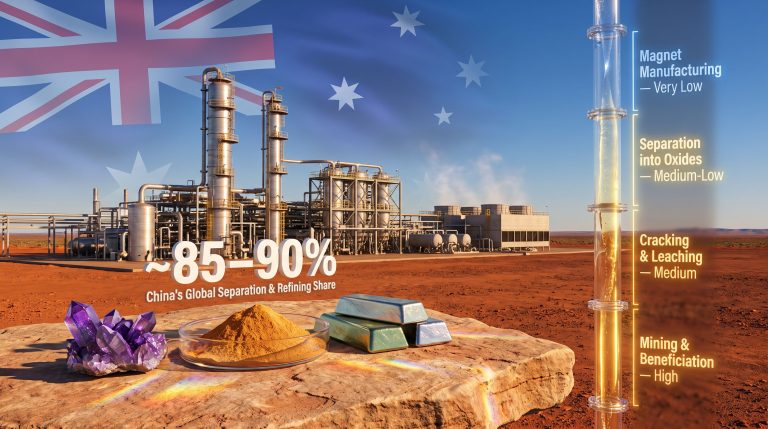
The concentration of supply tells the most critical part of this story. China controls an estimated 85 to 90 percent of global rare earth processing capacity, with Myanmar serving as a significant source of raw heavy rare earth ore that feeds Chinese separation facilities. Periodic disruptions to Myanmar export flows and the broader context of U.S.-China trade tensions have repeatedly demonstrated how fragile this supply architecture is for Western technology and defence manufacturers. Furthermore, China's export restrictions have intensified concerns about long-term supply reliability.
"The strategic calculus is straightforward: any nation or company that can deliver reliable dysprosium and terbium supply from outside China and Myanmar holds a position of significant geopolitical and commercial leverage."
How Ionic Adsorption Clay Changes the Supply Equation
Most rare earth mining operations extract elements from hard-rock deposits such as carbonatites, bastnäsite veins, or monazite-bearing sands. These require energy-intensive crushing, grinding, and complex hydrometallurgical circuits to liberate rare earth elements from their host minerals.
Ionic adsorption clay (IAC) deposits operate on a fundamentally different principle. In IAC systems, rare earth ions are loosely bonded to the surface of clay minerals through electrostatic attraction rather than locked within crystalline mineral structures. This means leaching solutions, typically ammonium sulphate or magnesium sulphate, can displace and recover rare earths at relatively low temperatures and pressures without the capital-intensive comminution circuits required for hard-rock processing.
The additional advantage that makes IAC deposits so strategically significant is their elemental fingerprint. Weathering processes that produce IAC deposits selectively concentrate heavy rare earth elements, meaning the ore basket from an IAC project is disproportionately rich in dysprosium, terbium, holmium, and erbium compared to light rare earth-dominated hard-rock deposits. China's Jiangxi Province built its HREE dominance almost entirely on IAC geology. The emergence of comparable deposits in Latin America represents a genuine structural shift in the potential geography of heavy rare earth supply, consequently reshaping rare earth supply chains for Western nations.
What the Itarantim Project Represents Geologically
Scale, Location, and Elemental Composition
The Itarantim rare earth project spans territory across the Brazilian states of Bahia and Minas Gerais in the country's northeast, a region where prolonged tropical weathering over geological timescales has produced clay profiles well-suited to HREE concentration. The project hosts an inferred mineral resource of approximately 1.1 billion metric tons, placing it among the largest known IAC rare earth deposits outside of Asia.
Brazil's geological setting deserves specific attention. The country holds the world's second-largest rare earth reserves by estimated tonnage yet remains dramatically underrepresented in global production figures. Tropical laterisation processes across northeastern Brazil have created clay weathering profiles remarkably similar to those found in Jiangxi Province, the historical heartland of Chinese HREE production. This is not coincidental geology but rather the predictable outcome of similar parent rock compositions subjected to comparable weathering intensities over extended timeframes.
The project's true economic argument rests not on tonnage alone but on the relative proportion of dysprosium and terbium within its total rare earth oxide basket. Light rare earths such as cerium and lanthanum are abundant globally and frequently treated as low-value byproducts. A deposit skewed toward heavy rare earths generates substantially higher revenue per tonne processed, which can justify development at lower throughput rates and in more remote settings than a comparable light rare earth project.
| Element | Primary Application | Supply Concentration | Strategic Classification |
|---|---|---|---|
| Dysprosium (Dy) | High-coercivity NdFeB magnets, EV motors, defence | China and Myanmar | Critical, no viable substitute |
| Terbium (Tb) | Magnet performance enhancement, green phosphors | China and Myanmar | Critical, extremely limited outside Asia |
| Neodymium (Nd) | Core NdFeB magnet material | Moderately diversified | Critical, high demand growth |
| Praseodymium (Pr) | Magnet alloys, high-strength materials | Moderately diversified | Important, moderate supply diversity |
| Cerium (Ce) | Polishing compounds, catalysts | Broadly available | Lower strategic priority |
A Rarely Discussed Feature of IAC Deposit Economics
One aspect of ionic adsorption clay economics that receives insufficient attention in mainstream coverage is the relationship between clay depth, HREE grade, and moisture content. IAC deposits are typically shallow, lying within the top 20 to 60 metres of the weathered profile. This has significant implications for mining method selection and strip ratios, generally favouring open-cut or in-situ leaching approaches that avoid the deep shaft infrastructure costs associated with hard-rock mining.
However, grade variability within IAC profiles can be significant. The highest HREE concentrations tend to cluster at specific depths within the laterite profile where clay mineral density and surface area are maximised. Delineating these zones precisely requires systematic auger and reverse circulation drilling programs with tight sample spacing, which is why resource upgrade drilling consumes a substantial portion of early-stage capital at projects like Itarantim.
"As of the IPO date, Itarantim carries an inferred mineral resource classification, the lowest confidence category under standard reporting frameworks such as JORC or NI 43-101. Inferred resources cannot support mine planning, reserve declarations, or bankable feasibility studies without significant additional drilling and technical validation."
The IMC Rare Earths NYSE Debut: Capital Structure and Strategic Intent
Breaking Down the IPO Numbers
The IMC Rare Earths NYSE debut and Itarantim rare earth project entered public markets on July 29, 2026, with trading commencing on NYSE American under the ticker symbol IMC. The company priced its initial public offering at $5.00 per share, selling 4 million ordinary shares to raise $20 million in gross proceeds. Mining Weekly reported the listing as a notable milestone for rare earth development in the Americas.
An overallotment option covering up to 600,000 additional shares was included in the offering, exercisable within a 45-day window. If fully exercised, this mechanism would lift total gross proceeds to approximately $23 million, a standard underwriting provision designed to stabilise post-IPO trading by providing the underwriter with flexibility to manage initial supply and demand dynamics.
| Metric | Detail |
|---|---|
| Exchange | NYSE American |
| Ticker Symbol | IMC |
| Trading Commencement | July 29, 2026 |
| IPO Price | $5.00 per share |
| Shares Sold | 4 million |
| Gross Proceeds | $20 million |
| Overallotment Option | Up to 600,000 shares, 45-day window |
| Maximum Total Proceeds | ~$23 million |
| Primary Asset | Itarantim Rare Earth Project |
| Location | Bahia and Minas Gerais, Brazil |
| Deposit Type | Ionic adsorption clay |
| Inferred Resource | ~1.1 billion metric tons |
| Development Stage | Exploration |
| CEO | Frank Scolaro |
How the $20 Million Is Expected to Be Deployed
The primary allocation of IPO proceeds will target resource definition drilling, aimed at converting the current inferred resource toward the indicated and measured classifications required for pre-feasibility and bankable feasibility studies. Secondary capital deployment priorities likely encompass metallurgical testwork to validate IAC processing assumptions at bench and pilot scale, environmental baseline studies, and community engagement programs consistent with Brazilian regulatory requirements.
The $20 million raise represents meaningful early-stage capital for an exploration company, though it is important to contextualise this figure against the capital requirements of a project at Itarantim's scale. Moving a deposit of this tonnage from exploration to production typically demands several hundred million dollars in cumulative investment across resource delineation, feasibility engineering, permitting, and construction. The IPO proceeds therefore fund the critical first phase of technical de-risking rather than representing anything approaching construction-ready capital.
What NYSE American Listing Signals
NYSE American, formerly known as AMEX, has emerged as an increasingly active venue for junior and emerging-stage mining companies seeking access to U.S. institutional and retail capital markets. The listing choice reflects a deliberate strategy to position IMC Rare Earths within the sightline of U.S.-based investors who are actively tracking critical minerals demand and supply chain diversification themes.
For fund managers operating within defence-sector-adjacent mandates or critical minerals-focused ESG frameworks, a U.S.-listed company with a Latin American HREE asset base offers a geopolitically differentiated exposure profile that Australian-listed or Canadian-listed peers cannot replicate. This jurisdictional differentiation is commercially meaningful in an environment where procurement agencies and fund managers increasingly weight counterparty geopolitical alignment alongside pure financial metrics.
Situating Itarantim Within the Global HREE Project Landscape
Competitive Comparison of Major Non-Chinese Heavy Rare Earth Projects
| Project | Company | Location | Deposit Type | Resource Scale | Development Stage |
|---|---|---|---|---|---|
| Itarantim | IMC Rare Earths (IMC) | Brazil (Bahia/MG) | Ionic adsorption clay | ~1.1 billion metric tons (inferred) | Exploration |
| Browns Range | Various | Western Australia | Xenotime-bearing | Smaller tonnage, higher grade | Advanced exploration |
| Songwe Hill | Mkango Resources | Malawi | Carbonatite | Moderate tonnage | Pre-feasibility |
| Nechalacho | Vital Metals | Canada (NWT) | Carbonatite/vein | Smaller, high-grade zones | Early production |
| Tanbreez | Various | Greenland | Lujavrite | Very large, complex processing | Exploration |
Itarantim's inferred resource of 1.1 billion metric tons is exceptionally large by global standards. However, experienced mining investors recognise that tonnage is only one variable in the project value equation. Grade, HREE basket proportion, metallurgical recovery rates, infrastructure proximity, water availability, and permitting timeline are equally determinative of whether a large inferred resource ever becomes a producing mine.
What makes Itarantim's positioning within this competitive set particularly notable is the combination of IAC deposit type and Latin American jurisdiction. For instance, the Tanbreez REE project in Greenland illustrates how complex processing requirements can constrain otherwise large-scale deposits. IAC is the only deposit type that naturally concentrates HREEs while simultaneously offering lower-cost processing pathways, and no other project in the Americas currently offers this combination at comparable scale.
Risk Factors Every Investor Should Understand
The IMC Rare Earths NYSE debut and Itarantim rare earth project narrative carries genuine strategic appeal, but responsible analysis requires clear-eyed engagement with the risk profile of an early-stage exploration company.
-
Resource confidence risk: The 1.1 billion metric ton figure carries inferred classification, the lowest confidence level. Substantial additional drilling is required before any portion of this can be converted to indicated or measured status suitable for economic studies.
-
Metallurgical risk: IAC processing performance varies significantly based on clay mineral composition, rare earth speciation, and leach chemistry. Testwork must confirm commercial-scale recovery rates and reagent consumption before project economics can be reliably modelled.
-
Permitting and environmental risk: Large-scale mining operations in Bahia and Minas Gerais require Brazilian federal and state environmental licensing through the ANM framework, a process that can extend over multiple years and involve significant community consultation requirements.
-
Financing risk: The gap between the current $20 million raise and the capital required to bring a project of this scale into production is measured in hundreds of millions of dollars. Future capital raises will likely involve dilution, debt, or strategic partnership structures.
-
Rare earth price risk: Dysprosium and terbium prices are volatile and heavily influenced by Chinese production policy, export quota decisions, and global demand cycles. Price assumptions embedded in future economic studies carry meaningful uncertainty.
-
Processing scale-up risk: Bench-scale and pilot-scale metallurgical results do not always translate linearly to commercial operations, particularly for in-situ or heap leach IAC processing where spatial variability in ore characteristics can affect recovery consistency.
The next major ASX story will hit our subscribers first
Key Milestones to Monitor Post-IPO
Investors tracking the IMC Rare Earths NYSE debut and Itarantim rare earth project over the coming 12 to 36 months should focus on the following technical and commercial milestones as indicators of genuine project progression:
- Announcement of a systematic resource definition drilling program with target drill hole density and spacing parameters
- Release of metallurgical testwork results confirming HREE recovery rates and leach solution performance at bench or pilot scale
- Commencement of environmental and social impact assessment processes with Brazilian regulatory authorities
- Conversion of portions of the inferred resource to indicated or measured classification
- Publication of a preliminary economic assessment or scoping study incorporating capital cost estimates, operating cost assumptions, and revenue projections
- Announcement of any strategic partnership, offtake agreement, or government-related financing arrangement that could accelerate project development timelines
The Americas Rare Earth Gap and Why It Matters Now
Despite holding substantial geological endowment, the Western Hemisphere currently contributes a negligible share of global heavy rare earth production. The regulatory and policy environment across the U.S., EU, and allied nations has created powerful structural incentives for HREE project development outside of China. Frameworks including the U.S. Inflation Reduction Act, the EU Critical Raw Materials Act, and Canada's Critical Minerals Strategy all establish mechanisms that could benefit qualifying projects.
Brazil's geopolitical positioning adds a further dimension to broader rare earth geopolitics. The country maintains constructive relationships with both Western and non-Western partners, and its existing bilateral mineral frameworks with the U.S. and EU provide a navigable diplomatic context for rare earth project development. IMC CEO Frank Scolaro has publicly articulated the company's intent to serve both advanced technology and defence sector demand across the Americas and Europe, framing Itarantim not as a speculative exploration asset but as a potential structural solution to HREE supply chain vulnerability.
Whether that vision translates into a producing mine depends on technical de-risking, capital markets conditions, and regulatory execution over a development timeline measured in years to decades. Furthermore, IMC Rare Earths' NYSE American debut confirms that market appetite for non-Chinese HREE exposure at the exploration stage remains genuine, and Brazil's ionic adsorption clay geology has finally begun attracting the institutional attention it has long warranted.
Disclaimer: This article is intended for informational purposes only and does not constitute financial or investment advice. The Itarantim project remains at the exploration stage with an inferred mineral resource classification. All forward-looking statements and projections involve material uncertainty. Investors should conduct independent due diligence and consult qualified financial advisors before making investment decisions.
Want to Stay Ahead of the Next Major Critical Minerals Discovery on the ASX?
Discovery Alert's proprietary Discovery IQ model scans ASX announcements in real time, instantly identifying significant mineral discoveries — including critical and rare earth elements — and delivering actionable alerts to subscribers before the broader market reacts. Explore how historic discoveries have generated extraordinary returns on Discovery Alert's dedicated discoveries page, and begin your 14-day free trial today to position yourself at the forefront of the next major find.