August 2, 2026
The Hidden Bottleneck Reshaping Global Industrial Strategy
For most of the twentieth century, the phrase "rare earths supply chain" existed only in the vocabulary of specialist chemists and niche industrial buyers. Today it sits at the centre of trade negotiations, defence procurement strategies, and energy transition planning across every major economy. The shift did not happen overnight, and understanding why it happened reveals something important: the problem was never really about geology.
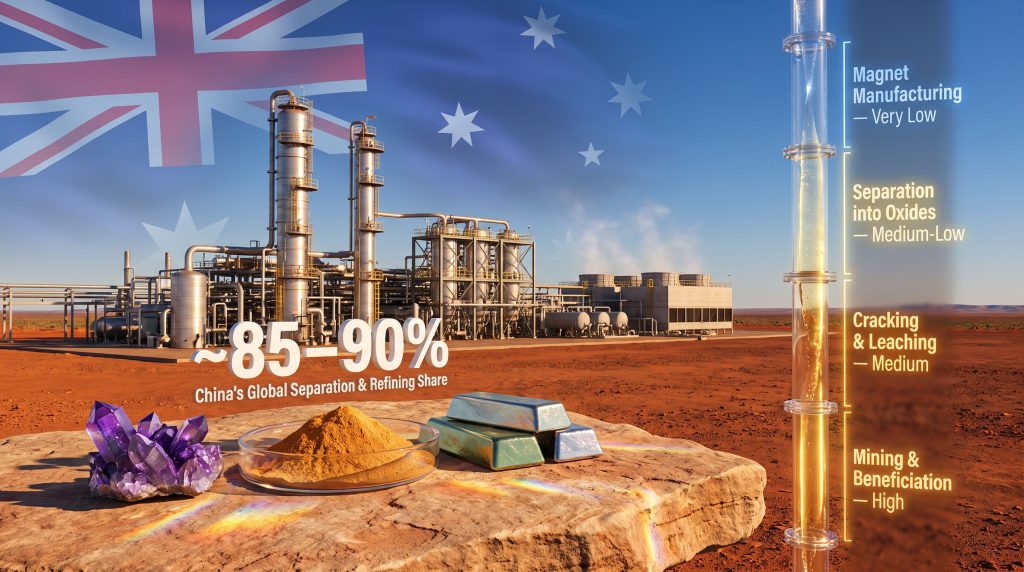
Rare earth elements are not geologically scarce. They exist in meaningful concentrations across multiple continents, including in Australia, the United States, and parts of Africa. The scarcity that drives geopolitical anxiety is a manufactured one, built over decades of deliberate industrial policy, subsidised processing infrastructure, and strategic pricing that gradually eliminated Western competitors from the market. What remains is a supply chain architecture that funnels roughly 85 to 90 percent of global rare earth separation and refining capacity through a single nation.
That structural reality is now colliding with an accelerating wave of demand from electric vehicles, wind turbines, and advanced defence systems, each of which depends on high-performance permanent magnets that cannot be made without specific rare earth inputs. The rare earths supply chain in Australia has become one of the most closely watched pieces of the global response.
When big ASX news breaks, our subscribers know first
Understanding the 17 Elements and Why Not All Are Equal
The rare earth elements comprise a group of 17 metallic elements, including the 15 lanthanides plus scandium and yttrium. Within that group, a sharp distinction exists between light rare earth elements (LREEs) and heavy rare earth elements (HREEs), and that distinction carries enormous strategic weight.
Light rare earths such as cerium and lanthanum are relatively abundant and find applications in catalysts, glass polishing compounds, and phosphors. Heavy rare earths, by contrast, occur in far lower concentrations even within mineralised deposits, making them genuinely difficult to source outside of specific geological settings. Among the heavies, terbium and dysprosium command the most attention because they are irreplaceable additives in neodymium-iron-boron (NdFeB) permanent magnets, the technology underpinning virtually every high-torque electric motor and wind turbine generator currently in production.
The four elements driving the most immediate commercial urgency are neodymium, praseodymium, terbium, and dysprosium. Removing any one of them from the magnet manufacturing equation currently has no viable substitute at commercial scale. That chemical specificity is what transforms a mining conversation into a national security conversation.
China's Processing Dominance: How It Was Built and Why It Persists
China's position in the global rare earths market did not emerge from geological luck alone. The country holds significant reserves, but more importantly it invested heavily over several decades in the complex hydrometallurgical processing infrastructure required to convert raw ore into separated oxides, metals, and alloys. That processing capability, built with state support and operating at scale, created cost structures that private Western operators found impossible to match under normal commercial conditions.
Furthermore, the rare earth processing challenges involved in replicating this infrastructure elsewhere are substantial. The result is a supply chain map that concentrates risk at every stage beyond the mine gate:
| Supply Chain Stage | China's Global Share | Australia's Current Role |
|---|---|---|
| Mining and Extraction | ~60% | Top 4 globally by reserves |
| Separation and Refining | ~85-90% | Emerging (Kalgoorlie, Eneabba) |
| Oxide and Alloy Production | ~90%+ | Very limited |
| Magnet Manufacturing | ~90%+ | Negligible |
China has also demonstrated a willingness to use its market position as a diplomatic instrument. Export restrictions, licensing controls, and quota systems have been deployed at various points over the past two decades, each episode reinforcing the perception among Western governments that supply chains dependent on Chinese rare earths processing carry embedded political risk. The rare earth geopolitical impact of these dynamics continues to reshape how allied nations coordinate their industrial responses.
The core vulnerability for Western manufacturers is not price volatility, it is the possibility of deliberate supply interruption at a moment of geopolitical tension. That asymmetry is what has elevated rare earths from a procurement issue to a strategic one.
Where Australia's Rare Earths Capability Actually Stands Today
Australia holds the world's fourth-largest rare earth reserves and has historically been a competent upstream producer, particularly through the Mount Weld deposit in Western Australia, which ranks among the highest-grade rare earth deposits identified anywhere globally. However, reserve size and mining capability have never been the constraint.
The honest assessment of Australia's position in the rare earths supply chain looks like this:
| Supply Chain Stage | Australia's Capability | Maturity Level |
|---|---|---|
| Mining and Beneficiation | Established, world-class | High |
| Cracking and Leaching | Developing (Kalgoorlie operational) | Medium |
| Separation into Oxides | Developing (Eneabba in construction) | Medium-Low |
| Metal and Alloy Production | Minimal domestic capacity | Low |
| Magnet Manufacturing | No established industry | Very Low |
For most of its modern mining history, Australia exported rare earth concentrate offshore for processing, primarily to China and to Lynas' own Malaysian facility. That model generated revenue but surrendered the higher-value processing stages, along with the strategic leverage that comes with controlling them.
The current moment, consequently, represents a deliberate pivot away from that model. Australia's critical minerals strategy is now firmly oriented toward capturing midstream value. Two major processing investments are reshaping Australia's midstream capability, though significant gaps remain downstream.
The Eneabba Refinery and the Kalgoorlie Plant: Australia's Processing Pivot
Iluka Resources and the Eneabba Rare Earths Refinery
The most consequential infrastructure project in the rare earths supply chain in Australia is Iluka Resources' $1.8 billion refinery at Eneabba, approximately 280 kilometres north of Perth in Western Australia's Midwest region. At roughly 60 percent complete as of mid-2026, the facility is targeting commissioning in 2027 and will produce separated rare earth oxides including neodymium, praseodymium, terbium, and dysprosium.
The project is underpinned by a $1.65 billion concessional loan from the Australian federal government's Critical Minerals Facility, one of the largest single sovereign investments in critical minerals processing infrastructure in the country's history.
Commercial validation arrived in June 2026, when Iluka secured its first offtake agreement with an undisclosed global automotive manufacturer. The deal covers magnet rare earth oxide supply from 2028 and is valued at approximately US$155 million (A$220 million), providing a demand anchor for the refinery's initial years of operation.
The counterparty's identity has been deliberately withheld. The reasoning is strategically significant: the automaker's existing supply chains rely on Chinese-sourced rare earths. Public disclosure of an alternative supply arrangement before the Eneabba facility reaches production could expose the company to supply disruption from its current Chinese suppliers during the transition window.
This dynamic illustrates something rarely discussed in public commentary on rare earths dealmaking: the transition period between supply chains may itself be the moment of greatest vulnerability, and managing that transition requires careful information control.
Iluka's head of rare earths, Dan McGrath, confirmed the company maintains numerous confidential discussions with prospective customers globally, spanning European, Japanese, and other markets, precisely because of this transition risk dynamic. The approach reflects a broader truth about the current state of rare earths diversification: publicly announced deals are a fraction of the actual commercial activity underway.
Lynas Rare Earths and the Kalgoorlie Processing Facility
Lynas Rare Earths, backed by Gina Rinehart, opened its $800 million cracking and leaching facility in Kalgoorlie in 2024, making it the most operationally mature example of Australian midstream rare earths processing currently in existence. The Kalgoorlie plant processes concentrate from the Mount Weld mine before it proceeds to downstream separation, representing a meaningful expansion of domestic processing capability beyond the mine gate.
The facility attracted diplomatic attention in mid-2026 when India's High Commissioner to Australia, Nagesh Singh, visited the Kalgoorlie plant during a stopover. His visit coincided with a uranium supply agreement signed between the two countries in July 2026, signalling a deepening of the Australia-India critical minerals relationship beyond any single commodity.
Singh's assessment of the current geopolitical landscape was pointed: he noted that trade and resources are being used as instruments of leverage by unnamed actors, and that like-minded nations sharing common objectives are increasingly moving to coordinate their responses. His position that critical minerals should be accessible to all nations without the threat of denial articulates an emerging framework for multilateral resource governance that extends well beyond bilateral trade agreements.
The Geopolitical Realignment Accelerating Australian Rare Earths Demand
Perhaps the most underappreciated driver of the rare earths supply chain in Australia is not the construction of processing plants but the formation of demand blocs. Western governments have moved from passive concern about Chinese rare earths dominance to active coordination on alternative sourcing.
The landmark Australia-United States rare earth minerals agreement signed in 2025, valued at $8.5 billion, created a preferential supply framework between the two countries and provided a form of demand certainty that helps justify the long-dated capital investment required to build processing infrastructure. The US rare earth supply chain strategy has become deeply intertwined with Australian production timelines as a result. For project developers, the knowledge that offtake demand exists within an allied-nation framework materially changes the risk calculus.
Australia's rare earths diplomacy now extends to:
- The United States, through the 2025 bilateral agreement
- European Union member nations, as the EU accelerates its Critical Raw Materials Act implementation
- Japan and South Korea, both heavily dependent on rare earth imports for their electronics and automotive manufacturing sectors
- India, as demonstrated by the uranium agreement and the Kalgoorlie visit
The convergence of these relationships is creating something qualitatively different from traditional resource trade: a network of committed demand relationships that treat rare earths supply as a matter of collective industrial security rather than purely commercial procurement.
The next major ASX story will hit our subscribers first
The Downstream Gap: Australia's Unresolved Challenge
Producing separated rare earth oxides is commercially significant but represents only the midpoint of the full value chain. Converting oxides into metals, then alloys, and finally into finished permanent magnets requires entirely separate industrial infrastructure and highly specialised chemical and metallurgical expertise.
Australia currently has no meaningful magnet manufacturing industry. Even when both the Eneabba refinery and the Kalgoorlie facility reach full operational capacity, the oxides they produce will still need to travel offshore for final conversion into the magnets that end users actually require. That dependency does not disappear simply because the processing stage moves onshore.
The downstream gap has three interconnected dimensions:
- Capital intensity: Magnet manufacturing requires substantial investment in alloy production, powder processing, and pressing facilities that go well beyond conventional mining and chemical processing infrastructure.
- Technical expertise: The workforce and institutional knowledge required for rare earth magnet production does not currently exist at commercial scale in Australia and takes years to build.
- Industrial ecosystem: Viable magnet manufacturing requires nearby customers, which in turn requires the growth of an advanced manufacturing sector that can absorb rare earth magnet inputs domestically.
How Australia Compares Internationally
| Country | Rare Earth Reserves | Processing Capacity | Magnet Manufacturing | Strategic Posture |
|---|---|---|---|---|
| China | Largest globally | Dominant (~85-90%) | World-leading | Supply controller |
| Australia | 4th largest globally | Emerging | Negligible | Upstream-to-midstream pivot |
| United States | Significant | Rebuilding (MP Materials) | Limited but growing | Re-industrialisation |
| Canada | Moderate | Early-stage | Minimal | Exploration phase |
| Japan | Minimal domestic | Advanced processing | World-class | Import-dependent, technology-rich |
In addition, understanding how rare earth supply chains are evolving globally provides essential context for assessing where Australia's comparative advantages are strongest and where gaps remain most exposed.
Frequently Asked Questions: Australia's Rare Earths Supply Chain
What rare earth elements does Australia produce?
Australia's rare earths sector produces a range of light and heavy rare earth elements, with the most strategically significant being neodymium, praseodymium, terbium, and dysprosium, which are essential to high-performance permanent magnets used in EVs, wind turbines, and defence systems.
Why has Australia historically exported ore rather than processing it domestically?
The economics of rare earths separation, combined with decades of Chinese investment in subsidised refining infrastructure, made exporting raw concentrate offshore more commercially viable than building domestic processing capacity. That model is now actively being reversed through major capital investments in midstream processing. For further context, the Australian government's framework for securing critical minerals supply with the United States outlines the policy architecture underpinning this shift.
When will Australia's rare earths refining capacity be fully operational?
Lynas' Kalgoorlie cracking and leaching plant opened in 2024. Iluka's Eneabba refinery, the most ambitious project in the current pipeline, is targeting commissioning in 2027.
Can Australia manufacture rare earth magnets domestically?
Not at any meaningful commercial scale. Magnet manufacturing represents the most underdeveloped segment of the rare earths supply chain in Australia, and addressing this gap will require substantial additional investment well beyond the projects currently underway.
How does the Australia-US rare earths agreement affect the supply chain?
The 2025 agreement, valued at $8.5 billion, establishes a framework for preferential supply arrangements between the two countries, helping underwrite demand certainty for Australian rare earths producers while advancing US objectives of reducing structural dependence on Chinese supply.
The Path Forward: What a Fully Integrated Supply Chain Would Require
A genuinely sovereign Australian rare earths supply chain would need to complete three sequential stages: scaling upstream production, building midstream separation to world-class capacity, and then constructing the downstream alloy and magnet manufacturing infrastructure that converts processed oxides into finished industrial inputs.
The first stage is largely established. The second is actively underway, with Eneabba and Kalgoorlie representing the most significant midstream investments in the country's history. The third stage, however, remains almost entirely unaddressed.
What could accelerate the downstream transition is the accumulation of strategic offtake agreements that provide the demand certainty required to justify magnet manufacturing investment. Iluka's first offtake deal, whilst modest in scale relative to the full value chain, demonstrates that global manufacturers are willing to commit to Australian supply even before facilities are operational.
Additional agreements of that type, particularly with European and Japanese partners, could create the demand foundation for downstream expansion. Analysts observing Australia's rare earths sector have noted that this accumulation of committed demand relationships may ultimately prove as strategically significant as the physical infrastructure itself.
The broader trajectory is clear. The rare earths supply chain in Australia has moved from an afterthought of the mining sector to a central pillar of allied-nation industrial strategy. But the distance between a well-capitalised mining jurisdiction and a fully integrated critical minerals powerhouse remains substantial, and the next five years of investment decisions will determine whether Australia captures the downstream value or once again exports that opportunity offshore.
Disclaimer: This article contains forward-looking statements and projections regarding infrastructure timelines, market dynamics, and geopolitical developments. These involve inherent uncertainty and should not be construed as financial advice. Readers should conduct their own due diligence before making any investment decisions.
Ready to Position Yourself Ahead of the Next Major Critical Minerals Discovery?
Discovery Alert's proprietary Discovery IQ model delivers real-time alerts on significant ASX mineral discoveries — including critical minerals like rare earths — instantly translating complex data into actionable investment insights for both short-term traders and long-term investors. Explore how major mineral discoveries have historically generated substantial returns on Discovery Alert's dedicated discoveries page, and begin your 14-day free trial today to secure a market-leading edge.