August 1, 2026
The Hidden Complexity Behind Building a Rare Earth Supply Chain From Scratch
Most investors scanning the critical minerals landscape focus on commodity prices, resource grades, and exploration upside. Far fewer pause to consider the deeper structural problem sitting beneath the surface: the rare earth industry does not simply lack production outside China. It lacks the processing infrastructure to make that production commercially useful without routing it through Chinese facilities. That distinction is not semantic. It is the central challenge that separates genuinely transformative rare earth projects from the many that plateau at the concentrate stage, permanently dependent on the very supply chain they claim to be disrupting.
Understanding this dynamic is essential to grasping why the Arafura Nolans rare earths project occupies a position unlike virtually any other development currently advancing toward production globally.
When big ASX news breaks, our subscribers know first
Why Rare Earth Concentrate Alone Solves Nothing
The rare earth supply chains discussion is frequently misunderstood, even by experienced resources investors. When most people visualise a rare earth mine, they picture extraction and some form of separation, followed by sale to an end customer. In reality, the typical supply chain involves multiple additional processing stages after mining, and the vast majority of those stages take place in China.
Global rare earth oxide refining capacity is estimated to sit between 85 and 90 percent under Chinese control, according to widely cited industry assessments. This figure applies not just to Chinese deposits but to the processing of concentrate produced elsewhere in the world. Projects operating in Australia, Canada, and Africa frequently ship their mixed rare earth concentrate to Chinese hydrometallurgical facilities before it can become a usable oxide feedstock for magnet manufacturers.
The practical consequence is stark: a non-Chinese mine producing concentrate has not actually escaped China's grip on the supply chain. It has simply moved one step upstream from it.
Neodymium-praseodymium (NdPr) oxide sits at the precise point in the value chain where this dependency becomes critical. It is the direct feedstock for sintered NdFeB permanent magnets, which are non-substitutable at scale in current electric vehicle drivetrain designs and offshore wind turbine generators. Defence systems including precision-guided munitions, radar platforms, and autonomous vehicles carry the same dependency.
The absence of credible non-Chinese NdPr oxide production is not a theoretical risk. It is a documented structural vulnerability that Western governments, automotive original equipment manufacturers, and defence contractors have been actively working to resolve for years.
What Makes the Nolans Deposit Geologically Unusual
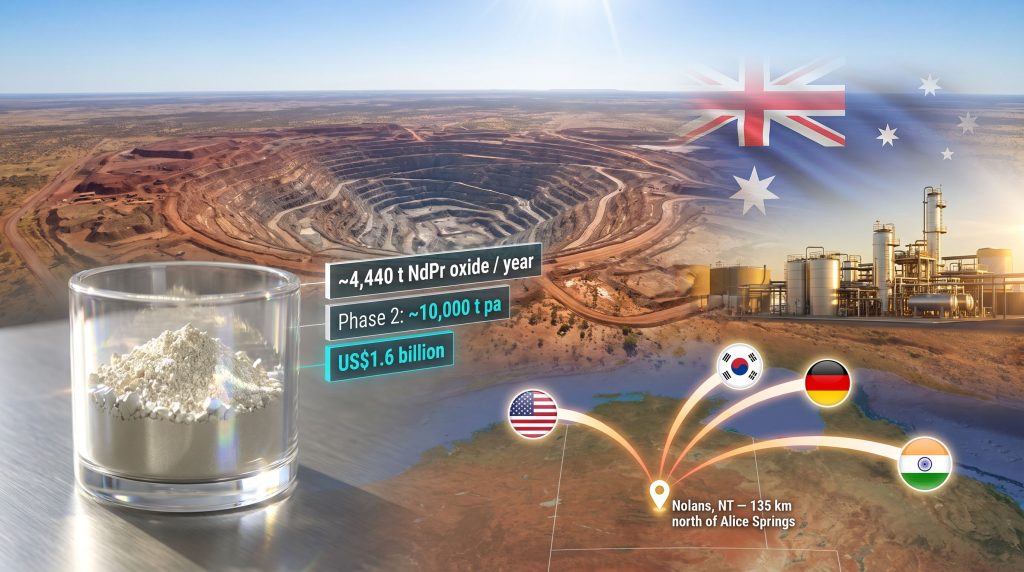
Located approximately 135 kilometres north of Alice Springs in Australia's Northern Territory, the Nolans deposit sits within an apatite-hosted rare earth system, which is geologically distinct from the ionic clay deposits that dominate Chinese heavy rare earth production. Apatite-hosted deposits tend to carry heavier regulatory processing considerations due to naturally occurring radioactive material (NORM) content, typically thorium and uranium, which co-occur with the rare earth mineralisation.
This is a dimension of rare earth processing challenges that rarely receives attention in mainstream coverage, but it materially affects processing design, regulatory approvals, and product specifications. Arafura's process design for Nolans is specifically engineered to produce a radiation-free NdPr oxide, separating and managing the NORM streams on site rather than passing them downstream to customers. This is a significant technical achievement that directly addresses a compliance barrier that has complicated rare earth product acceptance in markets including the United States, South Korea, and Europe.
The deposit's projected mine life of at least 23 years, with some project materials referencing operational longevity extending to 38 years, reflects both the scale of the resource and the consistency of mineralisation. This long asset life underpins the economics of the integrated processing investment, since the capital intensity of building ore-to-oxide infrastructure is only justifiable when spread across a sufficiently large and long-lived reserve base.
The Ore-to-Oxide Distinction: A Technical and Commercial Dividing Line
The phrase ore-to-oxide deserves precise explanation because it is used loosely across the sector and its implications are frequently underappreciated.
A standard rare earth operation produces a mixed rare earth carbonate or concentrate through physical beneficiation of mined ore. This intermediate product must then undergo solvent extraction and separation, typically requiring multiple processing circuits, before individual rare earth oxides can be isolated. For most projects, that separation work happens in China.
Nolans is designed to complete the entire processing sequence on Australian soil:
- Mining and crushing of apatite-hosted ore from the Northern Territory deposit
- Beneficiation to produce a rare earth concentrate on site
- Cracking and leaching to dissolve the rare earth content from the concentrate
- Solvent extraction and separation to isolate individual rare earth streams
- Precipitation and calcination to produce finished NdPr oxide ready for direct use by downstream manufacturers
This vertical integration eliminates every Chinese processing touchpoint in the value chain. The output is a finished, specification-grade, radiation-free oxide that can feed directly into metallisation plants and alloy producers building magnet manufacturing capacity outside China.
| Feature | Nolans (Arafura) | Typical Concentrate-Only Projects |
|---|---|---|
| Processing endpoint | NdPr oxide (fully integrated) | Mixed rare earth concentrate |
| Chinese processing dependency | None by design | High |
| Capital requirement | ~US$1.6 billion | Substantially lower |
| Product radiation status | Radiation-free | Variable, often requires management |
| Value chain position | Direct magnet feedstock | Requires further Chinese downstream processing |
| Customer addressable market | Magnet makers, alloy producers, metallisers | Chinese processors only |
The commercial logic is compelling but the execution challenge is substantial. As Arafura's managing director and CEO Darryl Cuzzubbo has noted publicly, the reason most rare earth projects stop short of oxide production is straightforwardly a capital one. Going all the way to oxide demands significantly more capital, which in turn requires more time to secure binding offtake agreements, arrange debt facilities, and bring in equity investors. The Nolans development timeline reflects precisely that compounding complexity.
Assembling a Billion-Dollar Funding Stack in a Market That Doesn't Do This Easily
Rare earth project finance represents one of the most structurally difficult corners of the mining capital markets. The combination of high capital requirements, long development timelines, complex processing chemistry, volatile commodity prices, and limited price discovery in non-Chinese markets creates a financing environment where most projects stall permanently at the feasibility stage.
Integrated ore-to-oxide projects face an additional layer of difficulty: they require institutional-scale capital commitments years before first production, against a commodity with limited spot market liquidity and pricing that is largely opaque outside Chinese domestic markets.
Arafura's funding resolution for Nolans drew on an unusually broad coalition of capital sources:
| Funding Source | Commitment | Instrument Type |
|---|---|---|
| National Reconstruction Fund Corporation (NRFC) | A$200 million | Convertible note |
| Export Finance Australia | A$146 million | Debt and equity investment |
| KfW (German Raw Materials Fund) | A$84 million (~€50 million) | Sovereign development finance |
| Northern Australia Infrastructure Facility (NAIF) | Up to A$200 million | Concessional debt |
| Hancock Prospecting | Early-stage cornerstone | Strategic equity |
| Total equity funding and commitments | More than A$900 million | Combined |
Hancock Prospecting's Role as the Credibility Anchor
Perhaps the least understood dimension of Nolans' financing journey is the sequencing of capital. Institutional investors and development finance institutions do not typically lead in rare earth project financing. They follow credible lead investors who have already stress-tested the investment thesis.
Hancock Prospecting, through executive chair Gina Rinehart, entered the Arafura register as a strategic investor before major institutional capital was prepared to engage. The significance of this is not purely financial. In the critical minerals financing ecosystem, cornerstone support from a globally recognised resources investor with deep technical credibility functions as a due diligence signal for the investors who follow.
Gina Rinehart has described large-scale mining project development as inherently complex, capital intensive, and requiring years of persistence and technical work to navigate the overlapping regulatory and approval systems that stand between exploration and revenue. That characterisation accurately reflects the decade-scale timeline Arafura required to bring Nolans to Final Investment Decision.
Cuzzubbo has been direct about the sequencing: Hancock's conviction preceded the rest of the market's recognition of the strategic case for non-Chinese rare earth supply, and that early commitment materially enabled subsequent investor engagement.
Why Germany's KfW Invested in an Australian Mine
KfW's A$84 million commitment through the German Raw Materials Fund is worth examining in its own right. Germany's industrial economy, anchored by automotive and precision manufacturing, is among the world's most structurally exposed to NdPr supply risk. German automakers have collectively committed to EV transition timelines that create long-dated NdPr demand requirements that cannot be satisfied from within Europe.
KfW's participation signals an emerging model in critical minerals development: importing nations co-funding upstream supply projects in resource-rich allied countries. This cross-border sovereign finance model bypasses the traditional assumption that private capital alone should bear project development risk for strategically important supply chain assets.
Export Finance Australia's decision to invest equity, rather than simply extending concessional debt, represents an analogous evolution in how Australian agencies approach strategic minerals projects.
Final Investment Decision: What It Means and Why So Few Projects Get There
A Final Investment Decision is the formal board-level commitment to deploy full project capital and proceed to construction. Reaching FID requires the simultaneous resolution of multiple independent workstreams, any one of which can delay or terminate a project. A comprehensive definitive feasibility study with independently reviewed engineering and cost estimates is one such critical workstream, alongside:
- Mineral resource definition and reserve certification to bankable standard
- Environmental impact assessment approvals at territory and federal level
- Binding debt facility agreements with lenders
- Equity funding commitments sufficient to satisfy debt coverage ratios
- Binding offtake agreements providing revenue certainty for lenders
The majority of mining projects globally never satisfy all of these conditions simultaneously. They stall in feasibility, fail to attract debt on acceptable terms, or cannot secure offtake agreements because customers are unwilling to commit to an unfinanced project.
Arafura reached FID on the Arafura Nolans rare earths project in May 2026, triggering a construction commencement target of September 2026 and a first production timeline targeting the second half of 2029.
Key Project Timeline at a Glance
| Milestone | Date / Target |
|---|---|
| FID approved | May 2026 |
| Construction commencement target | September 2026 |
| First NdPr oxide production | Second half of 2029 |
| Phase one annual NdPr output | ~4,440 tonnes per year |
| Phase two NdPr target | ~10,000 tonnes per year |
| Total project cost | ~US$1.6 billion |
| Mine life | 23 to 38 years |
| Global NdPr market share at phase one | ~4 to 5 percent |
The Construction-to-Production Sequence
The approximately three-year pathway from construction start to first oxide production reflects the sequential nature of large-scale hydrometallurgical plant development:
- Site mobilisation and infrastructure establishment covering access, accommodation, and utilities in a remote Northern Territory location
- Long-lead equipment procurement for processing plant components with extended fabrication and delivery timelines
- Civil, structural, and mechanical construction of the mine, processing facility, and tailings management infrastructure
- Electrical and instrumentation installation across the integrated processing circuits
- Commissioning and system integration testing conducted progressively across plant sections
- Operational ramp-up toward nameplate NdPr oxide production capacity
The next major ASX story will hit our subscribers first
A Customer Base Across Four Continents
Securing offtake agreements for a rare earth project is categorically more difficult than securing supply agreements for bulk commodities. NdPr oxide has limited spot market liquidity, its pricing is not publicly transparent in the way that iron ore or copper pricing is, and customers capable of consuming separated oxide are predominantly located in markets that have historically sourced directly from Chinese producers.
Arafura's commercial strategy addressed this by targeting customers specifically motivated to diversify away from Chinese supply. The Arafura rare earth offtake portfolio, rather than competing on price against Chinese producers in markets where Chinese supply is the default preference, spans four distinct geographies:
- United States: Customers aligned with the strategic imperative to build domestic or allied rare earth supply chains outside China, including participants in the US defence and advanced manufacturing base
- South Korea: Korean EV manufacturers and electronics producers represent a growing NdPr consumption base with documented interest in supply chain diversification
- Europe: Industrial customers aligned with the European Union's Critical Raw Materials Act, which mandates supply diversification benchmarks for strategic minerals
- India: A new Indian offtake agreement announced as the project moves toward construction, extending Nolans' commercial reach into one of the world's fastest-growing EV and manufacturing markets
The geographic diversification of this customer base is a deliberate risk management structure. Concentration in any single customer market would expose the project to demand-side shocks from regulatory changes, economic cycles, or bilateral trade disruptions in that market. Four-continent offtake coverage substantially reduces that exposure.
Furthermore, this rare earth offtake agreement structure plays a direct role in enabling these customer relationships. Magnet manufacturers and metallisation plants in South Korea, Europe, and the United States operate within regulatory frameworks that impose handling, transport, and environmental compliance requirements on radioactive materials. A radiation-free product removes that compliance burden entirely, providing a practical commercial advantage that is independent of price.
Phase Two and the Potential for a Northern Territory Processing Hub
Phase one at Nolans targets approximately 4,440 tonnes of NdPr oxide per annum, representing roughly 4 to 5 percent of current global NdPr supply from a single site. Phase two, as currently envisioned, would lift annual production to approximately 10,000 tonnes, positioning the Arafura Nolans rare earths project among the largest individual NdPr production facilities outside China.
Beyond volume expansion, Arafura has flagged a strategically interesting concept: processing rare earth feedstock from third-party Australian rare earth projects through the Nolans hydrometallurgical facility. This hub model would allow other Australian rare earth developers, potentially including projects that cannot justify the capital cost of building their own oxide processing infrastructure, to access world-class separation and oxide production capability.
If realised, this model would have implications well beyond Arafura's own output. It could reduce Australia's collective rare earth processing dependency on China across multiple projects simultaneously, creating a genuine alternative processing node for the region. The Nolans project page outlines further detail on the scope of this long-term processing vision.
The deposit also contains heavy rare earth elements (HREEs) including dysprosium and terbium, which are critical for high-temperature magnet performance in demanding applications such as EV traction motors operating under sustained load and offshore wind turbines exposed to variable temperature conditions. HREE production is identified as a long-term expansion pathway, adding a further dimension of strategic value to the project's future.
What Nolans Tells Us About the Future of Critical Mineral Supply Chains
The path from exploration to FID on a fully integrated rare earth operation spans roughly a decade under the best conditions. It requires technical development of novel processing chemistry suited to the specific mineralogy of the deposit, environmental assessment processes that are inherently lengthy for complex industrial facilities in sensitive locations, and a commercial development sequence that demands customers, debt providers, and equity investors all reach conviction simultaneously.
The Nolans experience demonstrates that this is achievable, however only with a specific configuration of enabling factors:
- A world-scale deposit with sufficient mine life to justify integrated processing capital
- A technically credible ore-to-oxide processing design that addresses product quality requirements for end customers
- Early-stage strategic investor conviction to anchor subsequent institutional participation
- International development finance participation from nations with a strategic interest in the project's output
- A commercially differentiated product specification that removes downstream barriers for target customers
This article is intended for informational purposes only and does not constitute financial advice. Forecasts, project timelines, and production targets referenced herein are forward-looking in nature and subject to change based on regulatory, operational, financing, and market conditions. Readers should conduct their own due diligence before making investment decisions.
| Summary Metric | Detail |
|---|---|
| Project location | 135 km north of Alice Springs, Northern Territory |
| FID date | May 2026 |
| Construction start target | September 2026 |
| First production target | Second half of 2029 |
| Phase one NdPr output | ~4,440 tonnes per year |
| Phase two NdPr target | ~10,000 tonnes per year |
| Total project cost | ~US$1.6 billion |
| Total equity funding and commitments | More than A$900 million |
| Mine life | 23 to 38 years |
| Estimated global NdPr market share at phase one | ~4 to 5 percent |
Want to Stay Ahead of the Next Major Critical Minerals Discovery?
Discovery Alert's proprietary Discovery IQ model scans ASX announcements in real time, instantly identifying significant mineral discoveries across rare earths and more than 30 other commodities — turning complex data into actionable investment insights before the broader market catches on. Explore how historic discoveries have generated substantial returns on Discovery Alert's dedicated discoveries page, and begin your 14-day free trial today to position yourself ahead of the market.